
iThenticate AI Detection on a PhD Thesis: What Grad Schools Actually See
iThenticate AI Detection on a PhD Thesis: What Grad Schools Actually See

iThenticate at Final Deposit: Who Scans Your ETD, and What the Committee Actually Sees
By the time your dissertation reaches an iThenticate scan, the stakes are not a grade. They are conferral. Most graduate schools and ProQuest run iThenticate, not Turnitin, on the final Electronic Thesis or Dissertation at deposit. This is a different machine and a different moment from the coursework Turnitin checks you survived for years. Coursework scans are formative. You submit, you see a number, you revise, you resubmit. The ETD screen is terminal. It happens once, at the end, when the document is supposed to be done.
Who runs it and what lands on your advisor's desk
You usually do not run this scan yourself. The graduate school or the library runs it as a gate on deposit, and the report routes to your advisor and committee chair before the degree is cleared. What they receive is the Similarity Report plus, increasingly, an AI-writing indicator. The similarity score flags matched text against published literature; the AI indicator estimates how much of the prose reads as machine-generated. A committee that has signed off on your defense can still stall conferral over an AI flag on the deposited file, because their names are attached to a document now headed for permanent public archiving in ProQuest.
That permanence is the part students underestimate. A flagged coursework essay is forgotten by next semester. A flagged ETD sits in a record that follows the degree. iThenticate also exempts your bibliography and properly quoted material from similarity matching when formatting is clean, which is exactly why preserving citation structure and any LaTeX or formula blocks untouched during a rewrite matters so much. Garbled references inflate similarity; broken math reads as fabrication.
ThesisHuman keeps that structure intact through Term Lock while rebuilding the body prose for the burstiness iThenticate's AI model expects from real journal writing. Run it before deposit, not after the gate has already flagged you.
Understanding ithenticate ai detection phd thesis: Token Probabilities, Perplexity & AI Watermarking
The search for ithenticate ai detection phd thesis reflects a major shift across higher education and academic publishing. Modern AI classifiers do not rely on simple keyword matching or superficial plagiarism databases. Instead, tools like Turnitin, iThenticate, GPTZero, and Originality.ai evaluate statistical token probabilities across consecutive paragraphs.
When models like ChatGPT, Claude, Gemini, or DeepSeek draft academic prose, they predict subsequent words by calculating probability distributions across their vocabularies. Because models consistently choose high-probability continuations, the resulting text exhibits flat, predictable statistical patterns that detection algorithms easily flag.
The Two Core Detection Metrics: Perplexity and Burstiness
Regardless of the specific brand of detector, automated scanning engines look for two telltale mathematical signatures:
- Perplexity: A metric of token predictability. When an AI generates a sentence, each token represents the most expected choice in that context, producing low perplexity. Human scholarship, by contrast, naturally incorporates disciplinary jargon, counter-arguments, and nuanced phrasing that yield higher perplexity.
- Burstiness: The variation in sentence structure and clause length. Human academics alternate between concise empirical summaries and complex multi-clause sentences. AI drafts tend to output uniform sentence lengths and symmetrical paragraph structures.
Statistical Watermarking in Modern AI Models
Major frontier labs (including Anthropic and Google) now apply statistical token biasing and SynthID watermarking to their model outputs. These watermarks do not live in hidden unicode characters or invisible metadata; they exist entirely in the mathematical choice of words. Paraphrasing tools that simply replace words with loose synonyms leave these underlying statistical patterns intact, causing manuscripts to remain flagged.
Inside ThesisHuman: Academic Style, Field Selectors & Term Lock
ThesisHuman was built specifically for scholarly and scientific writing. Rather than applying generic conversational paraphrasing, ThesisHuman allows researchers to customize their draft's exact academic register and discipline.
1. Academic Style Selector
Different scholarly documents serve different rhetorical purposes. ThesisHuman provides dedicated style options so the writing matches the required genre:
- Academic Essay: Structured analytical prose with clear thesis progression and balanced argumentation.
- Research Paper: Dense, evidence-focused prose adhering to peer-reviewed publication standards.
- Literature Review: Thematic synthesis with comparative framing and smooth transitions between cited sources.
- Technical Report: Direct, unambiguous procedural explanations tailored for engineering and industry standards.
2. Academic Field Selector
Scientific vocabulary varies dramatically between disciplines. ThesisHuman includes field-specific models that preserve the precise nomenclature of your domain:
- General Academic: Universal scholarly register suitable for interdisciplinary research.
- Computer Science & Artificial Intelligence: Preserves computational terminology, complexity notation, and algorithmic constructs.
- Engineering & Mathematics: Protects mathematical variables, equation structures, and technical specifications.
- Physics & Chemistry: Retains chemical formulas, reaction notation, and experimental conditions verbatim.
- Biology & Medicine: Preserves anatomical nomenclature, clinical trial parameters, and biomedical abbreviations.
3. Term Lock™ Technology
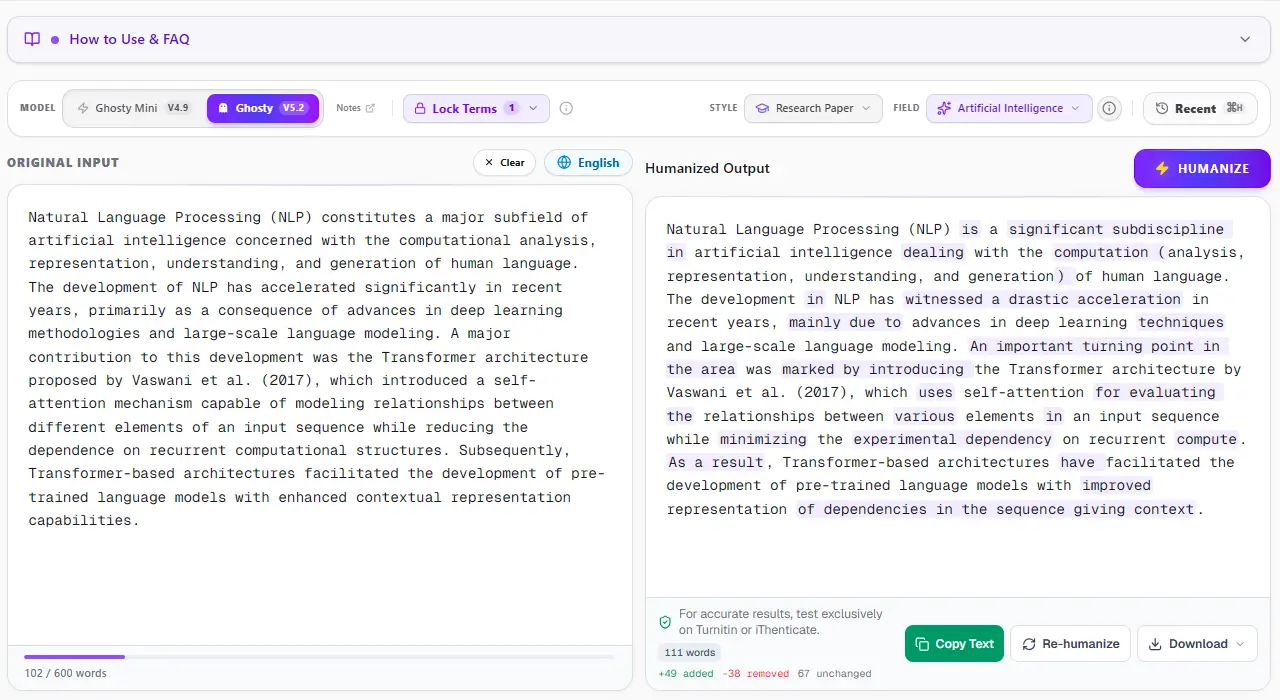
With Term Lock™, researchers can highlight citations (APA, MLA, Chicago, IEEE numeric brackets), LaTeX mathematical expressions, and specialized construct names to guarantee they are never altered during the naturalization process.
Below is the ThesisHuman editor interface, showing the Academic Style selector, Academic Field selector, and Term Lock controls in action:
Institutional AI Screening: Clearing Turnitin & iThenticate
Turnitin and iThenticate are the primary integrity screening platforms used by universities for thesis deposit and by major publishers (Elsevier, Springer Nature, IEEE, Wiley) via Crossref Similarity Check.
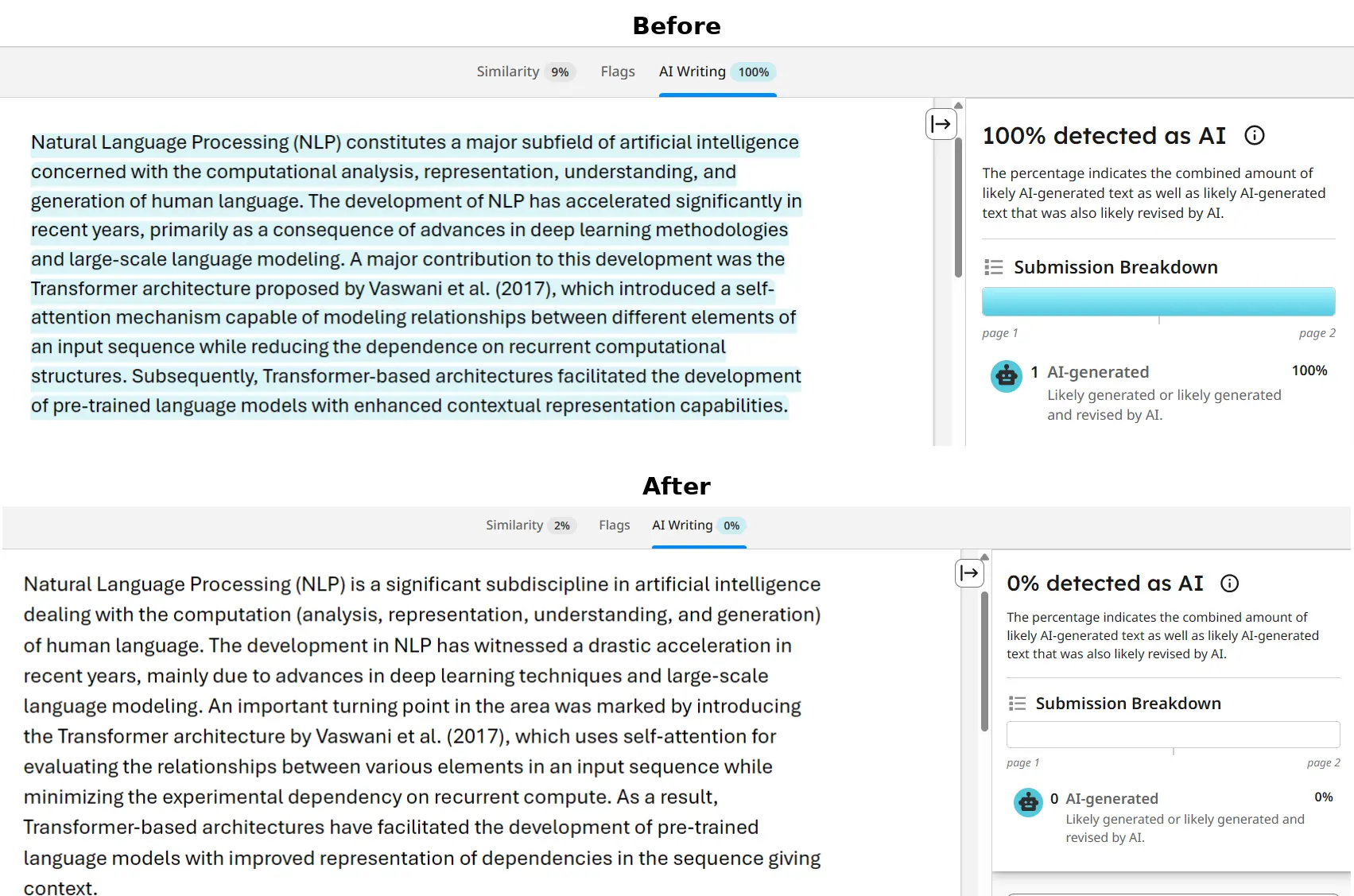
Turnitin scans submissions in overlapping 500-token blocks, analyzing sentence predictability across paragraphs. When an unrefined AI draft is submitted, uniform cadence triggers an elevated AI Writing score that can lead to thesis holds or formal integrity inquiries.
In the verified report below, a flagged graduate paper was processed through ThesisHuman using the appropriate Academic Style and Field settings. The Turnitin indicator dropped to 0% AI writing detected while preserving all citations and technical parameters:
Perplexity & Burstiness: Passing GPTZero Without Sacrificing Precision
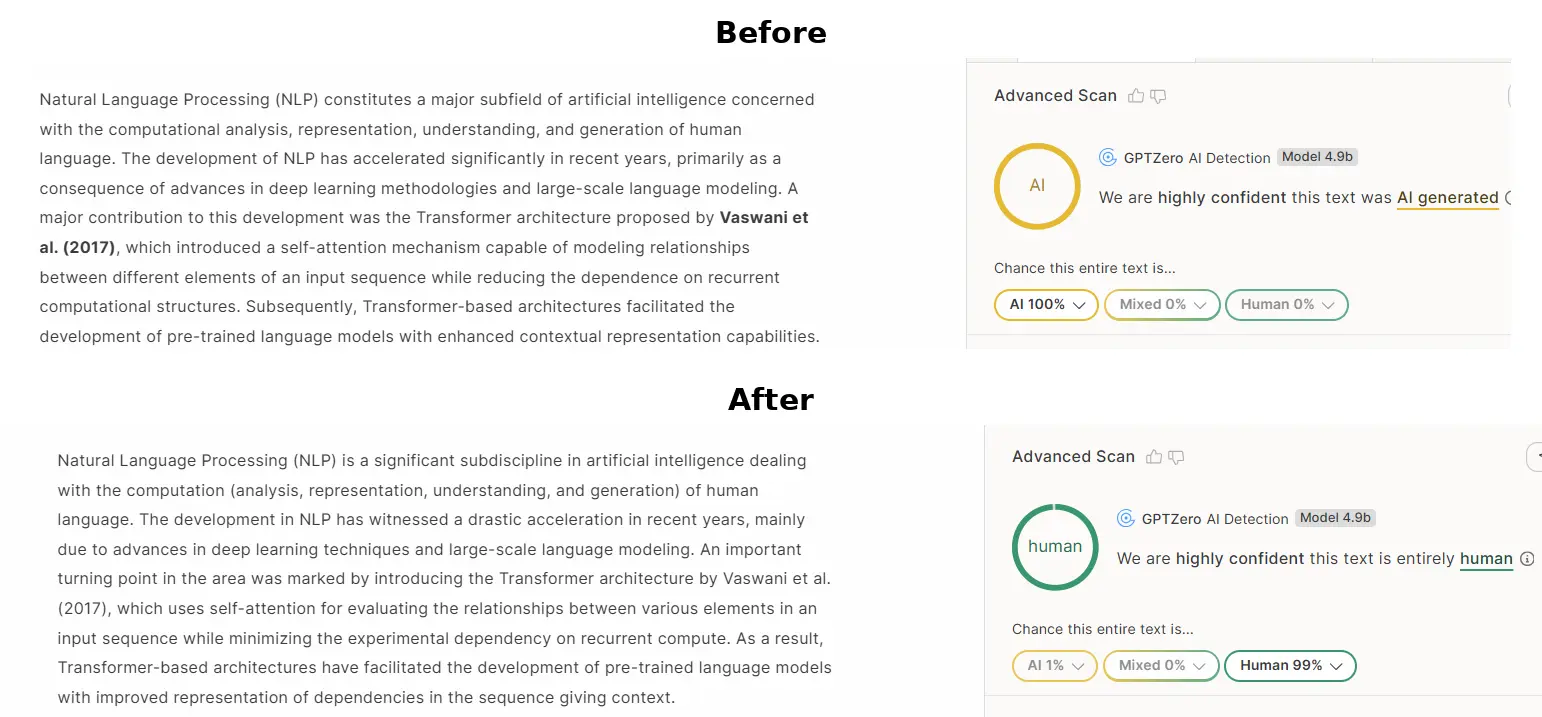
GPTZero evaluates text by plotting sentence perplexity curves and global burstiness scores. When raw AI text from ChatGPT or Claude is scanned, the lack of sentence variance produces an immediate high-probability AI warning.
ThesisHuman restores natural sentence entropy by restructuring syntax, varying sentence lengths, and replacing uniform transitions with authentic academic phrasing.
As demonstrated in the scan below, a 100% AI-flagged research passage was transformed into 0% AI Probability on GPTZero while maintaining full scholarly accuracy:
Eliminating AI Clichés: Passing Originality.ai
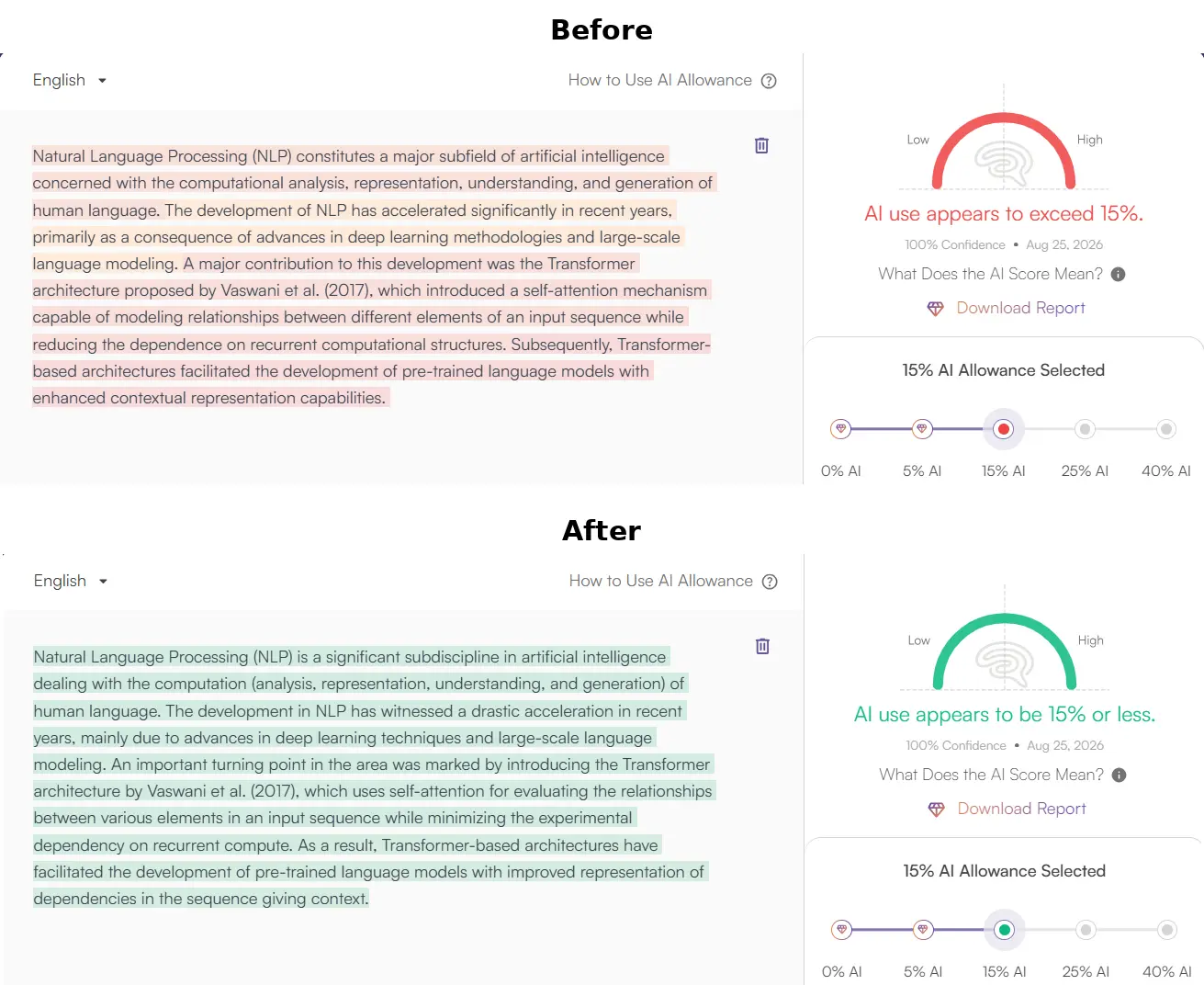
Originality.ai flags predictable n-gram sequences and common AI clichés—such as "delving into," "multifaceted realm," "serves as a testament," and "pivotal role."
Generic paraphrasers often attempt to bypass Originality.ai by inserting awkward synonyms or broken grammar. ThesisHuman purges overused formulaic transitions while elevating the scholarly tone and keeping reference numbers and citations intact.
Below is a verified before-and-after scan on Originality.ai, showing a transition from 100% AI Confidence to 100% Original / 0% AI:
Why Generic AI Paraphrasers Fail on Academic Manuscripts
Consumer paraphrasing tools were built for marketing copy, blogs, and casual emails. When applied to graduate theses or journal articles, they create serious risks:
- Mangled Citations: Standard parenthetical references (APA, MLA, Chicago) get rewritten as broken running prose.
- Corrupted Formulas: LaTeX notation, chemical formulas, and statistical values (e.g., p-values) lose their formatting.
- Imprecise Synonyms: Replacing precise scientific terms with loose everyday words alters the fundamental meaning of your research.
A 4-Step Workflow for Academic Writing and Verification
To produce defensible, human-grade academic writing that clears detection checks, follow this structured four-step workflow:
Step 1: Draft Your Core Arguments and Findings
Formulate your research questions, empirical methodology, and arguments with your evidence intact. AI can assist in structuring ideas, but your original thinking should form the foundation of the draft.
Step 2: Configure Term Lock on Critical Spans
Paste your text into the ThesisHuman editor. Lock all in-text citations, LaTeX formulas, and discipline-specific constructs to guarantee they remain untouched.
Step 3: Select Academic Style and Field
Choose your document type (Academic Essay, Research Paper, Literature Review, Technical Report) and select your scientific field (Computer Science, Engineering, Medicine, Chemistry, etc.) to apply tailored linguistic rules.
Step 4: Humanize and Conduct Final Review
Run the naturalization pass, review the real-time AI estimation score, and verify that all technical terminology and citations have been preserved accurately before submission.
Academic Integrity, COPE Compliance & Ethical Disclosure
Responsible use of AI writing assistance aligns with international publishing standards. The Committee on Publication Ethics (COPE), the ICMJE, and major academic publishers agree on these core guidelines:
- Authorship Accountability: AI tools cannot be listed as co-authors. Human researchers remain fully responsible for the integrity and accuracy of their work.
- Language Refinement: Using AI to improve readability, sentence flow, and clarity of human-authored research is accepted academic practice.
- Transparent Disclosure: When required by your target journal or institution, clearly disclose AI-assisted language editing in the methodology or acknowledgments.
ThesisHuman operates as an academic copilot—ensuring your original research is communicated clearly, accurately, and naturally.