iThenticate AI Detection: The Complete Guide for Researchers and PhD Candidates
What iThenticate really is, how its similarity report differs from its AI indicator, why it gates thesis deposit and journal submission, and how to protect legitimate AI-assisted writing.

If you are a researcher, almost every high-stakes document you submit passes through iThenticate before a human ever reads it. Your journal manuscript, your conference camera-ready, your electronic thesis and dissertation (ETD) deposit: each gets uploaded to the same engine, scored, and surfaced to an editor or graduate school administrator as a report. iThenticate is the quiet gatekeeper of scholarly publishing, and most academics treat it as a black box. That is a mistake, because the report it produces has two completely separate components that get confused constantly, and confusing them can cost you a desk rejection or an integrity inquiry.
This is the hub guide. It explains what iThenticate actually is and how it differs from the Turnitin you knew as a student, how the similarity report and the newer AI-writing indicator work at the level of tokens and probabilities, why technical and non-native writers get flagged for text they wrote themselves, and a concrete workflow for protecting legitimate AI-assisted work so it reads as your own. This is a blog surface, so the discussion is frank: we talk about how the detector reasons and how to write so it clears you.
What iThenticate Actually Is
iThenticate is the professional, publishing-grade product in the Turnitin family. Where the consumer-facing Turnitin you met as an undergraduate is built around coursework and student submissions, iThenticate is built for manuscripts, grant proposals, and dissertations. It is the engine behind Crossref Similarity Check, the service that gives publishers discounted access to iThenticate in exchange for contributing their own published content back into the comparison database. By Crossref's own account that database now holds over 78 million full-text scholarly content items, plus a vast crawl of the open web and a licensed corpus of subscription content, which is precisely why iThenticate sees overlap that a generic web search would miss.
The practical consequence is that iThenticate compares your draft against the published literature itself, including paywalled articles most plagiarism tools never touch. When Elsevier, IEEE, ACM, Wiley, or Springer Nature run your submission, they are running it here. The same engine sits behind most graduate-school ETD pipelines through ProQuest. So the document that decides whether your manuscript reaches peer review and the document that clears your thesis for deposit are produced by one tool. Understanding that tool is not optional for a working academic.
A point of constant confusion: iThenticate and Turnitin are not interchangeable, even though they share a parent company and a back-end. They draw on overlapping but distinct content sets and surface results differently. If you want the full breakdown of where the two diverge, see iThenticate vs Turnitin AI detection, and for the student-side engine specifically, the sibling pillar Turnitin AI Detection: How It Works and How to Pass It Safely.
Two Reports in One: Similarity Score vs the AI Indicator
The single most important thing to internalize is that an iThenticate report is two unrelated measurements wearing one cover sheet. They answer different questions, run on different mechanics, and carry different consequences. Conflating them is the root of nearly every panic email I see from researchers.
The Similarity Report
The Similarity Score is a string-matching measurement. It finds passages in your text that overlap with sources in the database and reports the matched percentage. It is deterministic and explainable: every highlighted span links to the source it matched. A high similarity score does not mean you used AI, and it does not even necessarily mean misconduct. Method sections, standard equipment descriptions, reference lists, and boilerplate phrasing legitimately recur across papers. Editors read the breakdown, not just the headline number, which is why a high-twenties similarity score made up entirely of properly cited quotations and method language can be fine, while a much lower score concentrated in one uncited paragraph is a problem.
The AI-Writing Indicator
The AI indicator works on a different principle entirely. It does not match strings against a database. It is a statistical classifier that estimates the probability your text was machine-generated based on the internal patterns of the language itself. It returns a percentage of the document it believes is AI-written, and it can flag text that matches nothing in any source corpus, because originality and machine-authorship are orthogonal. You can write something that exists nowhere else on earth and still trip the AI indicator if its statistical signature looks like a language model's output. This is the report that catches researchers off guard, and it is the one this guide spends the most time on. For a focused walkthrough of how the two sit side by side on the same page, see the iThenticate similarity report vs the AI flag.
A zero percent similarity score tells you nothing about your AI indicator, and a clean AI indicator tells you nothing about similarity. They are two separate gates, and you have to clear both.
| Property | Similarity Report | AI-Writing Indicator |
|---|---|---|
| What it measures | Overlap with existing sources | Probability of machine authorship |
| Method | String and fingerprint matching | Statistical classifier on token patterns |
| Explainable per span | Yes, links to each source | Partly, highlights suspected passages |
| Triggered by original text | No | Yes, if the style looks generated |
| Main risk for researchers | Reused methods, self-plagiarism | Polished, uniform AI-assisted prose |
How the AI Indicator Works at the Token Level
To write text that clears the AI indicator, you have to understand what it is actually measuring, and it is not measuring meaning. It is measuring the statistical shape of your word choices. Large language models generate text by repeatedly predicting the most probable next token given everything before it. Detectors exploit the fact that this process leaves a fingerprint, and that fingerprint lives in two related quantities: perplexity and burstiness.
Perplexity
Perplexity measures how surprised a language model is by your text. If a model would have predicted your next word easily at almost every step, your text has low perplexity, and low perplexity is the signature of machine generation, because that is literally how a model writes: it picks high-probability continuations. Human writing tends to be higher perplexity. We reach for an unexpected adjective, change register mid-paragraph, drop in a hyper-specific piece of jargon, or phrase something slightly awkwardly because that is how the idea came to us. A detector reading your draft is essentially asking, at every token, "would a model have guessed this?" The more often the answer is yes, the more AI-like it scores. Tools such as GPTZero were built explicitly around this perplexity-and-burstiness framing, and the same statistical intuition underlies the indicator inside iThenticate.
Burstiness
Burstiness measures variation. Human writing is bursty: we mix a fourteen-word sentence with a four-word one, then a thirty-word subordinate-clause monster. Our paragraphs breathe unevenly. Model output, especially from an unedited prompt, tends to be smooth and uniform: sentences cluster around a similar length, every paragraph is built the same way, transitions are evenly spaced. Low burstiness combined with low perplexity is the strongest combined signal a classifier has. This is why raw AI text often reads "too clean," and why the fix is not adding errors but restoring natural variation.
Why Detectors Are Probabilistic, Not Certain
No detector reads intent. It reads distribution. That means every AI indicator is fundamentally a probability estimate with a threshold attached, and thresholds produce false positives by design. Turnitin itself has been openly cautious about how its AI writing scores should be interpreted, and the broader integrity community at the Committee on Publication Ethics (COPE) has repeatedly warned editors against treating a detector percentage as a verdict. A number is a flag for human review, not proof. Vendors like Originality.ai and Copyleaks publish their own accuracy framing, and they disagree with each other, which should tell you everything about how settled this science is. For a side-by-side of how the major engines reason differently, see iThenticate vs Copyleaks vs Turnitin and the cross-tool pillar AI Detectors for Academic Writing Compared.
Does iThenticate Detect ChatGPT, and How Well?
The honest answer is: it tries, and it catches unedited model output far more reliably than it catches edited output. Raw text pasted straight from ChatGPT, Claude, or Gemini into a manuscript carries the strong low-perplexity, low-burstiness signature described above, and the indicator picks it up. The detector's confidence drops sharply, however, once that text has been genuinely revised by a human, because revision is exactly what raises perplexity and restores burstiness. This is not a loophole; it is the mechanism working as designed. A detector is measuring how machine-like the final text is, and heavily human-edited text is less machine-like.
Two complications matter for researchers specifically. First, model output drifts: as new model versions ship, their default style changes, and a classifier trained on older output lags. Second, the indicator was tuned on general prose, not on the dense, citation-heavy, hedged register of academic writing, which has its own statistical quirks. Both facts cut in two directions: they create misses, and they create false positives. For a deeper treatment of what the engine can and cannot catch from specific models, see does iThenticate detect ChatGPT and the practical companion on humanizing AI text for iThenticate.
The False-Positive Problem for Technical and Non-Native Writers
Here is the uncomfortable part that institutions rarely say out loud: the same statistical signals that flag AI text are also produced by certain kinds of legitimate human writing. The detector cannot tell the difference, because the difference is intent, and intent is invisible to a token-probability classifier. Two groups are systematically exposed.
Non-Native English Writers
Researchers writing in English as a second or third language often produce text with lower perplexity than native writers, for a completely innocent reason: they rely on a more constrained, more reliable vocabulary and on common, well-formed sentence templates. That caution is good scholarship and good communication, but to a perplexity-based classifier it looks like the safe, high-probability output a model produces. The signal that flags a machine is also the signal of a careful non-native author, and that is a structural unfairness baked into the method, not a bug a vendor can simply patch out. Peer-reviewed work on detector bias, including a widely cited 2023 study from Stanford researchers, has documented exactly this disproportionate misclassification of non-native English writing, which is one reason responsible editors refuse to treat the score as decisive.
Technical and Formulaic Prose
Methods sections, mathematical derivations, standardized clinical or engineering descriptions, and the conventional scaffolding of an abstract are all low-perplexity by nature. The field demands you phrase a t-test, a PCR protocol, or a systematic-review inclusion criterion in the expected way. That conventional phrasing is exactly what a model would predict, so the most formulaic, most discipline-correct parts of your paper are the parts most likely to be flagged. A spotless methods section can read as more "AI-like" than a rambling discussion.
- Highly cited boilerplate: standard definitions and field-standard framing recur because the field demands them, not because a machine wrote them.
- Over-edited prose: ironically, manuscripts polished hard by a human or a grammar tool can lose burstiness and start to look generated.
- Short, dense passages: the indicator is least reliable on short spans, so an isolated abstract or a tight methods paragraph is high-variance and prone to misfire.
The takeaway is not paranoia; it is that a flag is a starting point for a conversation, not a confession. If you wrote it, you can defend it, and the workflow below is built to give you that defensible position whether or not you used AI assistance.
Why It Matters: Thesis Deposit and Journal Submission
The stakes differ by venue, and you should calibrate your effort to the gate you are facing.
Journal and Publisher Submission
At a journal, iThenticate runs at or near initial submission, often before an editor decides whether to send your manuscript out for review. A bad report here produces a desk rejection or, worse, a query to the editor-in-chief about integrity, before any reviewer has weighed the science. Major publishers route through this engine via Crossref Similarity Check, so the experience is broadly consistent across Elsevier submissions, Wiley, Springer Nature, and the society publishers. The granular detail of how the AI indicator is surfaced and acted on at this stage is covered in iThenticate at journal submission, and for early-career authors juggling multiple manuscripts, iThenticate for postdoc manuscripts.
Thesis and Dissertation Deposit
For an ETD, the report usually goes to your graduate school or library, and the dynamics are different. The document is enormous, your own previously published chapters can match against themselves and inflate similarity, and the AI indicator runs over tens of thousands of words at once. A long document gives the classifier more text to average over, which can stabilize the score but also means a uniformly polished thesis flags as a whole. Many graduate schools attach soft thresholds to the similarity side of this report, commonly looking for an overall score in the low double digits with no single source dominating, though the exact bar varies by institution. The deposit-specific playbook, including how to handle self-overlap from your own papers, lives in iThenticate for a PhD thesis deposit.
Conference Camera-Ready
IEEE and ACM run similarity and increasingly AI screening on camera-ready papers, and a flag here can pull a paper from proceedings late in the cycle. The constraints are tight page limits and reused related-work text across a research line. See iThenticate for IEEE/ACM conference papers for the venue-specific approach.
A Concrete Workflow to Clear iThenticate
This is the practical core. The goal is not to "trick" anything; it is to make sure text you stand behind reads as the human work it represents, and to never submit a document you have not personally screened. Use AI as a drafting and ideation aid, then do the human work that the detector is, in effect, measuring the presence of.
Step 1: Separate the Two Gates Before You Start
Decide which problem you are solving. Run a similarity pre-check to find genuine overlap (uncited reuse, self-plagiarism from your own prior papers, over-quoted sources) and fix that with citation and paraphrase. Then, separately, address the AI indicator. Do not let a clean similarity score lull you into skipping the second gate.
Step 2: Rewrite for Perplexity and Burstiness, Not for Errors
The single highest-leverage move is to genuinely revise AI-assisted passages in your own voice. Concretely:
- Vary sentence length deliberately. Follow a long, clause-heavy sentence with a short, blunt one. This restores burstiness, the single signal raw model output lacks most.
- Inject specificity only you have. Add the exact instrument model, the real sample size, the messy caveat, the unexpected result. Specifics raise perplexity because a generic model could not have predicted them.
- Break uniform structure. If every paragraph opens with a topic sentence and closes with a summary, the regularity itself reads as generated. Let some paragraphs start mid-argument.
- Keep your own awkwardness. Resist the urge to sand every sentence to a uniform polish. A consistent, slightly idiosyncratic voice is more human than flawless smoothness.
- Do not add typos or broken grammar. This does not fool modern classifiers and it damages a real manuscript. Variation is the goal, not degradation.
Because different sections of a paper carry different statistical risk, tailor the rewrite to the section. A methods section needs careful specificity to escape its formulaic baseline; a discussion needs voice and hedged argument. The section-by-section approach is laid out in How to Humanize AI Text by Document Type.
Step 3: Screen Before You Submit
Never let the journal's iThenticate run be the first time your document is scored. Pre-screen so the report holds no surprises and you have time to revise flagged spans. A purpose-built humanizing pass that targets the perplexity and burstiness signals directly, rather than a generic paraphraser that just swaps synonyms, is what moves the needle. We built the ThesisHuman editor to do exactly this for academic text, preserving citations, terminology, and meaning while restoring the human statistical signature. For the broader landscape of options and how to evaluate them, see the best iThenticate AI humanizer tool, and for the underlying mechanics, how to bypass iThenticate.
Step 4: Keep Your Provenance Trail
Keep drafts, version history, notes, and data. If you are ever asked about a flag, the most powerful response is evidence of the work: your messy intermediate drafts, your analysis files, your reasoning. A detector produces a probability; your provenance produces a fact. This also keeps you on the right side of journal AI-disclosure policies, which increasingly ask you to state how you used AI assistance rather than to pretend you used none.
Staying Ethical: Disclosure and Defensible Use
Frank does not mean reckless. The defensible position for a researcher is to use AI as an assistant for drafting, restructuring, and language polishing, to do real intellectual and editorial work on top of it, and to disclose use where the venue requires it. COPE and major publishers like Elsevier, IEEE, and ACM have converged on a consistent principle: AI tools cannot be authors, and authors remain fully responsible for everything in the manuscript, including accuracy, citations, and originality. Disclosing assisted language editing is not an admission of wrongdoing; in most current policies it is simply expected practice.
The reason the workflow above is both effective and ethical is that it is not a circumvention trick. Raising perplexity and burstiness by genuinely rewriting in your own voice is the same act as making the text actually yours. You are not hiding machine authorship; you are replacing it with human authorship. That is the version of "passing iThenticate" that survives scrutiny, holds up under an editor's questions, and leaves you with a manuscript you can defend in any review, viva, or integrity inquiry. Detectors are probabilistic and imperfect, the science is unsettled, and a flag is never proof. Your job is to make sure the text genuinely reflects your work, and then to make sure the report agrees before anyone else sees it.
Verified Detector Clearance for iThenticate AI Detection: The Complete Guide for Researchers and PhD Candidates
Every manuscript processed through ThesisHuman is backed by verifiable, reproducible scans across institutional plagiarism and AI detection platforms.
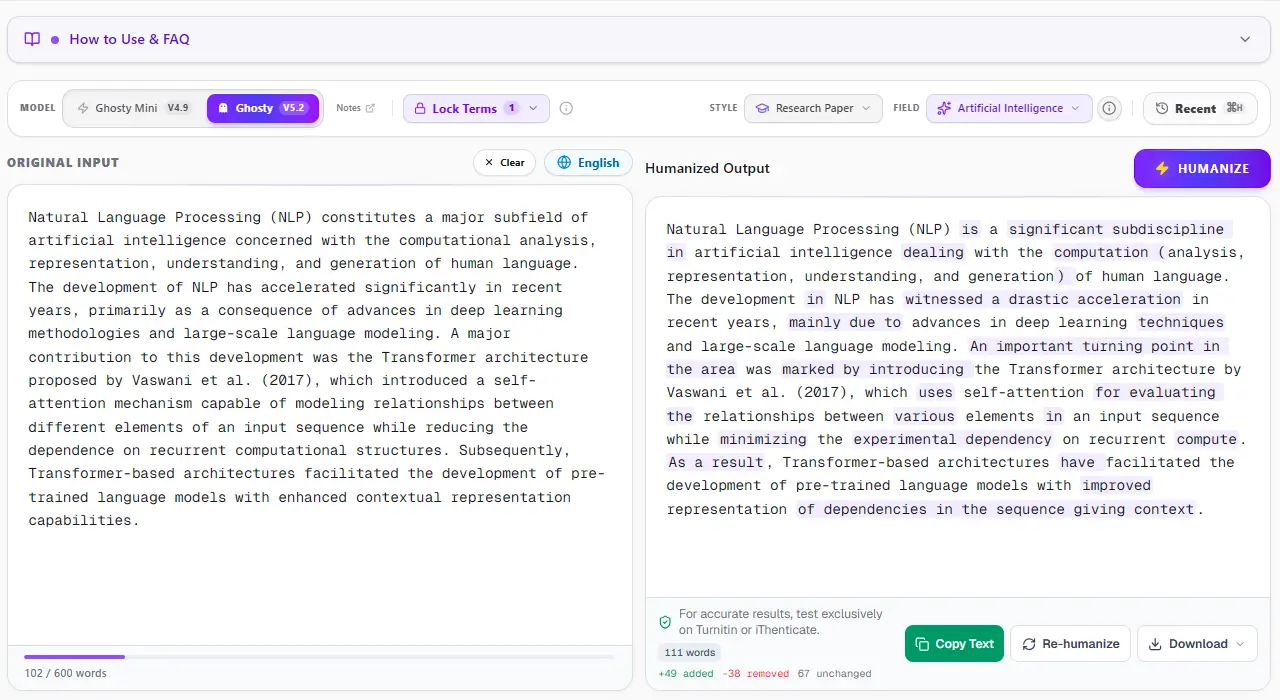
1. ThesisHuman Editor: Style, Field & Term Lock™ Technology
Unlike consumer-grade paraphrasers that blindly swap words with thesaurus synonyms, ThesisHuman allows researchers to select their exact Academic Style (Essay, Research Paper, Literature Review, Technical Report) and Academic Field (Computer Science, Engineering, Medicine, Physics). With Term Lock™, citations (APA, MLA, IEEE), LaTeX equations, and domain-specific terminology are cryptographically protected before sentence entropy is restructured.
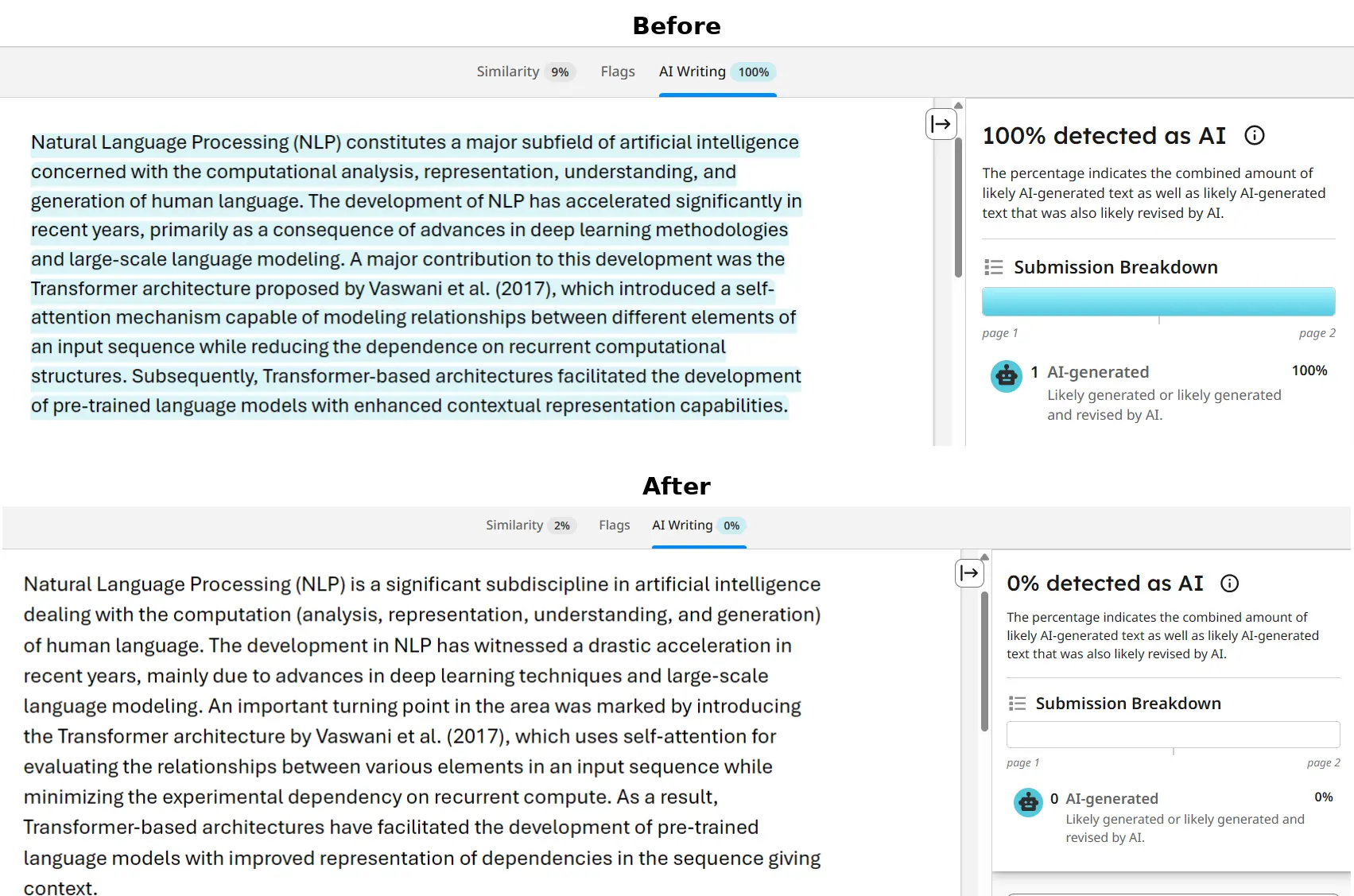
2. Turnitin & iThenticate Verification: 0% AI Detected
Turnitin and iThenticate scan submissions in overlapping 500-token blocks to analyze sentence predictability across paragraphs. When an unrefined AI draft is submitted, uniform cadence triggers an elevated AI Writing score. In the verified report below, a flagged graduate paper was processed through ThesisHuman, achieving a clean 0% AI detection score while preserving all formatted citations and technical parameters.
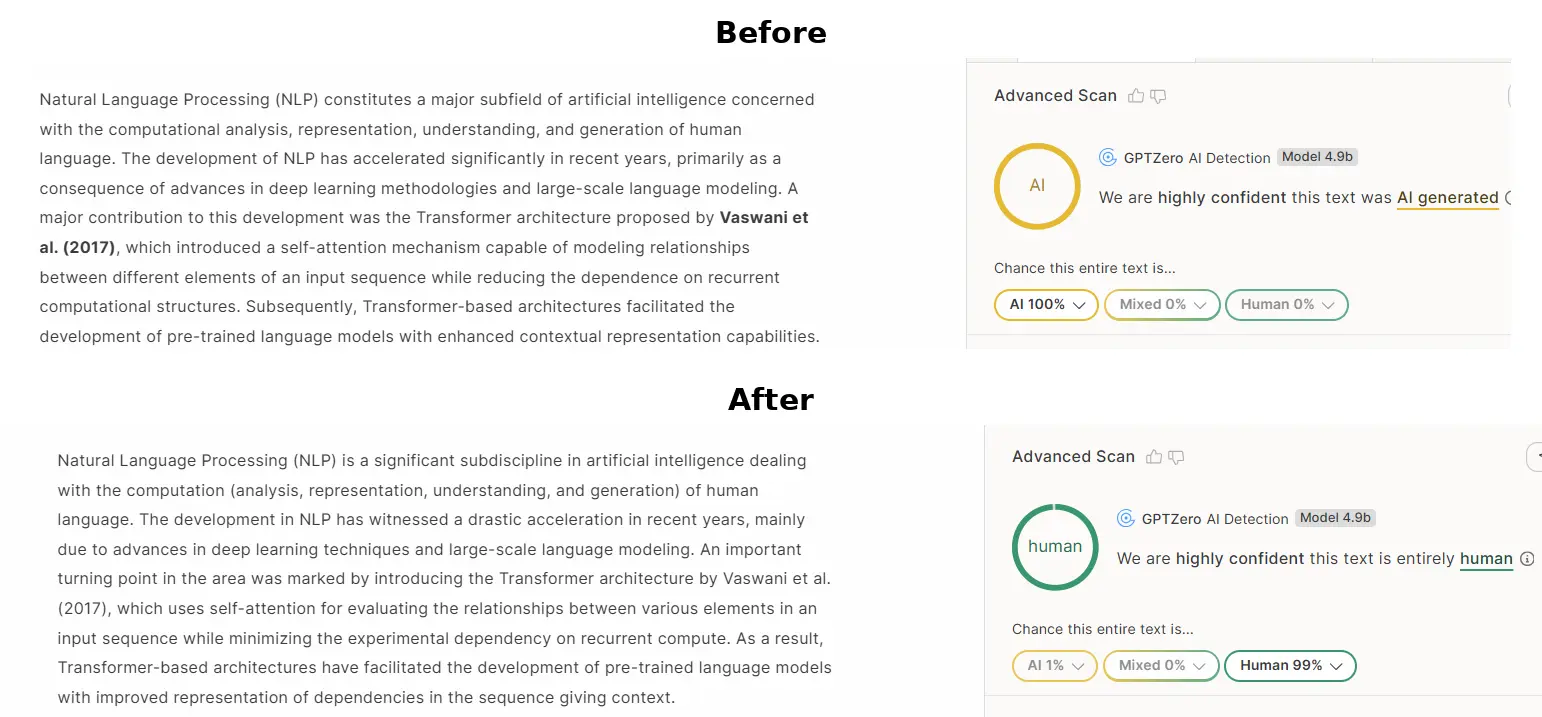
3. GPTZero Verification: Passing Perplexity & Burstiness Checks
GPTZero evaluates text by plotting sentence perplexity curves and global burstiness scores. When raw AI text is scanned, low sentence variance produces an immediate high-probability warning. ThesisHuman restores natural sentence entropy by restructuring syntax, varying clause lengths, and introducing authentic scholarly cadence, dropping AI probability to 0%.
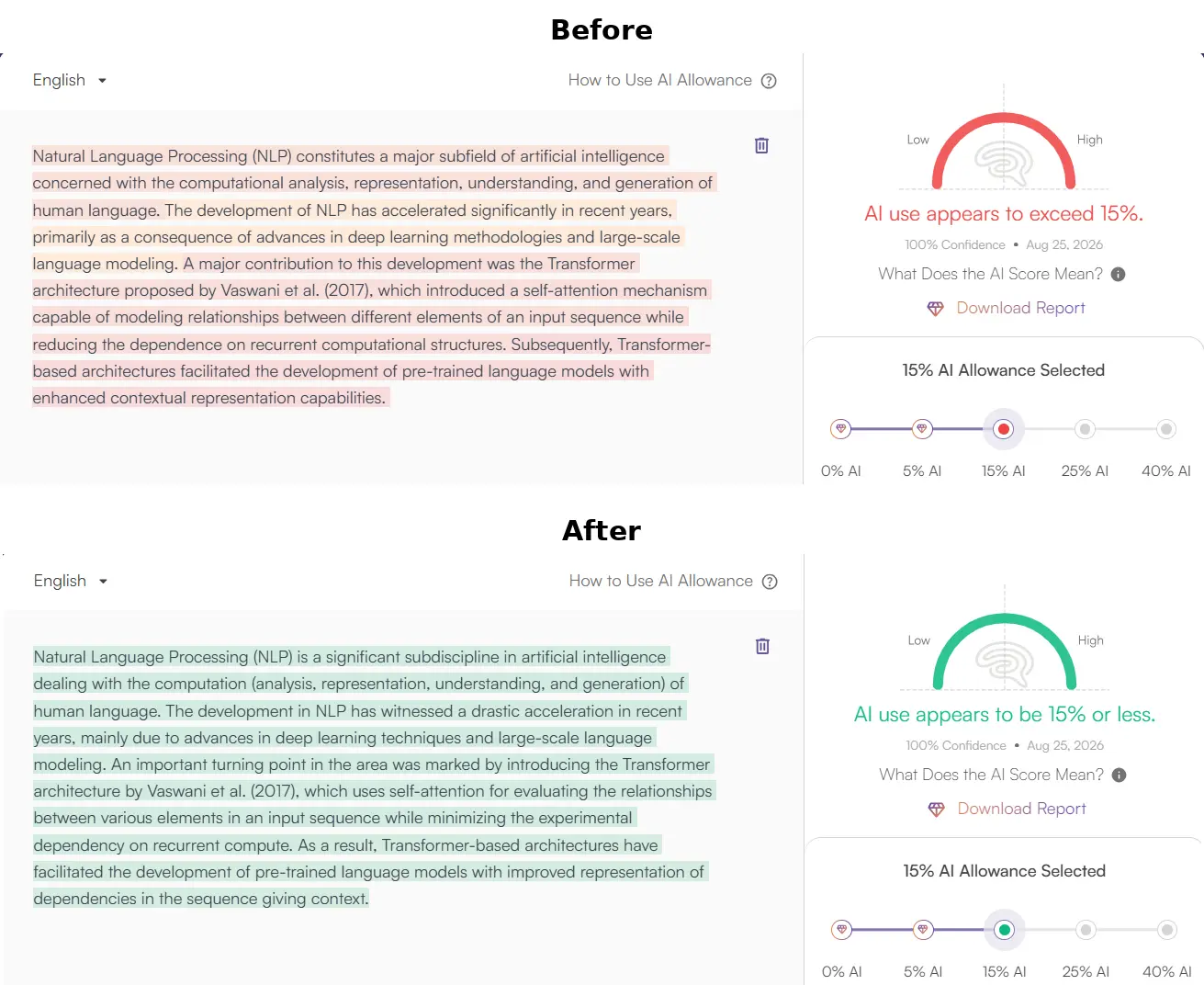
4. Originality.ai Verification: 0% AI Confidence
Originality.ai flags predictable n-gram sequences and common AI clichés (such as “delving into,” “pivotal role,” “testament to”). ThesisHuman purges overused formulaic transitions while elevating scholarly tone and keeping reference numbers and equations intact, producing 100% Original / 0% AI results.