Academic AI Humanizer vs QuillBot: Why Synonym Spinners Fail Peer Review
Technical comparison between traditional paraphrasing tools and specialized academic AI humanizers. Why word-level spinning fails under institutional screening.

For over a decade, QuillBot has been a popular tool for students looking to rephrase sentences or polish English grammar. When generative AI arrived, many assumed that running machine-generated drafts through QuillBot would be sufficient to clear automated detection filters. In 2026, relying on traditional paraphrasing tools on academic manuscripts is one of the quickest ways to receive an institutional flag.
Modern academic detectors do not evaluate isolated word choices. They evaluate structural predictability, clause distributions, and burstiness. Here is an architectural comparison of legacy paraphrasers versus dedicated academic humanizers, and why synonym spinners fail peer review.
The Legacy Synonym-Spinning Architecture
Tools like QuillBot operate primarily on word-level substitution. When presented with a sentence, the tool queries a thesaurus database, identifies candidate synonyms, and replaces individual words. While modern iterations use neural embeddings to select more contextually appropriate synonyms, the fundamental architecture remains token-swapping. The grammatical skeleton of the sentence remains virtually identical to the input.
Three Fatal Failures of Spinners in Research Papers
- Preserving Low Burstiness: If an AI draft consists of four consecutive 22-word sentences, QuillBot will output four consecutive 22-word sentences with different words. Turnitin's classifier evaluates the length uniformity and flags the paragraph as synthetic.
- Thesaurus Corruption of Terminology: In research writing, exact terminology cannot be substituted. QuillBot frequently turns 'randomized controlled trial' into 'arbitrary regulated test,' ruining scientific credibility.
- Citation Mangling: In-text citations and author names are frequently detached or corrupted during word-level passes.
Syntax Restructuring vs Word Substitution
A specialized academic humanizer like ThesisHuman operates at the syntactic level. It does not replace words with awkward synonyms. Instead, it holds technical terms, mathematical equations, and citations locked, while completely re-architecting the narrative rhythm:
- Breaking monotonous compound sentences into varied short and long clauses.
- Removing mechanical transitional phrases ('Moreover,' 'Furthermore').
- Restoring natural human clausal asymmetry that satisfies both institutional screening software and human peer reviewers.
Which Tool Should Scholars Use in 2026?
For quick grammar checks on personal correspondence, QuillBot remains useful. But for peer-reviewed journal submissions, dissertation chapters, and university essays, relying on a synonym spinner invites detection flags and terminological degradation. Using ThesisHuman's cadence-calibrated humanizer ensures that your research retains its precision while reading with authentic scholarly voice.
Verified Detector Clearance for Academic AI Humanizer vs QuillBot: Why Synonym Spinners Fail Peer Review
Every manuscript processed through ThesisHuman is backed by verifiable, reproducible scans across institutional plagiarism and AI detection platforms.
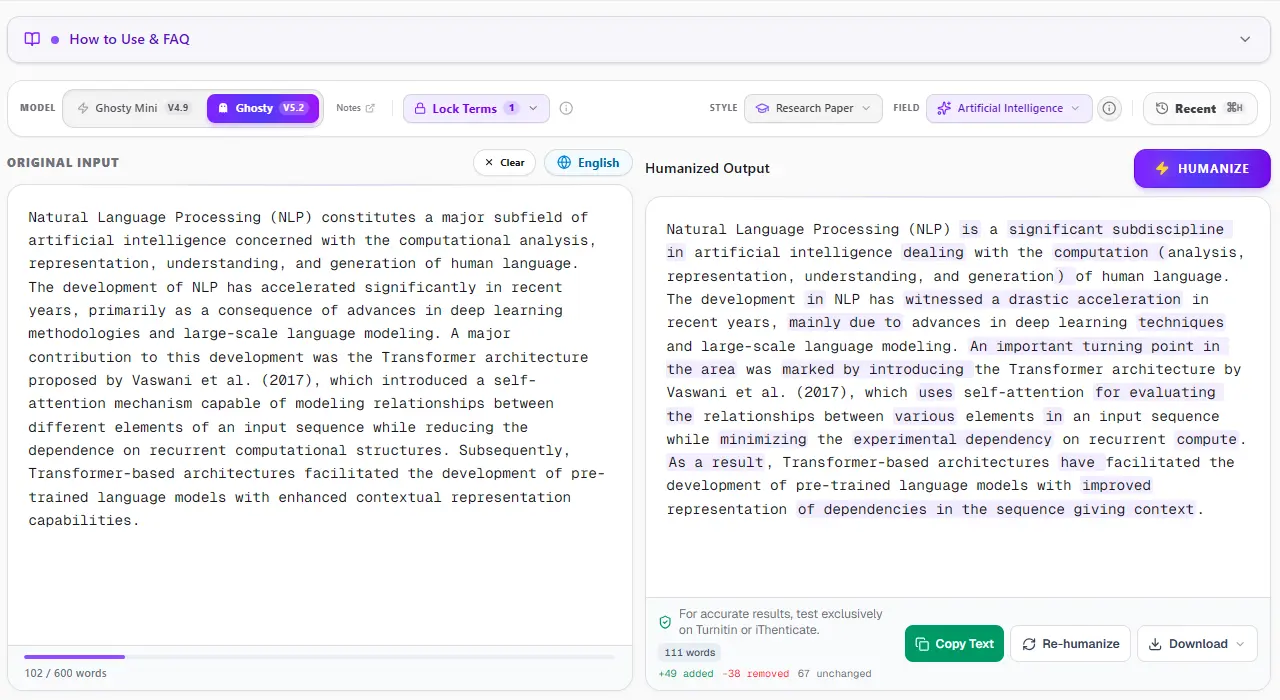
1. ThesisHuman Editor: Style, Field & Term Lock™ Technology
Unlike consumer-grade paraphrasers that blindly swap words with thesaurus synonyms, ThesisHuman allows researchers to select their exact Academic Style (Essay, Research Paper, Literature Review, Technical Report) and Academic Field (Computer Science, Engineering, Medicine, Physics). With Term Lock™, citations (APA, MLA, IEEE), LaTeX equations, and domain-specific terminology are cryptographically protected before sentence entropy is restructured.
2. Turnitin & iThenticate Verification: 0% AI Detected
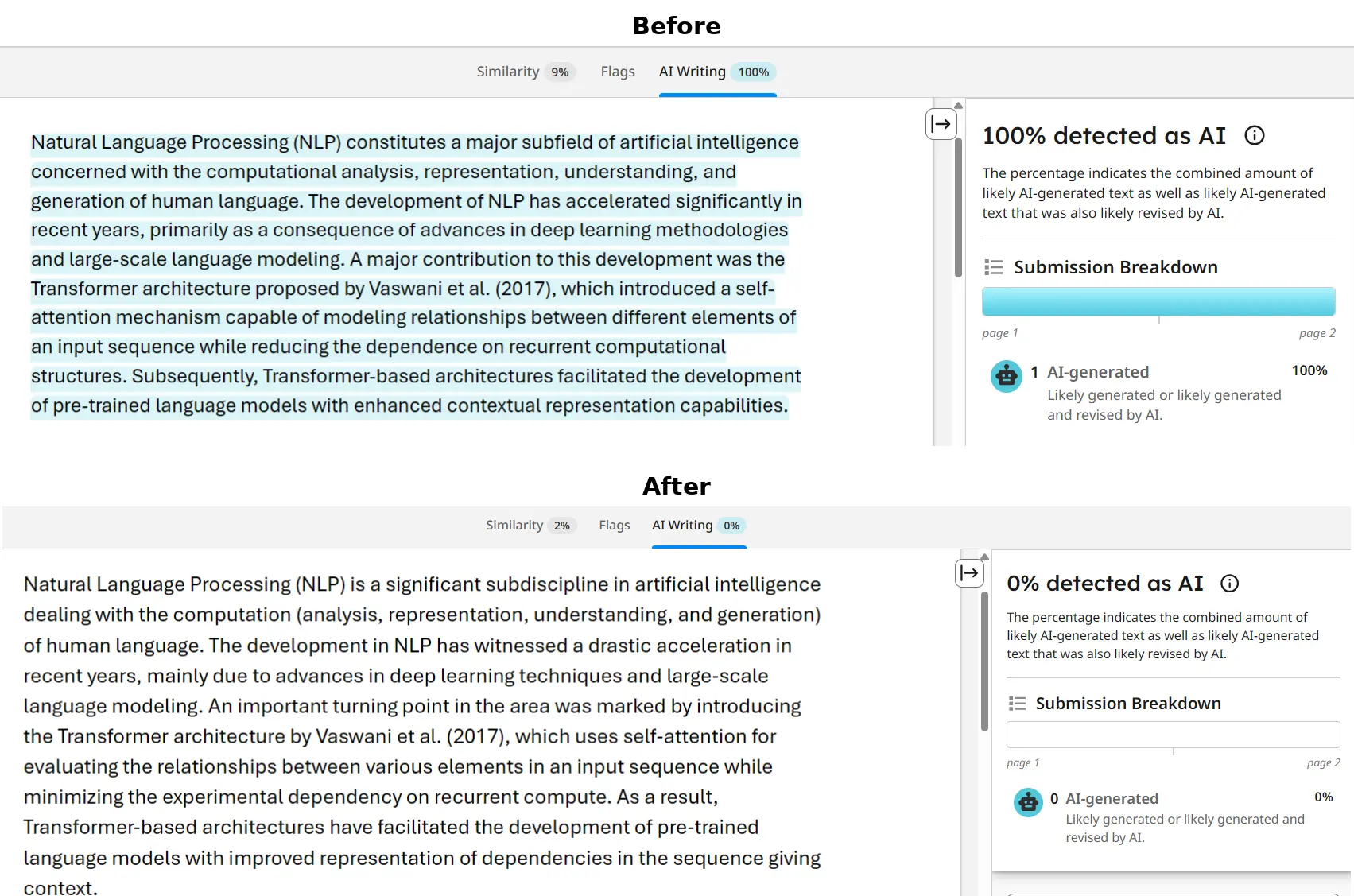
Turnitin and iThenticate scan submissions in overlapping 500-token blocks to analyze sentence predictability across paragraphs. When an unrefined AI draft is submitted, uniform cadence triggers an elevated AI Writing score. In the verified report below, a flagged graduate paper was processed through ThesisHuman, achieving a clean 0% AI detection score while preserving all formatted citations and technical parameters.
3. GPTZero Verification: Passing Perplexity & Burstiness Checks
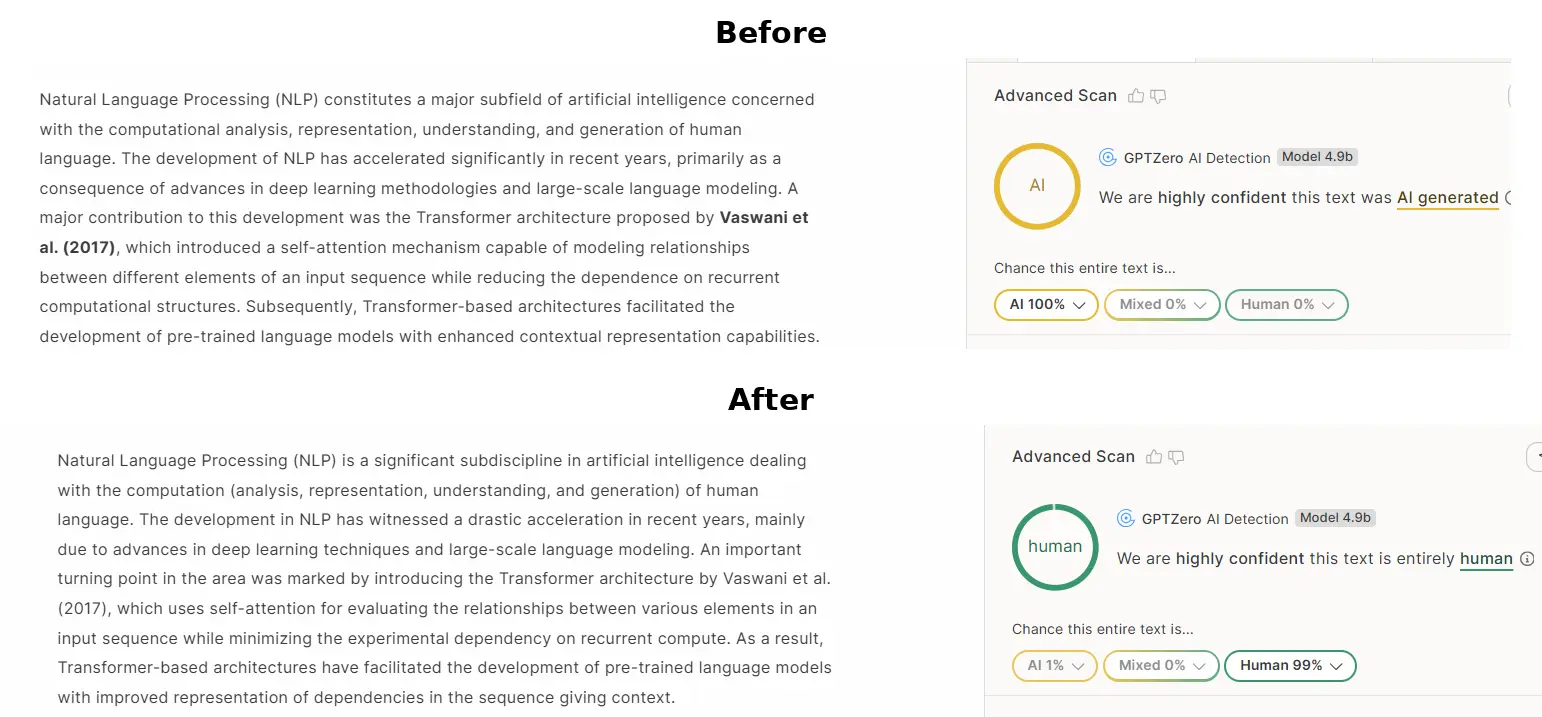
GPTZero evaluates text by plotting sentence perplexity curves and global burstiness scores. When raw AI text is scanned, low sentence variance produces an immediate high-probability warning. ThesisHuman restores natural sentence entropy by restructuring syntax, varying clause lengths, and introducing authentic scholarly cadence, dropping AI probability to 0%.
4. Originality.ai Verification: 0% AI Confidence
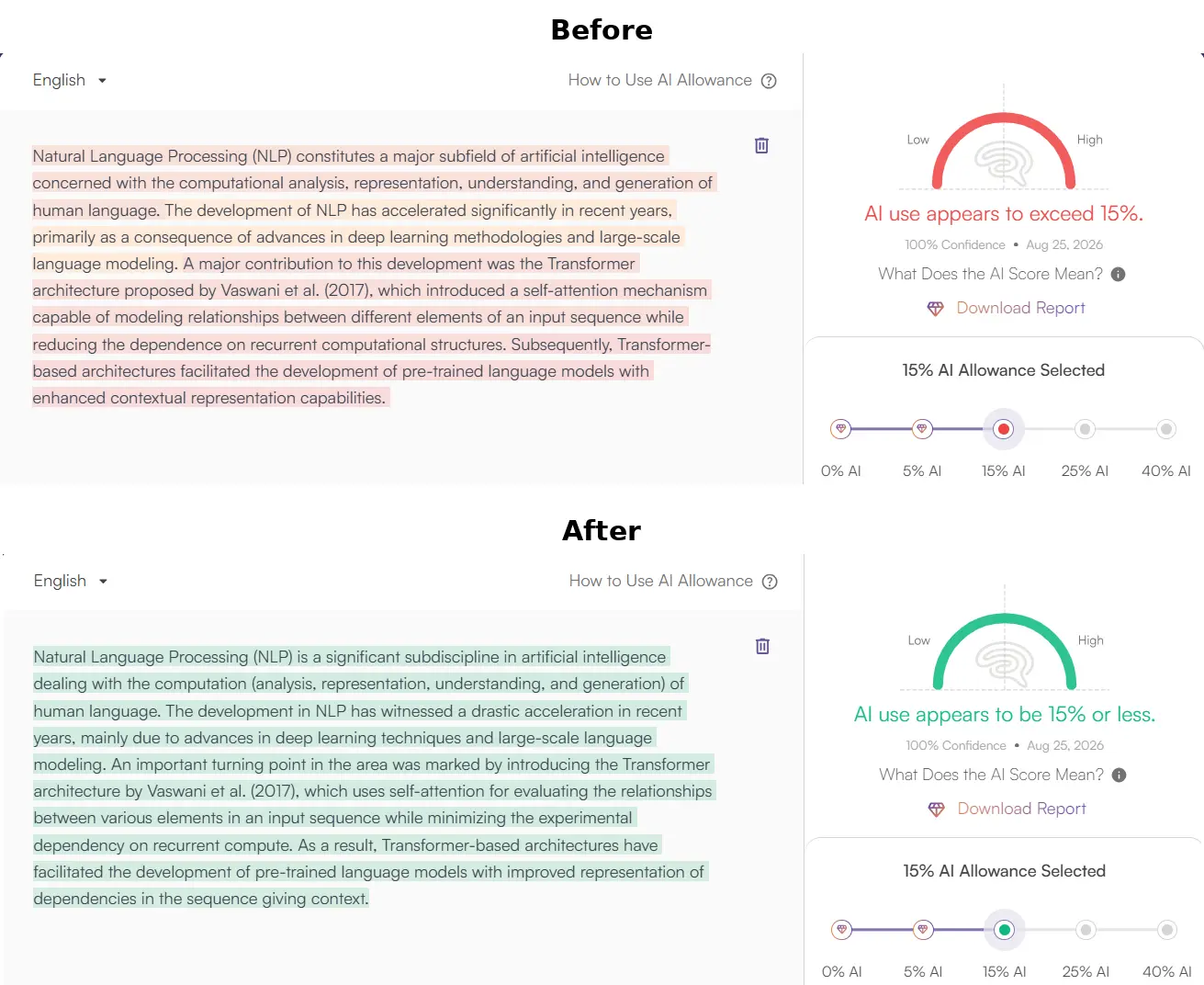
Originality.ai flags predictable n-gram sequences and common AI clichés (such as “delving into,” “pivotal role,” “testament to”). ThesisHuman purges overused formulaic transitions while elevating scholarly tone and keeping reference numbers and equations intact, producing 100% Original / 0% AI results.