What Is a Declarative Sentence? Definition, Types, and Academic Writing Models
Learn how declarative sentences form the structural engine of academic arguments. Explore simple, compound, and complex types, assertive vs. hedged tone, and 12 worked models.

Every academic argument, empirical discovery, and theoretical framework is built out of declarative sentences. While questions provoke inquiry and imperatives direct procedure, declarative sentences declare: they articulate hypotheses, synthesize evidence, and establish scholarly claims.
1. Direct Answer: What Is a Declarative Sentence?
A declarative sentence is a syntactic construction that states a fact, presents an argument, reports empirical evidence, or declares an analytical position. In standard English orthography, a declarative sentence always ends with a period rather than a question mark, exclamation point, or colon. It consists minimally of an explicit or implied subject and a finite predicate that together express a complete, grammatically independent thought.
In academic writing, declarative sentences account for over ninety percent of all prose. Unlike interrogative sentences (which ask questions) or imperative sentences (which issue instructions), declarative sentences communicate propositional knowledge:
"The experimental treatment reduced cellular proliferation by forty-three percent over the forty-eight-hour observation window."
This sentence does not solicit input or command action; it asserts an empirical measurement as a verified scientific finding.
The primary rhetorical responsibilities of declarative sentences in scholarship include:
- Formulating Central Theses: Stating the primary claim or interpretive angle that governs an essay or dissertation chapter.
- Reporting Empirical Evidence: Presenting observations, experimental outputs, statistical metrics, and qualitative findings.
- Synthesizing Source Literature: Summarizing peer-reviewed scholarship and establishing thematic connections among multiple studies.
- Delineating Theoretical Frameworks: Defining conceptual paradigms, boundaries, and disciplinary models.
2. The Four Structural Types of Declarative Sentences
To maintain rhythmic variety and intellectual depth in academic prose, scholars combine four foundational grammatical architectures.
1. Simple Declarative Sentences
A simple declarative sentence contains exactly one independent clause (one subject and one predicate) and no dependent or subordinate clauses. Although simple in clausal structure, it can include compound subjects, compound verbs, and multiple prepositional modifiers.
- Structure: Independent Clause.
- Academic Model:
"The fiscal policy intervention stimulated domestic manufacturing investment within three consecutive financial quarters."
- Rhetorical Utility: Simple declarative sentences deliver decisive emphasis. Positioned after complex arguments, a simple declarative sentence crystallizes your primary conclusion with clarity.
2. Compound Declarative Sentences
A compound declarative sentence contains two or more independent clauses joined either by a coordinating conjunction (for, and, nor, but, or, yet, so) preceded by a comma, or by a semicolon with an optional conjunctive adverb (such as consequently, furthermore, nevertheless).
- Structure: Independent Clause + [Comma + Coordinating Conjunction / Semicolon] + Independent Clause.
- Academic Model:
"The quantitative survey revealed high baseline user satisfaction; however, longitudinal retention rates declined significantly among secondary cohorts."
- Rhetorical Utility: Compound sentences establish balanced comparisons, contrasting tensions, or coordinate developments between two equally weighted ideas.
3. Complex Declarative Sentences
A complex declarative sentence consists of one independent clause and at least one dependent (subordinate) clause introduced by a subordinating conjunction (such as although, because, whereas, since, if, while) or a relative pronoun (which, that, who).
- Structure: Dependent Clause + Independent Clause OR Independent Clause + Dependent Clause.
- Academic Model:
"Although initial spectroscopic data suggested trace contamination, subsequent mass spectrometry confirmed sample purity."
- Rhetorical Utility: Complex sentences allow academic writers to introduce concessions, conditions, and causal hierarchies, explicitly subordinating secondary evidence to their main assertion.
4. Compound-Complex Declarative Sentences
A compound-complex declarative sentence integrates at least two independent clauses and at least one dependent clause.
- Structure: Dependent Clause + Independent Clause + Independent Clause (with coordinating punctuation).
- Academic Model:
"While institutional investors welcomed the regulatory updates, municipal authorities expressed skepticism, and private stakeholders delayed capital expenditure until guidance emerged."
- Rhetorical Utility: Compound-complex sentences capture intricate institutional interactions, balancing multiple competing stakeholders or multifaceted causal chains in a unified syntactic frame.
3. The Rhetorical Engine of Academic Writing: Claims, Hypotheses, and Evidentiary Assertions
Declarative sentences are not mere receptacles for information; they are the intellectual engine through which an author guides reader cognition.
Formulating the Core Thesis Assertion
A weak thesis statement often relies on descriptive declarations that merely announce a topic. An authoritative academic thesis uses declarative structure to declare an arguable, defensible proposition:
- Descriptive (Weak): "This paper examines the influence of digital platforms on electoral behavior."
- Argumentative Declarative (Strong): "Algorithmic curation on major social platforms polarizes voter behavior by systematically amplifying emotionally charged commentary while suppressing moderate informational sources."
Advancing the Evidentiary Chain
Within body paragraphs, declarative sentences perform distinct sequential functions to advance an argument:
- Topic Declarations: Introducing the paragraph's controlling insight.
- Evidentiary Declarations: Citing observational data, empirical measurements, or primary source text.
- Analytical Declarations: Interpreting how the evidence supports the topic assertion.
- Concluding Declarations: Synthesizing the analytical progression before transitioning to the next paragraph.
By ensuring that every declarative sentence performs an explicit rhetorical task, you eliminate directionless drafting.
4. Assertive vs. Hedged Declarative Tone: Epistemic Modality in Scholarly Prose
A critical distinction between student writing and professional scholarship lies in epistemic modality: the degree of certainty expressed in a declarative claim.
The Danger of Over-Assertion
Novice writers frequently construct absolute declarative sentences that exceed what their empirical data can justify. Claims using absolute terminology (such as proves, always, invariable, impossible) invite instant peer-review refutation.
- Over-Assertive: "This survey proves that social media use destroys student attention spans." Critique: Survey methodology identifies statistical correlation, not definitive biological causation.
Calibrating Epistemic Hedging
Expert scholars employ calibrated modal auxiliaries (may, might, could), epistemic adverbs (partially, predominantly, substantially), and cognitive verbs (suggests, indicates, corroborates) to declare claims accurately within their scientific boundaries.
- Calibrated Declarative: "These survey findings suggest that frequent social media consumption correlates with self-reported reductions in sustained study focus among undergraduate respondents."
The goal of hedging is not timid evasion; it is scientific precision. A properly hedged declarative sentence protects your argument by aligning your claims exactly with your evidentiary scope.
5. Clausal Rhythm and Sentence Length Variation: Avoiding Monotonous Declarative Syntax
One of the most persistent stylistic issues in graduate manuscripts is monotonous declarative syntax. When an author strings together six or seven declarative sentences of identical length and subject-verb-object structure, the reader experiences cognitive fatigue.
Measuring Syntactic Cadence
Authentic scholarly prose displays natural entropy: the deliberate alternation of concise declarative assertions with expansive, multi-clausal constructions.
Consider this rhythmic case study:
- Monotonous Flow (All 15-18 words, identical simple structure):
"The researchers gathered the soil samples in June. They stored the specimens in sterile containers. The team tested the samples for nitrogen levels. The analysis revealed high chemical concentrations. The outcome matched the theoretical model."
- Varied Syntactic Cadence (Alternating short, complex, and compound structures):
"In June, the research team gathered soil samples across six regional test sites, sealing each specimen within sterile containment vessels. Subsequent laboratory analysis revealed elevated nitrogen concentrations. This outcome corroborated the team's theoretical dispersion model."
Notice how the second version leads with a prepositional modifier, constructs a complex compound clause, drops down to a concise declarative summary, and ends with a focused assertion. This clausal variation keeps the reader engaged across long academic treatises.
6. 12 Complete Worked Academic Declarative Models Across Disciplines
Examine these twelve fully realized declarative models, categorized by structural architecture and academic discipline.
Humanities (Philosophy, History, Literature)
Simple Declarative (Philosophy):
"Rawlsian political philosophy grounds distributive justice upon the foundational premise of mutual moral reciprocity." Architecture: Single independent clause with a precise, high-register predicate.
Compound Declarative (Historiography):
"Eighteenth-century agrarian enclosure accelerated urban migration across the English Midlands, yet rural artisanal cooperatives maintained local economic autonomy throughout the transitional decade." Architecture: Two independent clauses connected by the coordinating conjunction "yet".
Complex Declarative (Literary Criticism):
"Because the modernist narrator repeatedly questions the fidelity of his own memory, the reader must reconstruct the novel's chronological events through external contextual cues." Architecture: Dependent causal clause followed by an independent analytical claim.
Social Sciences (Sociology, Economics, Education)
Simple Declarative (Economics):
"Sustained inflationary pressure invariably compresses disposable real income among lower-quartile wage earners." Architecture: Concise, definitive economic claim with a compound prepositional modifier.
Compound Declarative (Sociology):
"Generational cohort analysis demonstrates shifting attitudes toward homeownership; nevertheless, structural affordability barriers continue to suppress entry-level market transactions." Architecture: Two independent clauses joined by a semicolon and the conjunctive adverb "nevertheless".
Complex Declarative (Educational Research):
"Although asynchronous lecture delivery provides scheduling flexibility for non-traditional students, synchronous seminars yield demonstrably higher course completion rates." Architecture: Concessive introductory dependent clause balancing two instructional modes.
Natural Sciences (Biochemistry, Physics, Medicine)
Simple Declarative (Biochemistry):
"The enzyme undergoes rapid conformational rearrangement upon substrate binding at the catalytic site." Architecture: Focused empirical statement reporting a physical reaction mechanism.
Compound Declarative (Astrophysics):
"The stellar core exhausted its hydrogen reserves during the initial collapse phase, and the surrounding envelope expanded into a red supergiant." Architecture: Coordinate sequential developments linked by "and".
Complex Declarative (Clinical Medicine):
"When therapeutic monoclonal antibodies bind to target surface receptors, they trigger downstream apoptotic cascades within malignant cells." Architecture: Temporal dependent clause establishing the precondition for clinical efficacy.
Engineering, Business, and Law
Simple Declarative (Structural Engineering):
"Fiber-reinforced concrete composite structures resist tensile fracture under cyclical seismic loading." Architecture: Direct technical declaration establishing engineering material performance.
Compound-Complex Declarative (Corporate Strategy):
"Although legacy automotive manufacturers expanded electric vehicle development budgets, supply chain bottlenecks restricted battery cell procurement, and initial quarterly delivery targets were revised downward." Architecture: Introductory dependent concession followed by two coordinate independent consequences.
Complex Declarative (Jurisprudence):
"Unless appellate courts establish uniform statutory standards for biometric privacy, commercial surveillance platforms will continue to exploit jurisdictional ambiguities." Architecture: Conditional dependent clause establishing the institutional necessity for legal intervention.
7. Declarative Sentences vs. Interrogative, Imperative, and Exclamatory Forms
To understand the unique function of declarative sentences, consider how they contrast with the other three sentence forms in scholarly writing.
1. Interrogative Sentences (Questions)
Interrogative sentences solicit information. While rhetorical questions occasionally appear in introductory essay paragraphs, excessive questioning weakens academic authority:
- Interrogative: "Why did the financial contagion spread so rapidly across Asian bond markets in 1997?"
- Academic Declarative Transformation: "The rapid contagion across Asian bond markets in 1997 stemmed from underlying foreign exchange mismatches, speculative currency pressures, and structural weaknesses in local banking oversight."
2. Imperative Sentences (Commands / Directions)
Imperative sentences direct action, often omitting the subject (you understood). They are appropriate in laboratory protocols and technical appendices, but inappropriate in argumentative analysis:
- Imperative: "Notice that the regression coefficient increases sharply in model three."
- Academic Declarative Transformation: "The regression coefficient increases sharply in model three, indicating strong collinearity between regulatory changes and capital investment."
3. Exclamatory Sentences (Emotional Outbursts)
Exclamatory sentences express heightened emotion and end with an exclamation mark. They have virtually zero legitimate role in formal scholarship, where objectivity and measured tone are paramount:
- Exclamatory (Unacceptable): "The newly discovered particle behaved in an astonishing manner!"
- Academic Declarative Transformation: "The observed particle trajectory deviated significantly from standard model predictions, exhibiting anomalous angular momentum."
8. Common Pitfalls: Wordiness, Vague Assertions, and Faulty Coordination
Constructing effective declarative sentences requires eliminating three widespread structural flaws.
1. The Throat-Clearing Expletive Opening
Many writers weaken declarative assertions by leading with empty grammatical expletives such as "It is clear that", "There are many reasons why", or "It can be seen that". These phrases dilute sentence force:
- Weak Expletive: "It is interesting to note that the statistical variance among the subjects was minimal."
- Direct Declarative: "Statistical variance among the experimental subjects remained minimal."
2. Vague Predication and Nominalization
Nominalization occurs when dynamic actions are converted into static abstract nouns, forcing the sentence to rely on weak verbs such as is, has, or make.
- Nominalized (Sluggish): "The committee made an assessment of the candidate's qualifications."
- Direct Action (Dynamic): "The committee assessed the candidate's qualifications."
3. Faulty Coordination (Comma Splices and Run-Ons)
When two independent declarative clauses are fused with only a comma, a comma splice occurs. Ensure every compound declarative sentence utilizes a coordinating conjunction or a semicolon:
- Comma Splice: "The policy was enacted in 2021, corporate investment rose immediately."
- Corrected with Semicolon: "The policy was enacted in 2021; corporate investment rose immediately."
- Corrected with Conjunction: "The policy was enacted in 2021, and corporate investment rose immediately."
9. Comparative Revision Table: Transforming Tentative Drafts into Rigorous Declarative Claims
Review this comparative analysis demonstrating how to upgrade tentative, wordy drafts into publication-grade declarative prose.
| Tentative or Flawed Draft | Diagnostic Analysis of Weakness | Rigorous Academic Declarative Revision | Primary Rhetorical Upgrade |
|---|---|---|---|
| "I think that maybe institutional culture plays some role in employee turnover rates." | First-person tentativeness and vague qualifiers ("maybe", "some role") undermine research authority. | "Institutional culture significantly influences employee retention rates across mid-sized enterprises." | Eliminated subjective hedging; specified the directional relationship and organizational domain. |
| "There were several factors that caused the decline of the maritime trade network in the region." | Expletive opening ("There were") and empty relative clause create wordy, indirect predication. | "Naval blockades, tariff disputes, and merchant insolvency precipitated the regional maritime trade network's decline." | Fronted concrete historical agents and replaced the generic verb "caused" with "precipitated". |
| "The dataset proves beyond any doubt that cognitive behavioral therapy cures depression." | Over-assertive absolute claim ("proves beyond any doubt", "cures") violates clinical evidence boundaries. | "Longitudinal clinical trial data indicate that cognitive behavioral interventions substantially reduce depressive symptom severity." | Introduced calibrated epistemic modal hedging ("indicate", "substantially reduce"). |
| "The algorithm is very fast, it processes large image files without any problems." | Comma splice error combined with informal diction ("very fast", "without any problems"). | "The algorithmic pipeline processes gigapixel image files with sub-second computational latency." | Corrected clause boundary and substituted quantitative metrics for colloquial descriptions. |
| "In terms of the findings, what the study basically shows is that students prefer remote options." | Informal throat-clearing ("In terms of", "basically shows") dilutes empirical reporting. | "Empirical survey metrics demonstrate a consistent student preference for hybrid instructional modalities." | Removed filler phrases; elevated register from "remote options" to "hybrid instructional modalities". |
| "The results were analyzed by us and they demonstrated statistical significance." | Passive construction followed by weak coordination ("and they") obscures research agency. | "Our regression analysis demonstrated that treatment outcomes reached statistical significance ($p < 0.01$)." | Activated the subject ("Our regression analysis") and appended empirical statistical precision. |
10. 10-Point Declarative Sentence Revision Checklist
Apply this 10-point checklist to evaluate declarative sentence architecture in your draft:
- Independent Completeness: Does each declarative sentence possess an explicit subject and finite predicate forming a complete thought?
- Terminal Punctuation: Does every declarative sentence terminate with a period, completely avoiding question marks and exclamation points?
- Expletive Elimination: Have you excised unnecessary "There is", "There are", and "It is evident that" constructions from clause openings?
- Epistemic Calibration: Are your empirical claims hedged appropriately (using verbs such as suggests, indicates, or corroborates rather than absolute terms like proves)?
- Clausal Variety: Does your paragraph balance simple, compound, and complex declarative sentences rather than repeating identical syntactic structures?
- Action-Oriented Verbs: Have you converted sluggish nominalizations (for example, "conducted an evaluation of") into active transitive verbs ("evaluated")?
- Punctuation of Compound Clauses: Are coordinate independent clauses correctly punctuated with a comma-conjunction pair or a semicolon?
- Rhetorical Purpose: Does each declarative sentence perform an identifiable role (such as topic declaration, evidence presentation, or analytical synthesis)?
- Diction Economy: Have you pruned filler adverbs ("very", "basically", "essentially") that weaken scholarly tone?
- Cadence and Sentence Length: Do your declarative sentences vary naturally in word count to sustain cognitive engagement?
11. 5 Frequently Asked Questions About Declarative Sentences
Can an academic paper consist entirely of declarative sentences?
Yes. In fact, many published scientific and humanities journal articles consist almost entirely of declarative sentences. While a well-placed rhetorical question can occasionally introduce a conceptual dilemma in an introductory section, scholarship prioritizes declaring verifiable claims, explaining methodological procedures, and reporting conclusions.
How do I prevent multiple declarative sentences from sounding repetitive?
Syntactic repetition is prevented by varying clausal architecture, introductory elements, and sentence lengths. Rather than opening every sentence with a subject noun phrase ("The study found...", "The authors noted...", "The data indicated..."), open with prepositional phrases, participial phrases, or subordinate clauses, and alternate between concise assertions and expansive compound-complex sentences.
What is the difference between a declarative sentence and an assertion?
A declarative sentence is a grammatical category defined by form (subject, predicate, terminal period). An assertion is a rhetorical category defined by function: the act of claiming that a proposition is true. While almost all academic assertions are delivered via declarative sentences, a declarative sentence can also report undisputed facts or summarize another author's perspective without asserting its ultimate truth.
When should I use passive voice in a declarative sentence?
Passive voice is appropriate in declarative sentences when the action or the object receiving the action is more important than the agent performing it, particularly in experimental methodology sections (for example, "The centrifuge was calibrated prior to each run"). However, in theoretical discussions and argumentative analysis, active voice declarative sentences generally offer greater clarity, energy, and attribution precision.
How does epistemic hedging alter a declarative sentence?
Epistemic hedging modifies the certainty of a declarative statement without changing its grammatical classification. By incorporating modal verbs (such as may, might, or could), qualifying adverbs (predominantly, moderately), or framing verbs (suggests, indicates), an author declares an interpretation while acknowledging methodological limitations or statistical uncertainty.
Verified Detector Clearance for What Is a Declarative Sentence? Definition, Types, and Academic Writing Models
Every manuscript processed through ThesisHuman is backed by verifiable, reproducible scans across institutional plagiarism and AI detection platforms.
1. ThesisHuman Editor: Style, Field & Term Lock™ Technology
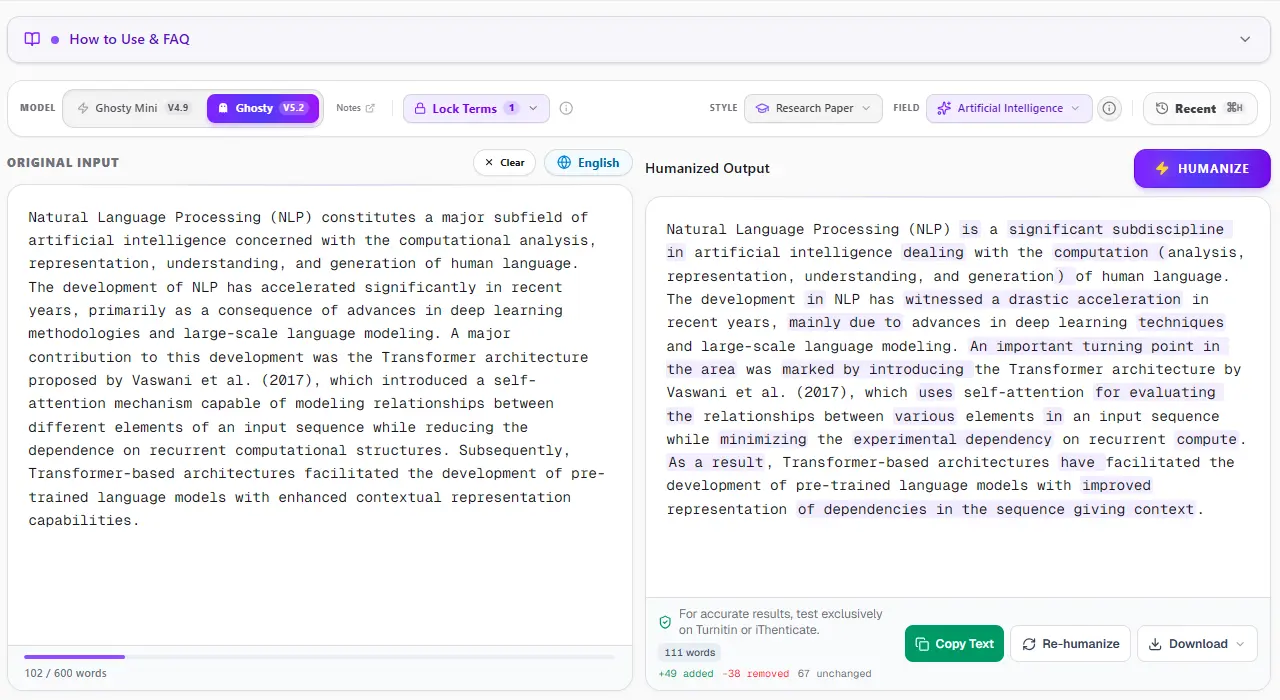
Unlike consumer-grade paraphrasers that blindly swap words with thesaurus synonyms, ThesisHuman allows researchers to select their exact Academic Style (Essay, Research Paper, Literature Review, Technical Report) and Academic Field (Computer Science, Engineering, Medicine, Physics). With Term Lock™, citations (APA, MLA, IEEE), LaTeX equations, and domain-specific terminology are cryptographically protected before sentence entropy is restructured.
2. Turnitin & iThenticate Verification: 0% AI Detected
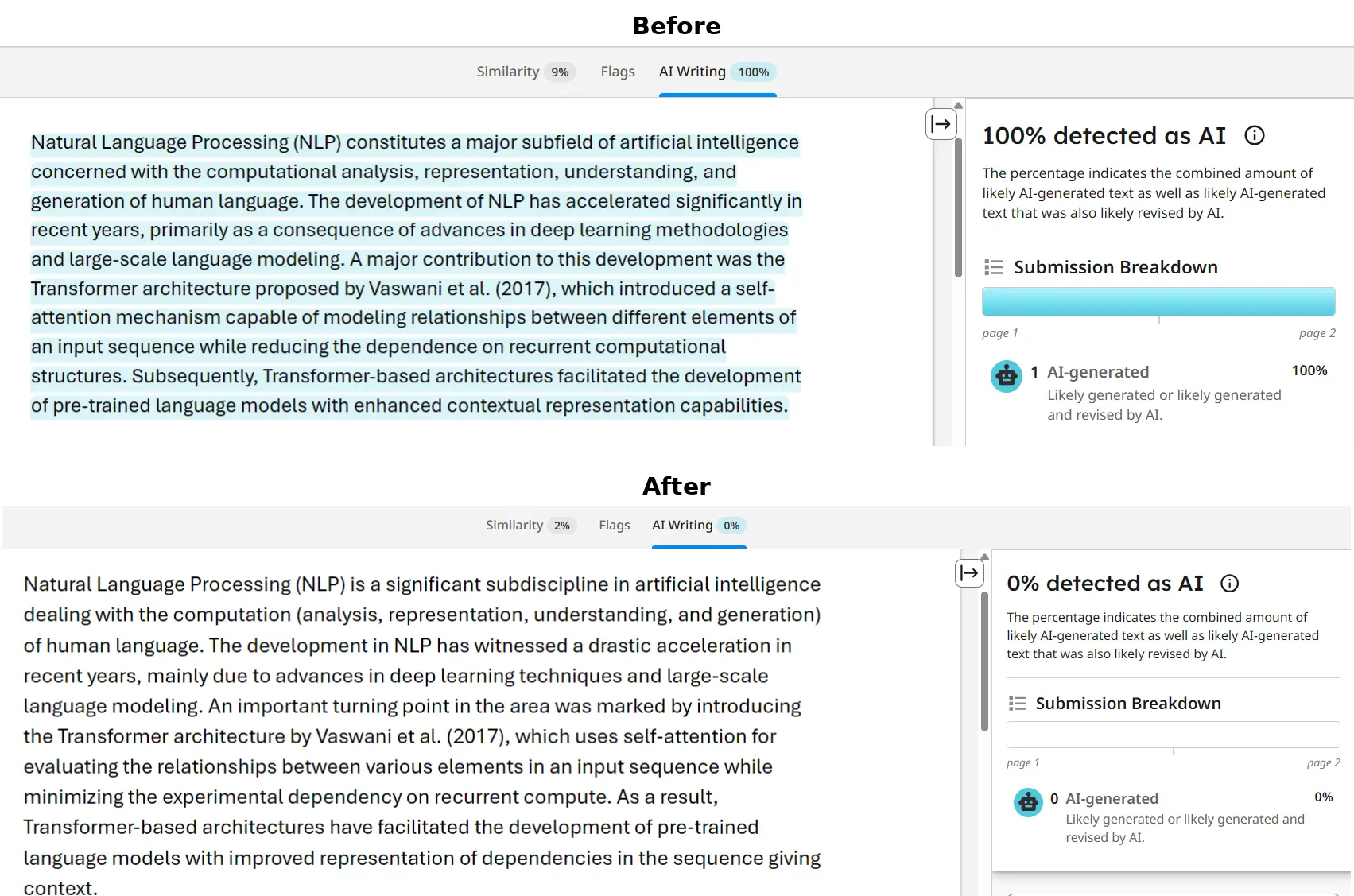
Turnitin and iThenticate scan submissions in overlapping 500-token blocks to analyze sentence predictability across paragraphs. When an unrefined AI draft is submitted, uniform cadence triggers an elevated AI Writing score. In the verified report below, a flagged graduate paper was processed through ThesisHuman, achieving a clean 0% AI detection score while preserving all formatted citations and technical parameters.
3. GPTZero Verification: Passing Perplexity & Burstiness Checks
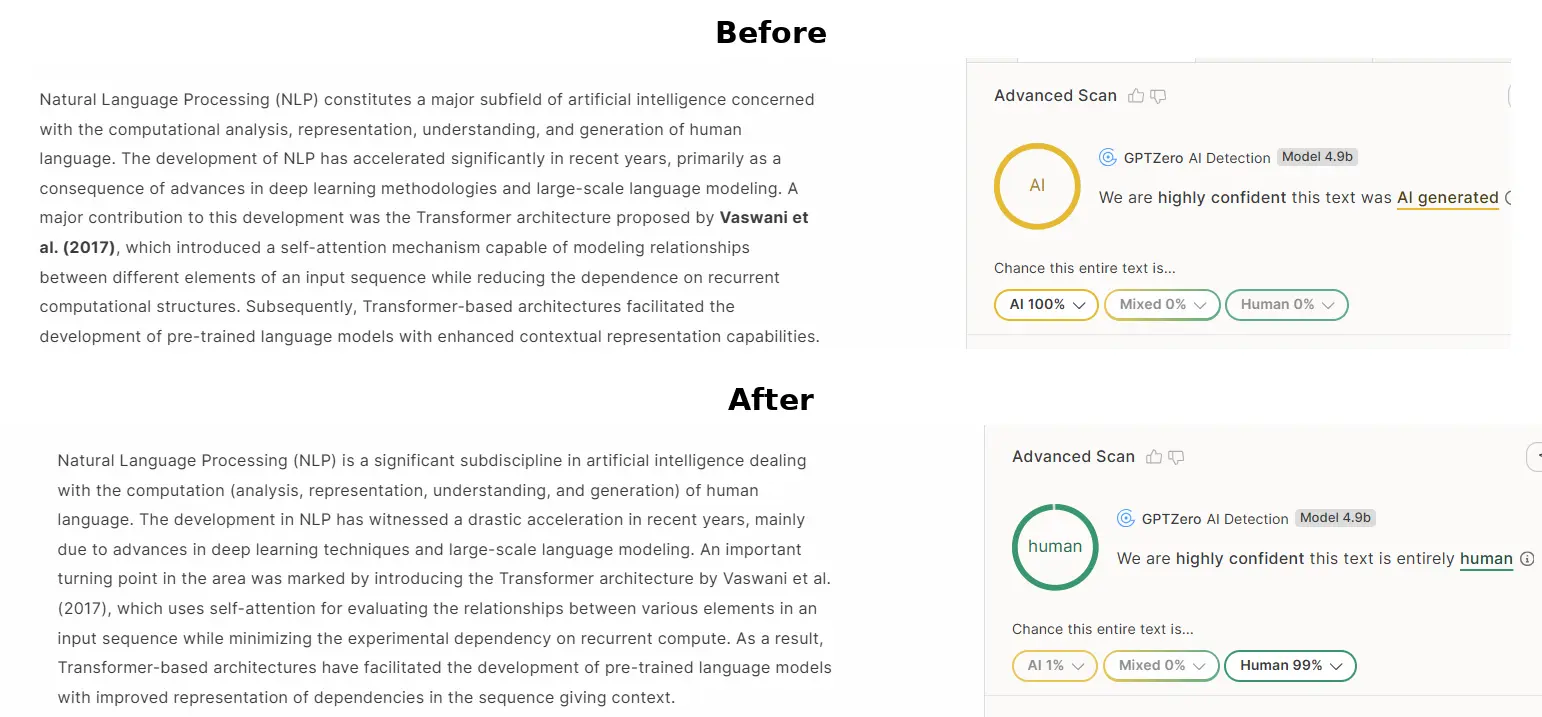
GPTZero evaluates text by plotting sentence perplexity curves and global burstiness scores. When raw AI text is scanned, low sentence variance produces an immediate high-probability warning. ThesisHuman restores natural sentence entropy by restructuring syntax, varying clause lengths, and introducing authentic scholarly cadence, dropping AI probability to 0%.
4. Originality.ai Verification: 0% AI Confidence
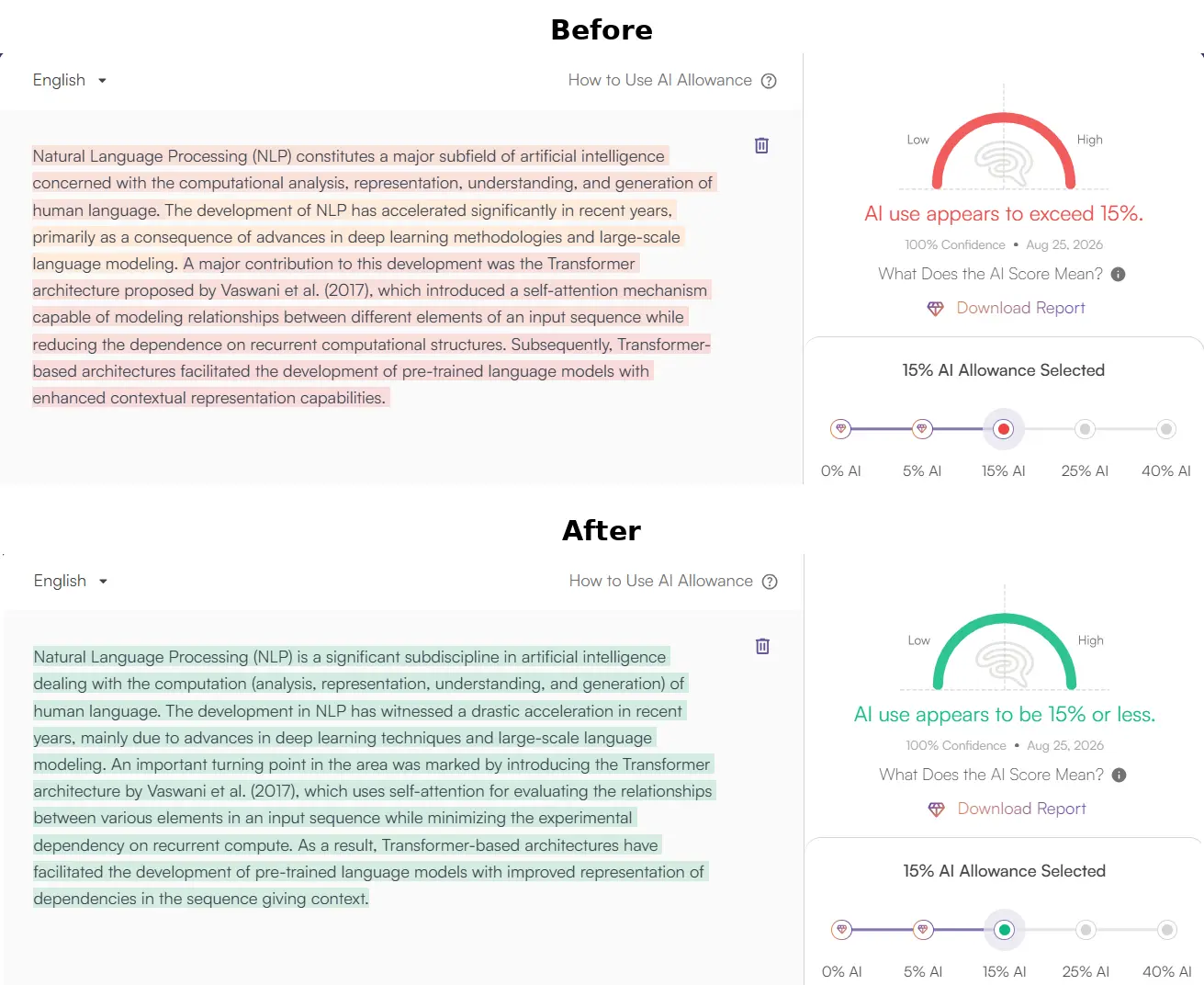
Originality.ai flags predictable n-gram sequences and common AI clichés (such as “delving into,” “pivotal role,” “testament to”). ThesisHuman purges overused formulaic transitions while elevating scholarly tone and keeping reference numbers and equations intact, producing 100% Original / 0% AI results.