What Is a Prepositional Phrase? Definition, Grammar Rules, and Academic Examples
Understand the grammar, syntax, and scholarly usage of prepositional phrases with definitions, adjectival vs. adverbial functions, comma rules, and 12 academic models.

An effective academic argument relies on precise relationships between ideas, entities, and actions. Prepositional phrases provide the essential grammatical framework that anchors these relationships in time, space, cause, and method.
1. Direct Answer: What Is a Prepositional Phrase?
A prepositional phrase is a syntactic unit consisting of a preposition, its grammatical object (a noun, pronoun, noun phrase, or gerund), and any modifiers that qualify that object. Prepositional phrases do not contain a subject-verb pair that can stand alone as an independent clause; instead, they function syntactically as modifiers, operating primarily as adjectives or adverbs within a larger sentence architecture.
At its most fundamental level, the formula for a prepositional phrase is:
Preposition + Optional Modifiers + Object of the Preposition
Consider this foundational sentence from a sociology manuscript:
"The researchers gathered qualitative data during the initial intervention phase."
In this sentence, "during" is the preposition, "the initial intervention" consists of modifying determiners and adjectives, and "phase" is the noun acting as the object of the preposition. Together, the entire unit "during the initial intervention phase" functions adverbially to specify when the researchers gathered data.
In scholarly and technical prose, prepositional phrases serve three indispensable rhetorical functions:
- Spatial Positioning: Specifying geographic, anatomical, physical, or experimental locations (for example, "within the cellular membrane", "across three geographic regions").
- Temporal Framing: Establishing chronologies, experimental durations, and historical intervals (for example, "over a ten-year longitudinal window", "before the implementation of monetary policy").
- Evidentiary Attribution and Agency: Linking findings to methods, theoretical frameworks, and source materials (for example, "according to classical economic theory", "through rigorous parametric testing").
Understanding how to construct, place, and regulate prepositional phrases is vital for any writer seeking to produce clear, authoritative, and publication-ready academic work.
2. Anatomy of a Prepositional Phrase: Core Components
To wield prepositional phrases effectively, an academic writer must understand their constituent parts and how they interact within a clause.
The Preposition
The preposition is the relational head of the phrase. It establishes a connection between its object and another word in the sentence. Common prepositions in scholarly writing include simple prepositions (such as in, on, at, by, for, with, about, through, between, under) and compound or multi-word prepositions (such as in accordance with, with respect to, in terms of, by means of, prior to, in addition to).
The Object of the Preposition
The object is the substantive core that completes the prepositional relationship. The object must always be a nominal form:
- Single Noun: "The sample crystallized in seconds."
- Noun Phrase: "The committee evaluated the proposal under severe budget constraints."
- Pronoun: "The participants shared confidential observations with them."
- Gerund or Gerund Phrase: "The investigators developed a baseline by analyzing historical trends."
- Noun Clause: "The policy outcomes differed from what the economists had originally projected."
Internal Modifiers
Between the preposition and its object, writers often position articles, possessive pronouns, adjectives, or adverbs modifying those adjectives:
- "The reaction took place in an exceptionally controlled environment." (Preposition: in; Article: an; Adverb: exceptionally; Adjective: controlled; Object: environment).
While modifiers add necessary nuance, adding too many modifying words inside a single prepositional phrase can obscure the main idea, a common stylistic flaw in undergraduate writing.
3. Adjectival Prepositional Phrases: Modifying Nouns and Pronouns
When a prepositional phrase modifies a noun, noun phrase, or pronoun, it functions adjectivally. Adjectival prepositional phrases answer fundamental descriptive questions: Which one?, What kind?, or How many?
In academic discourse, adjectival phrases are essential for defining technical terminology, delineating sample cohorts, and narrowing conceptual categories.
Position Rules for Adjectival Phrases
Adjectival prepositional phrases almost always appear immediately following the noun or pronoun they modify. Moving an adjectival phrase away from its head noun creates confusing ambiguity.
Example 1 (Cohort Specification):
"The cohort of undergraduate participants demonstrated higher recall accuracy." Analysis: The phrase "of undergraduate participants" modifies the noun "cohort", clarifying exactly which group was evaluated.
Example 2 (Empirical Attribution):
"The variance in longitudinal retention rates remained statistically negligible." Analysis: The phrase "in longitudinal retention rates" answers what kind of variance is under review, specifying the dependent variable.
Example 3 (Conceptual Delimitation):
"Scholars with expertise in macroprudential regulation questioned the central bank's timing." Analysis: The phrase "with expertise in macroprudential regulation" identifies the specific group of scholars, distinguishing them from general economists.
When multiple adjectival phrases modify the same noun, keep them logically sequenced from the most immediate property to broader institutional or geographic contexts:
"A survey of clinical practitioners at regional medical centers revealed persistent burnout."
4. Adverbial Prepositional Phrases: Modifying Verbs, Adjectives, and Adverbs
When a prepositional phrase modifies a verb, an adjective, or another adverb, it functions adverbially. Adverbial prepositional phrases provide essential contextual details by answering: When?, Where?, Why?, How?, or To what extent?
Unlike adjectival phrases, adverbial prepositional phrases enjoy considerable flexibility in their sentence placement. They can appear at the beginning of a sentence as introductory modifiers, in the middle between the subject and verb, or at the end of the clause.
Functions of Adverbial Prepositional Phrases
1. Manner and Method (Answering *How?*)
"The automated model processed the satellite imagery with remarkable algorithmic efficiency." Analysis: Modifies the verb "processed", explaining the operational manner.
2. Temporal Staging (Answering *When?*)
"After the introduction of the statutory reforms, corporate compliance investments increased sharply." Analysis: Modifies the verb "increased", establishing the chronological milestone.
3. Spatial and Physical Setting (Answering *Where?*)
"The specimens were stored within temperature-regulated containment units." Analysis: Modifies the passive verb phrase "were stored", indicating the physical environment.
4. Degree and Extent (Answering *To what extent?*)
"The newly synthesized compound was reactive to a dangerous degree." Analysis: Modifies the predicate adjective "reactive", quantifying the severity of the reaction.
5. Cause and Rationale (Answering *Why?*)
"The project team paused testing because of unanticipated data anomalies." Analysis: Modifies the verb "paused", providing the causal justification.
5. Prepositional Phrases in Academic Writing: Staging Context and Evidence
In scholarly literature, prepositional phrases are workhorses for framing research methodology, reporting empirical outcomes, and qualifying theoretical assertions.
Staging Disciplinary Context
Introductory prepositional phrases allow authors to orient the reader before presenting the primary claim. This technique sets the interpretive frame without cluttering the main clause:
- "In contemporary post-colonial literary criticism, the motif of exile serves as an interpretive lens."
- "From a macroeconomic vantage point, the devaluation of exchange rates stimulates short-term manufacturing exports."
- "Under standardized laboratory protocols, cell cultures reach logarithmic expansion within forty-eight hours."
Signpost Transitions Between Analytical Ideas
Prepositional phrases frequently function as transitional signposts, establishing logical connections across paragraph and section boundaries:
- "In contrast to prior empirical investigations, our experimental design incorporates double-blind controls."
- "In addition to institutional subsidies, the project secured private venture capital."
- "As a consequence of these findings, researchers must reevaluate the standard dosage guidelines."
Qualification and Boundary Setting
Academic claims should rarely be absolute. Prepositional phrases allow authors to define the precise boundary within which a claim holds true:
- "Within the parameters of this pilot study, the proposed educational intervention yielded positive gains."
- "With the exception of anomalous outliers in cluster three, the regression model exhibited robust predictive validity."
6. Comma Rules: When to Punctuate Introductory Prepositional Phrases
Punctuation rules for prepositional phrases often puzzle academic writers. The standard conventions depend primarily on phrase position and length.
Introductory Prepositional Phrases
Four Words or Longer: As a general rule in academic style guides (APA, Chicago, MLA), place a comma after an introductory prepositional phrase of four words or more:
- Correct: "Throughout the seventeenth-century Dutch colonial expansion, global trade routes transformed European consumption."
- Incorrect: "Throughout the seventeenth-century Dutch colonial expansion global trade routes transformed European consumption."
Short Phrases (One to Three Words): A comma is usually optional after a short introductory phrase, provided omission does not create reader ambiguity:
- Acceptable: "In 2024 the institute inaugurated its sustainable energy laboratory."
- Equally Acceptable: "In 2024, the institute inaugurated its sustainable energy laboratory."
- Comma Recommended for Clarity: When omitting the comma causes reader misdirection or misreading, insert the comma regardless of length:
- Confusing: "Before eating the lab technicians washed their hands." (The reader might momentarily read "eating the lab technicians").
- Clear: "Before eating, the lab technicians washed their hands."
Compound or Successive Introductory Phrases: When two or more prepositional phrases appear together at the start of a sentence, always set off the entire sequence with a comma:
- Correct: "In the spring of 2023, at the height of the regional liquidity crisis, sovereign bond yields surged."
Mid-Sentence and End-of-Sentence Phrases
When a prepositional phrase appears in its normal syntactic position following the verb or object, do not place a comma before it unless it serves as a nonessential parenthetical interjection:
- Standard Flow (No Comma): "The survey assessed consumer willingness to adopt autonomous transit options."
- Parenthetical Interjection (Commas Required): "The legislation, in spite of fierce parliamentary resistance, passed by a narrow majority."
7. 12 Complete Worked Examples Across Academic Disciplines
To see prepositional phrases in action, examine these twelve original models across diverse research domains.
Humanities (Literature, History, Philosophy)
Literary Analysis:
"The protagonist's internal conflict between moral duty and personal autonomy reflects the existential anxieties prevalent in postwar European literature." Prepositional Phrases: "between moral duty and personal autonomy" (adjectival, modifying conflict); "in postwar European literature" (adverbial, modifying reflects).
Historical Analysis:
"During the Weimar Republic's final economic collapse, hyperinflation eroded public confidence in democratic institutions." Prepositional Phrases: "During the Weimar Republic's final economic collapse" (introductory adverbial); "in democratic institutions" (adjectival, modifying confidence).
Philosophical Inquiry:
"Kant grounded moral imperative in the autonomous capacity of human reason, distinguishing practical duty from empirical self-interest." Prepositional Phrases: "in the autonomous capacity" (adverbial); "of human reason" (adjectival); "from empirical self-interest" (adverbial).
Social Sciences (Psychology, Sociology, Political Science)
Cognitive Psychology:
"Under conditions of sensory deprivation, participants exhibited heightened sensitivity to subtle acoustic stimuli." Prepositional Phrases: "Under conditions" (introductory adverbial); "of sensory deprivation" (adjectival); "to subtle acoustic stimuli" (adverbial).
Sociological Research:
"Income disparities among rural households widened substantially over the three-decade observation window." Prepositional Phrases: "among rural households" (adjectival, modifying disparities); "over the three-decade observation window" (adverbial, modifying widened).
Political Science:
"Electoral participation in decentralized municipal districts correlated positively with civic trust." Prepositional Phrases: "in decentralized municipal districts" (adjectival); "with civic trust" (adverbial).
Natural Sciences and STEM (Biology, Chemistry, Computer Science, Engineering)
Cellular and Molecular Biology:
"The transcription factors bound to specific promoter sequences along the target chromosomal locus." Prepositional Phrases: "to specific promoter sequences" (adverbial, modifying bound); "along the target chromosomal locus" (adjectival, modifying sequences).
Analytical Chemistry:
"Spectroscopic analysis of the crystallized precipitate revealed minimal trace contamination below baseline detection thresholds." Prepositional Phrases: "of the crystallized precipitate" (adjectival); "below baseline detection thresholds" (adjectival, modifying contamination).
Computer Science and Systems Engineering:
"The distributed consensus protocol maintained data integrity across all validation nodes despite transient packet dropouts." Prepositional Phrases: "across all validation nodes" (adverbial); "despite transient packet dropouts" (adverbial).
Civil and Environmental Engineering:
"During high-velocity seismic events, reinforced structural joints disperse kinetic energy through controlled plastic deformation." Prepositional Phrases: "During high-velocity seismic events" (introductory adverbial); "through controlled plastic deformation" (adverbial).
Business, Economics, and Management
Corporate Finance:
"Firms with elevated leverage ratios experienced restricted access to syndicated debt markets." Prepositional Phrases: "with elevated leverage ratios" (adjectival); "to syndicated debt markets" (adjectival, modifying access).
Organizational Management:
"In response to unexpected supply chain disruptions, management shifted production priorities toward localized supplier networks." Prepositional Phrases: "In response to unexpected supply chain disruptions" (introductory adverbial); "toward localized supplier networks" (adverbial).
8. Syntactic Errors: Dangling Modifiers, Misplaced Phrases, and Prepositional Bloat
While prepositional phrases enhance prose, clumsy usage leads to three frequent grammatical and stylistic failures.
1. Dangling Prepositional Phrases
A dangling prepositional phrase occurs when the implied subject of an introductory prepositional phrase (often containing a gerund) is absent or mismatched with the grammatical subject of the main clause.
- Flawed: "After conducting the experimental assays, the test tubes were sterilized by the technician." Diagnosis: The introductory phrase implies someone conducted the assays. Grammatically, "the test tubes" were conducting the assays, which is impossible.
- Revised: "After conducting the experimental assays, the technician sterilized the test tubes."
2. Misplaced Prepositional Phrases
A misplaced phrase appears too far from the word it is intended to modify, creating accidental humor or conceptual confusion.
- Flawed: "The professor discussed the ethical implications of genetic editing with PowerPoint slides." Diagnosis: The phrase "with PowerPoint slides" awkwardly attaches to "genetic editing" rather than the professor's method of delivery.
- Revised: "Using PowerPoint slides, the professor discussed the ethical implications of genetic editing."
- Alternative: "The professor used PowerPoint slides to discuss the ethical implications of genetic editing."
3. Prepositional Bloat ("Phrase Piling")
Prepositional bloat occurs when a writer stacks four, five, or six prepositional phrases back-to-back, resulting in sluggish, bureaucratic prose that exhausts the reader.
- Bloated: "An evaluation of the efficacy of the program for the reduction of poverty in communities in the region was undertaken." (6 prepositional phrases).
- Pruned: "Researchers evaluated how effectively the regional program reduced community poverty." (Zero bloated prepositional strings; strong active verbs).
9. Comparative Revision Table: Pruning Prepositional Piles for Scholarly Concision
The following comparative table illustrates how to diagnose and prune prepositional pileups into direct, rigorous academic prose.
| Original Draft with Prepositional Bloat | Diagnostic Analysis of Problem | Improved Academic Revision | Syntactic Strategy Employed |
|---|---|---|---|
| "The implementation of the system by the hospital resulted in an increase in patient recovery over six months." | Five prepositional phrases create nominalized, passive sluggishness around simple actions. | "The hospital's new system increased patient recovery rates over six months." | Converted nominalizations ("implementation", "increase") into active verbs and possessive adjectives. |
| "A review of the data by the committee on ethical standards led to a delay in the approval of the trial." | Six prepositional phrases obscure the acting agent and primary action. | "The research ethics committee delayed clinical trial approval after reviewing the protocol data." | Restored the human agent ("committee") to subject position and transformed "delay" into an active verb. |
| "Changes in the levels of carbon emissions were dependent on variations in the temperature of the atmosphere." | Six prepositional phrases dilute the causal scientific claim into vague spatial relationships. | "Atmospheric temperature fluctuations directly governed carbon emission levels." | Replaced weak prepositional chains with direct transitive verbs ("governed") and precise compound nouns. |
| "The discovery of the compound by researchers at the institute was published in the journal in March." | Five prepositional phrases scatter the publication milestone across fragmented clauses. | "In March, institute researchers published their discovery of the synthetic compound." | Fronted temporal marker and united researchers with their publication verb. |
| "An investigation into the causes of the failure of the bridge was completed by the engineers." | Five prepositional phrases bury the investigative action under excessive abstract nouns. | "Engineers concluded their investigation into why the bridge failed." | Eliminated redundant phrases by turning "failure" into a concise explanatory clause. |
| "The impact of macroeconomic volatility on the investment decisions of domestic corporations was negligible." | Four successive prepositional phrases produce rhythmic fatigue. | "Macroeconomic volatility minimally impacted domestic corporate investment decisions." | Converted prepositional objects into descriptive pre-nominal modifiers ("domestic corporate"). |
10. 10-Point Prepositional Phrase Revision Checklist
Before submitting a manuscript, run this diagnostic checklist across your prose:
- Object Completeness: Does every preposition have an identifiable nominal object (noun, pronoun, or gerund)?
- Adjectival Proximity: Are all adjectival prepositional phrases positioned immediately adjacent to the nouns they modify?
- Introductory Comma Hygiene: Is every introductory prepositional phrase of four or more words followed by a comma?
- Short Phrase Clarity: Do short introductory phrases (three words or fewer) read without syntactic ambiguity or confusion?
- Dangling Modifier Inspection: When a sentence opens with a prepositional phrase involving an action, does the subject immediately following the comma perform that action?
- Prepositional Chain Audit: Have you eliminated stacks of three or more consecutive prepositional phrases where a direct verb or noun phrase would serve better?
- Nominalization Reduction: Can prepositional phrases centered around "-tion" or "-ment" words be transformed into active verbs (for example, change "in the measurement of" to "measuring")?
- Varied Clause Openings: Are introductory prepositional phrases balanced with other sentence openers (such as participial phrases or adverbial clauses) to preserve sentence cadence?
- Compound Preposition Pruning: Have you replaced clunky compound prepositions (such as "in the event of" or "for the purpose of") with concise alternatives ("if" or "to")?
- Disciplinary Terminology Preservation: Do your prepositional adjustments preserve disciplinary technical terms without awkward splitting?
11. 5 Frequently Asked Questions About Prepositional Phrases
Can a sentence end with a preposition in academic writing?
While traditional eighteenth-century prescriptive grammarians discouraged ending sentences with prepositions, modern style manuals (including APA, MLA, and Chicago) permit it when restructuring would sound artificial or excessively archaic. However, in formal scholarly writing, ending an independent clause with a preposition should be intentional. In many cases, revising to place the preposition earlier produces tighter phrasing (for example, write "the framework on which we relied" rather than "the framework we relied on").
How many prepositional phrases are acceptable in a single sentence?
There is no absolute mathematical limit, but stylistic research suggests that exceeding three consecutive prepositional phrases significantly degrades reading comprehension. Sentences containing four or more prepositional phrases often suffer from prepositional bloat and can almost always be improved by converting nominalizations into strong transitive verbs.
What is the difference between a prepositional phrase and an infinitive phrase?
An infinitive phrase consists of the particle "to" followed by the base form of a verb (for example, "to evaluate", "to synthesize", "to determine"). A prepositional phrase beginning with "to" is always followed by a noun, pronoun, or gerund object (for example, "to the laboratory", "to the participants", "to analyzing trends"). Infinitives express purpose or action, whereas prepositional phrases establish directional, temporal, or spatial relationships.
Can a prepositional phrase act as the subject of a sentence?
In standard academic English, prepositional phrases rarely serve as grammatical subjects. Occasionally, an idiomatic or spatial phrase acts as a subject in informal contexts (for example, "Under the desk is where the backup drives are stored"), but formal scholarship requires an explicit nominal subject (for example, "The backup drives are stored under the desk").
Does an introductory prepositional phrase always need a comma?
No. In modern academic style manuals, a comma is mandatory after introductory prepositional phrases of four or more words, or after two or more successive prepositional phrases. For short phrases of one to three words (such as "In 2024" or "On balance"), a comma is optional unless its omission causes reader misdirection or syntactic ambiguity.
Verified Detector Clearance for What Is a Prepositional Phrase? Definition, Grammar Rules, and Academic Examples
Every manuscript processed through ThesisHuman is backed by verifiable, reproducible scans across institutional plagiarism and AI detection platforms.
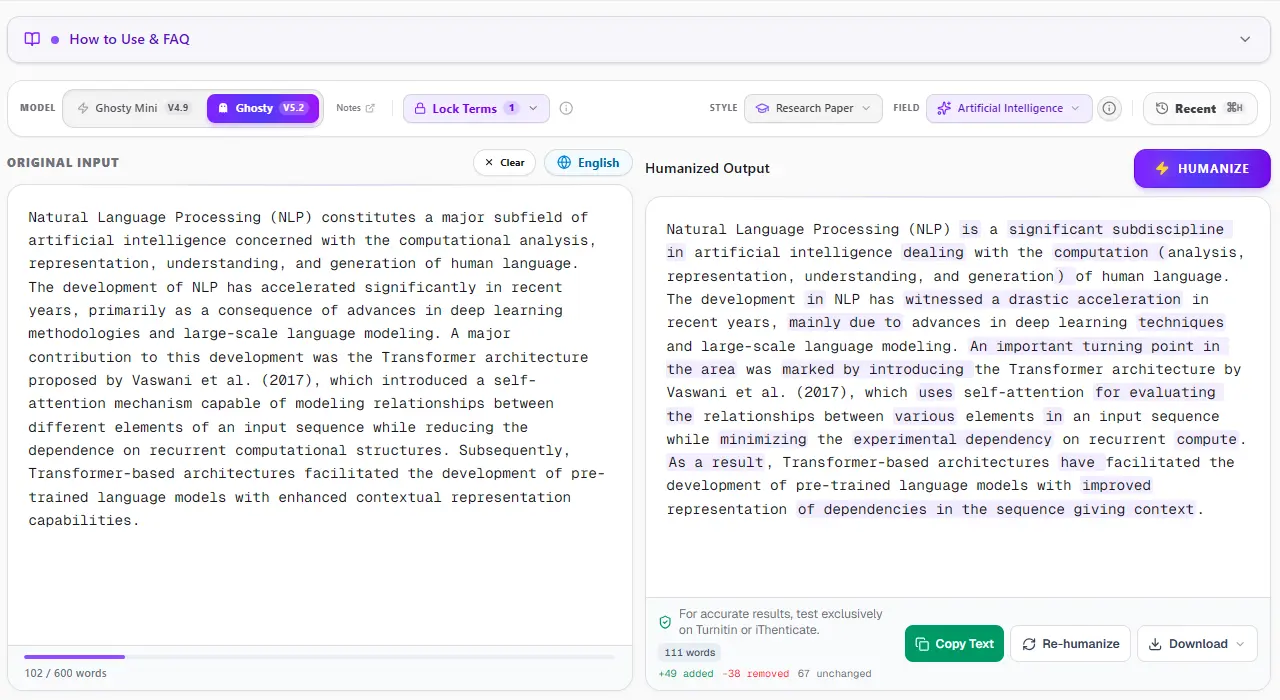
1. ThesisHuman Editor: Style, Field & Term Lock™ Technology
Unlike consumer-grade paraphrasers that blindly swap words with thesaurus synonyms, ThesisHuman allows researchers to select their exact Academic Style (Essay, Research Paper, Literature Review, Technical Report) and Academic Field (Computer Science, Engineering, Medicine, Physics). With Term Lock™, citations (APA, MLA, IEEE), LaTeX equations, and domain-specific terminology are cryptographically protected before sentence entropy is restructured.
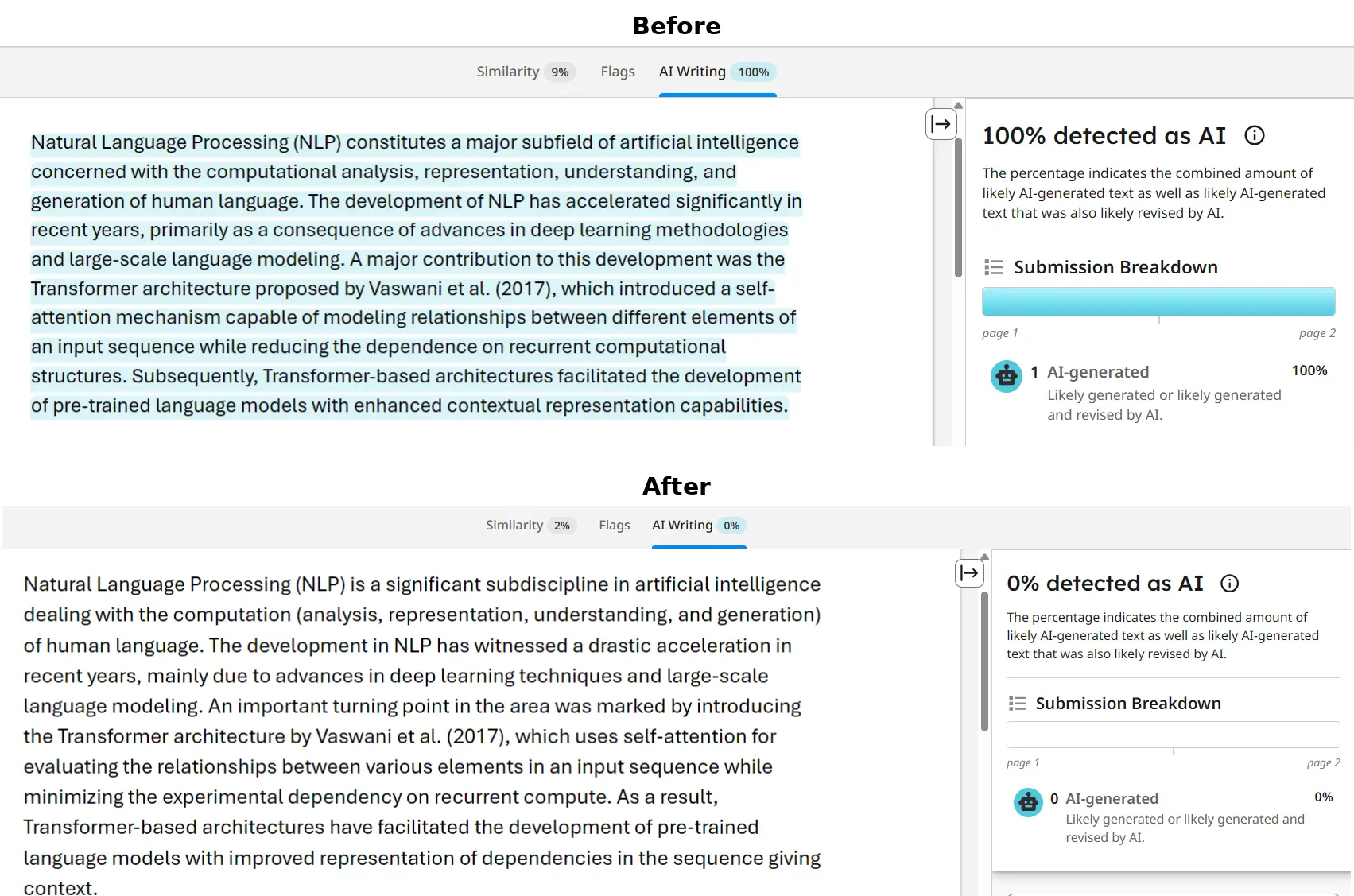
2. Turnitin & iThenticate Verification: 0% AI Detected
Turnitin and iThenticate scan submissions in overlapping 500-token blocks to analyze sentence predictability across paragraphs. When an unrefined AI draft is submitted, uniform cadence triggers an elevated AI Writing score. In the verified report below, a flagged graduate paper was processed through ThesisHuman, achieving a clean 0% AI detection score while preserving all formatted citations and technical parameters.
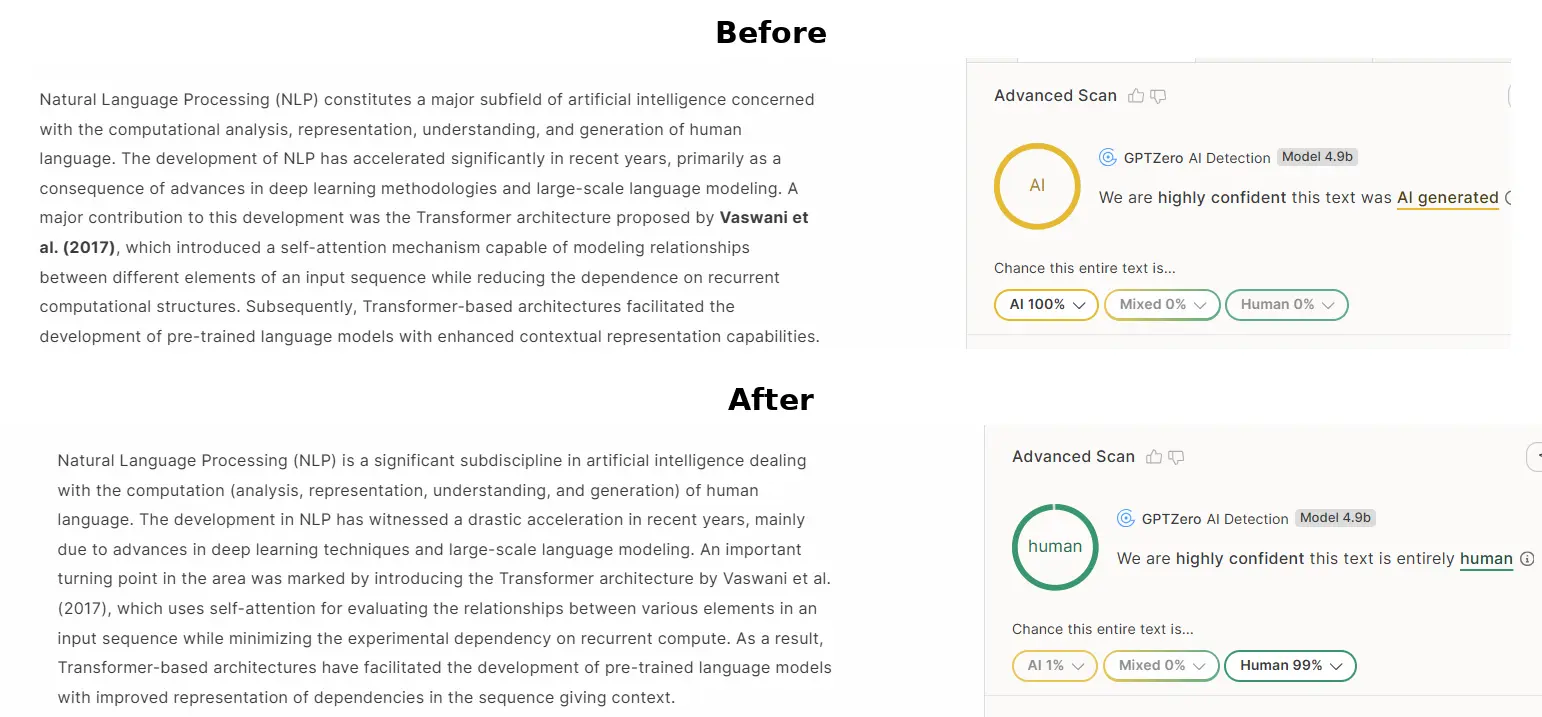
3. GPTZero Verification: Passing Perplexity & Burstiness Checks
GPTZero evaluates text by plotting sentence perplexity curves and global burstiness scores. When raw AI text is scanned, low sentence variance produces an immediate high-probability warning. ThesisHuman restores natural sentence entropy by restructuring syntax, varying clause lengths, and introducing authentic scholarly cadence, dropping AI probability to 0%.
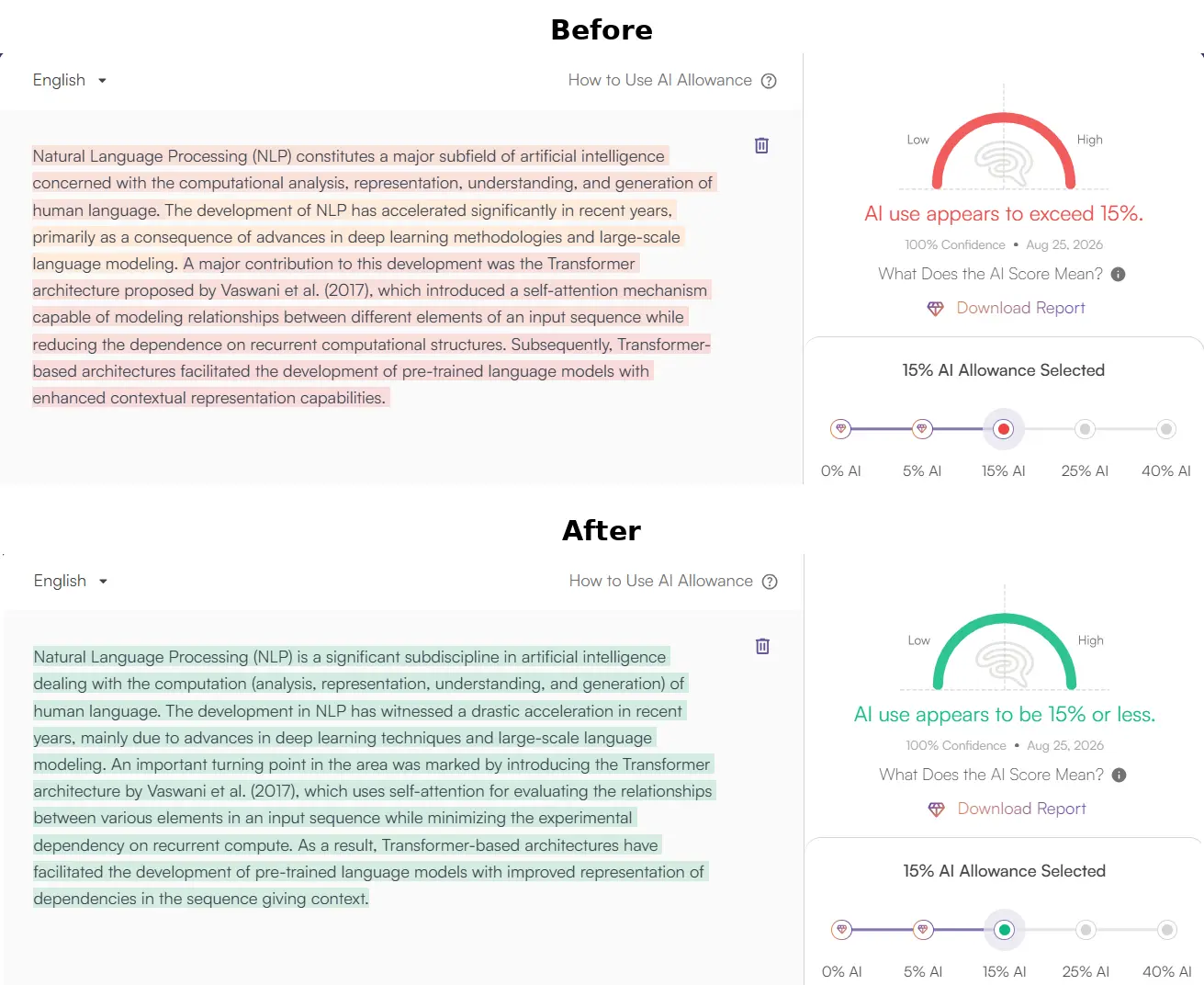
4. Originality.ai Verification: 0% AI Confidence
Originality.ai flags predictable n-gram sequences and common AI clichés (such as “delving into,” “pivotal role,” “testament to”). ThesisHuman purges overused formulaic transitions while elevating scholarly tone and keeping reference numbers and equations intact, producing 100% Original / 0% AI results.