Thesis Statement Templates: 12 Examples for Different Essay Types
Master academic thesis construction with 12 reusable templates, genre-specific models, weak vs. strong comparison tables, and a 10-point diagnostic checklist.

A thesis statement is the intellectual center of any academic essay, dissertation chapter, or research article. While inexperienced writers often search for a magic sentence that writes itself, experienced scholars know that a thesis statement template provides something more practical: an analytical scaffolding that organizes complex arguments into clear, defensible, and focused claims.
1. Direct Answer: What Is a Thesis Statement Template?
A thesis statement template is a reusable grammatical and rhetorical formula designed to help writers articulate their central claim, analytical angle, and supporting rationale. Rather than substituting for original thought, a template provides a structural blueprint: it forces the writer to connect a specific topic to an arguable assertion and a defined evidentiary scope.
At its most fundamental level, the core formula for an academic thesis template is:
[Topic / Subject] + [Defensible Analytical Claim] + [Primary Rationale / Evidentiary Boundary]
For example, when drafting an essay on environmental economics, a student might move from an initial topic to a structured template:
- Raw Topic: Carbon taxation in emerging economies.
- Template Application: While [critics argue carbon taxation slows manufacturing], [implementing targeted tax rebates on clean capital investment] [accelerates industrial decarbonization without depressing real wage growth].
A template is not a rigid cage; it is a diagnostic tool. It ensures your thesis avoids the two most common failures in undergraduate and graduate writing: remaining a purely descriptive topic summary, or asserting an opinion so broad that no single paper could ever substantiate it.
2. What Makes an Effective Thesis Statement?
Before choosing a template, you must understand the essential criteria that distinguish an authoritative thesis statement from an amateur one:
- Analytical Arguability: A strong thesis takes a stance that a reasonable reader could question or dispute, establishing the overarching claim that governs your supporting topic sentences (analyzed in our topic sentence examples guide). Statements of established fact (such as "Photosynthesis converts sunlight into chemical energy") cannot function as thesis statements because they require no evidentiary defense.
- Sharp Specificity: Avoid vague umbrella terms like "good", "bad", "influential", or "impactful". Specify the exact mechanism, tension, or consequence your paper analyzes.
- Manageable Scope: Align the breadth of your claim with the length of your assignment. A five-page undergraduate essay cannot explain "why democracy succeeds"; it can, however, analyze "how independent election commissions safeguard municipal voting integrity."
- Evidentiary Alignment: Every major sub-claim in your thesis must correspond directly to the evidence and arguments developed in your body paragraphs, following the structural principles established in our body paragraph examples guide.
- Calibrated Epistemic Hedging: Scholarly thesis statements rarely rely on absolute language like "always", "never", or "proves beyond doubt." They use measured phrasing that reflects the real boundaries of empirical or historical evidence.
3. Thesis Statement vs. Topic: Moving from Subject to Claim
The single most frequent mistake in student drafting is mistaking an announcement of a topic for a thesis statement.
- Topic (Descriptive Subject): "The history of urban redlining in mid-century American cities." Why it fails: It merely identifies the domain of discussion. It tells the reader what you are looking at, but nothing about what you have discovered or concluded.
- Thesis Statement (Analytical Claim): "Mid-century urban redlining systematically concentrated environmental hazards in minority neighborhoods, creating persistent disparities in public health outcomes that contemporary zoning reforms still fail to remediate." Why it succeeds: It identifies specific causes ("redlining"), distinct mechanisms ("concentrated environmental hazards"), measurable effects ("disparities in public health"), and an evaluative contemporary conclusion ("zoning reforms fail to remediate").
4. Thesis Statement vs. Research Question: Inquiry vs. Assertion
In empirical and graduate research, the writing process begins with a research question, but the finished paper must deliver a thesis statement.
- Research Question (The Exploration): "How does microfinance lending affect female entrepreneurial autonomy in rural regions?"
- Thesis Statement (The Answer): "Although microfinance lending increases household capital access, its social impact remains constrained unless accompanied by local property ownership protections and legal literacy training."
Your research question frames your investigation; your thesis statement declares the nuanced answer your analysis established.
5. Basic Academic Thesis Statement Template
The basic thesis statement template serves as the foundation for introductory college essays, expository arguments, and short papers.
Formula
By examining [Specific Evidence / Context], this paper demonstrates that [Focused Claim], because [Key Analytical Rationale].
Worked Model
"By examining nineteenth-century municipal hospital records, this paper demonstrates that antiseptic sanitation protocols reduced postoperative mortality rates primarily because they institutionalized hand-washing discipline among rotating medical staff."
When to Use
Use this structure when you need a direct, robust declaration for short analytical or research essays where early clarity is paramount.
Common Limitation
If used uncritically across multiple assignments, this formula can sound mechanical. Upgrade the formula by moving the explanatory clause to an introductory prepositional phrase or dependent clause.
6. Argumentative Thesis Statement Template
Argumentative essays require taking a definitive stance on a debatable issue and defending that stance against competing interpretations.
Formula
Although [Opposing Viewpoint / Concession], [Author's Core Position] because [Primary Evidentiary Argument], which ultimately leads to [Broader Implication].
Worked Model
"Although proponents argue that algorithmic criminal sentencing reduces human judicial bias, proprietary risk-assessment software entrenches racial disparities because historical arrest datasets systematically overrepresent minority communities, thereby delegitimizing the principle of equal protection under the law."
Analytical Utility
This template forces you to acknowledge counterarguments immediately, preventing your essay from reading like a one-sided polemic.
7. Analytical Thesis Statement Template
Analytical essays break down a complex text, process, historical event, or dataset into its component elements to explain how the parts produce an overall effect.
Formula
An examination of [Primary Subject / Text] reveals that [Key Dynamic / Tension], which operates through [Element 1], [Element 2], and [Element 3] to [Overall Purpose / Result].
Worked Model
"An examination of Gabriel Garcia Marquez's narrative structure reveals that chronological distortion operates through cyclical repetition, prophetic prolepsis, and fragmented focalization to critique Latin American political stagnation."
Analytical Utility
Notice that this template does not merely list three things; it explains how those three elements work together to achieve an interpretive outcome.
8. Compare-and-Contrast Thesis Statement Template
A common trap in comparative writing is producing two parallel summaries without ever synthesizing the relationship between them.
Formula
While [Subject A] and [Subject B] both share [Superficial Similarity], they diverge significantly in [Core Point of Divergence], demonstrating that [Critical Insight or Superiority].
Worked Model
"While both the United States Constitution and the German Basic Law establish federalized judicial review, they diverge significantly in their institutional protection of fundamental rights, demonstrating that post-conflict constitutional design prioritizes human dignity over procedural formalism."
Analytical Utility
This template ensures that your comparative essay is grounded in a meaningful conceptual insight rather than a mechanical list of similarities and differences.
9. Cause-and-Effect Thesis Statement Template
Cause-and-effect essays investigate the origins, triggers, and downstream consequences of historical phenomena, social trends, or scientific processes.
Formula
The emergence of [Phenomenon] was precipitated not merely by [Commonly Assumed Factor], but predominantly by [Deeper Underlying Cause], which subsequently triggered [Consequence 1] and [Consequence 2].
Worked Model
"The collapse of the Bronze Age Aegean civilizations was precipitated not merely by external maritime invasions, but predominantly by prolonged climatic drought, which subsequently triggered systemic agricultural failure and fractured long-distance bronze trade networks."
Analytical Utility
By moving beyond a single simplistic cause, this structure reflects genuine scholarly complexity.
10. Expository Thesis Statement Template
Expository essays explain an intricate concept, scientific mechanism, or institutional policy to inform the reader without requiring an adversarial political stance.
Formula
The operational mechanism of [Complex Process] depends upon [Foundational Component], which facilitates [Intermediate Step] to ensure [Final Systemic Outcome].
Worked Model
"The operational mechanism of mRNA vaccine technology depends upon lipid nanoparticle encapsulation, which facilitates cellular ribosomal uptake to ensure robust antigenic spike-protein synthesis without incorporating live viral pathogens."
Analytical Utility
This structure provides clarity, logical progression, and technical precision for scientific exposition.
11. Rhetorical Analysis Thesis Statement Template
Rhetorical analysis examines how an author, orator, or text employs communicative techniques to persuade a specific audience.
Formula
In [Text / Speech], [Author / Speaker] employs [Rhetorical Strategy 1], [Rhetorical Strategy 2], and [Rhetorical Strategy 3] to appeal to [Audience's Values], ultimately urging them to [Intended Action / Ideological Shift].
Worked Model
"In his Letter from Birmingham Jail, Martin Luther King Jr. employs theological typology, constitutional precedent, and empathetic narrative pacing to appeal to moderate Christian clergymen, ultimately urging them to recognize nonviolent direct action as a moral imperative."
Analytical Utility
The template connects the stylistic devices directly to the target audience and rhetorical purpose.
12. Synthesis Essay Thesis Statement Template
A synthesis essay evaluates multiple diverse sources to formulate an original stance within a broader scholarly or cultural conversation.
Formula
While scholars such as [Scholar A] and [Scholar B] debate whether [Issue] is driven by [Factor X] or [Factor Y], a comprehensive synthesis indicates that [Original Proposition], which resolves [Underlying Scholarly Disagreement].
Worked Model
"While educational researchers debate whether the post-pandemic literacy decline is driven primarily by remote instruction or socioeconomic resource gaps, a comprehensive synthesis indicates that classroom instructional fragmentation interacts synergistically with chronic absenteeism, rendering standalone curriculum overhauls ineffective without targeted community attendance interventions."
Analytical Utility
This template demonstrates sophisticated scholarly mastery by synthesizing competing perspectives into a higher-order conclusion.
13. Literary Analysis Thesis Statement Template
Literary analysis interprets the deeper thematic meaning of literature rather than summarizing its plot.
Formula
Through the recurring motif of [Symbol / Motif], [Author] illustrates how [Character / Society] grapples with [Central Thematic Conflict], suggesting that [Author's Philosophical Insight].
Worked Model
"Through the recurring motif of unnavigable architectural labyrinths, Franz Kafka illustrates how Joseph K. grapples with opaque bureaucratic authority, suggesting that modern institutional power derives its dominance not from coherent law, but from perpetual procedural obscurity."
Analytical Utility
It locks your essay's focus onto thematic interpretation and authorial craft rather than descriptive narrative retelling.
14. Research Paper Thesis and Central Claim: Empirical Contexts
In empirical natural and social sciences, the term "thesis statement" is often replaced by "central claim", "research objective", or "primary hypothesis."
Formula
To determine whether [Independent Variable] governs [Dependent Variable], this study evaluated [Sample / Experimental Cohort] under [Controlled Conditions], revealing that [Empirical Finding], which challenges [Prevailing Theoretical Model].
Worked Model
"To determine whether sleep fragmentation impairs neuroplastic recovery following mild ischemic stroke, this study evaluated murine cortical remapping under chronobiologically controlled disruptions, revealing that slow-wave sleep deprivation suppresses dendritic spine consolidation, which challenges the assumption that total rest duration alone dictates rehabilitation efficacy."
Analytical Utility
Empirical research papers require precise operational variables, experimental boundaries, and theoretical contextualization.
15. Qualified Thesis Statements and Epistemic Hedging
Novice writers often believe that making sweeping, absolute claims makes an argument sound stronger. In academic writing, the opposite is true: absolute claims invite instant refutation, while carefully qualified claims demonstrate intellectual rigor.
Unqualified Draft (Too Broad and Defective)
"AI learning software always improves educational outcomes for every student." Critique: A single student who struggled with software immediately disproves the entire thesis.
Qualified Academic Revision
"While adaptive AI learning systems demonstrate measurable gains in procedural mathematical fluency among secondary students, their efficacy varies considerably depending upon teacher pedagogical integration, baseline digital literacy, and broadband equity."
By acknowledging contextual variables and boundary limits, the qualified thesis becomes defensible and persuasive.
16. Concession-Based Thesis Statement Templates
The most intellectually sophisticated thesis statements lead with a substantive concession to the opposing viewpoint before pivoting to the author's primary argument.
Formula
Notwithstanding the undeniable validity of [Legitimate Counter-Evidence / Alternative Perspective], [Author's Core Thesis] remains superior because [Critical Explanatory Advantage].
Worked Model
"Notwithstanding the undeniable validity of market-based carbon offsets in funding immediate reforestation initiatives, mandatory statutory caps on industrial emissions remain superior because offset registries suffer from persistent accounting fraud, lack of permanence, and delayed climate mitigation."
Analytical Utility
Concession-based templates disarm critics early by demonstrating that you have rigorously evaluated the opposing evidence.
17. 8-Row Comparative Table: Weak vs. Strong Thesis Statements
Review this comparative diagnostic table illustrating how to transform weak, descriptive, or overly broad drafts into rigorous academic thesis statements.
| Essay Genre | Weak, Descriptive, or Overly Broad Draft | Strong, Focused, and Qualified Academic Revision | Primary Rhetorical Transformation |
|---|---|---|---|
| Argumentative | "Social media has a huge negative impact on mental health and should be banned." | "Because algorithmic recommendation feeds exploit dopamine reward loops to maximize screen engagement, regulatory limits on youth social media usage are constitutionally justified under public health protection doctrines." | Replaced sweeping moralizing with specific technical mechanisms and legal frameworks. |
| Analytical | "This paper analyzes the themes of love and death in Emily Dickinson's poetry." | "In Dickinson's lyric poetry, the personification of Death as a courteous suitor domesticates existential dread, transforming nineteenth-century Calvinist terror into a quiet celebration of psychological sovereignty." | Shifted from a vague topic announcement to a specific stylistic device and philosophical outcome. |
| Comparative | "Thomas Hobbes and John Locke wrote about the social contract differently." | "While Hobbes conceptualizes the social contract as an irrevocable surrender of natural liberties to avert violent chaos, Locke grounds political legitimacy upon conditional consent, establishing a moral right to revolution when natural rights are violated." | Specified the foundational theoretical mechanisms and political implications of each philosopher. |
| Cause-and-Effect | "The 2008 financial crisis was caused by bad mortgages and greedy banks." | "The 2008 global financial crisis was precipitated by regulatory deregulation of credit default swaps, predatory subprime securitization, and systemic ratings agency conflicts of interest that obscured structural risk in secondary capital markets." | Replaced colloquial blame with precise financial instruments and institutional failures. |
| Expository | "Autonomous vehicles use sensors and artificial intelligence to drive on highways." | "Commercial autonomous vehicle architectures integrate LiDAR point clouds, computer vision neural networks, and Kalman filtering to maintain localized spatial telemetry within complex urban transit corridors." | Elevated technical register and detailed the specific hardware-software sensor fusion framework. |
| Rhetorical Analysis | "The advertisement uses bright colors and emotional appeals to sell running shoes." | "By juxtaposing gritty visual realism with second-person imperative voice, the commercial frames athletic footwear not as a consumer commodity, but as a symbolic instrument of personal resilience and self-transcendence." | Connected visual aesthetics and grammatical voice to ideological branding. |
| Synthesis | "Many authors have written about artificial intelligence in the workplace." | "Although technological optimists predict that generative AI will automate routine administrative overhead, labor economic indicators suggest that without institutional retraining programs, white-collar displacement will disproportionately impact entry-level professionals." | Synthesized competing economic perspectives into an actionable institutional conclusion. |
| Research Paper | "Our experiment tested how temperature affects enzyme activity." | "Kinetic spectrophotometry assays revealed that increasing reaction temperature beyond 42 degrees Celsius induces irreversible denaturation of the catalytic domain, reducing substrate turnover velocity by sixty-eight percent." | Replaced casual descriptive summary with quantitative parameters and mechanistic biochemistry. |
18. A Step-by-Step Thesis Development Progression
To write an original thesis, or when evaluating how to restructure a paper with an academic paper rewriter, follow this 4-step developmental progression:
- Step 1: Identify the Broad Topic
- Draft: Higher education tuition costs.
- Step 2: Formulate a Focused Research Question
- Question: What primary institutional mechanisms drive administrative budget expansion in public universities?
- Step 3: Draft a Preliminary (Working) Thesis
- Draft: Public university tuition has risen because administrative staffing has grown faster than instructional budgets.
- Step 4: Refine into a Qualified, Defensible Final Thesis
- Final: "While public university administrators attribute tuition inflation to state funding reductions, institutional spending data indicate that disproportionate investment in non-instructional student service bureaucracies and executive compensation accounts for the largest share of per-student fee increases."
19. Thesis and Body Paragraph Alignment Demonstration
A thesis statement must govern the topical progression of your entire manuscript. When refining clausal cadence and epistemic hedging across your draft, using an academic tone rewriter helps ensure consistent scholarly register across sections. Consider how this final thesis breaks down into three distinct body paragraph controlling ideas:
- Central Thesis:
"Urban heat islands exacerbate socioeconomic inequality in industrial cities because historical disinvestment concentrates impervious asphalt surfaces in low-income wards, municipal tree canopy initiatives favor wealthier zip codes, and baseline energy costs consume a disproportionate share of lower-income household budgets."
- Supporting Paragraph 1 (Topic Sentence):
"Historical urban zoning systematically allocated asphalt-dense manufacturing facilities and elevated expressways adjacent to lower-income residential communities, creating localized heat microclimates."
- Supporting Paragraph 2 (Topic Sentence):
"Contemporary municipal forestry investments disproportionately enrich affluent neighborhoods, compounding historical microclimate disparities through unequal distribution of shade canopy."
- Supporting Paragraph 3 (Topic Sentence):
"These elevated urban temperatures impose severe financial burdens on vulnerable households by driving air-conditioning utility bills to punitive proportions of monthly disposable income."
Notice the structural harmony: each body paragraph tackles one explicit clause of the controlling thesis statement.
20. 10-Point Diagnostic Thesis Revision Checklist
Before finalizing your thesis statement, verify that it passes all ten diagnostic criteria:
- Assertion Check: Does the statement make an arguable, defensible claim rather than merely announcing a topic or stating a widely known fact?
- Specificity Check: Have you eliminated vague adjectives such as "good", "bad", "interesting", and "important" in favor of precise terminology?
- Scope Alignment: Can the claim be thoroughly supported within your assignment's word count without making superficial generalizations?
- Roadmap Clarity: Does the statement indicate the primary analytical direction or logical steps the paper will pursue?
- Epistemic Hedging: Are absolute qualifiers ("always", "never", "undeniably") tempered with measured scholarly verbs ("suggests", "demonstrates", "corroborates")?
- Concession Integration: Does the thesis acknowledge reasonable opposing interpretations or key empirical limitations where appropriate?
- Body Paragraph Traceability: Does every sub-claim in the thesis correspond to an actual planned body paragraph or section in the manuscript?
- Placement Verification: Is the thesis statement placed in the standard rhetorical position (typically the final sentence of your introductory section)?
- Single Thought Unity: Does the thesis express a cohesive, unified argument rather than two unrelated claims awkwardly connected with "and"?
- Tone and Register: Is the diction formal, scholarly, and objective, completely avoiding informal first-person announcements like "In this essay I will prove"?
21. 5 Frequently Asked Questions About Thesis Statement Templates
Can a thesis statement be two sentences long?
Yes. While introductory composition courses often teach the single-sentence thesis as a pedagogical convention, complex arguments, graduate dissertations, and published journal articles frequently use a two-sentence thesis statement. In a two-sentence structure, the first sentence typically establishes the broader context, tension, or concession, while the second sentence delivers the specific, arguable assertion and evidentiary scope.
Is it acceptable to use a fill-in-the-blank thesis template for college essays?
Using a thesis template is entirely acceptable as an initial brainstorming exercise and structural scaffold. However, you should never submit a raw, clunky template with awkward phrasing. Once the template has clarified your relationship between subject, claim, and evidence, refine the syntax into fluid, natural academic prose that reflects your authorial voice.
Where should the thesis statement be located in an essay?
In standard academic and scholarly prose across the humanities and social sciences, the thesis statement is traditionally positioned at the very end of the introductory paragraph or introductory section. Placing the thesis at the conclusion of the introduction allows you to hook the reader, establish necessary historical or conceptual background, and then provide the decisive argumentative roadmap before entering the evidentiary body paragraphs.
How do I know if my thesis statement is too broad?
A thesis statement is too broad if it attempts to address an entire historical era, a universal human condition, or an impossibly large field of study within a limited word count (for example, "Technology has fundamentally ruined human communication"). If you cannot cite specific empirical studies, textual passages, or historical documents to support every word in your claim within your assigned page limit, narrow the focus to a specific demographic, geographic area, timeframe, or operational mechanism.
What is the difference between an argumentative thesis and an expository thesis?
An argumentative thesis takes a definitive stand on a controversial or debatable issue, requiring evidence and persuasive reasoning to defend against competing perspectives (for example, arguing that a specific public health policy should be adopted). An expository thesis, by contrast, explains or clarifies an intricate process, concept, or historical event for the reader's comprehension without taking an adversarial political or ideological position (for example, explaining the chemical steps involved in solar cell energy conversion).
Verified Detector Clearance for Thesis Statement Templates: 12 Examples for Different Essay Types
Every manuscript processed through ThesisHuman is backed by verifiable, reproducible scans across institutional plagiarism and AI detection platforms.
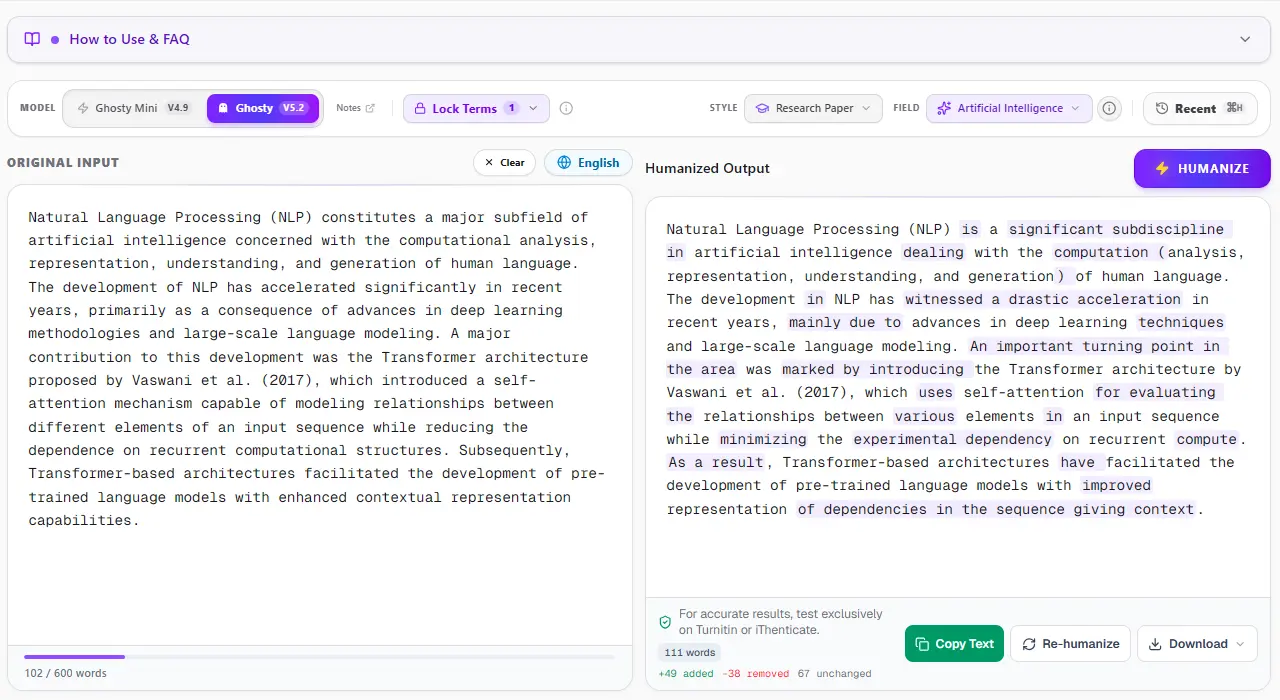
1. ThesisHuman Editor: Style, Field & Term Lock™ Technology
Unlike consumer-grade paraphrasers that blindly swap words with thesaurus synonyms, ThesisHuman allows researchers to select their exact Academic Style (Essay, Research Paper, Literature Review, Technical Report) and Academic Field (Computer Science, Engineering, Medicine, Physics). With Term Lock™, citations (APA, MLA, IEEE), LaTeX equations, and domain-specific terminology are cryptographically protected before sentence entropy is restructured.
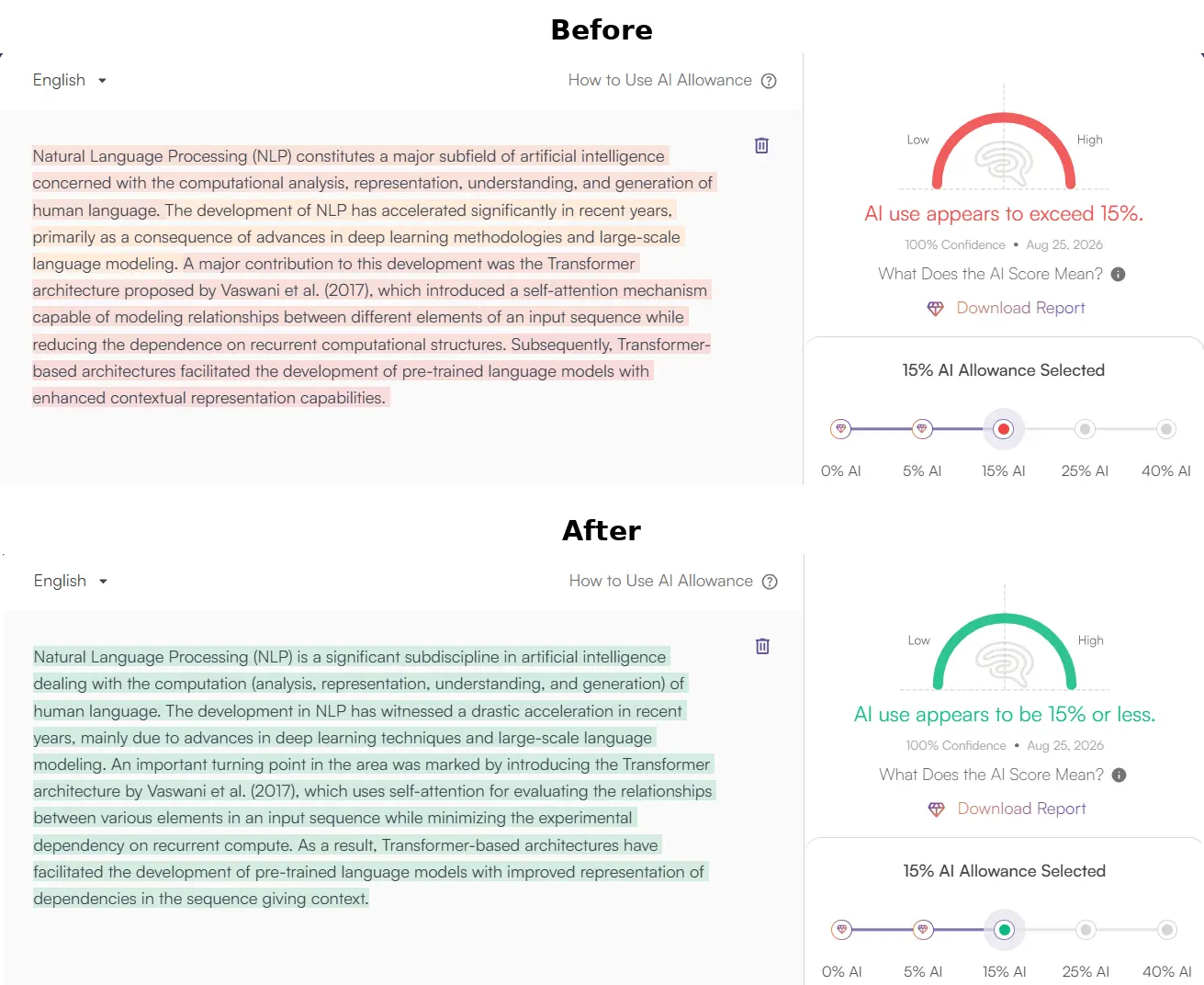
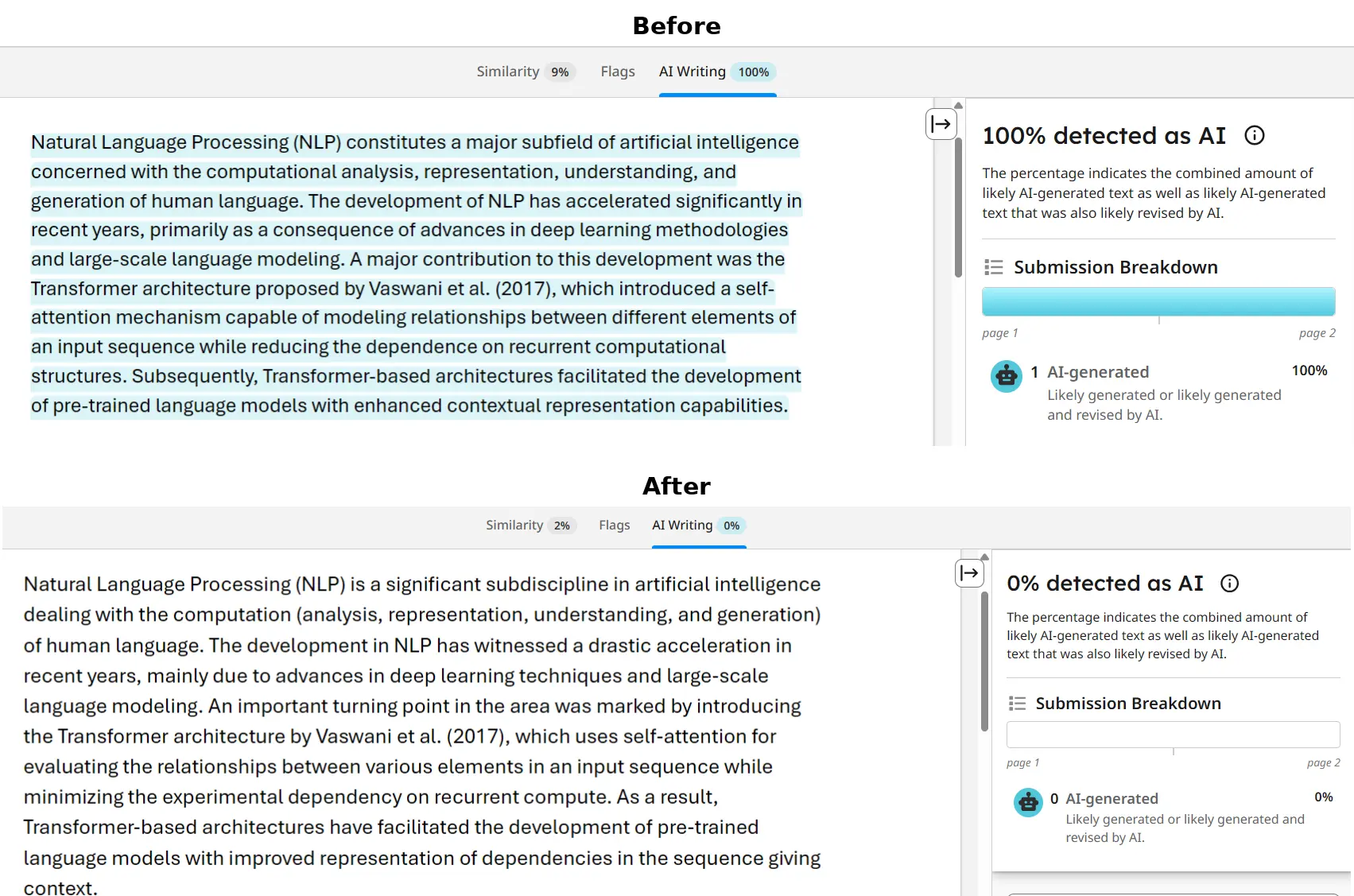
2. Turnitin & iThenticate Verification: 0% AI Detected
Turnitin and iThenticate scan submissions in overlapping 500-token blocks to analyze sentence predictability across paragraphs. When an unrefined AI draft is submitted, uniform cadence triggers an elevated AI Writing score. In the verified report below, a flagged graduate paper was processed through ThesisHuman, achieving a clean 0% AI detection score while preserving all formatted citations and technical parameters.
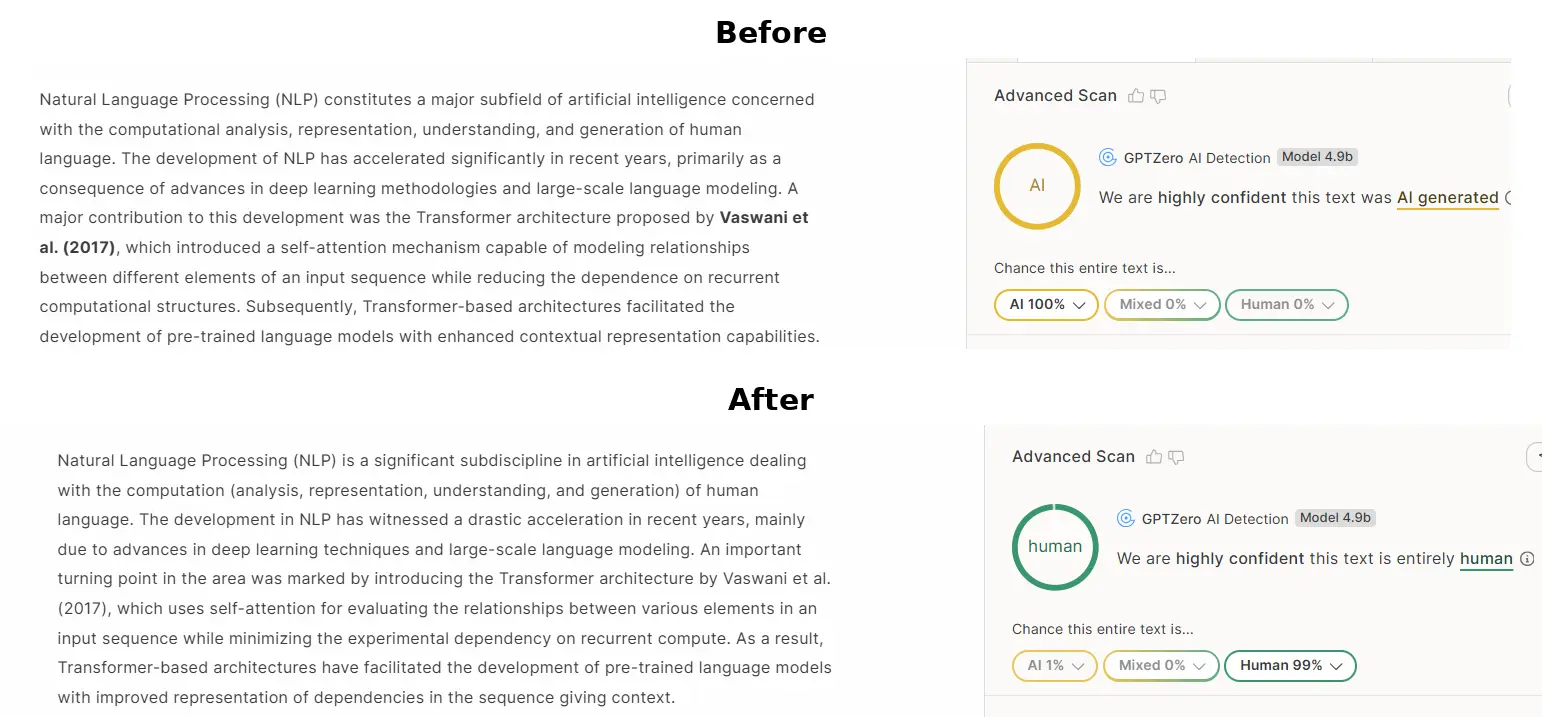
3. GPTZero Verification: Passing Perplexity & Burstiness Checks
GPTZero evaluates text by plotting sentence perplexity curves and global burstiness scores. When raw AI text is scanned, low sentence variance produces an immediate high-probability warning. ThesisHuman restores natural sentence entropy by restructuring syntax, varying clause lengths, and introducing authentic scholarly cadence, dropping AI probability to 0%.
4. Originality.ai Verification: 0% AI Confidence
Originality.ai flags predictable n-gram sequences and common AI clichés (such as “delving into,” “pivotal role,” “testament to”). ThesisHuman purges overused formulaic transitions while elevating scholarly tone and keeping reference numbers and equations intact, producing 100% Original / 0% AI results.