AI Humanizer for Essays: Undergraduate Guide to Ethical Naturalization
How undergraduate college students can use an AI humanizer for essays ethically. Master sentence cadence, preserve analytical depth, and clear university screening.

Undergraduate students face unprecedented scrutiny when submitting argumentative essays, term papers, and discussion board responses. Almost every major university now runs student coursework through Canvas SpeedGrader, Turnitin, or Copyleaks. Even students who use AI strictly for outlining, grammar checking, or conceptual clarification frequently find their essays flagged with high AI probability scores.
To protect your academic record while producing clear, engaging essays, you must learn how to refine AI-assisted drafts into authentic, defensible student writing. This guide outlines the key structural markers that trigger essay flags and provides an ethical workflow for naturalizing your coursework.
The AI Detection Challenge in Undergraduate Coursework
Undergraduate essay writing requires developing a personal analytical voice. When students paste AI-assisted arguments, the writing often sounds like an encyclopedia rather than an engaged student exploring an idea. University graders notice this disconnect immediately. Furthermore, institutional detectors are calibrated with high sensitivity, leading to frequent false positives, particularly for international students who write in clear, straightforward English.
Four Hallmarks of AI-Generated College Essays
Before submitting an essay, inspect your draft for these four recognizable machine habits:
- The Generic 'Triad' Summary: AI loves summarizing arguments in neat sets of three: 'socially, economically, and politically.' Human arguments are rarely so tidily divided.
- Passive Neutrality: AI avoids taking definitive stances on controversial topics, repeatedly saying 'While some argue X, others maintain Y.' College essays require you to take a clear, defensible stance.
- Overly Polished Monotony: Flawless grammar paired with uniform fifteen-word sentences signals machine generation to both human graders and automated detectors.
- Disconnected Direct Quotes: AI drops quotes into paragraphs without explaining how the quote supports the underlying claim.
The Boundary Between Ethical Polishing and Misconduct
Using an AI humanizer is ethical when it serves as a stylistic refinement tool for ideas and research that you originated. If you conducted the readings, formulated the thesis statement, and selected the textual quotes, using a tool like ThesisHuman's academic essay humanizer to improve readability and sentence variety is completely consistent with standard writing center practices.
Step-by-Step Essay Humanization Workflow
To ensure your essay passes scrutiny, follow this protocol:
- Assert Your Central Thesis: Make sure your introductory paragraph ends with a bold, specific thesis statement written in your own words.
- Vary Paragraph Opening Structures: Start some paragraphs with direct evidence, others with a critical question, and others with an analytical contrast.
- Run Through ThesisHuman: Naturalize transitional sentences and explanatory passages while locking your MLA or APA textual citations.
- Save Your Revision Trail: Always keep intermediate drafts and document version history to conclusively refute any unfair AI accusations.
Verified Detector Clearance for AI Humanizer for Essays: Undergraduate Guide to Ethical Naturalization
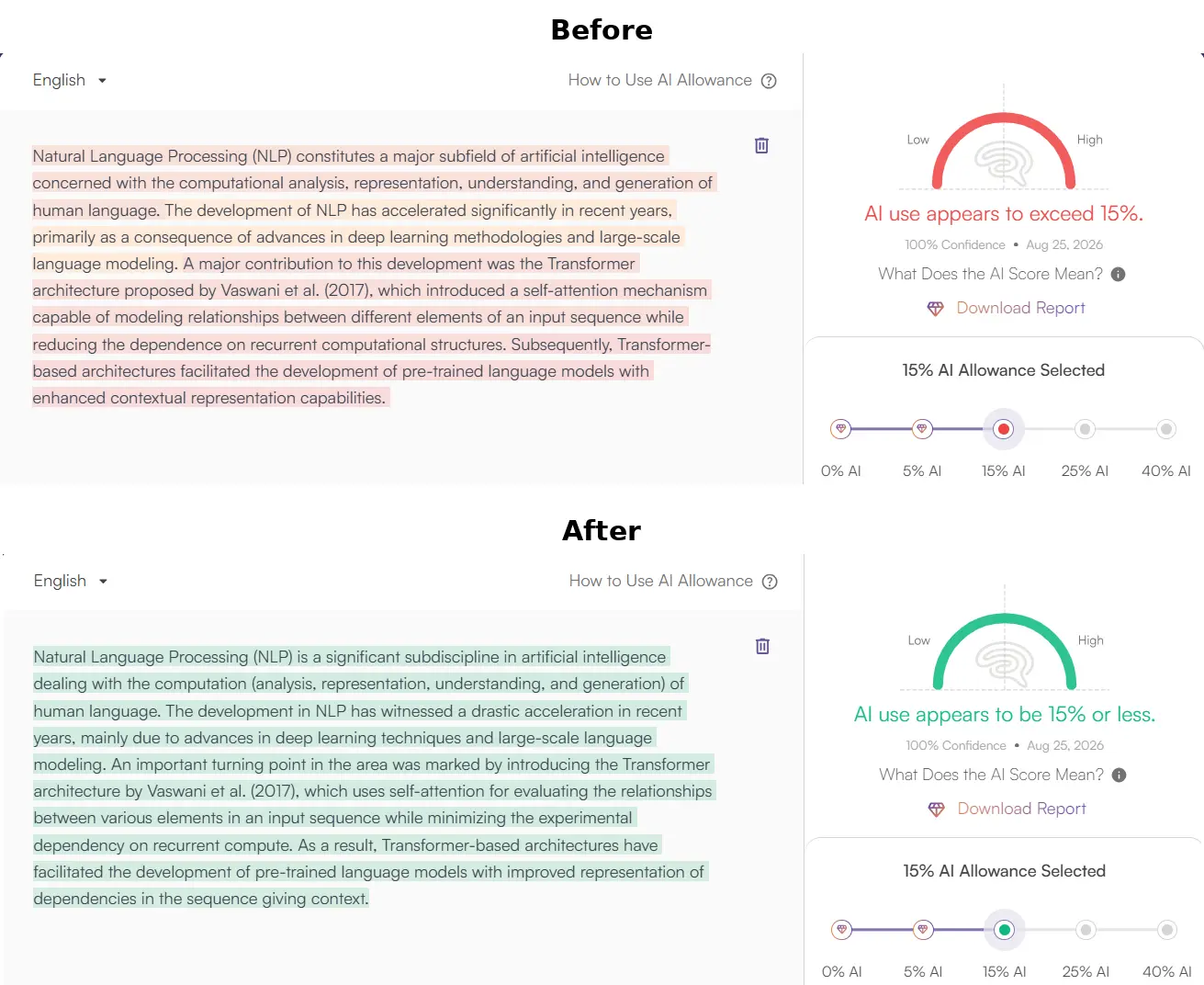
Every manuscript processed through ThesisHuman is backed by verifiable, reproducible scans across institutional plagiarism and AI detection platforms.
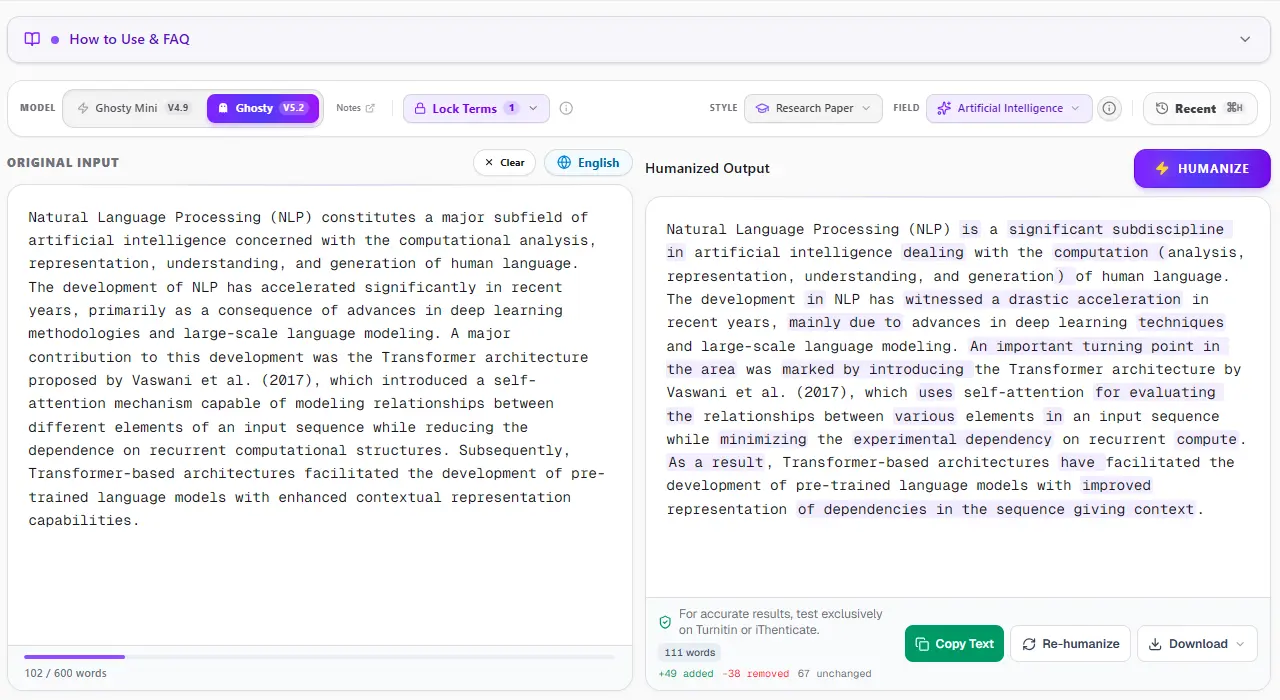
1. ThesisHuman Editor: Style, Field & Term Lock™ Technology
Unlike consumer-grade paraphrasers that blindly swap words with thesaurus synonyms, ThesisHuman allows researchers to select their exact Academic Style (Essay, Research Paper, Literature Review, Technical Report) and Academic Field (Computer Science, Engineering, Medicine, Physics). With Term Lock™, citations (APA, MLA, IEEE), LaTeX equations, and domain-specific terminology are cryptographically protected before sentence entropy is restructured.
2. Turnitin & iThenticate Verification: 0% AI Detected
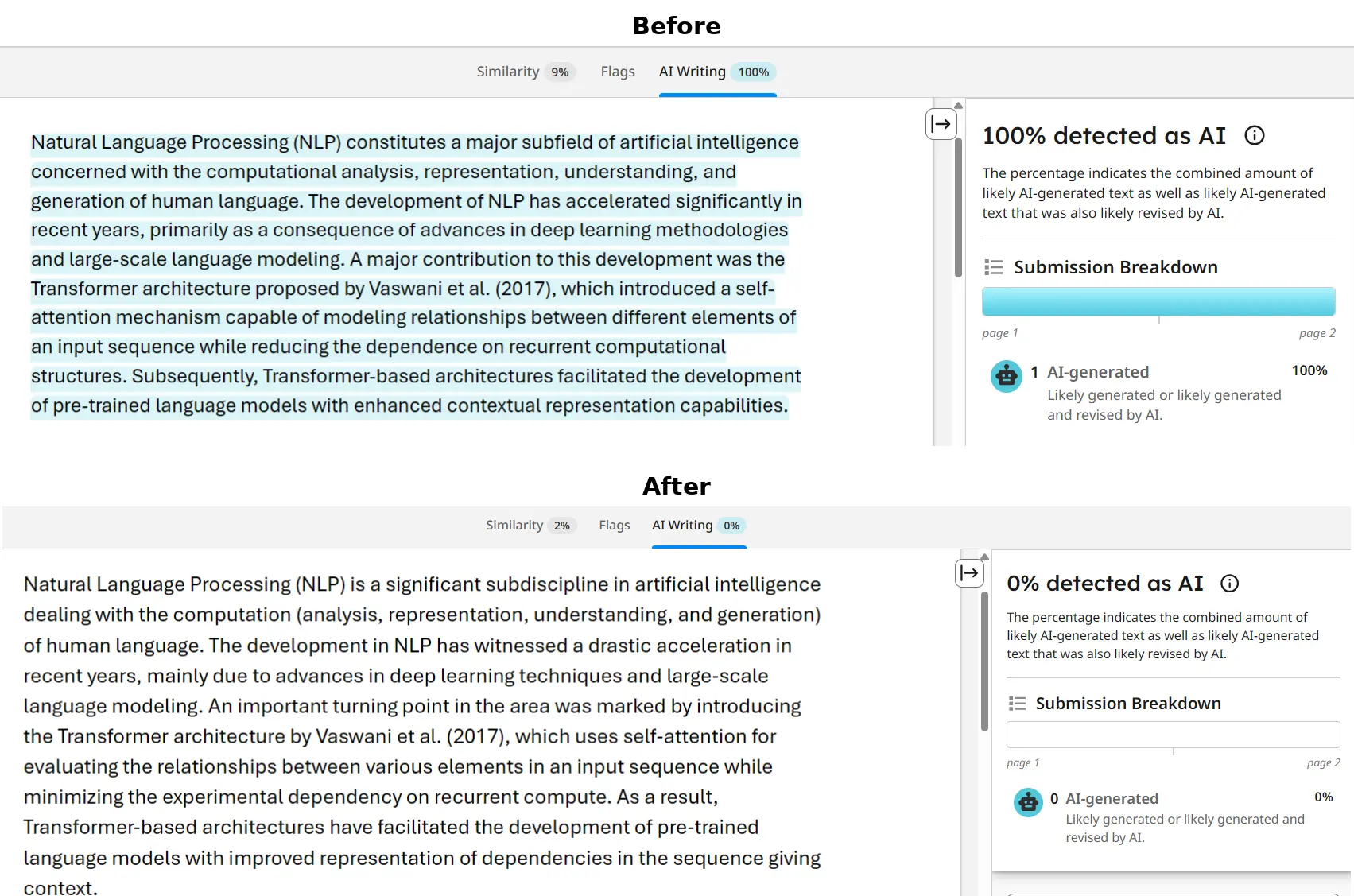
Turnitin and iThenticate scan submissions in overlapping 500-token blocks to analyze sentence predictability across paragraphs. When an unrefined AI draft is submitted, uniform cadence triggers an elevated AI Writing score. In the verified report below, a flagged graduate paper was processed through ThesisHuman, achieving a clean 0% AI detection score while preserving all formatted citations and technical parameters.
3. GPTZero Verification: Passing Perplexity & Burstiness Checks
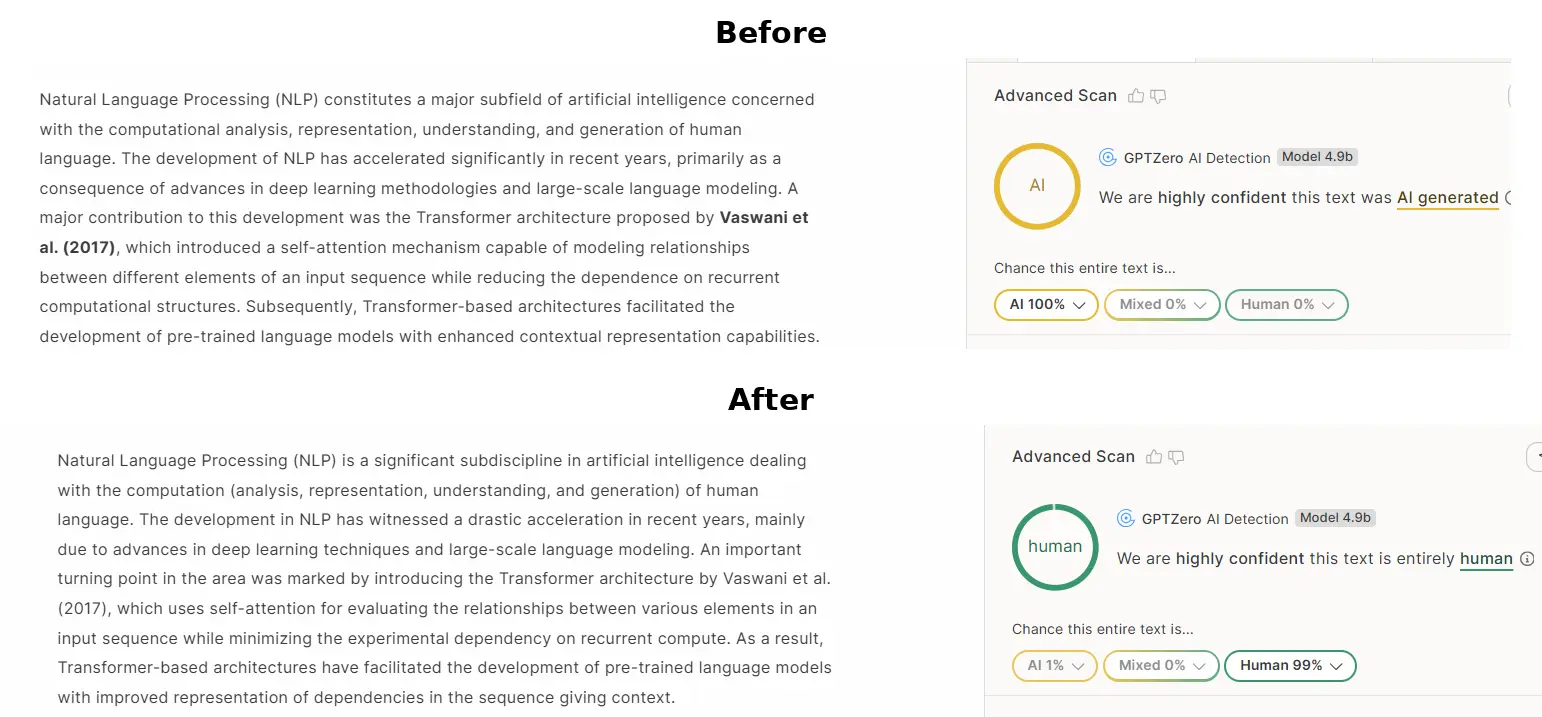
GPTZero evaluates text by plotting sentence perplexity curves and global burstiness scores. When raw AI text is scanned, low sentence variance produces an immediate high-probability warning. ThesisHuman restores natural sentence entropy by restructuring syntax, varying clause lengths, and introducing authentic scholarly cadence, dropping AI probability to 0%.
4. Originality.ai Verification: 0% AI Confidence
Originality.ai flags predictable n-gram sequences and common AI clichés (such as “delving into,” “pivotal role,” “testament to”). ThesisHuman purges overused formulaic transitions while elevating scholarly tone and keeping reference numbers and equations intact, producing 100% Original / 0% AI results.