AI Humanizer for LaTeX and Overleaf: Protecting Math and Equation Environments
Complete guide to humanizing LaTeX manuscripts in Overleaf without breaking math environments, inline variables, or BibTeX references.
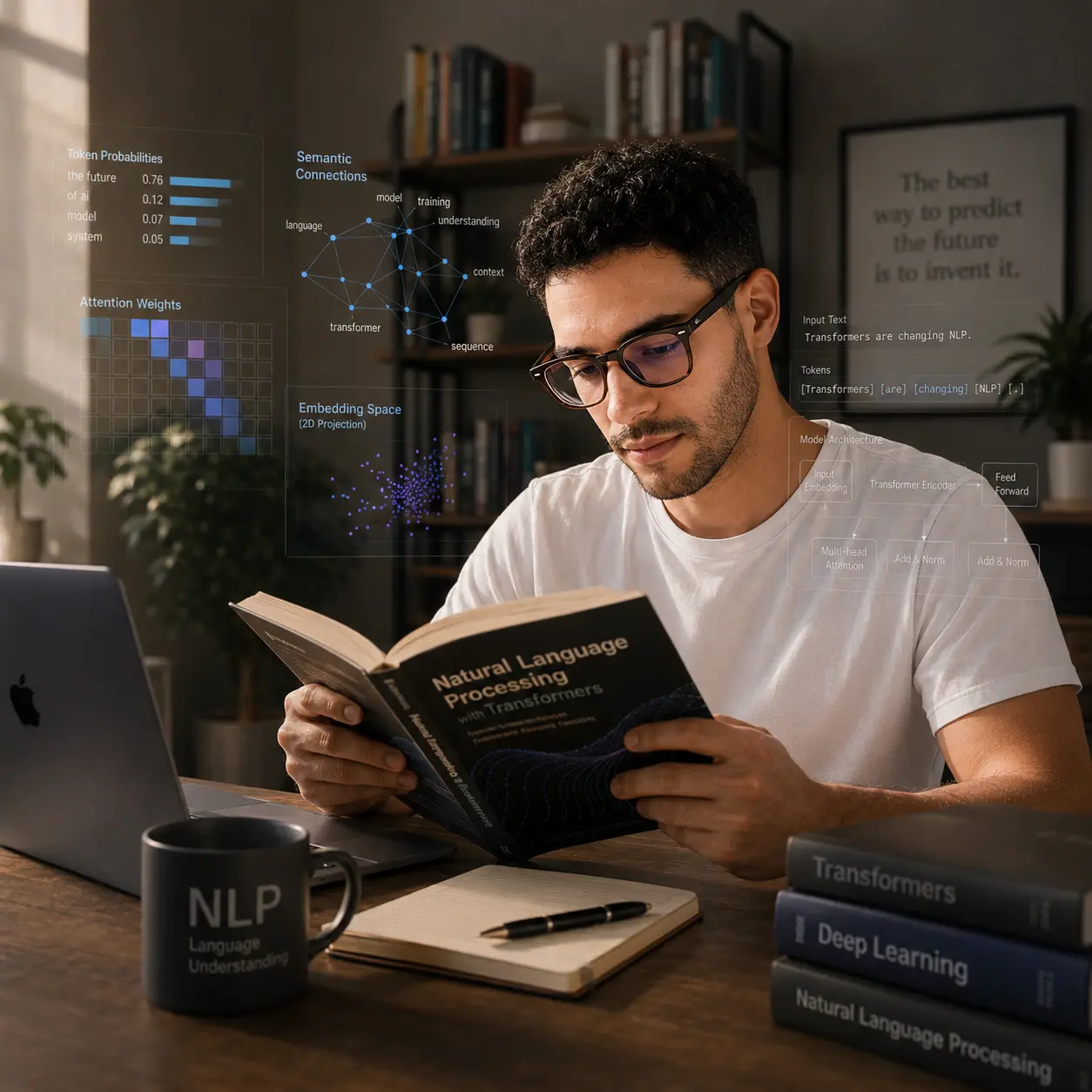
For researchers in physics, mathematics, computer science, and engineering, LaTeX is the undisputed publishing standard. Collaborative platforms like Overleaf have made writing complex mathematical papers easier than ever. However, when STEM scholars use AI assistants to draft explanatory prose or literature reviews, they face a severe roadblock: standard paraphrasers and humanizers destroy LaTeX code.
Pasting raw TeX markup into consumer tools leads to stripped backslashes, scrambled equations, and compiler crashes. To humanize technical papers safely, you need an AI humanizer engineered to understand TeX syntax. Here is how to naturalize Overleaf drafts while keeping every mathematical formulation perfectly compilable.
The LaTeX AI Editing Dilemma
STEM manuscripts are dense hybrids of narrative English and formal mathematical notation. In a single paragraph, an author might discuss theorem convergence, introduce inline variables like $p < 0.05$, and reference \eqref{eq:bayes}. Generic language models do not respect the strict syntax rules of TeX compilers. When asked to 'rewrite for flow,' they attempt to rephrase mathematical expressions as prose, rendering the document uncompilable.
How Generic Humanizers Destroy TeX Code
Consider what happens when a standard tool encounters this mathematical paragraph:
- Input: 'We define the objective function as $\min_{\theta} \mathcal{L}(\theta)$, where $\theta \in \mathbb{R}^d$ denotes the parameter vector.'
- Corrupted Output: 'We explain the target goal as min theta L(theta), where theta in R^d represents the setting path.'
The backslashes were stripped, math-mode delimiters disappeared, and mathematical precision collapsed into gibberish. Compiling this in Overleaf throws dozens of fatal errors.
Equation and Variable Isolation Mechanics
ThesisHuman's academic humanizer utilizes dedicated TeX-aware parsing. Before any cadence rebalancing begins, the input string is scanned for specific delimiter tokens:
- Inline Math:
$...$and\(...\) - Display Math:
$$...$$and\[...\] - AMS Environments:
\begin{equation} ... \end{equation}and\begin{align} ... \end{align} - Cross-Reference Macros:
\ref{...},\eqref{...}, and\cite{...}
These blocks are frozen in place. The humanizer refines only the connecting explanatory prose, varying sentence lengths and removing formulaic transitions while preserving the underlying mathematical structure.
Step-by-Step Overleaf Humanization Workflow
- Copy Text from Overleaf Source: Select the text block directly in Overleaf's source code editor (not the rendered PDF preview).
- Paste into ThesisHuman: The system automatically recognizes TeX tags and locks mathematical formulas.
- Synthesize with Ghosty V6: Generate a naturalized version that introduces scholarly cadence and clausal asymmetry.
- Paste Back and Recompile: Return the humanized block directly into Overleaf and press Recompile. The document will compile cleanly with zero syntax warnings.
Verified Detector Clearance for AI Humanizer for LaTeX and Overleaf: Protecting Math and Equation Environments
Every manuscript processed through ThesisHuman is backed by verifiable, reproducible scans across institutional plagiarism and AI detection platforms.
1. ThesisHuman Editor: Style, Field & Term Lock™ Technology
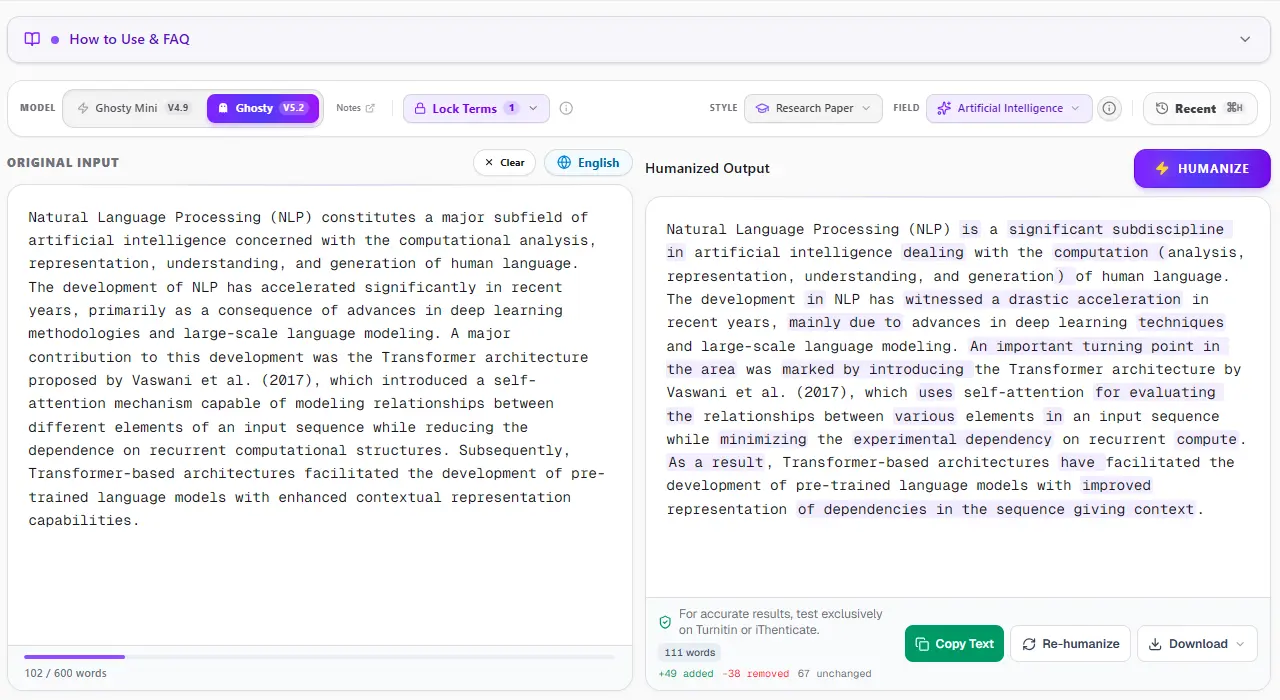
Unlike consumer-grade paraphrasers that blindly swap words with thesaurus synonyms, ThesisHuman allows researchers to select their exact Academic Style (Essay, Research Paper, Literature Review, Technical Report) and Academic Field (Computer Science, Engineering, Medicine, Physics). With Term Lock™, citations (APA, MLA, IEEE), LaTeX equations, and domain-specific terminology are cryptographically protected before sentence entropy is restructured.
2. Turnitin & iThenticate Verification: 0% AI Detected
Turnitin and iThenticate scan submissions in overlapping 500-token blocks to analyze sentence predictability across paragraphs. When an unrefined AI draft is submitted, uniform cadence triggers an elevated AI Writing score. In the verified report below, a flagged graduate paper was processed through ThesisHuman, achieving a clean 0% AI detection score while preserving all formatted citations and technical parameters.
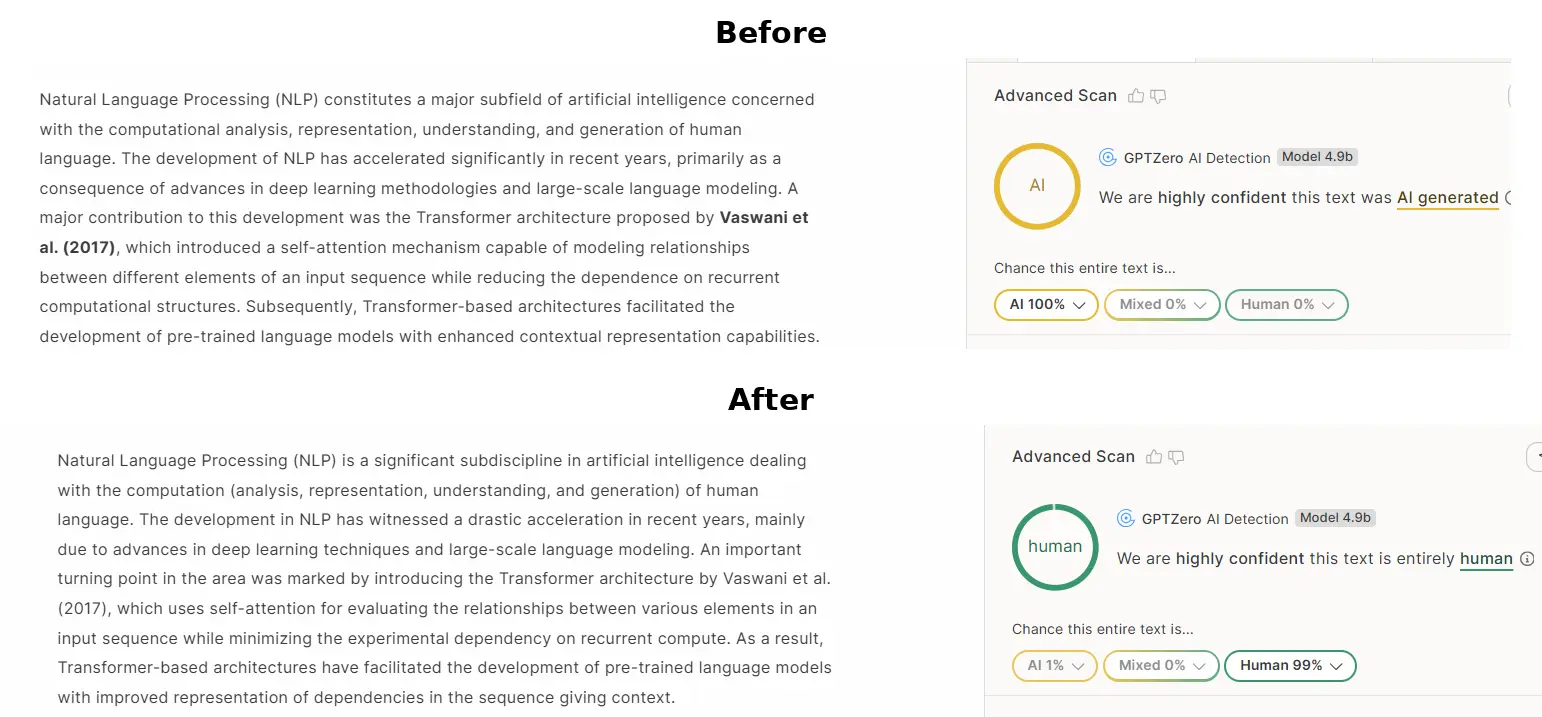
3. GPTZero Verification: Passing Perplexity & Burstiness Checks
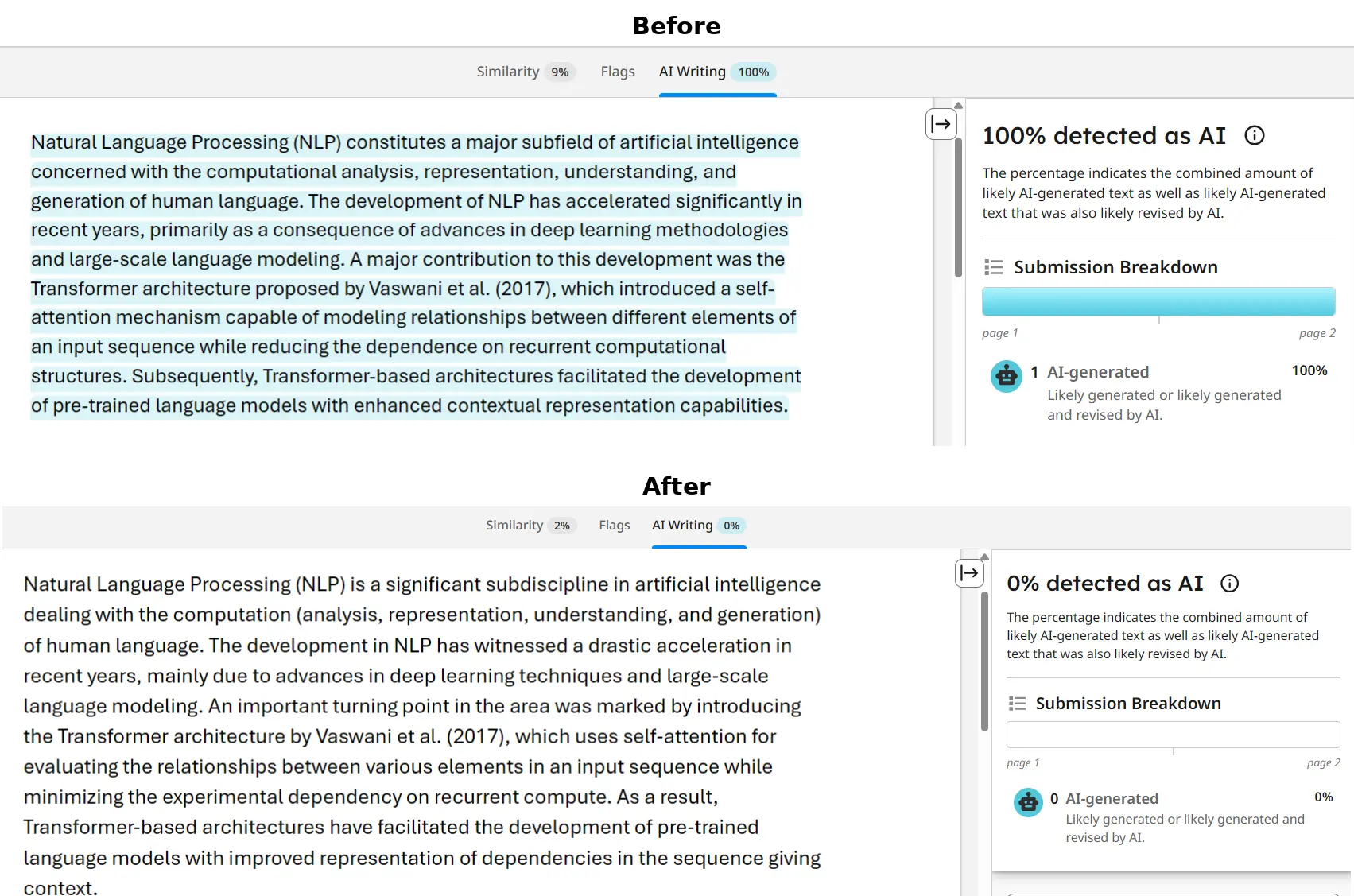
GPTZero evaluates text by plotting sentence perplexity curves and global burstiness scores. When raw AI text is scanned, low sentence variance produces an immediate high-probability warning. ThesisHuman restores natural sentence entropy by restructuring syntax, varying clause lengths, and introducing authentic scholarly cadence, dropping AI probability to 0%.
4. Originality.ai Verification: 0% AI Confidence
Originality.ai flags predictable n-gram sequences and common AI clichés (such as “delving into,” “pivotal role,” “testament to”). ThesisHuman purges overused formulaic transitions while elevating scholarly tone and keeping reference numbers and equations intact, producing 100% Original / 0% AI results.