AI Humanizer for Medical Manuscripts: Upholding ICMJE Ethics and Clinical Accuracy
Navigating ICMJE guidelines and automated screening in medical publishing. How to refine clinical trial and case study manuscripts safely.

Medical publishing carries the highest ethical stakes in academia. A poorly reported trial, an inaccurate drug dosage, or a misrepresented confidence interval can directly compromise clinical practice and patient care. Leading medical journals, including The Lancet, NEJM, and JAMA, adhere strictly to standards formulated by the International Committee of Medical Journal Editors (ICMJE).
Medical researchers frequently utilize generative AI to assist with translating complex clinical trial results into fluent academic English. However, medical manuscripts face intense screening by managing editors. Here is how clinical authors can humanize medical manuscripts while maintaining strict adherence to ICMJE ethics and scientific accuracy.
ICMJE Guidelines on Artificial Intelligence in Medical Journals
The ICMJE updated its guidance to establish clear author responsibilities regarding generative models. Key principles include:
- AI technologies cannot be listed as authors because they cannot take legal or ethical responsibility for the work.
- Authors must explicitly declare the use of AI technologies in the paper's methodology or acknowledgments.
- Authors must verify that source data, clinical citations, and statistical inferences are accurate and free from bias or hallucination.
The Zero-Tolerance Stakes of Clinical Accuracy
In medical manuscripts, subtle word alterations introduce catastrophic errors. Changing 'adverse event occurred in 4% of participants' to 'side effects were exceptionally rare' alters clinical risk assessment. Generic paraphrasers frequently commit these interpretive errors. Medical authors must use software that reliably preserves clinical outcomes without unintended semantic modification.
Shielding CONSORT, STROBE, and Dosage Terminology
Clinical manuscripts adhere to structured reporting guidelines such as CONSORT (for randomized trials) and STROBE (for observational studies). ThesisHuman's clinical humanizer allows researchers to lock specific trial identifiers (e.g., ClinicalTrials.gov NCT numbers), baseline demographic figures, and pharmacological units before synthesis.
A 4-Step Clinical Manuscript Humanization Workflow
- Lock All Clinical Parameters: Freeze drug dosages, titration schedules, inclusion cutoffs, and statistical hazard ratios.
- Rebalance Narrative Cadence: Humanize the introduction and discussion sections, replacing generic AI hedging with clear clinical reasoning.
- Maintain Confidentiality: Ensure patient data is fully de-identified before processing in ThesisHuman's ephemeral memory vault.
- Draft Transparent Disclosure: Formulate a formal ICMJE-compliant statement detailing assistive language editing tools used in manuscript preparation.
Verified Detector Clearance for AI Humanizer for Medical Manuscripts: Upholding ICMJE Ethics and Clinical Accuracy
Every manuscript processed through ThesisHuman is backed by verifiable, reproducible scans across institutional plagiarism and AI detection platforms.
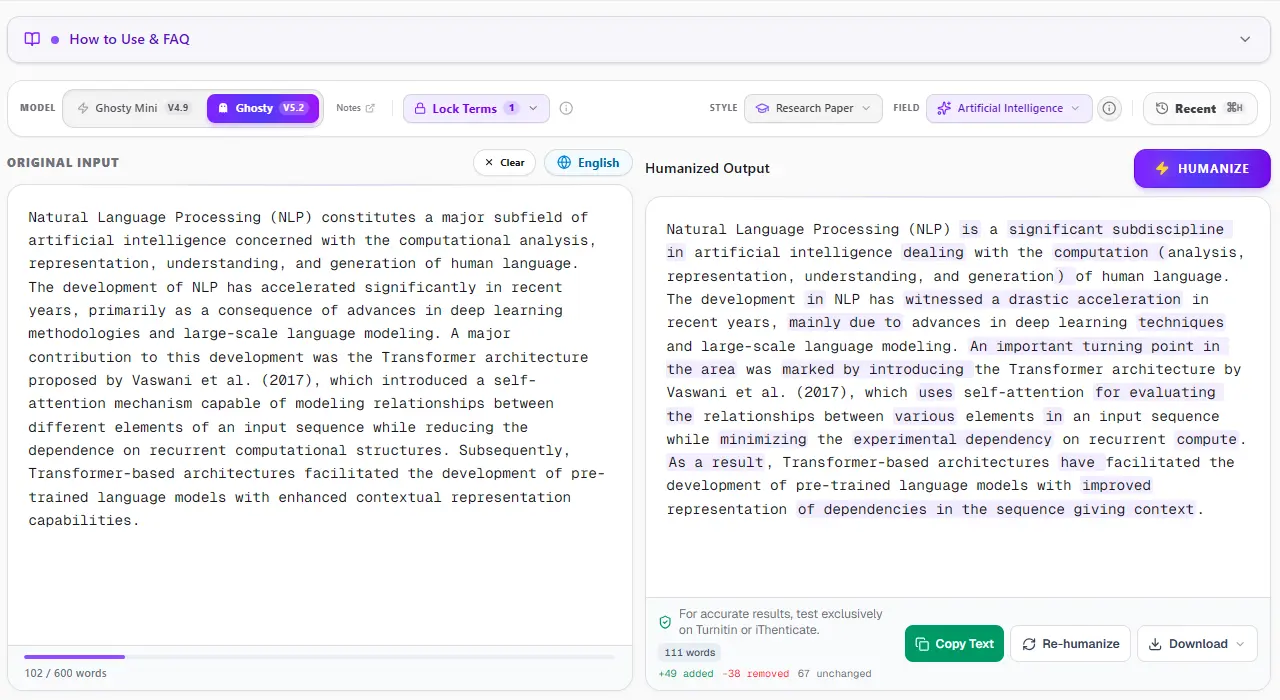
1. ThesisHuman Editor: Style, Field & Term Lock™ Technology
Unlike consumer-grade paraphrasers that blindly swap words with thesaurus synonyms, ThesisHuman allows researchers to select their exact Academic Style (Essay, Research Paper, Literature Review, Technical Report) and Academic Field (Computer Science, Engineering, Medicine, Physics). With Term Lock™, citations (APA, MLA, IEEE), LaTeX equations, and domain-specific terminology are cryptographically protected before sentence entropy is restructured.
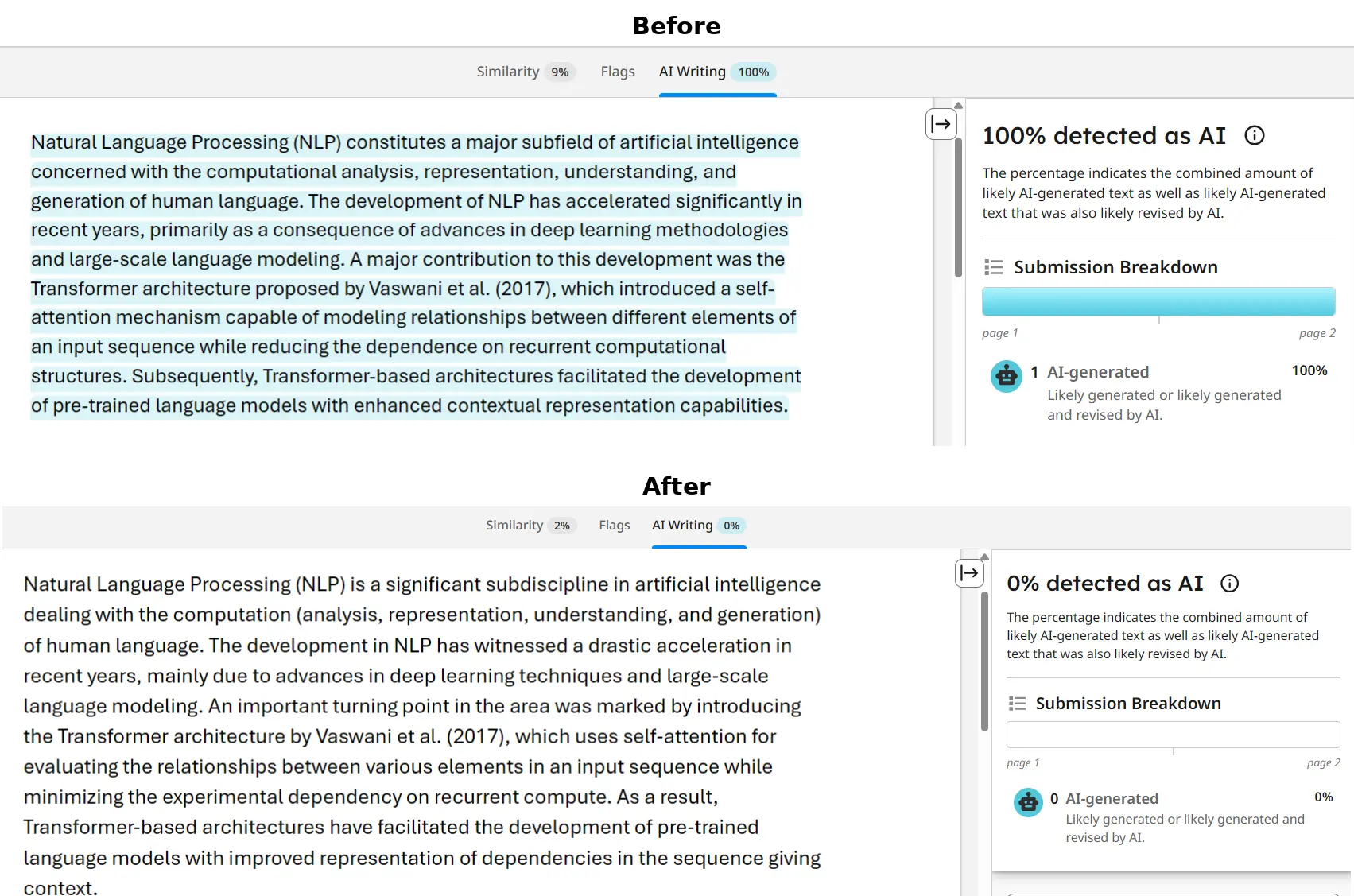
2. Turnitin & iThenticate Verification: 0% AI Detected
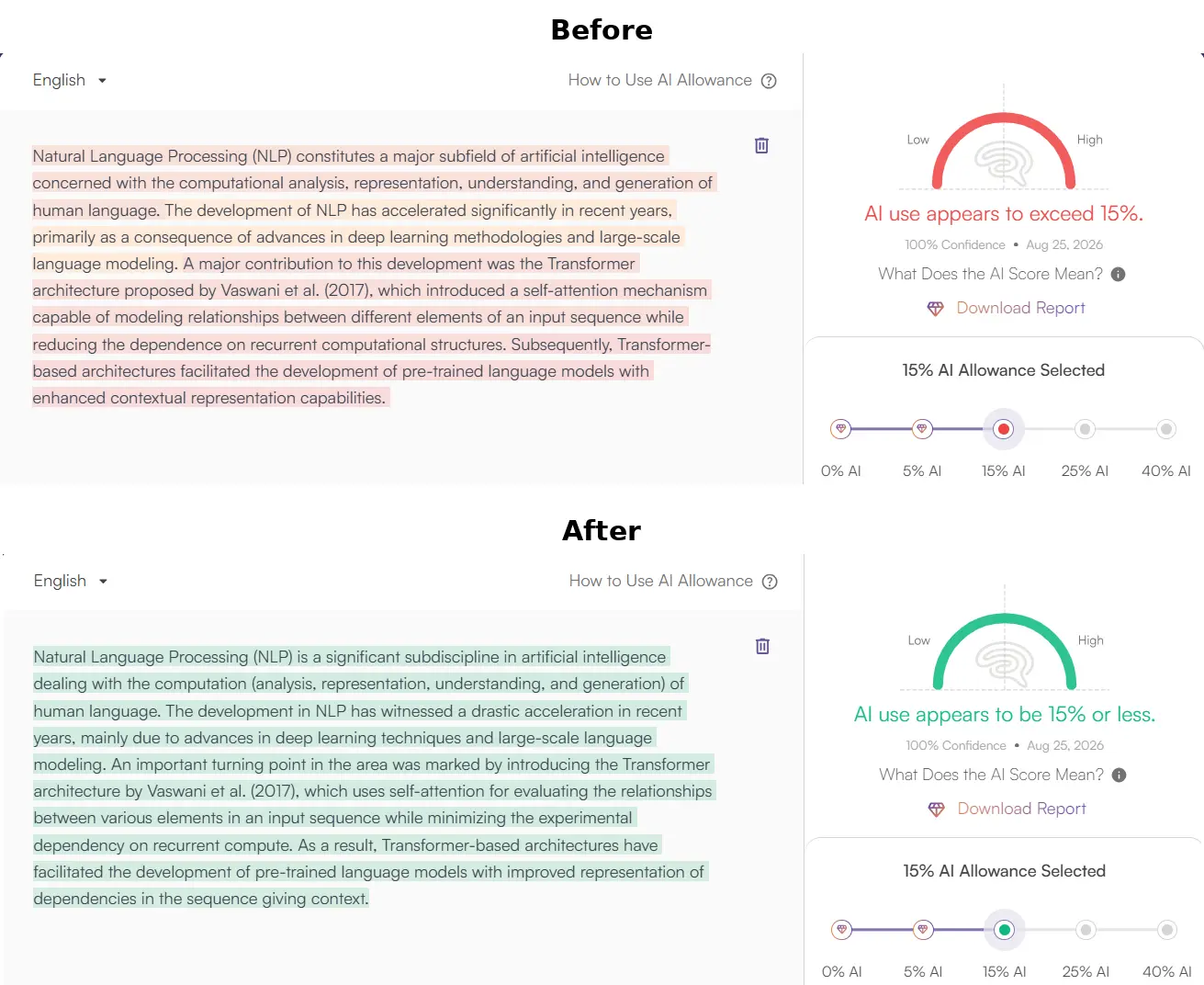
Turnitin and iThenticate scan submissions in overlapping 500-token blocks to analyze sentence predictability across paragraphs. When an unrefined AI draft is submitted, uniform cadence triggers an elevated AI Writing score. In the verified report below, a flagged graduate paper was processed through ThesisHuman, achieving a clean 0% AI detection score while preserving all formatted citations and technical parameters.
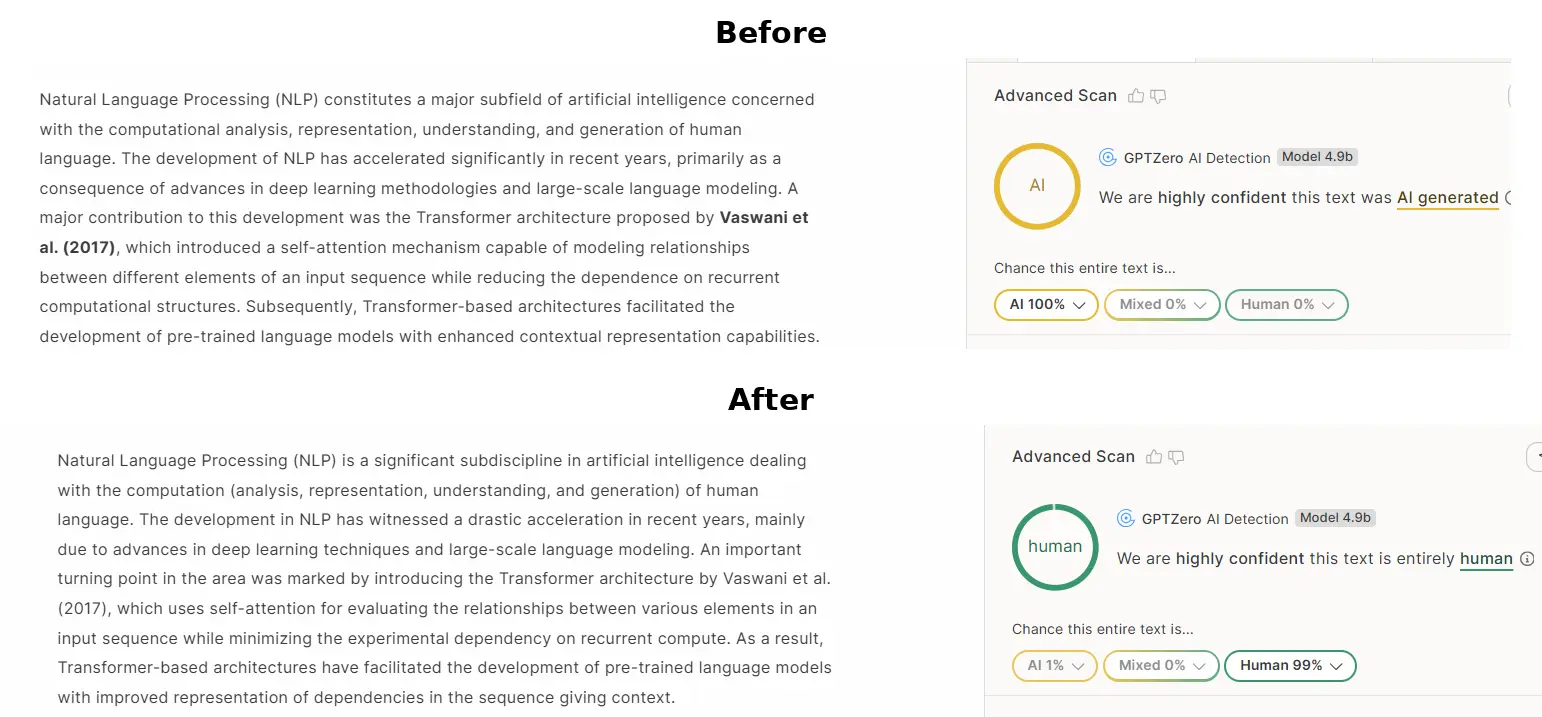
3. GPTZero Verification: Passing Perplexity & Burstiness Checks
GPTZero evaluates text by plotting sentence perplexity curves and global burstiness scores. When raw AI text is scanned, low sentence variance produces an immediate high-probability warning. ThesisHuman restores natural sentence entropy by restructuring syntax, varying clause lengths, and introducing authentic scholarly cadence, dropping AI probability to 0%.
4. Originality.ai Verification: 0% AI Confidence
Originality.ai flags predictable n-gram sequences and common AI clichés (such as “delving into,” “pivotal role,” “testament to”). ThesisHuman purges overused formulaic transitions while elevating scholarly tone and keeping reference numbers and equations intact, producing 100% Original / 0% AI results.