AI Humanizer for Scientific Writing: Protecting Numbers, Units, and P-Values
Why scientific papers require dedicated STEM humanization. How to protect quantitative data points, confidence intervals, and chemical notation from semantic distortion.

In scientific research, accuracy is non-negotiable. A claim that a drug reduced blood pressure by 14.2 mmHg with a 95% confidence interval of [11.8, 16.6] is an exact empirical finding. When researchers use generative AI to assist with manuscript drafting, they must ensure that no post-processing tool alters these numerical values.
Generic AI humanizers designed for content marketing frequently 'smooth' prose by approximating numbers or rephrasing statistical measures. In STEM publishing, this is fatal to peer review. Here is why scientific writing requires specialized quantitative safeguards and how to humanize STEM manuscripts safely.
The Imperative of Quantitative Precision in STEM
Scientific manuscripts communicate through exact data. Reviewers at journals like Nature, Science, and IEEE Transactions scrutinize statistical distributions, degrees of freedom, effect sizes, and p-values. If an automated tool rewords 'p = 0.042' to 'the p-value was roughly 0.04,' or transforms 'pH 7.4' into 'neutral biological acidity,' the scientific validity of the paper is ruined.
How Generic Spinners Distort Statistical Evidence
Standard rewriters commit three widespread data distortions:
- Unit Truncation: Converting specific units of measurement (e.g., $\mu\text{g}/\text{mL}$ or $\text{kW}\cdot\text{h}$) into colloquial approximations ('small amounts' or 'energy power').
- Statistical Rounding: Altering exact statistical figures to match general conversational tone, destroying replicability.
- Chemical Formula Corruption: Modifying subscript and superscript notations in chemical compounds (e.g., converting $\text{Fe}_2\text{O}_3$ into Fe2O3 or 'iron oxide').
Shielding Units, Confidence Intervals, and Chemical Formulas
ThesisHuman's STEM humanizer enforces strict numerical and notation boundaries. By configuring Term Lock on statistical descriptors and experimental variables, researchers ensure that every measurement, sample size ($N = 450$), and test statistic ($F(2, 48) = 14.2$) remains exactly intact.
Guidelines for Humanizing Scientific Manuscripts
- Keep Tables Separate: Never run tabular data or raw experimental outputs through text humanizers. Humanize only the accompanying analytical narrative.
- Lock Disciplinary Constants: Specify key constants (e.g., Planck's constant, Boltzmann constant, molecular weights) in your Term Lock configuration.
- Focus on Explanatory Flow: Use the humanizer to break rigid clausal cadence in your introduction, theoretical derivation, and discussion sections.
- Perform a Final Data Sanity Check: Always cross-reference humanized numerical values against your raw experimental spreadsheets before submission.
Verified Detector Clearance for AI Humanizer for Scientific Writing: Protecting Numbers, Units, and P-Values
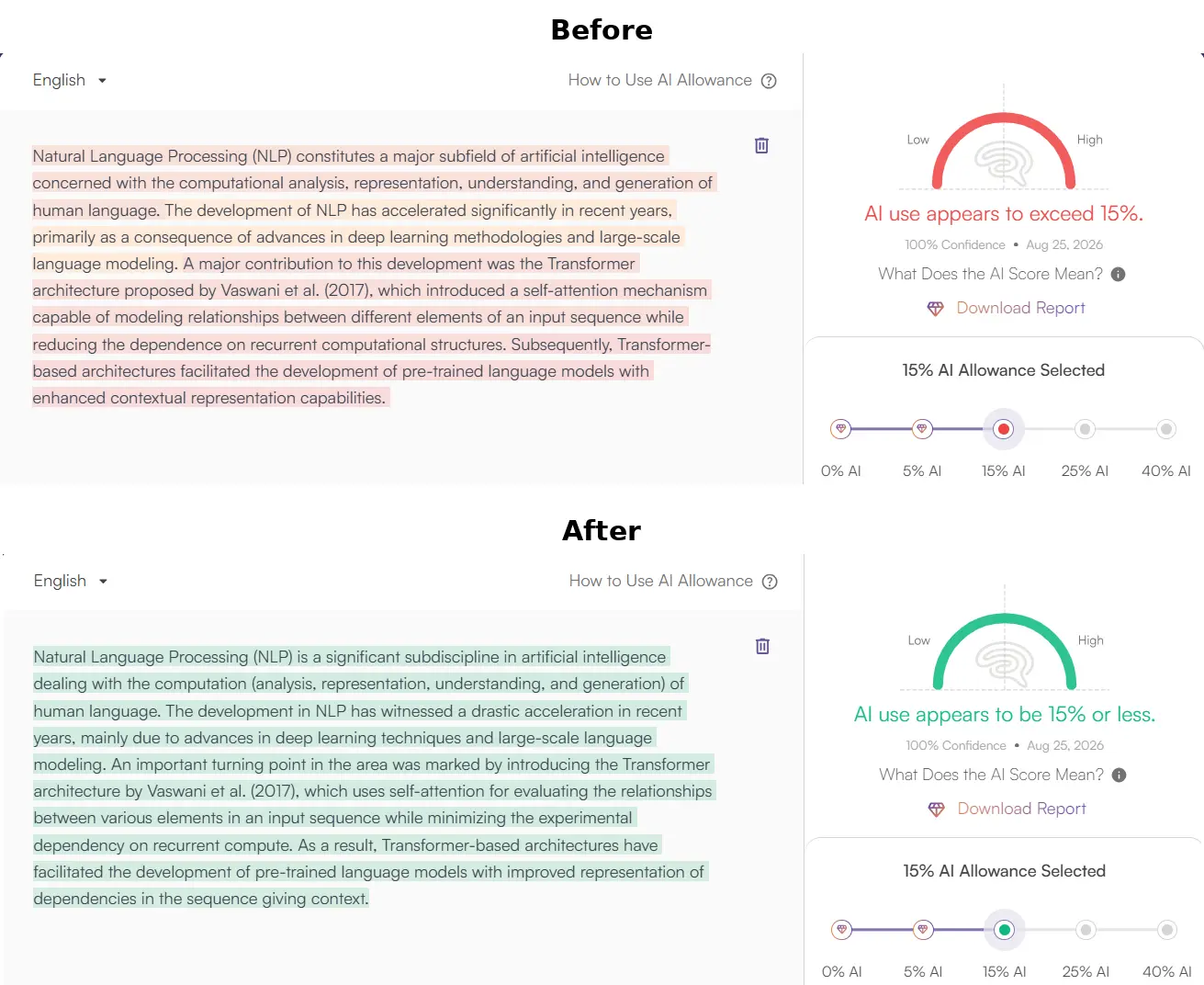
Every manuscript processed through ThesisHuman is backed by verifiable, reproducible scans across institutional plagiarism and AI detection platforms.
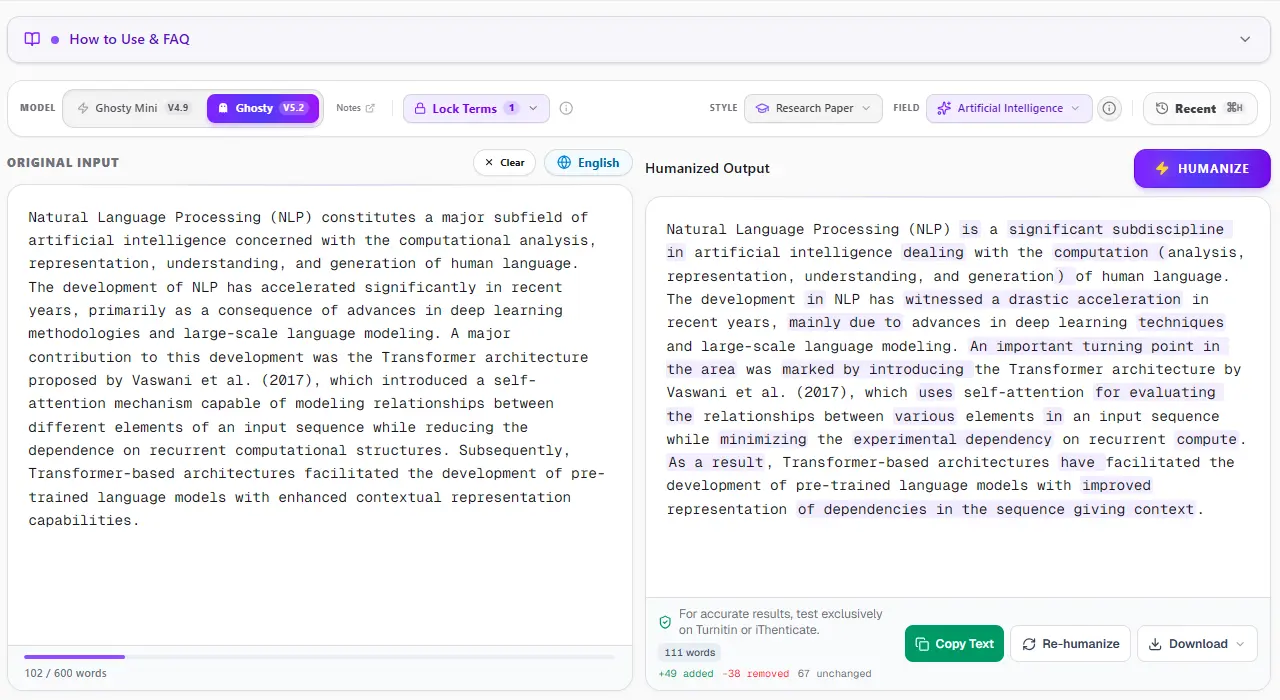
1. ThesisHuman Editor: Style, Field & Term Lock™ Technology
Unlike consumer-grade paraphrasers that blindly swap words with thesaurus synonyms, ThesisHuman allows researchers to select their exact Academic Style (Essay, Research Paper, Literature Review, Technical Report) and Academic Field (Computer Science, Engineering, Medicine, Physics). With Term Lock™, citations (APA, MLA, IEEE), LaTeX equations, and domain-specific terminology are cryptographically protected before sentence entropy is restructured.
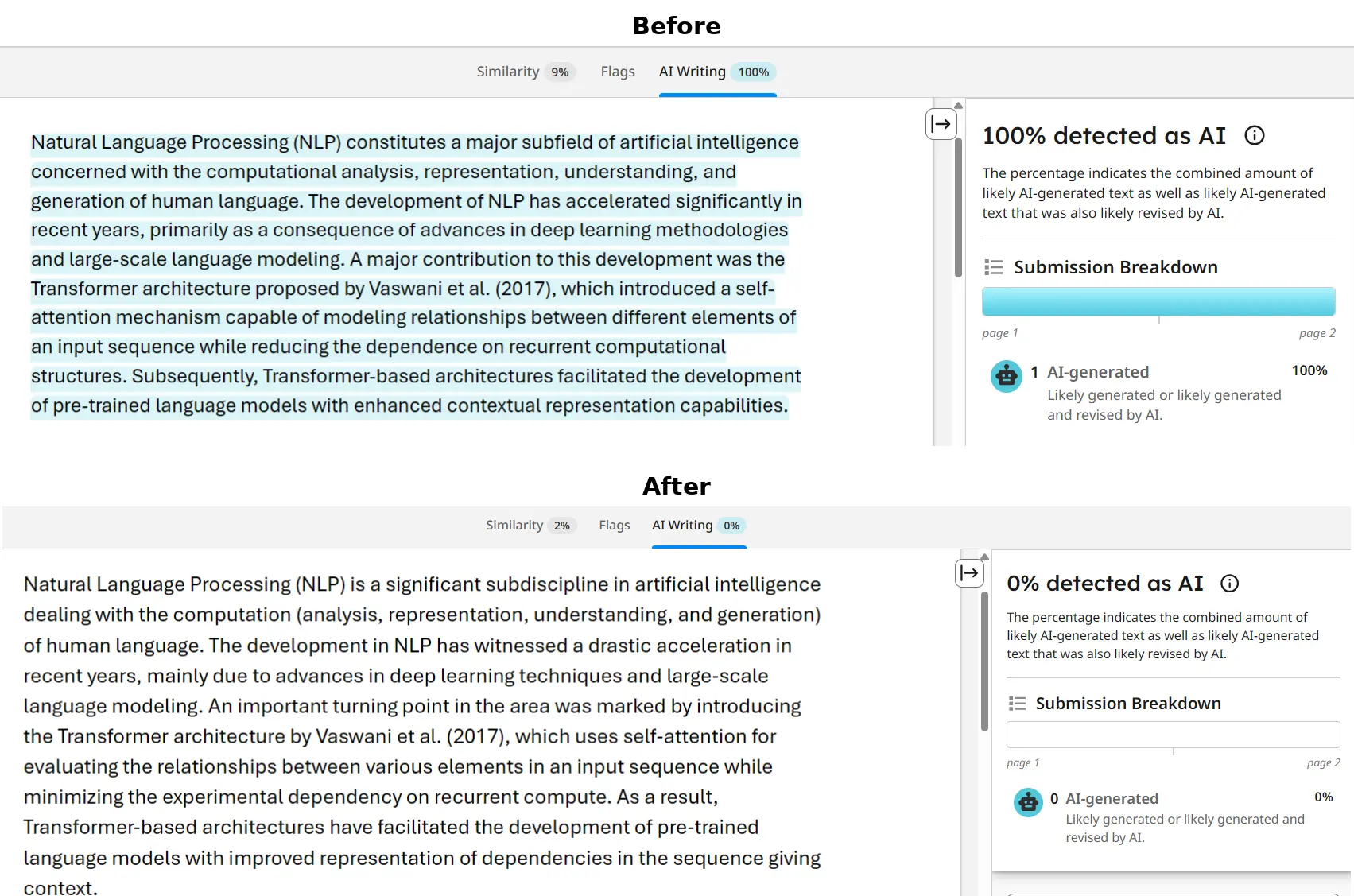
2. Turnitin & iThenticate Verification: 0% AI Detected
Turnitin and iThenticate scan submissions in overlapping 500-token blocks to analyze sentence predictability across paragraphs. When an unrefined AI draft is submitted, uniform cadence triggers an elevated AI Writing score. In the verified report below, a flagged graduate paper was processed through ThesisHuman, achieving a clean 0% AI detection score while preserving all formatted citations and technical parameters.
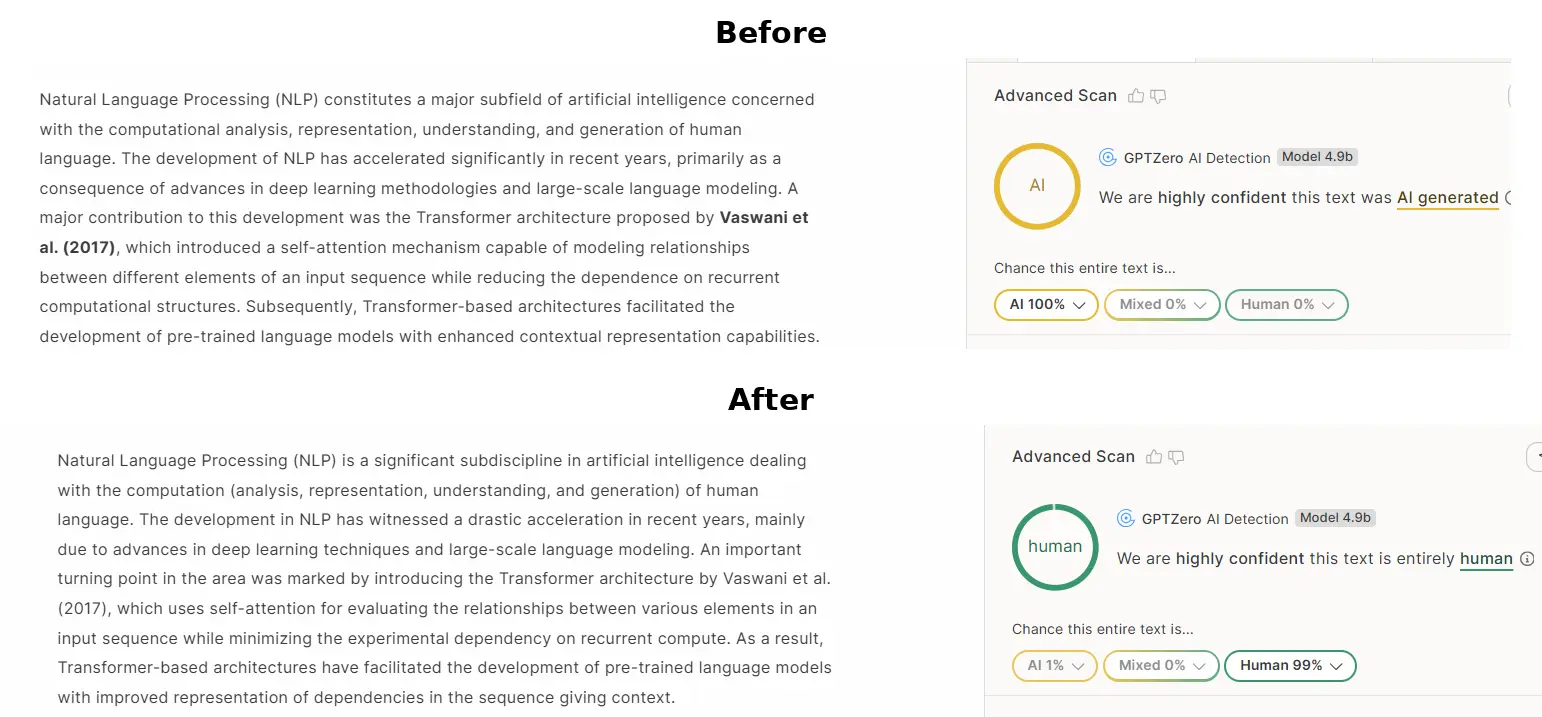
3. GPTZero Verification: Passing Perplexity & Burstiness Checks
GPTZero evaluates text by plotting sentence perplexity curves and global burstiness scores. When raw AI text is scanned, low sentence variance produces an immediate high-probability warning. ThesisHuman restores natural sentence entropy by restructuring syntax, varying clause lengths, and introducing authentic scholarly cadence, dropping AI probability to 0%.
4. Originality.ai Verification: 0% AI Confidence
Originality.ai flags predictable n-gram sequences and common AI clichés (such as “delving into,” “pivotal role,” “testament to”). ThesisHuman purges overused formulaic transitions while elevating scholarly tone and keeping reference numbers and equations intact, producing 100% Original / 0% AI results.