Best AI Humanizer for Students: Academic Integrity, Ethics, and Best Practices
How university students can navigate AI detection policies responsibly. Learn where academic honor codes draw the line between legitimate editing and misconduct.

University campuses in 2026 operate under heightened anxiety surrounding generative AI. Institutions have implemented software to screen student submissions, while academic integrity boards handle record numbers of disputed AI accusations. In this high-stakes environment, students who use AI as a legitimate drafting assistant or grammar aid often find themselves caught between wanting to write well and fearing false accusations.
Using an AI humanizer can help ensure your writing sounds natural, engaged, and authentic. However, using these tools requires understanding university honor codes and maintaining clear ethical boundaries. Here is an undergraduate and postgraduate guide to responsible AI humanization.
The University Academic Integrity Landscape in 2026
Most universities have updated their academic honor codes to address generative models. While policies range from outright bans to open integration, a broad consensus has emerged: students are evaluated on their critical thinking, analytical reasoning, and empirical synthesis. If an AI generates your core arguments and conclusions, that constitutes academic dishonesty. If AI helps format outlines, clarify sentence structures, or brainstorm perspectives that you subsequently research and verify, it falls under permitted assistive technology.
The Spectrum: From Ethical Editing to Academic Dishonesty
| Practice | Integrity Status | Rationale |
|---|---|---|
| Generating entire essay from prompt | Misconduct | Zero student critical engagement or empirical effort |
| Using AI for ideation, writing own draft | Permitted | Student formulates arguments, claims, and citations |
| Humanizing clausal cadence on student draft | Permitted Editorial | Stylistic refinement analogous to writing center feedback |
| Submitting fabricated citations generated by AI | Severe Misconduct | Fabrication of academic evidence |
Building a Defensible Document Audit Trail
Because AI detection software produces probabilistic estimates rather than definitive proof, false accusations remain a reality. To protect yourself, always maintain a comprehensive audit trail:
- Continuous Version History: Write in Google Docs or Microsoft Word with version history enabled, documenting your multi-hour typing and revision process.
- Annotated Source PDFs: Save local copies of research papers with your highlighted notes and marginal comments.
- Initial Outlines and Drafts: Keep early scratchpads showing how your thesis statement evolved over time.
What Students Should Look for in an AI Humanizer
Students should avoid generic spinners that inject bizarre vocabulary. Use an academic tool like ThesisHuman's student essay humanizer, which refines clausal cadence while strictly locking cited evidence, ensuring that your essay remains your authentic intellectual work.
Verified Detector Clearance for Best AI Humanizer for Students: Academic Integrity, Ethics, and Best Practices
Every manuscript processed through ThesisHuman is backed by verifiable, reproducible scans across institutional plagiarism and AI detection platforms.
1. ThesisHuman Editor: Style, Field & Term Lock™ Technology
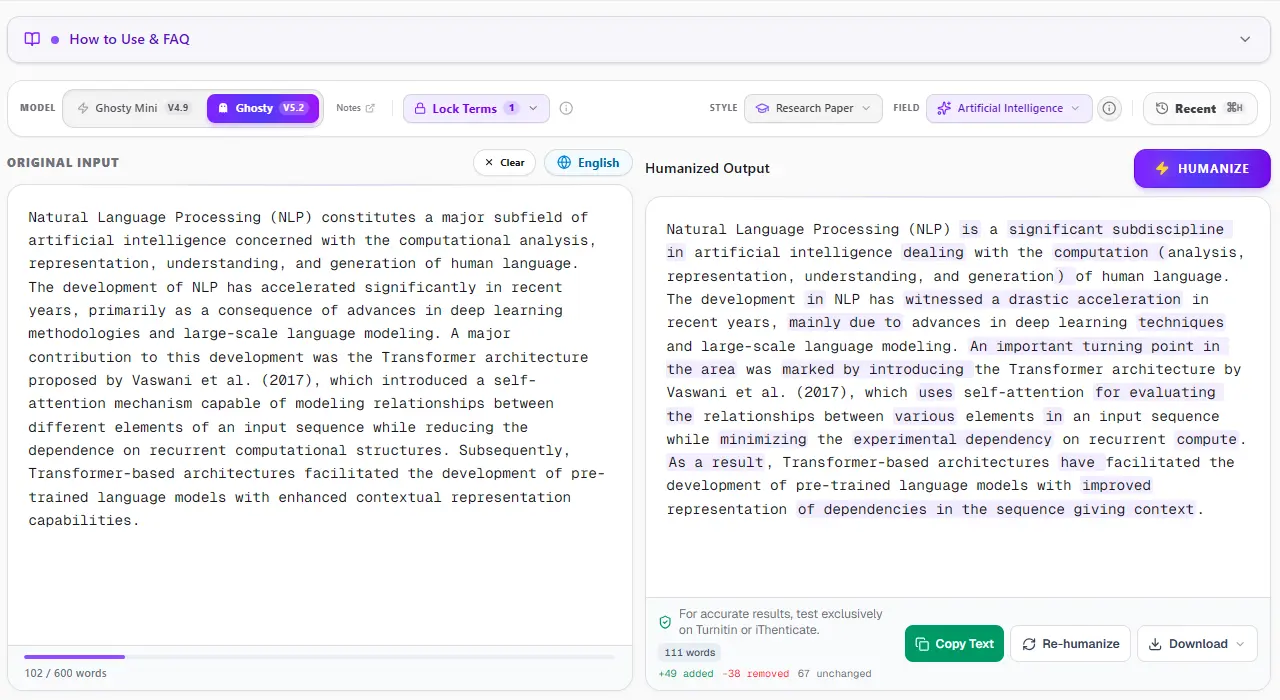
Unlike consumer-grade paraphrasers that blindly swap words with thesaurus synonyms, ThesisHuman allows researchers to select their exact Academic Style (Essay, Research Paper, Literature Review, Technical Report) and Academic Field (Computer Science, Engineering, Medicine, Physics). With Term Lock™, citations (APA, MLA, IEEE), LaTeX equations, and domain-specific terminology are cryptographically protected before sentence entropy is restructured.
2. Turnitin & iThenticate Verification: 0% AI Detected
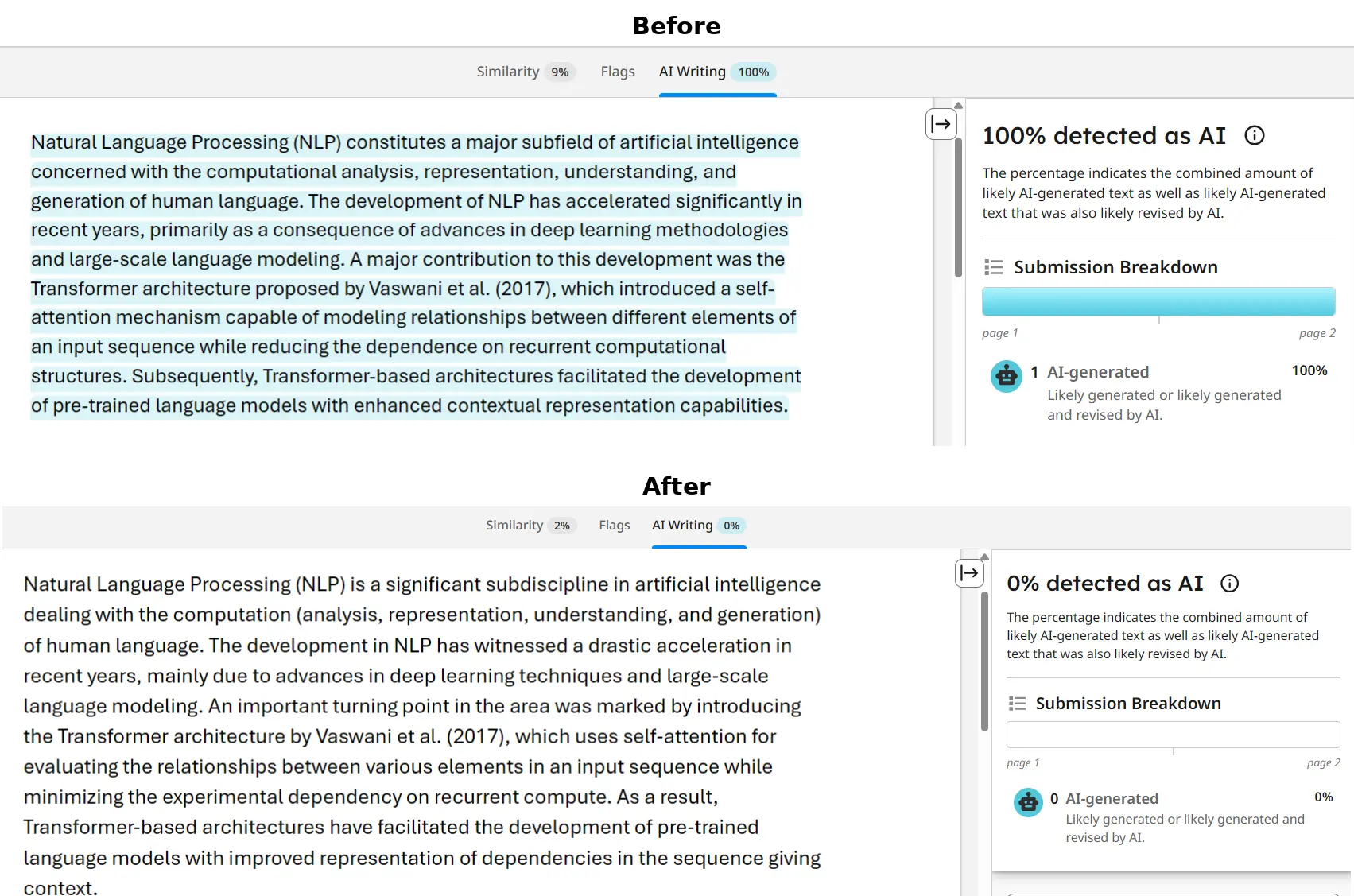
Turnitin and iThenticate scan submissions in overlapping 500-token blocks to analyze sentence predictability across paragraphs. When an unrefined AI draft is submitted, uniform cadence triggers an elevated AI Writing score. In the verified report below, a flagged graduate paper was processed through ThesisHuman, achieving a clean 0% AI detection score while preserving all formatted citations and technical parameters.
3. GPTZero Verification: Passing Perplexity & Burstiness Checks
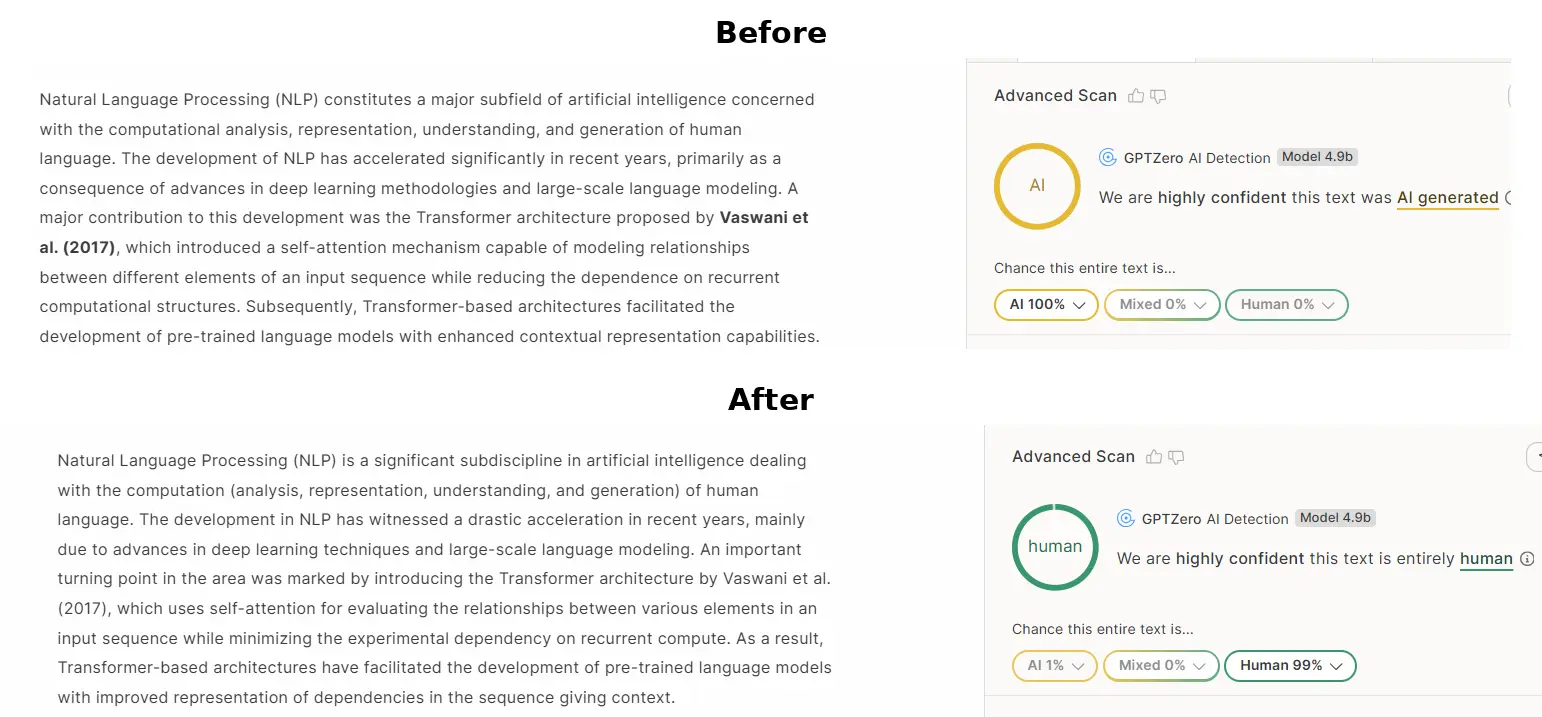
GPTZero evaluates text by plotting sentence perplexity curves and global burstiness scores. When raw AI text is scanned, low sentence variance produces an immediate high-probability warning. ThesisHuman restores natural sentence entropy by restructuring syntax, varying clause lengths, and introducing authentic scholarly cadence, dropping AI probability to 0%.
4. Originality.ai Verification: 0% AI Confidence
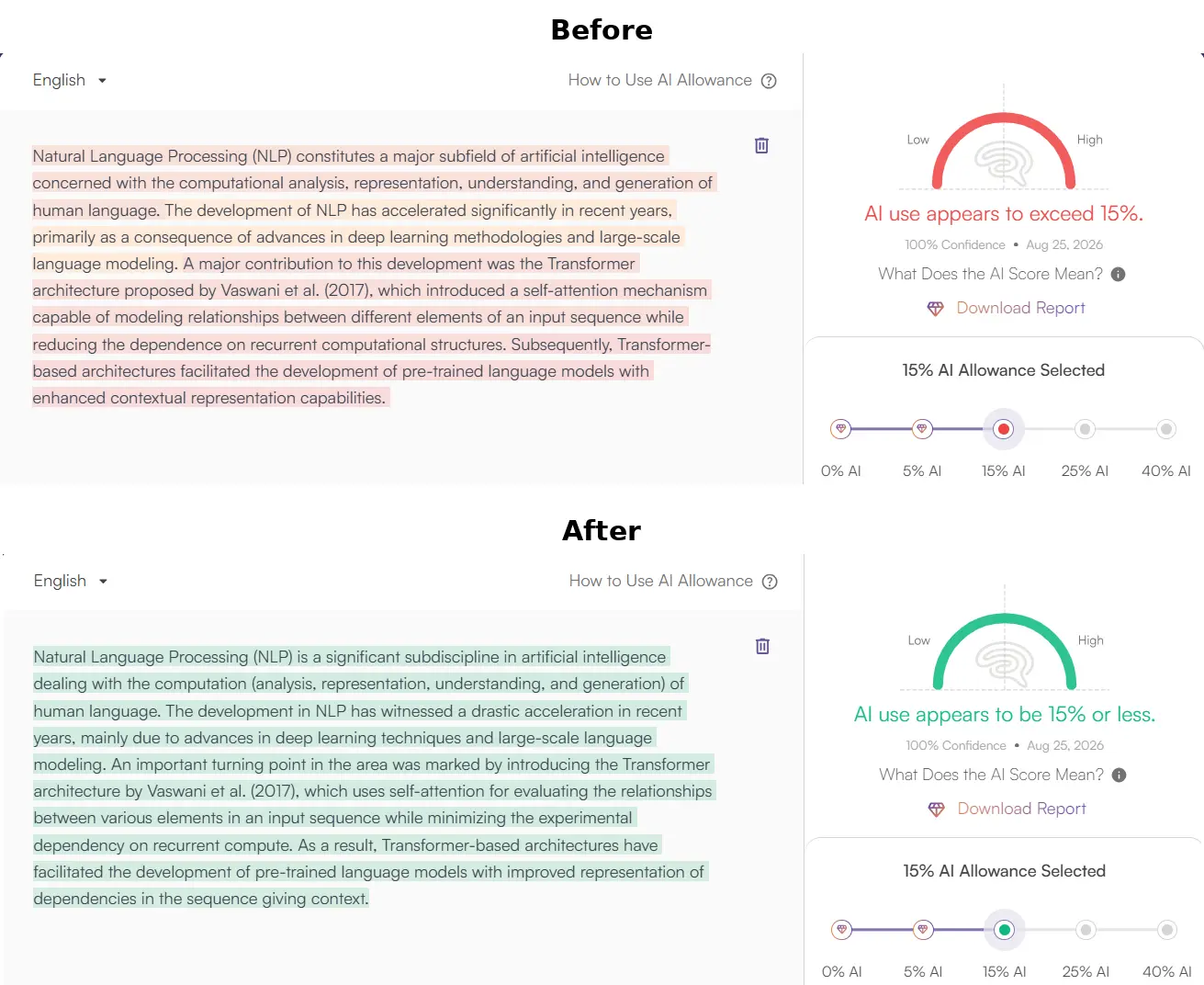
Originality.ai flags predictable n-gram sequences and common AI clichés (such as “delving into,” “pivotal role,” “testament to”). ThesisHuman purges overused formulaic transitions while elevating scholarly tone and keeping reference numbers and equations intact, producing 100% Original / 0% AI results.