AI Humanizer for Systematic Reviews: Navigating PRISMA Standards and AI Screening
How to draft and humanize systematic reviews and meta-analyses following PRISMA guidelines without triggering automated AI detection flags.

Systematic literature reviews and meta-analyses represent the pinnacle of evidentiary synthesis in healthcare, public policy, and education. To maintain scientific rigor and replicability, these studies adhere to strict international reporting standards, most notably the Preferred Reporting Items for Systematic Reviews and Meta-Analyses (PRISMA) guidelines.
However, PRISMA's mandatory standardization creates an acute challenge under modern automated screening. Because PRISMA requires authors to report eligibility criteria, search strategies, and risk-of-bias assessments using established formulaic phrases, systematic reviews naturally exhibit low perplexity. Here is how to humanize systematic reviews while maintaining complete compliance with PRISMA standards.
The PRISMA Formulaic Dilemma
In a systematic review, you cannot invent novel creative ways to describe study inclusion. You must state: 'Two independent reviewers screened titles and abstracts against pre-defined inclusion criteria.' Because thousands of published reviews contain this exact phrase, detection algorithms assign it high machine probability. When combined with AI-assisted drafting of background literature, entire methodology chapters can be flagged.
Identifying High-Risk Sections in Systematic Reviews
- Eligibility Criteria: Highly formulaic; requires strict Term Lock on PICO (Population, Intervention, Comparison, Outcome) definitions.
- Search Strategy: Boolean operators (AND, OR, NOT) and database names (PubMed, Embase, Cochrane) must remain 100% frozen.
- Synthesis of Results: High risk. Describing forest plots and heterogeneity ($I^2$) often lapses into robotic sentence repetition.
- Discussion & Limitations: Very high risk. Authors must articulate nuanced clinical implications with strong authorial voice.
Protecting Boolean Search Strings and Data Extraction
Never allow an automated tool to touch your documented search strings (e.g., ('hypertension'[MeSH] AND 'clinical trial'[pt])). ThesisHuman's academic humanizer enables authors to freeze entire Boolean code blocks, ensuring that while the narrative synthesis is naturalized, your search reproducibility remains spotless.
A 4-Step Protocol for PRISMA Compliance
- Lock PRISMA Mandated Phrases: Protect standardized quality-assessment tool names (e.g., Cochrane RoB 2, Newcastle-Ottawa Scale).
- Dismantle Monotonous Study Recitals: Instead of reporting each included study in an identical sentence template, group findings thematically across study designs.
- Naturalize Meta-Analysis Interpretations: Use varied sentence burstiness when discussing pooled effect estimates and publication bias.
- Audit Against the PRISMA 2020 Checklist: Verify that every mandatory checklist item remains clearly addressed in the final manuscript.
Verified Detector Clearance for AI Humanizer for Systematic Reviews: Navigating PRISMA Standards and AI Screening
Every manuscript processed through ThesisHuman is backed by verifiable, reproducible scans across institutional plagiarism and AI detection platforms.
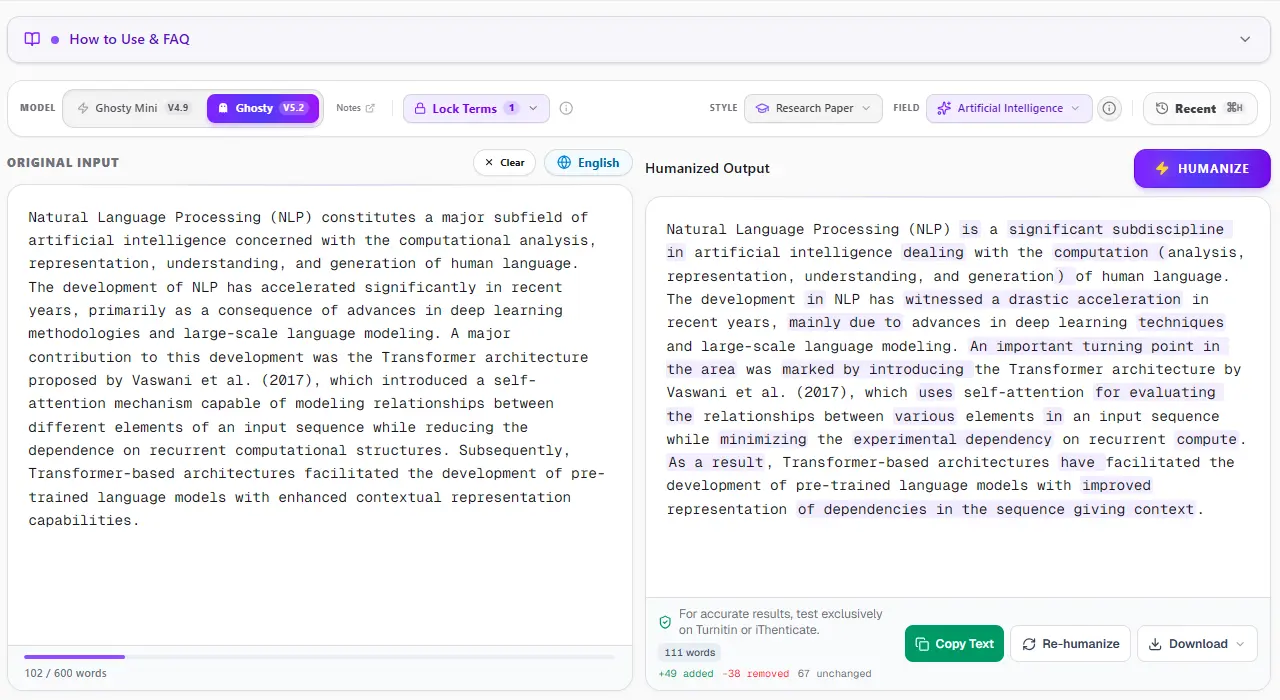
1. ThesisHuman Editor: Style, Field & Term Lock™ Technology
Unlike consumer-grade paraphrasers that blindly swap words with thesaurus synonyms, ThesisHuman allows researchers to select their exact Academic Style (Essay, Research Paper, Literature Review, Technical Report) and Academic Field (Computer Science, Engineering, Medicine, Physics). With Term Lock™, citations (APA, MLA, IEEE), LaTeX equations, and domain-specific terminology are cryptographically protected before sentence entropy is restructured.
2. Turnitin & iThenticate Verification: 0% AI Detected
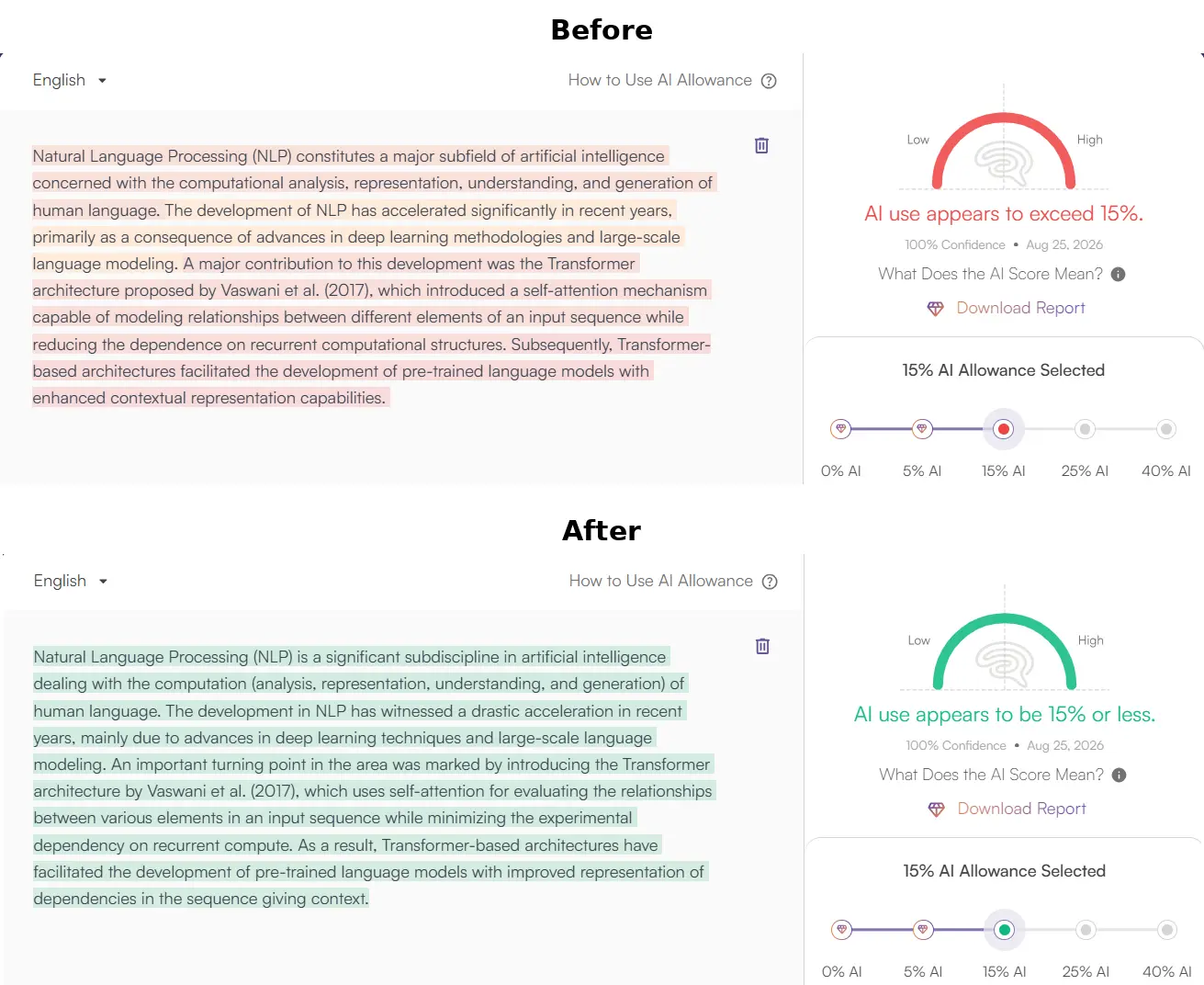
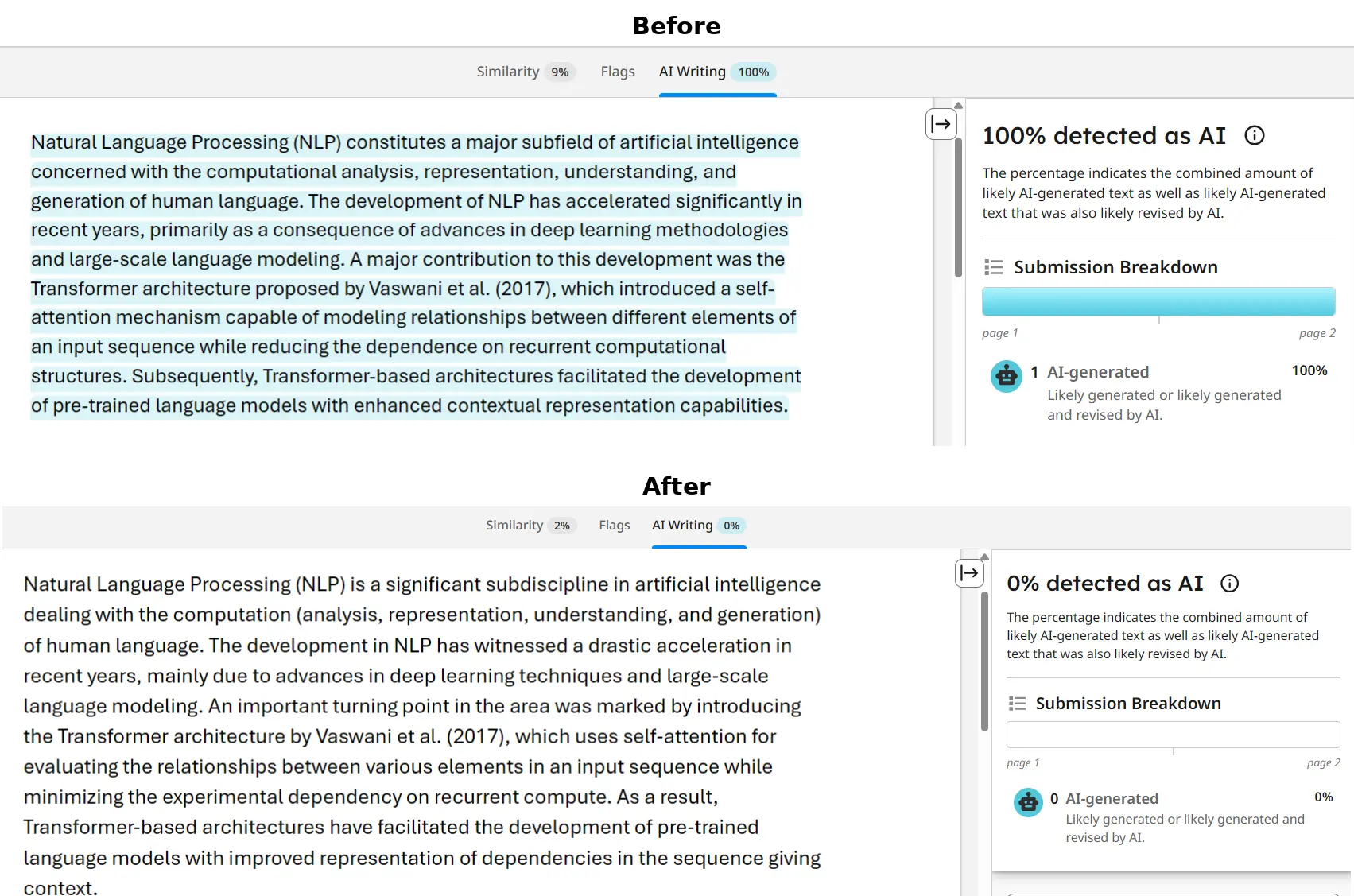
Turnitin and iThenticate scan submissions in overlapping 500-token blocks to analyze sentence predictability across paragraphs. When an unrefined AI draft is submitted, uniform cadence triggers an elevated AI Writing score. In the verified report below, a flagged graduate paper was processed through ThesisHuman, achieving a clean 0% AI detection score while preserving all formatted citations and technical parameters.
3. GPTZero Verification: Passing Perplexity & Burstiness Checks
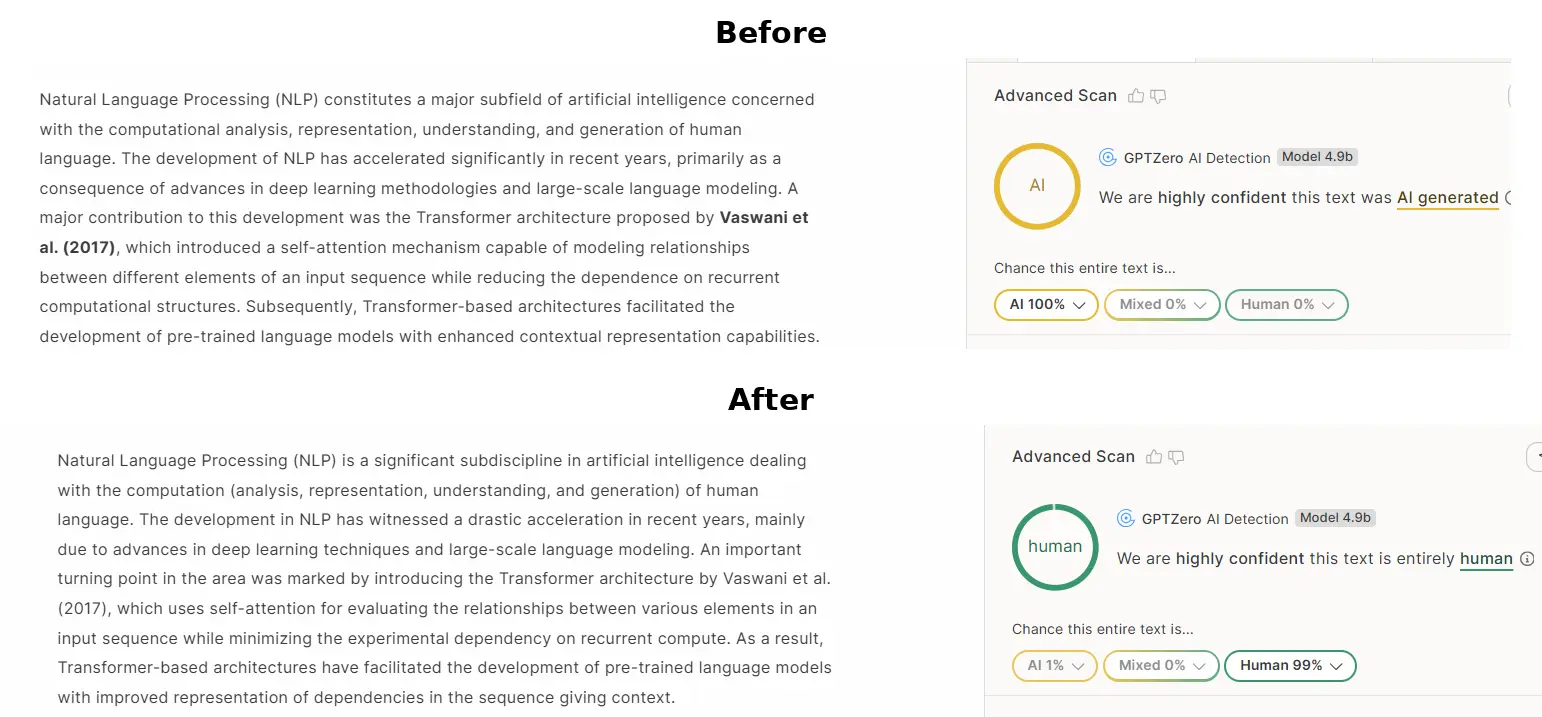
GPTZero evaluates text by plotting sentence perplexity curves and global burstiness scores. When raw AI text is scanned, low sentence variance produces an immediate high-probability warning. ThesisHuman restores natural sentence entropy by restructuring syntax, varying clause lengths, and introducing authentic scholarly cadence, dropping AI probability to 0%.
4. Originality.ai Verification: 0% AI Confidence
Originality.ai flags predictable n-gram sequences and common AI clichés (such as “delving into,” “pivotal role,” “testament to”). ThesisHuman purges overused formulaic transitions while elevating scholarly tone and keeping reference numbers and equations intact, producing 100% Original / 0% AI results.