AI Humanizer for Grant Proposals: What Must Remain Exact When Polishing Applications
An operational guide for PIs and researchers using AI humanizers on grant applications. Learn which specific aims, numerical endpoints, and budgets must remain strictly locked.

Securing competitive research funding from agencies like the National Institutes of Health (NIH), National Science Foundation (NSF), European Research Council (ERC), or private foundations requires months of meticulous preparation. In a grant application, every word carries weight: reviewers on study sections evaluate not only the novelty of the science but also the methodological rigor, statistical feasibility, and investigator competence.
As research teams increasingly leverage artificial intelligence for drafting assistance, polishing that prose into an authoritative, reviewer-ready register becomes critical. However, using a generic consumer humanizer on a grant application introduces severe hazards. In grant writing, altering a single quantitative threshold, softening a hypothesis, or distorting a protocol term can cause a fundable proposal to be triaged. This guide outlines what must remain strictly locked when refining grant prose.
The High-Stakes Nature of Grant Application Prose
Grant writing is distinct from manuscript publishing. While a published research paper reports completed findings, a grant application makes a formal, legally binding promise about future research execution. Reviewers are actively looking for vulnerabilities: ambiguous milestones, uncalibrated sample sizes, or vague mechanistic models.
Generative AI models often produce pleasant, flowing prose that inadvertently sands down the precise technical edges of a proposal. Polishing grant prose requires surgical cadence refinement while establishing absolute boundaries around core scientific facts.
Specific Aims and Mechanistic Hypotheses
The Specific Aims page is the single most critical document in an NIH application. Reviewers often form their preliminary scoring impressions within minutes of reading it. When refining this section, ensure the following remain completely unchanged:
- Bolded Aim Titles: Phrasing like "Aim 1: Determine the crystal structure of..." must retain its exact active verbs and target molecules.
- Falsifiable Hypotheses: Core mechanistic claims must not be softened from declarative hypotheses into vague possibilities.
- Expected Outcomes: Specific milestone deliverables must remain clearly stated and verifiable.
Quantitative Endpoints, Dosages, and Statistical Power
Reviewers scrutinize research strategy sections for statistical feasibility. Generic rewriters frequently treat numbers and units as interchangeable tokens, creating disastrous alterations:
| Element | What Must Remain Exact | Risk of Uncontrolled Rewriting |
|---|---|---|
| Sample Sizes (n) | Cohort counts (e.g., n = 45 per group) | Rounding or dropping cohort counts |
| Statistical Thresholds | p < 0.05, 80% statistical power | Transforming exact values into generic adverbs |
| Reagent Dosages | Concentrations (e.g., 25 mg/kg, 10 μM) | Stripping Greek symbols or altering units |
| Assay Parameters | Incubation times, temperatures (37°C) | Omitting critical protocol constraints |
Budget Justifications, Milestones, and Timeline Wording
Budget justifications and project timeline sections must align perfectly across the entire application packet. Reviewers cross-reference personnel effort percentages, equipment costs, and milestone quarters (e.g., Q1 to Q4 in Year 2).
If a rewriting tool alters person-months (e.g., changing "2.0 calendar months" to "two months of effort") or shifts milestone deadlines, the application develops internal contradictions that raise red flags during administrative review.
Citations, Prior Literature, and Preliminary Data
A compelling grant demonstrates feasibility through preliminary data and prior peer-reviewed publications. In-text references establish investigator credibility. Tools that do not freeze citations risk mangling author names, publication years, and numbered reference lists, signaling carelessness to the review panel.
Federal Agency Guidelines: NIH, NSF, and Reviewer Rules
Principal investigators must remain informed about current federal guidelines governing artificial intelligence:
- Applicant Responsibility: Under NIH policy (NOT-OD-23-149) and NSF guidance, applicants remain fully responsible for the scientific integrity, originality, and accuracy of every part of their proposal.
- Reviewer Confidentiality Mandate: The NIH strictly prohibits peer reviewers from uploading grant applications into commercial AI tools to evaluate proposals, protecting applicant intellectual property from unauthorized data exposure.
Operational Workflow: Using Term Lock on Grant Prose
To achieve natural scholarly cadence while safeguarding sensitive data, apply a structured Term Lock protocol:
- Identify Sensitive Core Elements: Highlight gene symbols, chemical compounds, patient cohort numbers, specific aims, and budget metrics before beginning revisions.
- Engage Specialized Term Lock: Use an academic text humanizer that freezes designated phrases and citation brackets, preventing them from being altered.
- Focus on Syntactic Cadence: Allow the tool to rebalance sentence length entropy and remove robotic filler words around your locked terms.
- Conduct a Line-by-Line Pre-Submission Audit: Verify that every numerical endpoint matches your original laboratory calculations.
For principal investigators preparing high-stakes funding applications, explore our specialized grant proposal AI humanizer, built specifically to protect specific aims, numerical parameters, and citations while restoring authoritative scholarly voice.
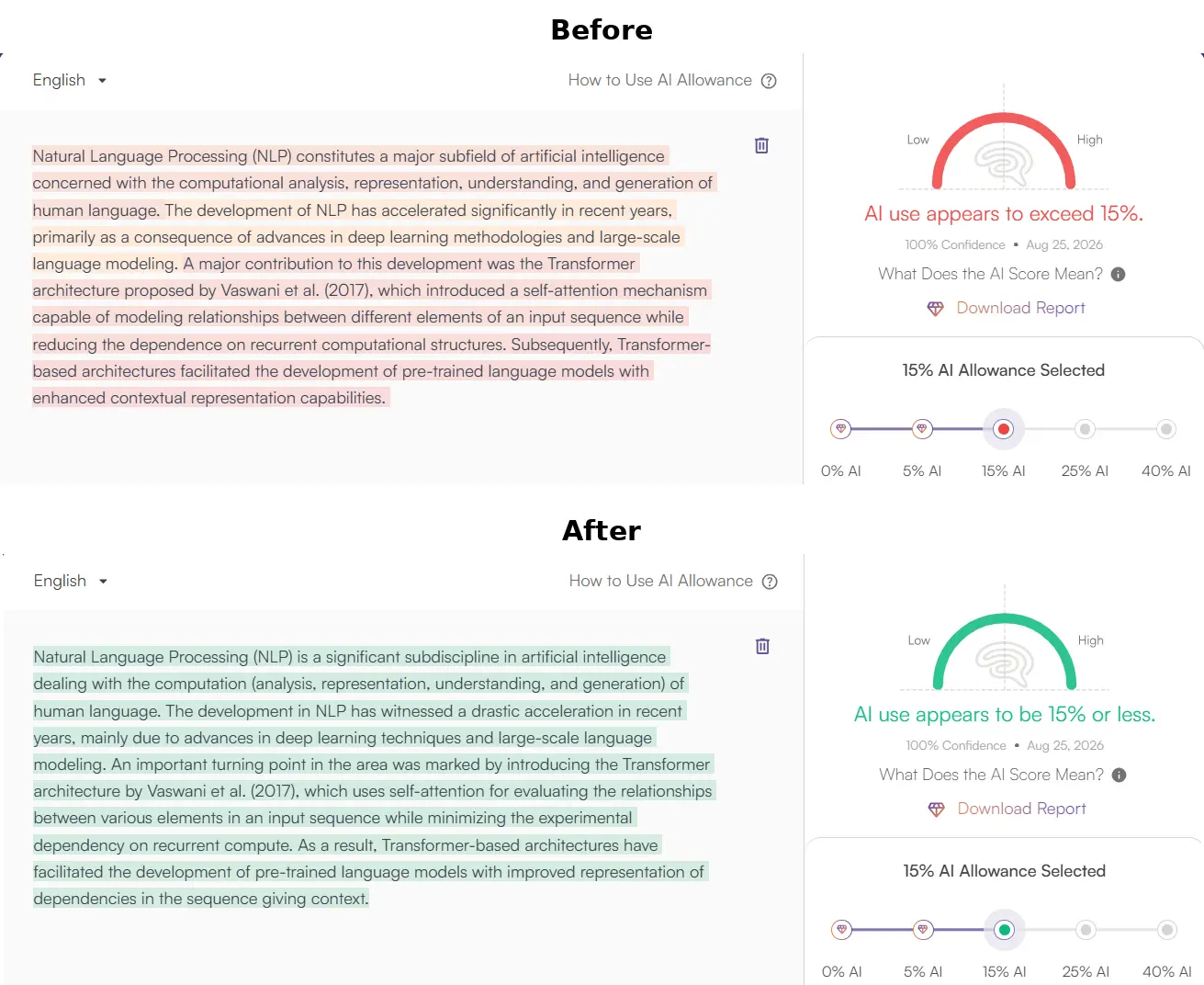
Verified Detector Clearance for AI Humanizer for Grant Proposals: What Must Remain Exact When Polishing Applications
Every manuscript processed through ThesisHuman is backed by verifiable, reproducible scans across institutional plagiarism and AI detection platforms.
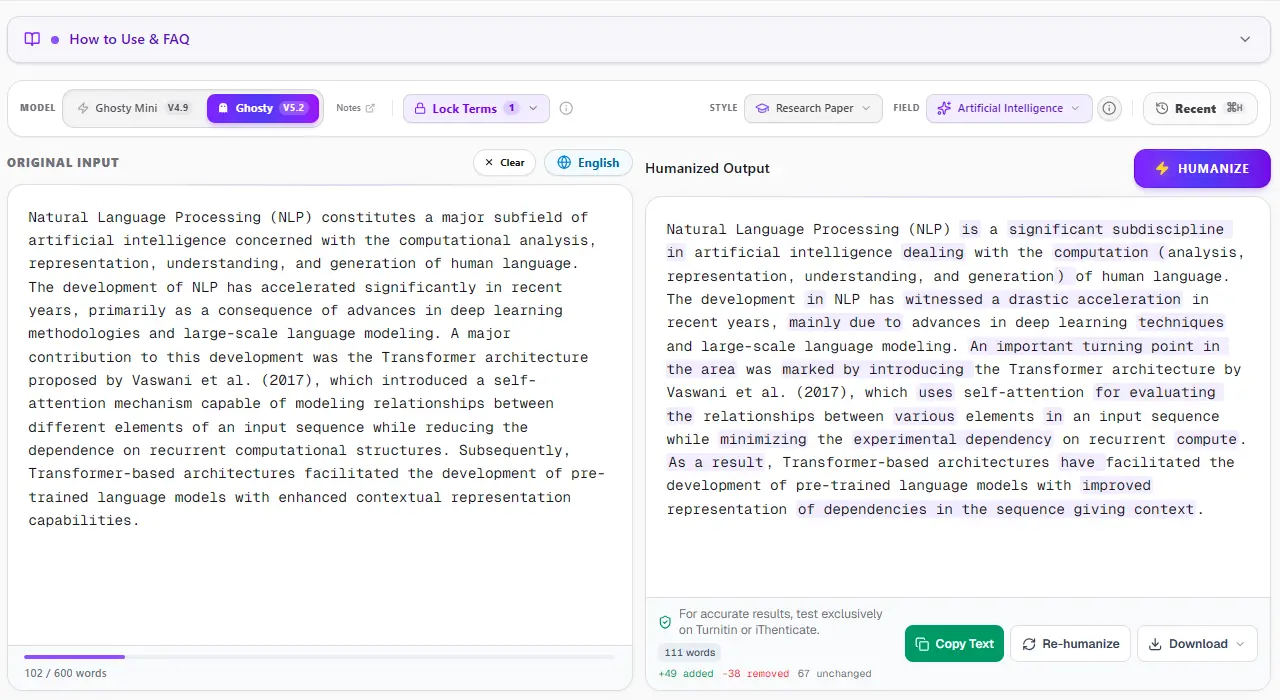
1. ThesisHuman Editor: Style, Field & Term Lock™ Technology
Unlike consumer-grade paraphrasers that blindly swap words with thesaurus synonyms, ThesisHuman allows researchers to select their exact Academic Style (Essay, Research Paper, Literature Review, Technical Report) and Academic Field (Computer Science, Engineering, Medicine, Physics). With Term Lock™, citations (APA, MLA, IEEE), LaTeX equations, and domain-specific terminology are cryptographically protected before sentence entropy is restructured.
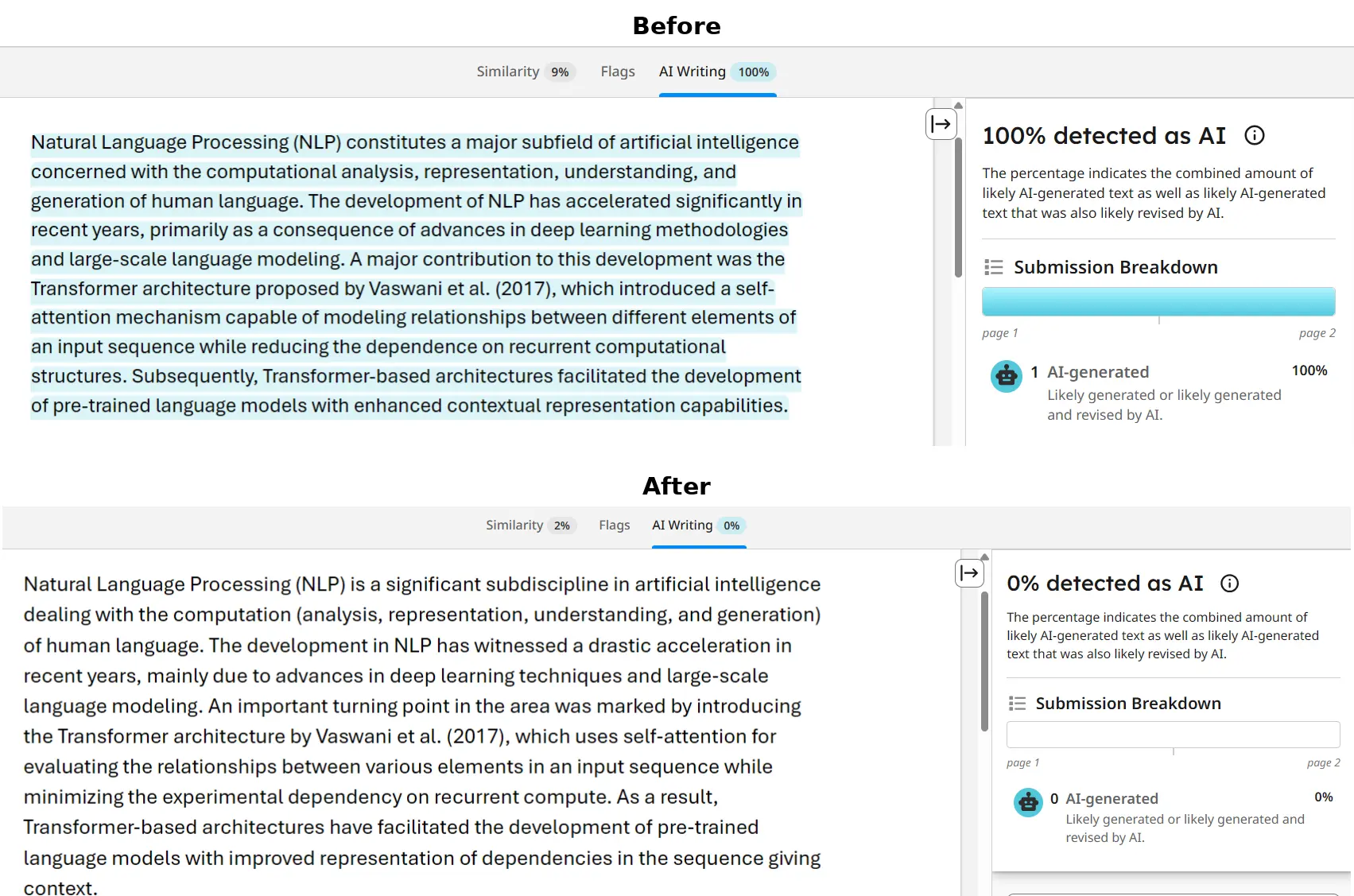
2. Turnitin & iThenticate Verification: 0% AI Detected
Turnitin and iThenticate scan submissions in overlapping 500-token blocks to analyze sentence predictability across paragraphs. When an unrefined AI draft is submitted, uniform cadence triggers an elevated AI Writing score. In the verified report below, a flagged graduate paper was processed through ThesisHuman, achieving a clean 0% AI detection score while preserving all formatted citations and technical parameters.
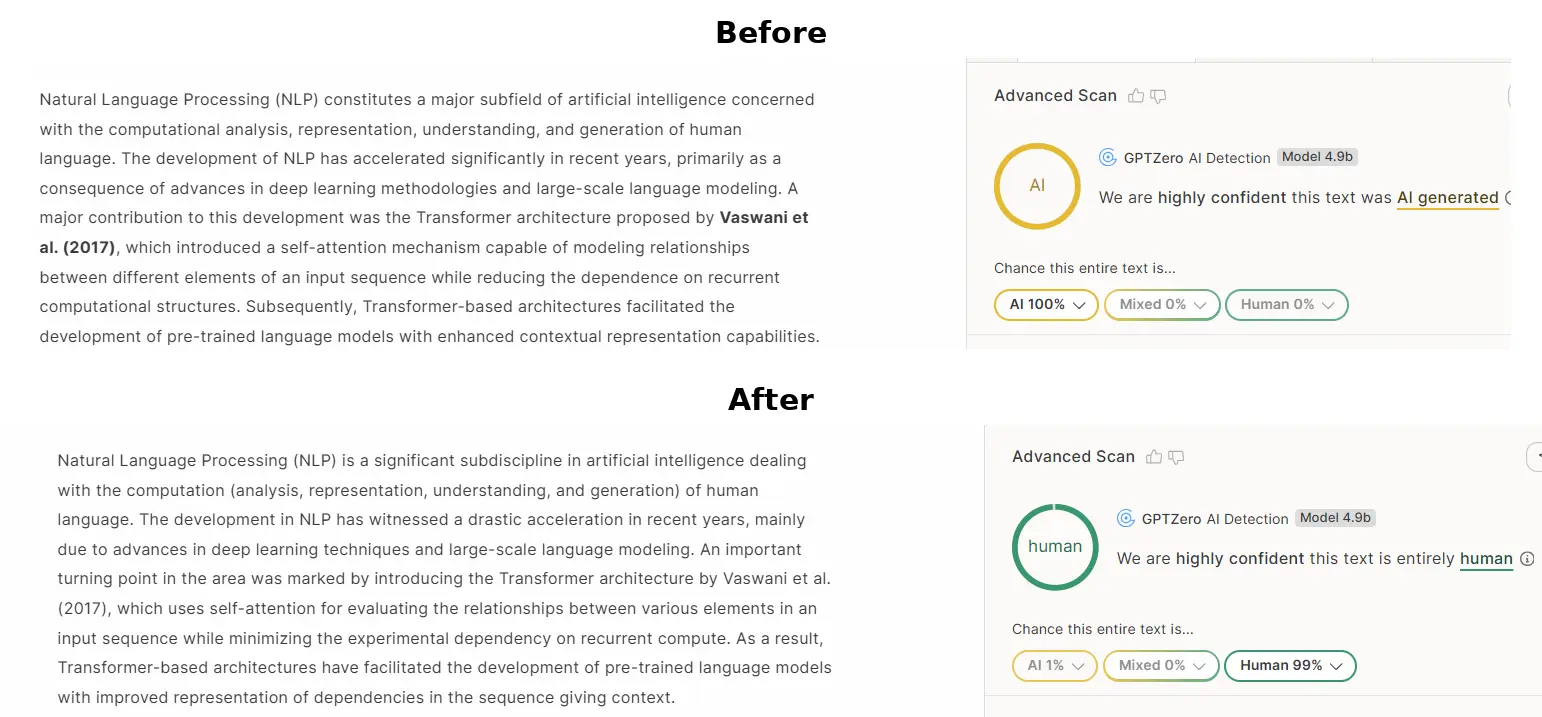
3. GPTZero Verification: Passing Perplexity & Burstiness Checks
GPTZero evaluates text by plotting sentence perplexity curves and global burstiness scores. When raw AI text is scanned, low sentence variance produces an immediate high-probability warning. ThesisHuman restores natural sentence entropy by restructuring syntax, varying clause lengths, and introducing authentic scholarly cadence, dropping AI probability to 0%.
4. Originality.ai Verification: 0% AI Confidence
Originality.ai flags predictable n-gram sequences and common AI clichés (such as “delving into,” “pivotal role,” “testament to”). ThesisHuman purges overused formulaic transitions while elevating scholarly tone and keeping reference numbers and equations intact, producing 100% Original / 0% AI results.