Active vs Passive Voice in Scientific Writing: Rules and Examples
Learn when to use active vs. passive voice in scientific writing. Understand journal guidelines, section-by-section rules, agent clarity, and practical examples.

1. Direct Answer: When to Use Active vs. Passive Voice in Scientific Papers
The modern consensus among leading scientific journals (including Nature, Science, Cell, and IEEE Transactions) is unequivocal: you should use both active and passive voice strategically depending on the section of your manuscript and the focus of each sentence.
Use this operational rule of thumb:
- Use Active Voice when you describe the researchers' analytical decisions, theoretical interpretations, hypothesis formulations, or comparative evaluations (We hypothesized that..., Our findings indicate that..., This study demonstrates that...).
- Use Passive Voice when describing standardized experimental methodologies where the object being acted upon is the central scientific focus and the human operator is irrelevant (Samples were centrifuged at 12,000 g for 15 minutes, RNA was extracted using trizol reagent).
The outdated dogma that scientific prose must be 100% passive is dead. Top-tier publishers explicitly reject passive voice when it creates ambiguity, buries experimental agency, or generates suffocating, monotonous sentences. Effective scientific writing alternates dynamically between active and passive constructions to maintain clarity, cadence, and empirical precision.
To master broader sentence structure and information ordering, review our comprehensive guide on how to improve clarity in academic writing.
2. The Historical Evolution of Voice in Scholarly Publishing
To understand contemporary voice conventions, researchers must understand how scientific writing evolved.
During the seventeenth and eighteenth centuries, pioneering natural philosophers like Isaac Newton and Robert Boyle wrote predominantly in the first person active voice (I pressed the prism against the ray of light). Scientific communication was understood as a personal, eyewitness testimony of experimental phenomena.
In the early twentieth century, an epistemological shift occurred. The rise of positivism and industrial-scale scientific laboratories popularized the passive voice. Researchers adopted the third-person passive (The solution was heated) to project an aura of detached, objective neutrality. The underlying assumption was that the experiment operated independently of human subjectivity; anyone following the protocol would observe identical outcomes.
By the early 2000s, this convention began to crumble. Editors noticed that universal passive voice caused severe editorial problems:
- It produced bloated, impenetrable sentences loaded with abstract nominalizations.
- It obscured responsibility for critical experimental choices (It was assumed that... left reviewers asking Who assumed this: the authors or previous literature?).
- It created monotonous, repetitive syntax that bored peer reviewers.
Today, major style guides (APA 7th, AMA 11th, ACS, and IEEE) actively encourage first-person active voice whenever researchers describe their own investigative decisions.
3. Grammatical Anatomy: Agent, Action, and Recipient in Technical Prose
Every sentence describes an action involving three fundamental components:
- The Agent: The entity performing the action.
- The Action: The verb expressing what occurred.
- The Recipient (Patient): The entity receiving or experiencing the action.
The grammatical voice determines the arrangement of these three elements:
- Active Voice: The Agent serves as the grammatical subject and precedes the verb.
Formula: [Agent] + [Action Verb] + [Recipient]
Example: "The research team [Agent] isolated [Action] twenty-four novel peptides [Recipient]." - Passive Voice: The Recipient serves as the grammatical subject, followed by a form of to be and the past participle. The Agent is either relegated to a prepositional phrase or omitted entirely.
Formula: [Recipient] + [Auxiliary Verb to be + Past Participle] + (optional by [Agent])
Example: "Twenty-four novel peptides [Recipient] were isolated [Action] (by the research team)."
When you choose between active and passive voice, you are choosing what to place in the high-prominence topic position (the beginning of the sentence). If the peptides are the focus of your investigation, the passive structure appropriately spotlights them. If the team's novel extraction technique is the focus, the active voice delivers superior rhetorical impact.
4. Section-by-Section Voice Protocol Across the IMRaD Structure
A well-crafted manuscript does not use a single voice uniformly from title to references. Instead, voice shifts systematically across the standard IMRaD (Introduction, Methods, Results, and Discussion) architecture:
1. Abstract
- Voice Allocation: 70% Active, 30% Passive.
- Guideline: Abstracts have strict word ceilings (typically 150 to 250 words). Active voice is indispensable because it requires fewer words and establishes narrative urgency. State the problem and your core findings actively: We developed a novel neural architecture that outperforms conventional baselines by fourteen percent.
2. Introduction
- Voice Allocation: 80% Active, 20% Passive.
- Guideline: Introductions establish the research context, identify gaps in existing literature, and state hypotheses. Use active voice to critique prior studies and define your objectives: Previous models overlook microclimate fluctuations; here, we formulate an adaptive climate model.
3. Materials and Methods
- Voice Allocation: 75% Passive, 25% Active.
- Guideline: This is the only section where passive voice legitimately dominates. The focus must remain on the materials, specimens, reagent concentrations, and operational parameters: Blood samples were incubated at 37 degrees Celsius for twenty minutes. However, if you developed a custom algorithm or made an unusual methodological choice, switch to active voice: To correct for spatial autocorrelation, we applied a customized Moran's I weighting matrix.
4. Results
- Voice Allocation: 60% Active, 40% Passive.
- Guideline: Use active voice when reporting statistical findings and directional trends: Figure 3 illustrates the dose-dependent response. Use passive voice when summarizing baseline sample distributions: A total of 420 participants were enrolled.
5. Discussion and Conclusion
For a detailed section breakdown, see our comparative guide on the difference between discussion and conclusion sections.
- Voice Allocation: 85% Active, 15% Passive.
- Guideline: The discussion is your opportunity to interpret data, contextualize findings, defend limitations, and argue theoretical implications. Passive voice here makes your arguments sound evasive and unconfident. Claim your intellectual contributions actively: We propose that this pathway mediates cellular senescence... rather than It is proposed that....
5. Publisher Standards: Nature, Science, IEEE, APA 7th, and AMA
Before drafting, consult the specific author instructions of your target publishing venue. Leading scientific organizations have explicit policies endorsing active voice:
- Nature Portfolio: Nature's official Guide for Authors explicitly instructs: "Nature journals prefer authors to write in the active voice ('we performed the experiment...') as experience has shown that readers find it easier to read."
- Science (AAAS): Science guidelines state: "Use active voice whenever possible, particularly when referring to decisions or procedures carried out by the investigators."
- IEEE Transactions: IEEE Author Center advises: "Write in the active voice. Active sentences are more direct, lively, and shorter than passive sentences. Instead of writing 'A filter was designed by the authors', write 'We designed a filter'."
- American Psychological Association (APA 7th Edition): Section 4.13 of the APA Publication Manual directs researchers: "Use the active voice rather than the passive voice... Active voice is direct and concise. Use first-person pronouns ('we investigated', 'I conducted') to avoid the ambiguity of the editorial 'we' or passive evasions."
- American Medical Association (AMA Manual of Style): AMA guidelines emphasize: "In general, authors should prefer active voice over passive voice, particularly when describing authorial decisions in the Discussion section."
Submitting a paper written entirely in passive voice to these journals does not signal professionalism; it signals unfamiliarity with modern scientific publishing standards.
6. The Hazard of the Agentless Passive: Resolving Ambiguous Responsibility
The single most dangerous stylistic pitfall in scientific writing is the agentless passive: a passive construction that omits the entity responsible for the action.
Consider this ambiguous sentence from a biochemistry draft:
"It was concluded that the assay was contaminated during preparation."
This sentence raises unresolved questions for peer reviewers:
- Did the current authors conclude this during their own post-hoc analysis?
- Did previous literature (e.g., Smith et al.) arrive at this conclusion?
- Did an independent laboratory report the contamination?
Restoring Accountability
- If it was the authors' conclusion: "We concluded that the assay was contaminated during preparation."
- If it was a previous study: "Zhang et al. (2022) concluded that the assay was contaminated during preparation."
- If it was an external audit: "An external quality auditor concluded that the assay was contaminated during preparation."
Whenever an action involves subjective judgment, hypothesis formulation, diagnostic interpretation, or experimental error, always use active voice to identify the responsible agent.
7. Comparative Analysis Table: 8 Section-Specific Active vs. Passive Pairs
The following reference table presents eight side-by-side comparisons across distinct sections of a scientific manuscript, illustrating when each voice is preferred:
| Manuscript Section | Weak / Misapplied Voice | Strong / Recommended Voice | Rationale for Selection |
|---|---|---|---|
| Abstract Objective | An evaluation of cardiovascular risk markers in diabetic mice was conducted by our team. | We evaluated cardiovascular risk markers in diabetic mice. | Active voice cuts three words and places the scientific objective immediately upfront. |
| Introductory Gap | It has been overlooked by researchers that microplastics cross the blood-brain barrier. | Previous studies overlooked how microplastics cross the blood-brain barrier. | Active voice clearly attributes the analytical gap to prior literature. |
| Standard Methodology | We pipetted 50 microliters of buffer into each well using a multi-channel instrument. | Fifty microliters of buffer were pipetted into each well. | Passive voice appropriately spotlights the reagent volume; the operator's identity is irrelevant. |
| Novel Protocol Step | A custom Python script was written to filter low-confidence variant calls. | We developed a custom Python script to filter low-confidence variant calls. | Active voice claims authorial credit for creating proprietary research software. |
| Results Observation | A significant decrease in tumor volume was observed to occur in cohort 2. | Cohort 2 exhibited a significant decrease in tumor volume. | Active voice with an empirical subject eliminates redundant passive padding (was observed to occur). |
| Statistical Association | A positive correlation was found between dietary sodium and arterial stiffness. | Dietary sodium correlated positively with arterial stiffness. | Active statistical verb (correlated) is direct, concise, and mathematically rigorous. |
| Discussion Claim | It is suggested by these observations that autophagy suppresses metastasis. | These observations suggest that autophagy suppresses metastasis. | Active subject (These observations) drives direct causal interpretation. |
| Study Limitation | It is acknowledged that long-term patient follow-up was not accomplished. | We acknowledge that our cohort lacked long-term follow-up data. | Active voice demonstrates scholarly integrity and straightforward accountability. |
8. End-to-End Case Study: Transforming a Confusing Biomedical Protocol
To understand how strategic voice selection clarifies complex technical procedures, examine this before-and-after case study from a pharmacology manuscript.
Original Draft (Overly Passive and Ambiguous, 126 Words)
"In order to achieve effective separation of cellular metabolites, the high-performance liquid chromatography protocol was initiated. By the investigation team, mobile phase A (0.1% formic acid in water) and mobile phase B (acetonitrile) were prepared. A flow rate of 0.4 mL/min was maintained across a C18 stationary column. It was decided that a non-linear gradient would be utilized due to the fact that co-elution of polar compounds had been observed in earlier trials. Peak identification was accomplished via comparison with authentic analytical standards. Total ion chromatograms were subsequently acquired by the mass spectrometer. From the acquired spectra, it was deduced that compound 3a was synthesized with ninety-two percent purity, while secondary degradation byproducts were noted to have been eliminated."
Editorial Interventions Applied
- Differentiate Standard Steps from Decisions: Use passive voice for standardized instrument operation (A flow rate was maintained), but use active voice for the authors' tactical gradient adjustment (We used a non-linear gradient because...).
- Eliminate Clunky Passive Agents: Cut By the investigation team and by the mass spectrometer.
- Remove Passive Fluff: Replace Peak identification was accomplished via comparison with with We identified peaks by comparing them to. Replace it was deduced that with we confirmed that.
Clear Revised Version (82 Words, Balanced and Authoritative)
"To separate cellular metabolites, we utilized high-performance liquid chromatography with mobile phase A (0.1% formic acid in water) and mobile phase B (acetonitrile). A flow rate of 0.4 mL/min was maintained across a C18 column. Because polar compounds co-eluted in preliminary trials, we designed a non-linear gradient. Peaks were identified by comparison with authentic analytical standards. Mass spectrometry confirmed that compound 3a was synthesized with ninety-two percent purity, without detectable secondary degradation byproducts."
Transformation Metrics
- Word Count: Decreased from 126 words to 82 words (35% reduction).
- Clarity: Clear distinction between routine mechanical conditions (flow rate, standards) and custom investigative choices (gradient design, purity verification).
- Cadence: Eliminates the droning rhythm of eight consecutive was [verb]ed passive constructions.
9. The Detector Connection: Why Stacking Passive Voice Triggers AI Flags
An unexpected development in modern academic publishing is the interaction between passive voice and automated AI detection algorithms (such as Turnitin, iThenticate, and GPTZero).
Automated detectors rely heavily on two statistical metrics:
- Perplexity: How predictable a word is given the preceding context.
- Burstiness: The variation in sentence length, clausal architecture, and grammatical rhythm across a document.
When authors write entirely in passive voice, their text becomes statistically uniform. Passive constructions require predictable auxiliary verbs (was, were, has been, is being) combined with past participles and stereotypical passive prepositional phrases (by the, in the, of the).
This mechanical regularity drives sentence perplexity down into the exact probability range characteristic of large language models like ChatGPT. Consequently, human researchers writing rigorous, 100% human-authored manuscripts in dense, passive academic prose frequently get hit with false-positive AI flags.
By weaving active voice throughout your introduction, results, and discussion, you introduce authentic human burstiness: varied sentence lengths, dynamic transitive verbs, and irregular token distributions that reflect genuine cognitive reasoning.
To ensure your submission satisfies major publisher ethics rules, follow our complete protocol on how to revise AI-assisted manuscripts for journals.
10. Five Critical Voice Mistakes in Scientific Manuscripts
Avoid these five prevalent errors when managing grammatical voice in technical papers:
- The Insecure Avoidance of First-Person Pronouns: Many graduate students go to extraordinary lengths to avoid writing we, inventing awkward third-person circumlocutions like the present writers, the current investigator, or this author. Modern style manuals consider these circumlocutions pretentious and confusing. If you performed the research as a team, write we.
- Switching Voice Mid-Sentence Without Parallelism: Shifting from active to passive within a single compound predicate creates jarring grammatical whiplash: We washed the culture plates and the supernatant was discarded. Maintain parallel voice: We washed the culture plates and discarded the supernatant.
- Using Passive Voice to Conceal Inadequate Data: Writing It is generally assumed that X operates through pathway Y without a citation hides the fact that no empirical citation exists. Be candid: Although pathway Y has been implicated, empirical confirmation remains lacking.
- Passive Nominalization Compounding: Stacking passive voice on top of nominalizations creates impenetrable sentences: The determination of the threshold was accomplished by the implementation of an automated script. Restored active: We determined the threshold using an automated script.
- Universal Active Voice in Laboratory Protocols: In an overzealous attempt to sound lively, some authors write laboratory protocols like culinary recipes: Next, we took the flask, and then we measured the absorbance, and then we recorded the values. This trivializes scientific prose. Standard physical procedures belong in concise, passive documentation.
11. Legitimate Exceptions: When Passive Voice Is Grammatically Superior
While active voice deserves greater prominence, passive voice remains an indispensable, highly effective tool in the scientist's rhetorical repertoire.
Passive voice is superior under three clear scientific conditions:
1. When the Patient/Result Is the Star of the Sentence
If you discover a breakthrough room-temperature superconductor, the material itself should occupy the topic position:
- Passive (Superior): "A stable room-temperature superconducting phase was discovered in carbonaceous sulfur hydride."
- Active (Inferior): "Our graduate student, John Doe, discovered a stable room-temperature superconducting phase in carbonaceous sulfur hydride."
2. When Maintaining Thematic Cohesion Across Sentence Boundaries
If preceding sentences discuss the recombinant plasmid, the next sentence should maintain that topic in the subject position:
- Cohesive Passive: "The recombinant plasmid was constructed using Gibson assembly. It was then transformed into competent E. coli cells."
- Disruptive Active: "We constructed the recombinant plasmid using Gibson assembly. Then, laboratory technicians transformed it into competent E. coli cells."
3. When the Actor Is Genuinely Unknown or Universal
When describing natural phenomena or universal technical standards, identifying an actor is redundant or impossible:
- "The Earth is estimated to be approximately 4.5 billion years old."
- "Standard atmospheric pressure is defined as 101.325 kPa."
12. Practical 10-Point Pre-Submission Voice Audit Checklist
Use this practical audit checklist before submitting your manuscript to an academic journal:
- Journal Guidelines Checked: Have you verified whether your target journal (e.g., Nature, IEEE, Elsevier) explicitly requests active voice?
- Abstract Voice Balance: Does your abstract state the central research goal and primary conclusion using energetic active verbs?
- Introduction Agency: Are your research objectives expressed actively (In this study, we investigate...) rather than passively (In this study, an investigation is conducted)?
- Agentless Passive Audit: Have you eliminated ambiguous phrases like It was determined where the responsible party is unclear?
- Methods Routine vs. Custom: Are standard laboratory protocols written in concise passive voice, while custom algorithms or strategic decisions use active voice?
- Parallel Sentence Voice: Do coordinated verbs within compound sentences maintain consistent voice throughout?
- Pronoun Appropriateness: Are first-person pronouns (we, our) used strictly for authorial actions and interpretations, rather than generic editorial commentary?
- Nominalization Scan: Have you checked passive verbs paired with empty auxiliaries (was conducted, was performed, was achieved) and restored direct verbs?
- Discussion Authority: Does your discussion interpret findings boldly using active voice (Our results indicate, We propose) rather than retreating into evasive passive hedging?
- Cadence and Variety Check: Does your text exhibit natural syntactic burstiness, avoiding repetitive sequences of identical grammatical structures?
13. Frequently Asked Questions
Can I use the first-person pronoun "I" in a single-author scientific paper?
Yes. If you are the sole author of a scientific manuscript or doctoral thesis, write in the first-person singular (I hypothesized, I constructed). Using the plural we when you are the only author (the royal "we") is considered outdated and inaccurate by modern style manuals like APA 7th and Chicago.
Will peer reviewers reject my paper for using active voice in the methodology?
No reputable journal will reject a paper simply for using active voice to describe novel experimental choices. While routine, standardized steps (Cells were incubated...) should remain passive, reviewers appreciate active voice when it clarifies custom methodological decisions (To avoid cross-contamination, we designed a custom enclosed chamber).
Does active voice make a scientific paper sound less objective?
No. Objectivity in science arises from rigorous methodology, transparent data reporting, robust controls, and reproducible results; it does not arise from pretending that humans did not conduct the experiment. Leading scientific bodies acknowledge that writing We observed is just as objective as writing It was observed, while being far more honest and concise.
What is the ideal ratio of active to passive voice in a scientific manuscript?
Most published editorial analyses indicate that top-tier journals (Nature, Science, PLOS ONE) average roughly 60% to 70% active voice and 30% to 40% passive voice across the entire manuscript. The exact proportion shifts predictably by section: high active voice in Introduction and Discussion, high passive voice in Materials and Methods.
How does ThesisHuman assist with calibrating active and passive voice?
ThesisHuman analyzes your manuscript at the clausal level using our academic writing engine and research paper humanizer. Scholars can review our transparent subscription options for extended chapter editing., highlighting agentless passives, clunky nominalizations, and repetitive grammatical sequences. Our platform helps scholars restore active academic authority in discussion sections while preserving the necessary passive rigor of methodology chapters, all while keeping your citations, LaTeX formulas, and specialized domain terms securely protected with Term Lock.
Verified Detector Clearance for Active vs Passive Voice in Scientific Writing: Rules and Examples
Every manuscript processed through ThesisHuman is backed by verifiable, reproducible scans across institutional plagiarism and AI detection platforms.
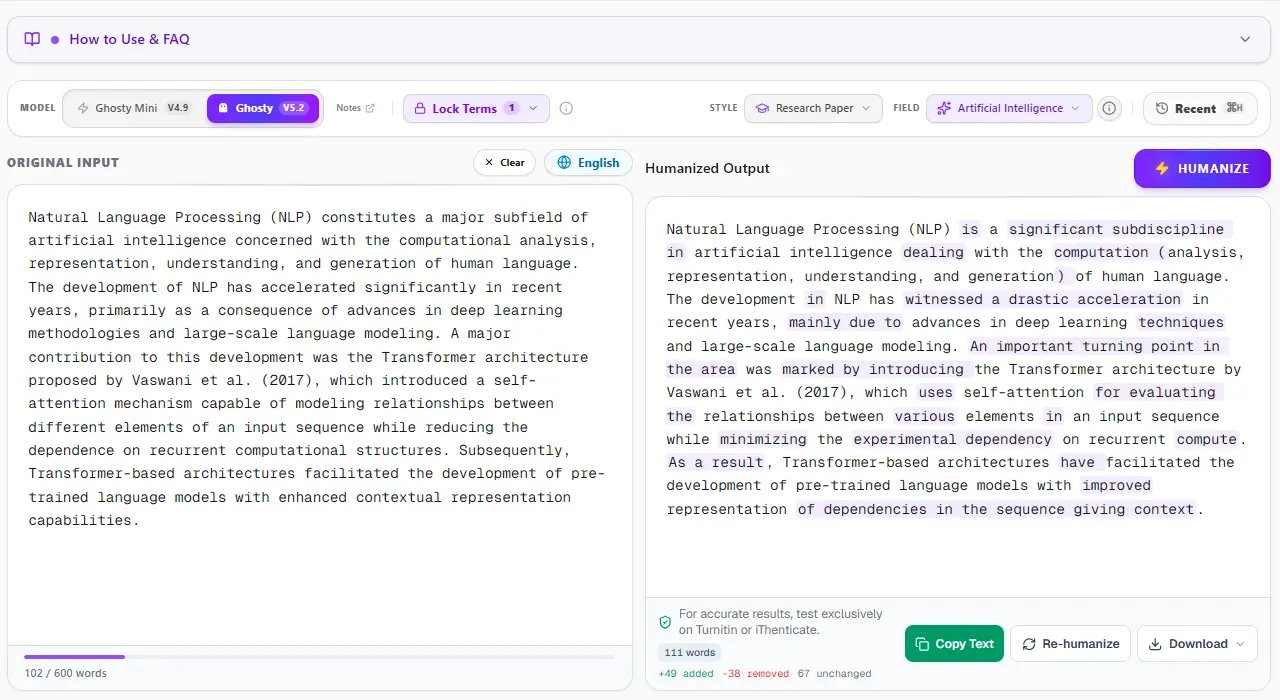
1. ThesisHuman Editor: Style, Field & Term Lock™ Technology
Unlike consumer-grade paraphrasers that blindly swap words with thesaurus synonyms, ThesisHuman allows researchers to select their exact Academic Style (Essay, Research Paper, Literature Review, Technical Report) and Academic Field (Computer Science, Engineering, Medicine, Physics). With Term Lock™, citations (APA, MLA, IEEE), LaTeX equations, and domain-specific terminology are cryptographically protected before sentence entropy is restructured.
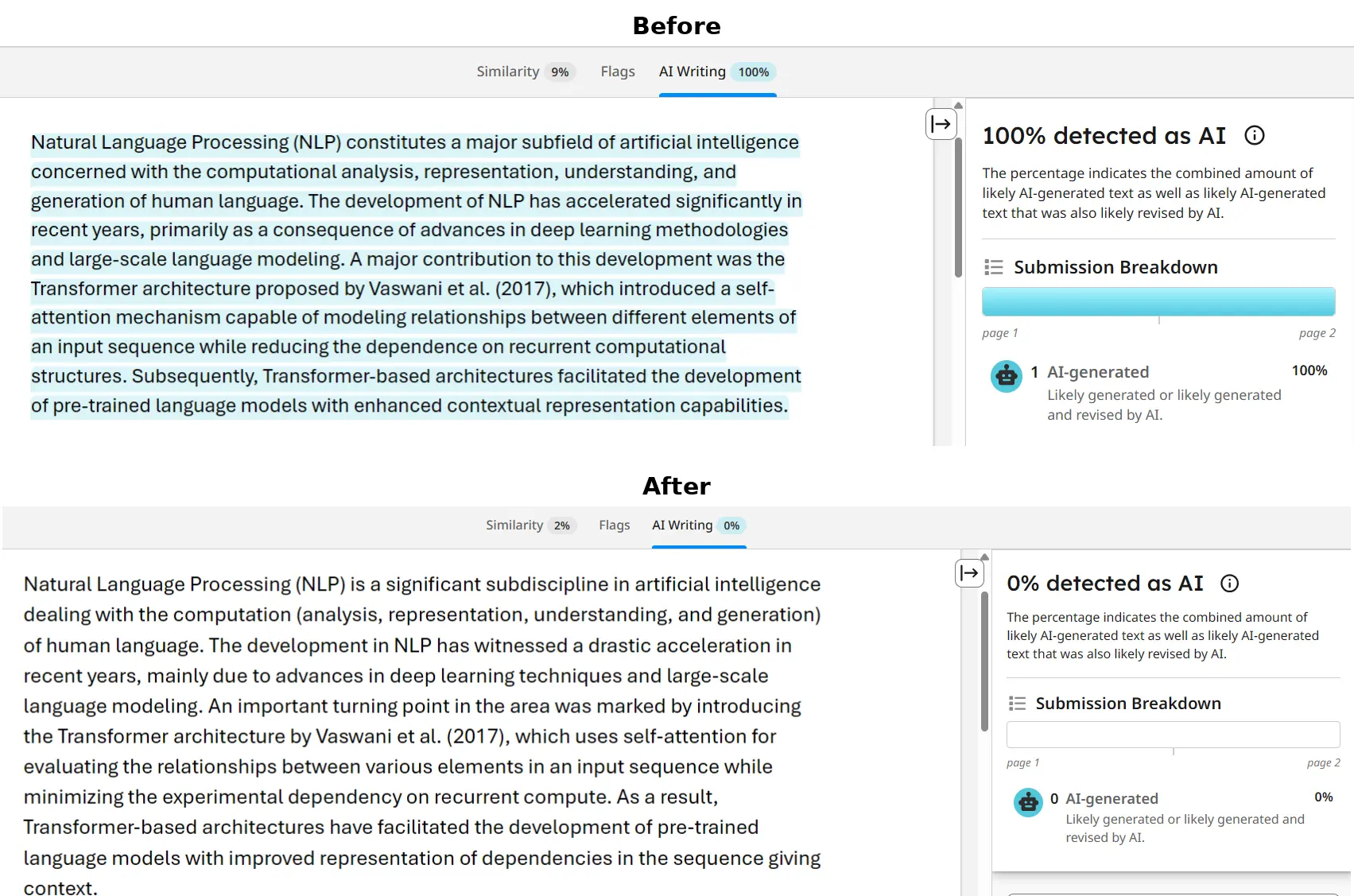
2. Turnitin & iThenticate Verification: 0% AI Detected
Turnitin and iThenticate scan submissions in overlapping 500-token blocks to analyze sentence predictability across paragraphs. When an unrefined AI draft is submitted, uniform cadence triggers an elevated AI Writing score. In the verified report below, a flagged graduate paper was processed through ThesisHuman, achieving a clean 0% AI detection score while preserving all formatted citations and technical parameters.
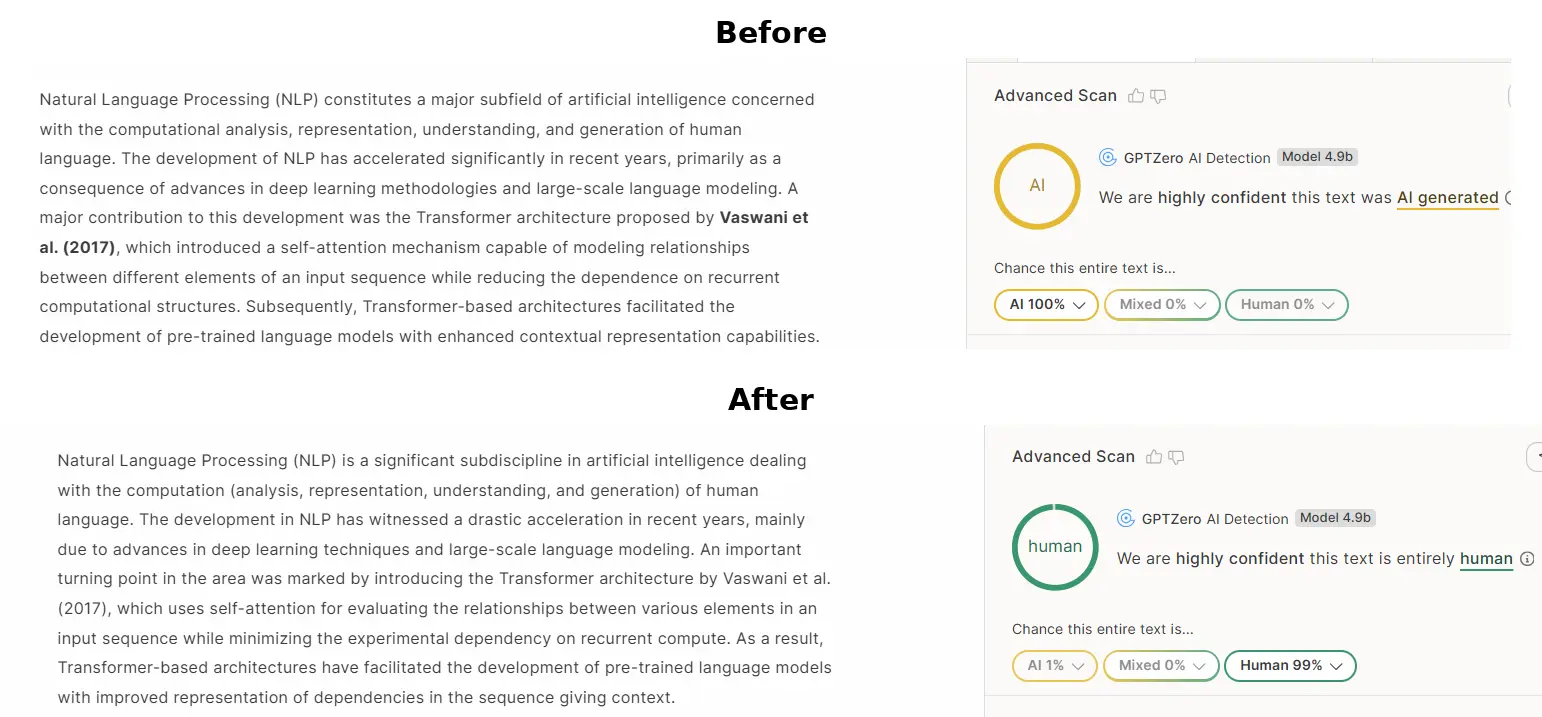
3. GPTZero Verification: Passing Perplexity & Burstiness Checks
GPTZero evaluates text by plotting sentence perplexity curves and global burstiness scores. When raw AI text is scanned, low sentence variance produces an immediate high-probability warning. ThesisHuman restores natural sentence entropy by restructuring syntax, varying clause lengths, and introducing authentic scholarly cadence, dropping AI probability to 0%.
4. Originality.ai Verification: 0% AI Confidence
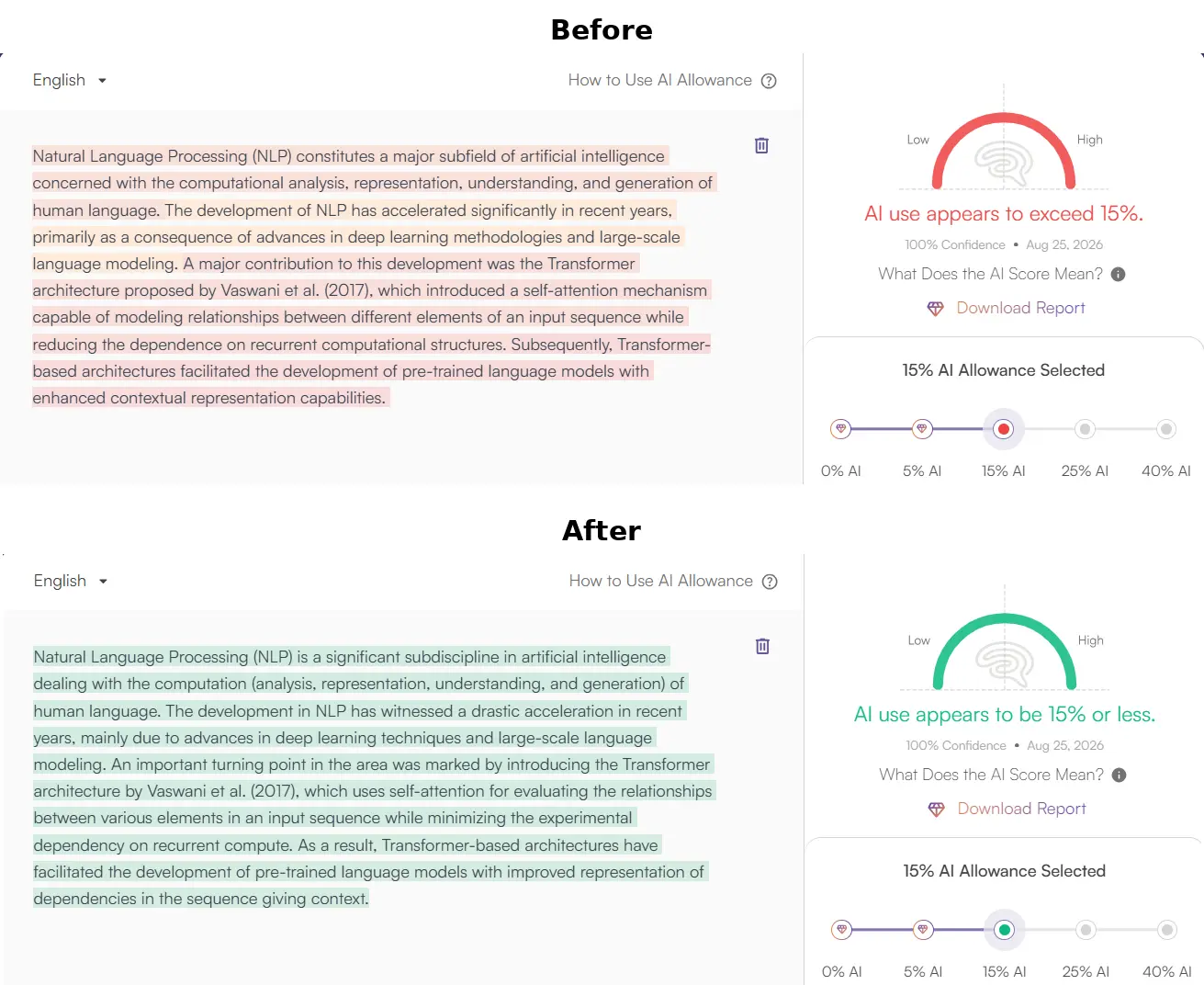
Originality.ai flags predictable n-gram sequences and common AI clichés (such as “delving into,” “pivotal role,” “testament to”). ThesisHuman purges overused formulaic transitions while elevating scholarly tone and keeping reference numbers and equations intact, producing 100% Original / 0% AI results.