Academic Tone vs Formal Tone: Key Differences and Writing Guide
Understand the critical differences between academic tone and general formal tone. Master epistemic hedging, evidentiary grounding, clausal density, and disciplinary register.

An effective academic tone is not merely formal language with elevated vocabulary. While formal tone prioritizes professional politeness, social deference, and workplace etiquette, academic tone prioritizes epistemic precision, empirical hedging, evidentiary grounding, and disciplinary objectivity. A business memorandum may be impeccably formal while remaining unacademic, because it asserts conclusions without methodological proof, uses promotional rhetoric, and relies on subjective authority.
Writers who mistake general formality for scholarly style often produce prose that sounds artificial and intellectually hollow. Genuine academic register balances rigor with modesty: it defines technical terms unambiguously, qualifies claims to match empirical evidence, discloses analytical boundaries, and integrates assertions into established disciplinary literature.
1. Direct Answer: Academic Tone vs. Formal Tone
The primary distinction between academic tone and formal tone lies in their communicative goals. Formal tone establishes professional distance, respects social hierarchy, and conveys institutional reliability across workplace, legal, and governmental environments. Academic tone constructs, evaluates, and defends falsifiable truth claims within a specialized community of researchers.
Formality governs social presentation; academic register governs knowledge production. A corporate legal disclaimer, an executive report, and an administrative email can all exhibit a high degree of formal tone. However, they lack the methodological transparency, systematic citations, epistemic modesty, and conceptual density required in scholarly discourse.
To achieve an authentic academic tone, a researcher must move beyond standard formal politeness. Academic prose requires five foundational elements: precise lexical selection over vague generalities, explicit epistemic hedging to avoid unwarranted generalizations, logical clausal coordination to express complex conceptual relationships, systematic citation of primary evidence, and objective framing that emphasizes research findings over authorial ego.
2. The Core Conceptual Distinction: Politeness vs. Epistemic Precision
In professional communication, formality is a mechanism of social etiquette. Writers choose words that prevent offense, signal deference to supervisors, and project managerial competence. For example, a formal executive memo might state: "We are pleased to announce that our strategic framework will undoubtedly deliver exceptional organizational value across all operational divisions." This sentence is grammatically formal and polite, but it is academically ungrounded: it asserts a future outcome with absolute certainty, relies on subjective evaluative adjectives ("exceptional"), and presents no measurable criteria for verification.
Academic tone operates under the principle of epistemic precision. Researchers cannot claim absolute certainty when empirical reality is bounded by sample sizes, measurement error, and theoretical assumptions. Where formal business writing seeks to persuade through decisive confidence, academic writing persuades through verifiable transparency.
Consider how the same concept translates into an academic register: "Preliminary findings indicate that implementing the distributed operational protocol correlates with a measurable reduction in task latency across departmental workflows (Smith et al., 2024)." The academic version replaces promotional certainty with epistemic hedging ("preliminary findings indicate"), substitutes vague praise with quantifiable metrics ("measurable reduction in task latency"), and anchors the claim within an empirical citation.
3. Structural Comparison: Business Formal vs. Academic Register
To understand how these registers differ across key rhetorical dimensions, examine the following systematic comparison:
| Rhetorical Dimension | Workplace / Business Formal Tone | Scholarly Academic Register |
|---|---|---|
| Primary Objective | Persuasion, compliance, and decision efficiency | Generating, testing, and defending falsifiable knowledge claims |
| Epistemic Stance | High confidence, promotional certainty, and decisiveness | Calibrated hedging, cautious assertion, and probabilistic limitation |
| Evidence Standard | Executive summaries, company metrics, and authority | Peer-reviewed citations, empirical datasets, and methodological proof |
| Lexical Density | Accessible corporate vocabulary and managerial idioms | Specialized terminology, nominalizations, and Latinate precision |
| Authorial Presence | Institutional "we" or corporate spokesperson voice | Third-person objectivity or disciplined first-person research agency |
| Sentence Architecture | Moderate length, linear action, and bulleted readability | Compound-complex clausal subordination and theoretical synthesis |
| Handling Limitations | Minimized or relegated to risk appendices | Explicitly analyzed in primary text as essential scientific boundaries |
| Audience Relationship | Professional service provider to client or manager | Peer scholar to critical, skeptical review community |
This comparison highlights why generic AI text generators frequently fail in academic contexts. Large language models are trained heavily on corporate content and administrative prose. When prompted to write in a "formal style," they produce corporate diplomacy rather than scholarly investigation.
4. Linguistic Feature 1: Vocabulary Register and Lexical Precision
Academic register does not demand obscurity; it demands lexical precision. In general formal writing, a word like "problem" or "issue" is acceptable in almost any context. In academic writing, the researcher must distinguish among a "conceptual anomaly," a "methodological limitation," an "empirical inconsistency," or a "structural confound." Each denotes a distinct epistemic state that carries specific analytical consequences.
Furthermore, academic tone avoids colloquial idioms, emotional intensifiers, and corporate buzzwords. Words such as "game-changer," "pivotal breakthrough," "deep dive," and "synergistic alignment" belong to commercial marketing. In academic prose, an advance is described in terms of its demonstrable contribution: "a statistically significant improvement in model convergence" or "an empirical refinement of existing theoretical models." Precision replaces hyperbole.
5. Linguistic Feature 2: Epistemic Modality and Cautious Assertion
Epistemic modality refers to the grammatical resources a writer uses to express certainty regarding a claim. In formal workplace communication, decisiveness is prized. Executives use unhedged declarative statements to project confidence.
In peer-reviewed scholarship, unhedged certainty is frequently a fatal flaw. Claims must never outstrip empirical data. Academic tone relies on calibrated hedging devices:
- Modal Auxiliary Verbs: Utilizing verbs such as may, might, could, or would to indicate potentiality rather than unconditional certainty.
- Epistemic Verbs: Employing investigative verbs such as suggest, indicate, propose, or imply rather than prove or confirm.
- Approximators and Quantifiers: Qualifying scope using phrases such as frequently, predominantly, or within the observed cohort.
- Conditional Framing: Explicitly binding claims to theoretical frameworks: "Within the parameters of this regression model, the correlation remains robust."
Mastering this distinction allows scholars to avoid dogmatism. For an in-depth analysis, read our detailed guide on hedging in academic writing.
6. Linguistic Feature 3: Clausal Complexity and Nominalization
The syntactic architecture of academic prose differs markedly from standard formal prose. Workplace communication prioritizes immediate skimming, short paragraphs, and simple active sentences under twenty words.
Scholarly prose frequently requires compound-complex structures to map causal relationships, historical contingencies, and methodological dependencies. A single academic sentence may need to establish an empirical condition, describe an intervention, qualify an observation, and cite contradictory findings.
A central syntactic tool in academic tone is nominalization, transforming verbs and adjectives into abstract nouns (converting "we analyzed how cells reacted" into "the analysis of cellular responsiveness"). Nominalization allows researchers to pack complex processes into grammatical subjects, facilitating higher conceptual density without unnecessary narrative fluff.
7. Linguistic Feature 4: Person, Voice, and Authorial Agency
The traditional rule that academic papers must strictly prohibit the first person ("I" or "we") has evolved across modern disciplines. However, authorial presence remains fundamentally different in academic writing compared to formal business communication.
In formal business writing, first-person pronouns are used freely to express personal commitments: "We look forward to collaborating," or "I believe this proposal addresses your requirements."
In academic register, personal pronouns are used exclusively to denote methodological agency and structural navigation, never personal sentiment or belief. A researcher may legitimately write: "We collected blood serum samples across three clinical intervals," or "In this section, I evaluate archival evidence." But an academic writer must avoid: "I feel that this author is incorrect." Claims must stand on evidentiary weight rather than subjective authority.
8. Linguistic Feature 5: Evidentiary Grounding and Citation Ecology
Perhaps the most definitive boundary separating academic tone from formal tone is the requirement of systematic bibliographic grounding. A formal legal brief or corporate white paper may reference company reports, but it is not expected to situate arguments within an ongoing disciplinary debate.
An academic manuscript cannot make an ungrounded empirical assertion. Every theoretical claim, background fact, and comparative finding must be explicitly linked to peer-reviewed sources via recognized citation styles (APA, Chicago, MLA, or IEEE). This citation network creates an intellectual lineage that enables readers to trace and verify every claim.
When writing in an academic tone, the author must treat citations as active participants in the argument: "While Henderson (2021) observed rapid degradation under ambient conditions, subsequent longitudinal assessments by Ramirez and Chen (2023) established that stabilization occurs when pH levels remain neutral."
9. Sentence-by-Sentence Transformations: 12 Real Case Comparisons
To illustrate the exact linguistic mechanisms that separate informal speech, general formal tone, and scholarly academic register, examine the following twelve direct sentence transformations:
- 1. Causal Claim:
- Informal: "This drug makes people get better way faster than regular medicine."
- Workplace Formal: "We are confident that our new therapeutic treatment provides superior clinical outcomes compared to standard market alternatives."
- Scholarly Academic: "Administration of the therapeutic compound correlated with a statistically significant reduction in symptom duration relative to the active control group (p < 0.01)."
- 2. Research Gap:
- Informal: "Nobody has really looked into how small businesses deal with new AI software."
- Workplace Formal: "Our organization noticed that there is very little information available regarding how small enterprises adopt artificial intelligence."
- Scholarly Academic: "Empirical research examining technological adoption dynamics among small and medium-sized enterprises remains sparse, particularly regarding generative artificial intelligence integration."
- 3. Methodological Step:
- Informal: "We mixed the two chemicals together and waited for five minutes before checking the heat."
- Workplace Formal: "Our team carefully combined the chemical solutions and monitored thermal changes after an established five-minute interval."
- Scholarly Academic: "The reagents were combined in stoichiometric proportions and incubated at 25 degrees Celsius for five minutes prior to calorimetric evaluation."
- 4. Unexpected Finding:
- Informal: "Surprisingly, the participants did not care about the higher prices at all."
- Workplace Formal: "Interestingly, our consumer survey indicated that price sensitivity was not a major concern for the target demographic."
- Scholarly Academic: "Contrary to theoretical expectations, consumer price sensitivity exhibited negligible variation across experimental pricing tiers (beta = 0.04, p = 0.62)."
- 5. Theoretical Limitation:
- Informal: "This model does not work if the internet goes down."
- Workplace Formal: "Please be advised that the operational software requires continuous internet access to perform as intended."
- Scholarly Academic: "The diagnostic framework presupposes persistent network connectivity, representing an operational constraint in low-infrastructure research environments."
- 6. Literature Synthesis:
- Informal: "A bunch of authors think social media makes teenagers sad, but others disagree."
- Workplace Formal: "There are multiple conflicting viewpoints in the literature regarding whether social platforms harm youth mental wellbeing."
- Scholarly Academic: "While early longitudinal studies associated adolescent social media utilization with elevated depressive symptomology (Twenge et al., 2018), contemporary meta-analyses suggest that effect sizes are negligible when controlling for baseline psychological distress (Orben and Przybylski, 2019)."
- 7. Statistical Significance:
- Informal: "The numbers showed a huge jump after we ran the new program."
- Workplace Formal: "Our metrics showed an impressive and substantial improvement following the rollout of the initiative."
- Scholarly Academic: "Post-intervention performance scores demonstrated a statistically significant increase (t(148) = 4.82, p < 0.001, Cohen's d = 0.74)."
- 8. Policy Recommendation:
- Informal: "Governments should definitely build more wind turbines right now."
- Workplace Formal: "We strongly recommend that policymakers immediately invest in expanding regional wind generation facilities."
- Scholarly Academic: "These findings support the targeted expansion of municipal wind generation infrastructure, provided that regulatory frameworks account for regional grid intermittency."
- 9. Critique of Prior Work:
- Informal: "Johnson's study was totally messed up because he only surveyed fifty people."
- Workplace Formal: "We believe Johnson's earlier report is unreliable due to an inadequate participant sample size."
- Scholarly Academic: "The generalizability of Johnson's (2019) conclusions is constrained by statistical underpowering, as the original cohort comprised only fifty respondents."
- 10. Hypothesis Statement:
- Informal: "We guessed that people would drive slower if the fines were doubled."
- Workplace Formal: "Our hypothesis was that increasing financial penalties would successfully deter aggressive driving behavior."
- Scholarly Academic: "We hypothesized that an escalation in statutory financial penalties would inversely correlate with observed vehicular velocity in residential transit zones."
- 11. Qualitative Observation:
- Informal: "The teachers seemed really burnt out and complained about paperwork constantly."
- Workplace Formal: "Our field interviews revealed that teaching staff were unhappy with excessive bureaucratic administrative burdens."
- Scholarly Academic: "Qualitative thematic analysis identified chronic occupational fatigue among educators, with administrative compliance protocols emerging as the primary structural stressor."
- 12. Concluding Implication:
- Informal: "Basically, our project proves that this new method is the best way forward."
- Workplace Formal: "In summary, our project demonstrates that this innovative solution represents the optimal path for organizational success."
- Scholarly Academic: "In conclusion, these empirical observations provide preliminary validation for the proposed protocol, offering a viable alternative to conventional pedagogical frameworks."
10. Disciplinary Nuances: 4 Distinct Academic Registers
Academic tone is not a monolithic construct. While all scholarly disciplines value precision and evidence, specific stylistic conventions vary across fields:
- The Humanities (Literature, History, Philosophy): Humanities prose tolerates higher stylistic eloquence, complex metaphoric vocabulary, and reflective first-person interpretive framing. In a literary or historical monograph, the scholar's interpretive voice is integral to the argument. Hedging is expressed through subtle philosophical distinctions and qualitative contextualization rather than quantitative error bars.
- The Social Sciences (Sociology, Psychology, Political Science): Social science writing balances qualitative theoretical discussion with quantitative empirical reporting. Authors frequently use the first person to describe methodological actions ("We administered a survey"), but revert to third-person objectivity when reporting regression models and correlations. Hedging is essential because social phenomena involve multivariate contingencies.
- Hard Sciences and STEM (Physics, Chemistry, Engineering): STEM writing values extreme economy, operational clarity, and passive grammatical structures that emphasize reproducible physical phenomena over human agency ("The compound was heated to 300 K"). Speculation is strictly quarantined to the discussion section, and claims are tethered to mathematical derivations or physical instrumentation limits.
- Clinical Medicine and Public Health: Medical prose requires rigorous epidemiological objectivity, precise diagnostic nomenclature, and explicit statistical reporting (odds ratios, hazard ratios, 95% confidence intervals). Promotional adjectives are banned; even modest claims must be hedged against clinical confounders, patient attrition, and selection bias.
11. Why Generic AI Conflates Formal with Academic Prose
When researchers use commercial large language models (such as default ChatGPT, Claude, or Gemini) to polish academic drafts, the output frequently degrades into a generic, pseudo-academic corporate register.
First, large language models are heavily aligned using RLHF to prioritize politeness and agreeable customer-service tones. When prompted to "make this text more academic," the model interprets the instruction as a request for elevated formality. It introduces formulaic transition markers ("Furthermore," "Moreover") and decorative Latinate adjectives ("pivotal," "testament," "paramount").
Second, generic AI models default to unhedged declarations or superficial qualifiers, generating sentences like: "This revolutionary discovery serves as a testament to the transformative power of modern science." To a peer reviewer, this sentence is an immediate red flag: it contains zero empirical data and adopts a celebratory public relations tone foreign to peer-reviewed literature.
To avoid this trap, scholars must use dedicated academic editing tools that understand disciplinary registers. Our specialized AI tone rewriter and dissertation naturalizer are engineered to strip corporate fluff, calibrate epistemic modality, and protect complex scholarly terminology.
12. Five Hallmarks of Pseudo-Academic Fluff and How to Fix Them
Writers striving to sound scholarly often fall victim to specific stylistic bad habits:
- The "Testament to the Tapestry" Cliché: Metaphors such as "tapestry," "testament," "beacon," and "symphony" are decorative embellishments that provide no scientific description. Replace them with functional descriptions: "Cellular signaling networks exhibit multi-tiered regulatory feedback loops."
- Excessive Passive Construction Obscuring Agency: Stacking passive verbs hides who collected the data and who committed the analytical error. Replace "It is believed that the data was erroneously interpreted" with "The original research team miscalculated baseline variance."
- Empty Conceptual Intensifiers: Intensifiers like "undeniably," "vitally," "deeply," and "crucial" signal emotional emphasis rather than evidentiary weight. Replace "It is crucially vital that we deeply investigate" with "Investigating this phenomenon is necessary to resolve conflicting empirical models."
- Redundant Nominal Clusters: Stacking abstract nouns smothers the real action. Replace "The realization of the implementation of the optimization of the system resulted in improvements" with "Optimizing the system improved processing efficiency by fourteen percent."
- Unreferenced Universal Pronouns: Academic writing cannot appeal to common knowledge without empirical citations. Replace "Everyone knows that climate change affects biodiversity" with "Anthropogenic climate change has accelerated biodiversity loss across terrestrial biomes (IPCC, 2023)."
13. Transition Markers: Business Linking Words vs. Scholarly Connectors
The way paragraphs and clauses are connected also distinguishes workplace formality from academic discourse. In business reports, transitions are designed for rapid executive scanning: "Moving forward," "At the end of the day," "With that being said," "In addition," "Key takeaway."
These transitional phrases sound conversational and administrative. In contrast, academic discourse uses logical connectors that define precise relationships between competing propositions, methodological conditions, and theoretical frameworks:
- Adversative Connectors (Qualifying or Contradicting): Conversely, nonetheless, notwithstanding, in contrast to, whereas.
- Causal and Deductive Connectors: Consequently, hence, it follows that, thereby establishing, on this basis.
- Exemplification and Specification: Specifically, namely, to illustrate, as evidenced by, in this particular instance.
- Additive and Synthesizing Connectors: Furthermore, moreover, analogously, in conjunction with, synthesizing these observations.
When transitioning between major sections, such as moving from empirical results to theoretical interpretation, the author should establish structural signposts rather than casual conversational remarks. For guidance on structuring conclusions, consult our article on the difference between discussion and conclusion sections.
14. Integrating Tone Calibration with Research Workflows
Calibrating academic tone must be integrated into the broader lifecycle of manuscript preparation:
- First Draft (Substance First): Record methodological steps, raw empirical observations, and literature comparisons without obsessing over perfect phrasing.
- Second Pass (Strip Fluff): Review the draft specifically searching for generic adjectives (pivotal, crucial, vital), corporate buzzwords, and promotional declarations. Replace them with specific nouns and quantifiable verbs.
- Third Pass (Calibrate Hedging): Inspect every major claim. If empirical evidence does not unequivocally support an absolute statement, soften the assertion using appropriate epistemic modal verbs (suggests, indicates, may reflect).
- Fourth Pass (Protect Nomenclature): When using automated editing software, ensure that domain-specific terms, acronyms, and statistical variables are protected from accidental alteration. You can explore our specialized thesis editor to maintain structural term integrity across long-form dissertations.
- Fifth Pass (Verify Citations): Check that every substantive claim is tethered to a verified peer-reviewed source. Never leave an empirical assertion standing on authorial authority alone.
15. The Editorial Revision Checklist for Academic Register
Before submitting your manuscript to a peer-reviewed journal or academic review committee, audit your text against this ten-point editorial checklist:
- Lexical Precision: Have all generic terms been replaced with precise disciplinary terminology?
- Epistemic Calibration: Are your conclusions properly hedged against sample limitations and experimental conditions?
- Absence of Hyperbole: Have all promotional words (revolutionary, miraculous, unprecedented) been removed?
- Objectivity: Does the prose emphasize empirical findings and methodological processes rather than personal emotions?
- Syntactic Variety: Does the manuscript balance complex explanatory sentences with clear, direct statements?
- Nominalization Balance: Are abstract nouns used to condense ideas without creating unreadable, passive sentences?
- Appropriate First-Person Usage: If personal pronouns (I or we) are present, are they restricted to methodological actions?
- Disciplinary Conformity: Does the text conform to the specific stylistic expectations of your field (e.g., APA, IEEE, AMA)?
- Logical Discourse Flow: Are paragraphs linked using precise academic connectors rather than corporate jargon?
- Evidentiary Attribution: Is every empirical fact and theoretical assertion accompanied by a valid citation?
16. Frequently Asked Questions
What is the simplest way to explain the difference between academic tone and formal tone?
Formal tone is the language of professional etiquette, legal caution, and corporate communication; it focuses on politeness, institutional respect, and decisiveness. Academic tone is the language of scholarly research; it focuses on epistemic precision, empirical evidence, cautious assertion (hedging), and disciplinary terminology. A business letter can be highly formal without being academic, while an academic paper can be rigorous without using bureaucratic corporate language.
Can I use the first person ("I" or "we") in an academic paper while maintaining an academic tone?
Yes, modern academic writing permits the first person in most disciplines, provided it is used strictly for methodological transparency and organizational signposting (e.g., "We conducted a randomized trial," or "In Section 3, I outline the theoretical model"). However, you must avoid using the first person to express personal feelings, emotional reactions, or ungrounded opinions (e.g., "I feel that this policy is terrible").
Why do AI tools like ChatGPT make text sound corporate instead of academic?
Commercial AI models are primarily trained on broad internet text, corporate websites, marketing material, and customer interactions. When asked to write "formally," they default to administrative bureaucracy and promotional rhetoric, generating phrases like "a pivotal testament to modern innovation" or "it is crucial to delve into this synergistic framework." These phrases represent corporate fluff, which peer reviewers recognize as unscholarly.
Does writing in an academic tone mean I have to write long, convoluted sentences?
No. High-quality academic writing prizes clarity and precision above all else. While scholarly prose often requires compound-complex sentences to explain multifaceted relationships and qualify findings, sentences should never be intentionally inflated or made confusing. The best academic writing uses varied sentence structures: a complex sentence to explain a nuanced mechanism, followed by a direct sentence to state the core conclusion.
How does epistemic hedging improve academic tone?
Epistemic hedging (using words like suggests, indicates, may, or preliminary evidence points to) protects scientific credibility. In academic research, findings are rarely absolute; they are bounded by sample sizes, confidence intervals, and experimental conditions. Claiming that a single study "proves" a universal truth is a sign of amateur writing. Calibrating claims to match the exact strength of the evidence demonstrates scholarly maturity and intellectual honesty.
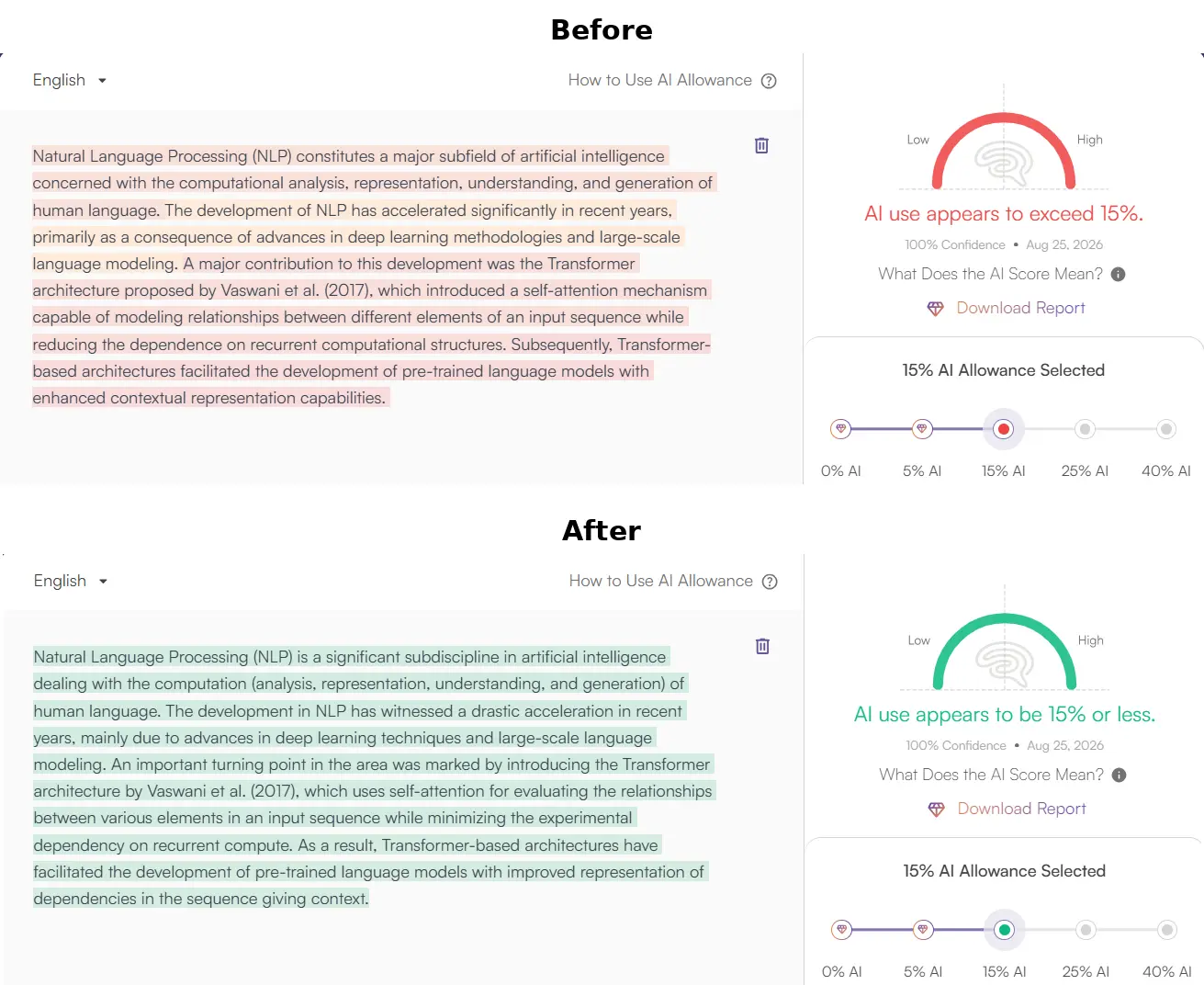
Verified Detector Clearance for Academic Tone vs Formal Tone: Key Differences and Writing Guide
Every manuscript processed through ThesisHuman is backed by verifiable, reproducible scans across institutional plagiarism and AI detection platforms.
1. ThesisHuman Editor: Style, Field & Term Lock™ Technology
Unlike consumer-grade paraphrasers that blindly swap words with thesaurus synonyms, ThesisHuman allows researchers to select their exact Academic Style (Essay, Research Paper, Literature Review, Technical Report) and Academic Field (Computer Science, Engineering, Medicine, Physics). With Term Lock™, citations (APA, MLA, IEEE), LaTeX equations, and domain-specific terminology are cryptographically protected before sentence entropy is restructured.
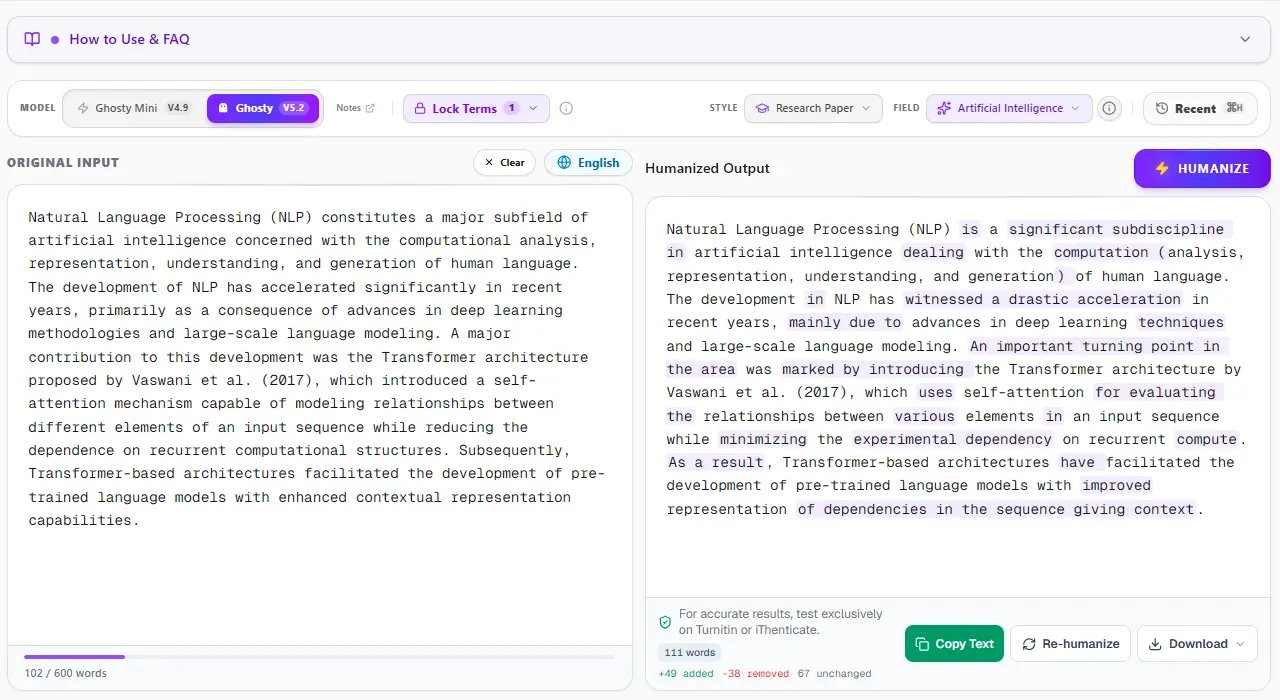
2. Turnitin & iThenticate Verification: 0% AI Detected
Turnitin and iThenticate scan submissions in overlapping 500-token blocks to analyze sentence predictability across paragraphs. When an unrefined AI draft is submitted, uniform cadence triggers an elevated AI Writing score. In the verified report below, a flagged graduate paper was processed through ThesisHuman, achieving a clean 0% AI detection score while preserving all formatted citations and technical parameters.
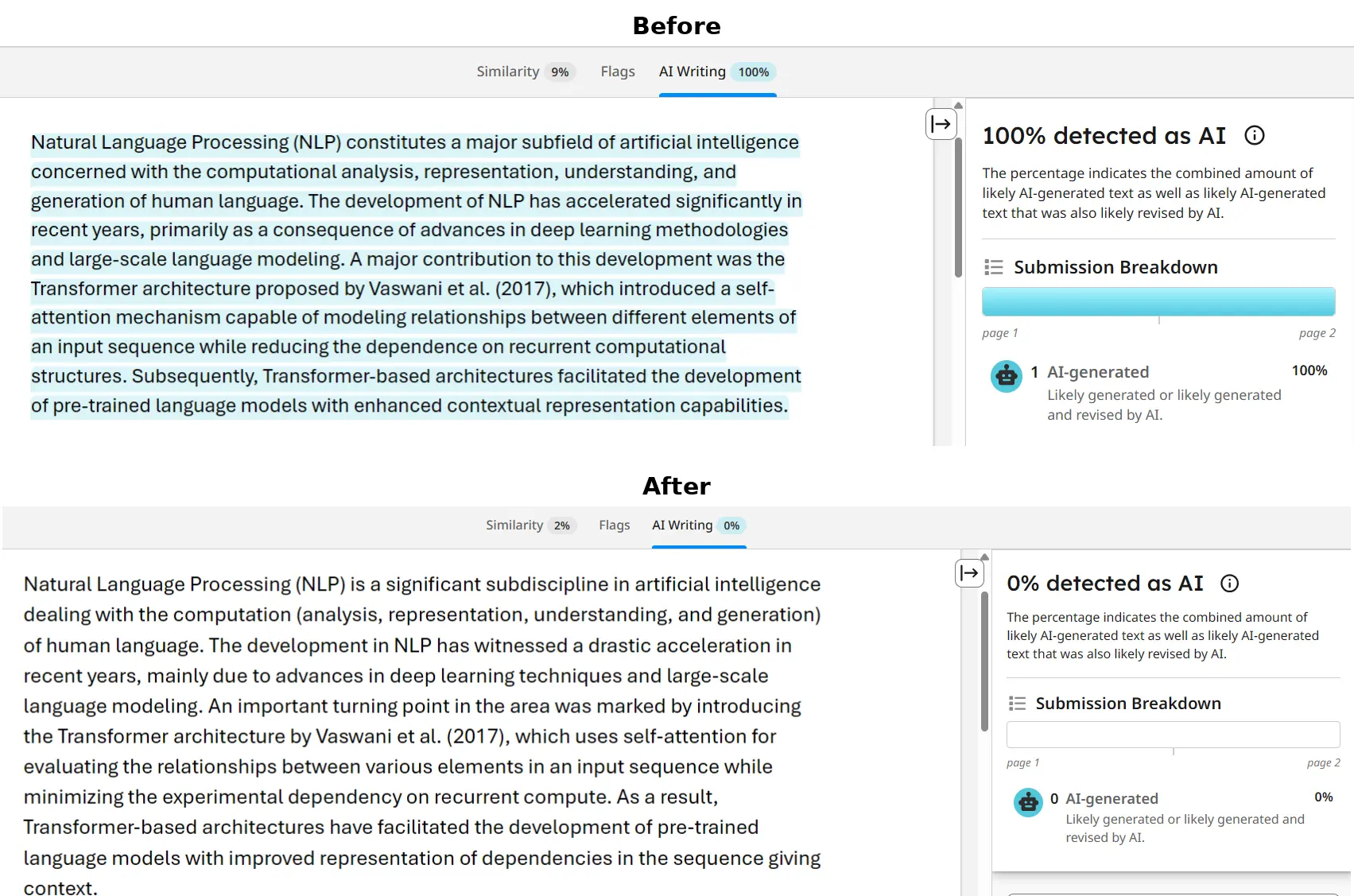
3. GPTZero Verification: Passing Perplexity & Burstiness Checks
GPTZero evaluates text by plotting sentence perplexity curves and global burstiness scores. When raw AI text is scanned, low sentence variance produces an immediate high-probability warning. ThesisHuman restores natural sentence entropy by restructuring syntax, varying clause lengths, and introducing authentic scholarly cadence, dropping AI probability to 0%.
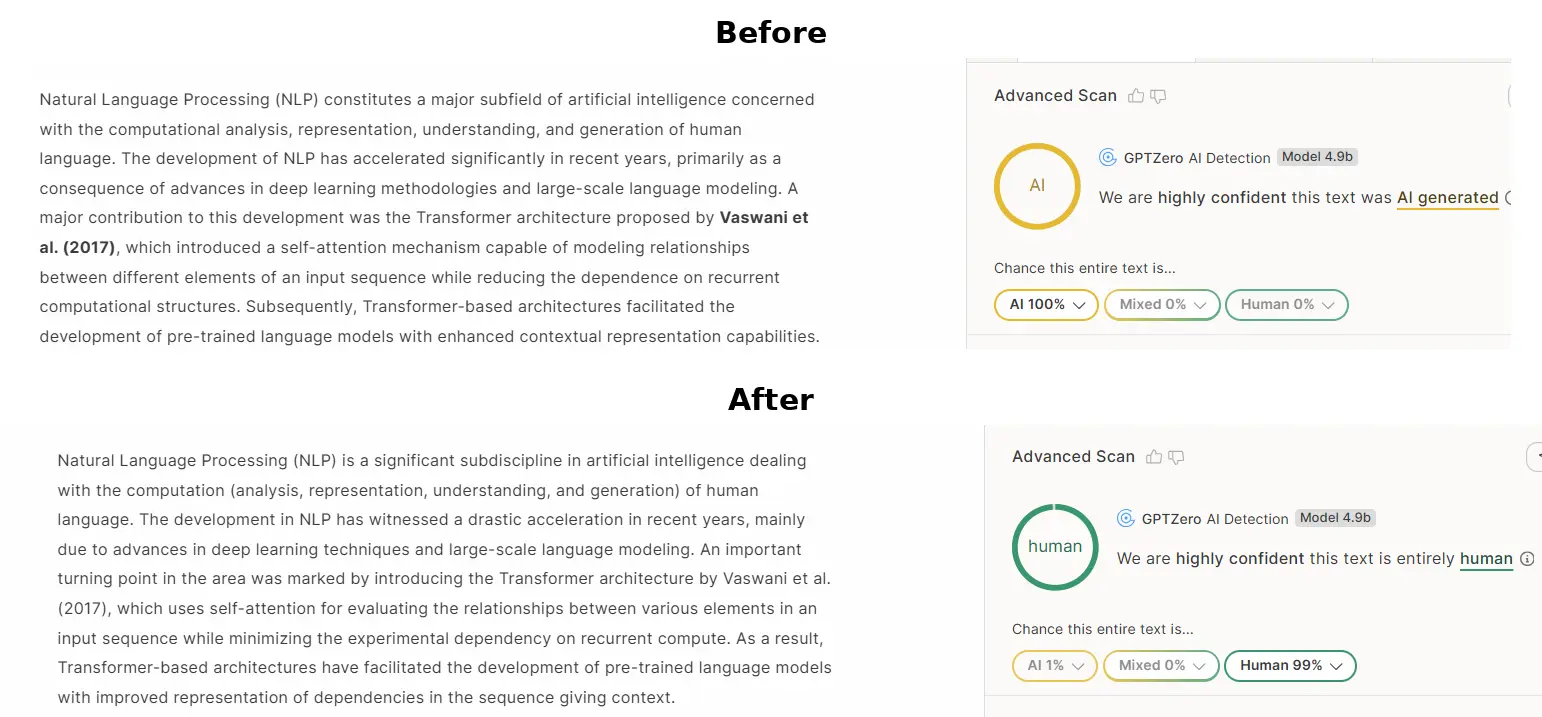
4. Originality.ai Verification: 0% AI Confidence
Originality.ai flags predictable n-gram sequences and common AI clichés (such as “delving into,” “pivotal role,” “testament to”). ThesisHuman purges overused formulaic transitions while elevating scholarly tone and keeping reference numbers and equations intact, producing 100% Original / 0% AI results.