How to Revise AI-Assisted Manuscripts for Academic Journals
A comprehensive guide to revising AI-assisted research manuscripts for peer-reviewed journal submission. Navigate publisher AI policies, eliminate hallucinations, calibrate hedging, and prepare compliant disclosure statements.

The integration of large language models into scientific research has fundamentally transformed manuscript drafting. Researchers routinely utilize artificial intelligence to synthesize literature notes, translate non-native prose into fluent English, restructure cumbersome paragraphs, and format code. However, submitting an AI-assisted manuscript to a peer-reviewed journal without rigorous, structured revision introduces severe ethical, legal, and editorial risks.
Major scholarly publishers including Elsevier, Springer Nature, IEEE, and Wiley have enacted strict policies governing generative artificial intelligence. These publishers hold authors legally and intellectually accountable for every word, formula, and reference in their submitted papers. When manuscripts containing unrevised AI output reach editorial desks, they are routinely desk-rejected for fabricated citations, statistical drift, generic promotional hyperbole, or failure to disclose AI tools transparently.
Revising an AI-assisted manuscript is not a superficial matter of running a basic grammar checker or swapping synonyms. It is an intensive editorial audit that verifies empirical truth, restores disciplinary voice, calibrates scientific modesty, and guarantees full compliance with Committee on Publication Ethics (COPE) guidelines. This comprehensive guide outlines the systematic methodology required to prepare an AI-assisted manuscript for successful peer review.
1. Direct Answer: The Five Rules of Journal-Compliant AI Revision
To navigate journal peer review successfully when utilizing artificial intelligence during manuscript preparation, authors must adhere to five non-negotiable editorial rules:
- Verify Every Single Citation Against Primary Databases: Generative models routinely hallucinate fictitious DOIs, combine real authors with invented titles, or cite papers for findings they never contained. Never submit a reference you have not personally verified in PubMed, Scopus, Web of Science, or IEEE Xplore.
- Audit Numerical and Statistical Consistency: Large language models treat numbers as linguistic tokens rather than mathematical values. When rephrasing results sections, AI often rounds p-values erroneously, reverses confidence intervals, or alters decimal points.
- Strip Synthetic Stylistic Markers and Hyperbole: Automated drafting introduces identifiable linguistic patterns, including excessive transition markers (Furthermore, Moreover, In conclusion), decorative Latinate adjectives (pivotal, testament, delve, beacon), and empty promotional praise. Replace them with rigorous disciplinary terminology.
- Calibrate Epistemic Hedging to Match Observed Data: AI models default to either unwarranted absolute certainty (proves conclusively) or repetitive superficial caveats. Ensure claims accurately reflect your experimental sample size, effect size, and analytical boundaries.
- Draft a Transparent, Venue-Compliant AI Disclosure Statement: Almost every major scientific publisher requires an explicit declaration detailing which AI tools were used, the exact version or model, and the precise purpose of the assistance. Concealing AI use is an ethical violation that can trigger paper retraction.
2. Current Publisher AI Policy Matrix: Elsevier, Nature, IEEE, and Wiley
Scholarly publishers have established clear, binding policies regarding the acceptable boundaries of generative artificial intelligence in manuscript preparation. While nuanced variations exist, they share a universal consensus on core ethical principles:
| Publisher / Organization | Authorship Eligibility | Permitted Scope of AI Use | Mandatory Disclosure Requirement | Scientific Figures / Artwork |
|---|---|---|---|---|
| Elsevier | Strictly Prohibited (AI cannot be an author) | Language polishing and editorial clarity only | Mandatory declaration section at the end of the manuscript prior to References | Strictly Prohibited (Generative AI images are banned except in AI research) |
| Springer Nature | Strictly Prohibited (Cannot meet accountability criteria) | Drafting assistance and language translation | Must be documented in Methods section (or Acknowledgments if no Methods) | Strictly Prohibited (AI-generated photos and figures not permitted) |
| IEEE | Strictly Prohibited (Authors must approve final submission) | Editorial aid and linguistic refinement | Explicit disclosure in the Acknowledgment section including tool version | Prohibited unless specifically relevant to the technical study |
| Wiley | Strictly Prohibited (AI cannot be legally liable) | Writing assistance and stylistic improvements | Formal disclosure statement describing tools and specific prompts/roles | Prohibited from generating or altering diagnostic and scientific imagery |
| COPE Guidelines | Strictly Prohibited | Author-supervised writing assistance | Full transparency and complete author accountability for accuracy | Subject to publisher-specific image integrity and verification rules |
Across all major publishing houses, the baseline rule is absolute: artificial intelligence cannot be listed as an author because it cannot take legal or intellectual responsibility for the work. Authors retain total accountability for any plagiarism, fabrication, or copyright infringement introduced by generative software.
3. The Ethical Baseline: Authorship Accountability and COPE Guidelines
The Committee on Publication Ethics (COPE) position statement on artificial intelligence establishes that authorship implies intellectual ownership, accountability for data veracity, and legal responsibility for scientific integrity. Because an algorithmic tool cannot be sued, cannot hold copyright, cannot sign publishing agreements, and cannot face academic disciplinary proceedings, it can never meet the criteria for scholarly authorship.
This principle has profound practical consequences for authors submitting to peer-reviewed venues. If an AI tool introduces a fabricated quotation, distorts a statistical finding, or inadvertently reproduces copyrighted text from a training dataset, the human authors cannot claim algorithmic ignorance. In the eyes of journal editors and university integrity committees, submitting false AI-generated text is categorized as scientific misconduct, specifically falsification or plagiarism.
Therefore, revising an AI-assisted manuscript is not merely a stylistic exercise. It is a protective compliance protocol designed to ensure that human researchers can defend every sentence before an editorial board, peer reviewer, or doctoral defense committee.
4. Step 1: Verification of Factual Claims and Citation Grounding
The most dangerous failure mode of large language models in scientific writing is the generation of synthetic, hallucinated citations. LLMs operate by predicting statistically probable token sequences; when prompted for literature support, they frequently construct realistic-sounding citations that do not exist.
A classic hallucination pattern involves pairing the name of a prominent researcher with a plausible-sounding title and a real journal name, accompanied by an invalid DOI. In other cases, the paper exists, but the model attributes conclusions to it that the original authors never reached.
The Zero-Tolerance Citation Audit Protocol:
- Direct DOI and URL Verification: Copy every DOI in your reference list and test it directly in a browser. Every link must resolve to the official publisher article page.
- Title Search in Primary Indexes: Search the exact title in PubMed, Scopus, Google Scholar, or IEEE Xplore. If no index contains the paper, it must be removed immediately.
- Claim-to-Source Verification: Re-read the primary source to confirm that it actually supports the specific empirical assertion made in your sentence. Never rely on an AI summary of a paper.
- Reference Management Software Integration: Import verified primary sources into reference management software (such as Zotero or Mendeley) and regenerate citations automatically. For matrix-based literature tracking, consult our guide on using a literature review matrix template.
5. Step 2: Eliminating AI Stylistic Distortion and Formulaic Cadence
Generative AI models possess distinct linguistic signatures that experienced peer reviewers and journal editors identify immediately. While using AI for language polishing is permissible under publisher guidelines, submitting unrevised prose filled with robotic patterns damages scientific authority.
The AI Vocabulary Stripping List
Audit your manuscript and ruthlessly excise these ubiquitous AI words and phrases:
- Overused AI Verbs: Delve, underscore, foster, harness, leverage, unravel, shed light on.
- Decorative AI Adjectives: Pivotal, paramount, transformative, crucial, vital, intricate, multifaceted, groundbreaking.
- Formulaic AI Nouns: Tapestry, testament, beacon, nexus, realm, panacea, cornerstone.
- Generic Mechanical Transitions: Furthermore, Moreover, In addition, Additionally, It is important to remember that, In conclusion.
Worked Distortion Correction
- Raw AI Sentence: "This study delves into the multifaceted tapestry of epigenetic modifications, serving as a pivotal testament to the crucial role that environmental exposures play in human oncology."
- Distortion Analysis: Contains five classic AI clichés ("delves into", "multifaceted tapestry", "pivotal testament", "crucial role"). It provides zero empirical specificity and reads like promotional marketing.
- Revised Academic Sentence: "This investigation evaluated how sustained occupational chemical exposures altered DNA methylation profiles across cohort participants diagnosed with non-small-cell lung carcinoma."
6. Step 3: Statistical and Quantitative Data Integrity
When authors feed raw experimental data, tables, or notes into large language models to generate results paragraphs, the models frequently introduce subtle mathematical distortions. Because LLMs lack deterministic computational logic, they manipulate numbers as probabilistic text strings.
Critical Numerical Hazards to Check:
- Reversal of Statistical Inequalities: An AI tool may rewrite p < 0.05* as *p > 0.05 or mistakenly report a trend toward significance as non-significant.
- Distortion of Confidence Intervals: Models frequently transpose upper and lower bounds or alter decimal precision (e.g., converting a 95% CI of [1.14, 2.89] into [1.4, 2.9]).
- Sample Size Discrepancies: Ensure patient, animal, or survey respondent totals remain consistent across text, tables, and supplementary data files.
- Unit and Dimensional Drift: Verify that metric units (mg/dL, micromolar, kilopascals) have not been inadvertently converted or dropped during rephrasing.
Worked Statistical Preservation Example
- Raw AI Output: "The drug showed strong efficacy, with roughly 45% of patients responding well (p was around 0.04) and survival times doubling across most groups."
- Flawed AI Distortion: The word "roughly," the approximate p-value, and the vague phrase "responding well" violate scientific reporting standards.
- Revised Scholarly Sentence: "The experimental therapeutic achieved an objective response rate of 44.8% (95% CI: 38.2%-51.6%), correlating with a statistically significant extension in median progression-free survival (hazard ratio = 0.58; p = 0.038)."
7. Step 4: Calibrating Epistemic Modality and Removing Hyperbole
Peer-reviewed scientific journals demand extreme modesty when interpreting experimental findings. AI drafting tools, by contrast, frequently inject promotional certainty, presenting preliminary observations as definitive proofs.
When reviewing AI-assisted drafts, systematically downgrade promotional rhetoric:
- Replace "This revolutionary finding undeniably proves..." with "These preliminary observations suggest that..."
- Replace "Our novel approach completely solves the long-standing crisis in..." with "The proposed architecture addresses specific limitations in..."
- Replace "This methodology guarantees optimal performance..." with "Under controlled experimental conditions, the protocol exhibited enhanced computational throughput..."
Scientific credibility relies on acknowledging experimental limitations, potential confounders, and alternative hypotheses. If your discussion section reads like an investment pitch, peer reviewers will suspect both the methodology and the author's objectivity. For more on this calibration, see our guide on the difference between discussion and conclusion sections.
8. Step 5: Disciplinary Voice Recovery and Syntactic Variety
One of the most noticeable side effects of generative AI drafting is syntactic monotony. Large language models generate sentences of strikingly uniform length, typically between twenty and twenty-five words, following a predictable Subject-Verb-Object clausal pattern.
To recover authentic academic voice, authors must deliberately introduce burstiness and clausal variation:
- Pairing Complex Explanations with Direct Statements: Follow a long, clause-heavy sentence describing an intricate biochemical pathway with a short, punchy sentence that synthesizes the practical takeaway.
- Varying Sentence Openers: Break the repetitive cycle of opening every sentence with a grammatical subject. Begin sentences with participial phrases, prepositional conditions, or comparative clauses.
- Restoring Domain Terminology: Replace generic phrasing generated by the model with the exact technical nomenclature recognized by your field. If you are preparing a doctoral dissertation or high-stakes monograph, specialized tools like our dissertation naturalizer help restore authentic academic cadence while locking citations.
9. Step 6: Addressing Section-Specific Hazards Across the Manuscript
Different sections of an academic manuscript present distinct vulnerabilities when drafted with AI assistance:
1. The Introduction Section
- The AI Hazard: Generates sweeping historical platitudes ("Since the dawn of human civilization, cancer has been a major health challenge") and vague background summaries.
- The Revision Remedy: Cut universal introductory statements. Open immediately with the specific research problem, the precise scientific debate, and the empirical gap your study addresses.
2. The Methodology Section
- The AI Hazard: Omits critical experimental parameters, manufacturer models, reagent lot numbers, software versions, and ethical review board approval codes.
- The Revision Remedy: Manually inspect every procedural step. Ensure exact replication details are provided: equipment serial numbers, incubation temperatures, chemical concentrations, and statistical software packages (with version numbers).
3. The Results Section
- The AI Hazard: Mixes narrative interpretation into objective data reporting, rounds numbers inaccurately, and invents qualitative descriptions of statistical trends.
- The Revision Remedy: Strip editorial commentary from results. Present findings objectively, linking every reported trend directly to numbered tables and figures.
4. The Discussion Section
- The AI Hazard: Regurgitates results verbatim instead of interpreting them, fails to engage deeply with existing literature, and overlooks study limitations.
- The Revision Remedy: Contextualize findings within broader theoretical debates. Explicitly analyze discrepancies between your results and previously published studies, dedicating a thorough subsection to study limitations.
10. Worked Revision Case Study 1: Transforming an Over-Polished Clinical Summary
To understand how these principles function in clinical research, examine this real-world revision of an AI-assisted draft:
Unrevised AI Draft:
"In this groundbreaking clinical study, we delved into the remarkable therapeutic efficacy of Compound-4B in patients suffering from acute myocardial infarction. The multifaceted findings clearly demonstrate that this revolutionary drug fosters substantial reductions in inflammatory biomarkers, serving as a powerful testament to modern pharmacological innovation. Furthermore, all patients exhibited exceptional recovery outcomes with zero notable adverse events."
Editorial Audit:
- Clichés Identified: Groundbreaking, delved into, remarkable therapeutic efficacy, multifaceted findings, fosters substantial reductions, powerful testament, exceptional recovery outcomes.
- Methodological Omissions: No sample size ($n$), no primary endpoint, no biomarker names, no statistical confidence intervals, and an ungrounded claim of "zero notable adverse events."
Fully Revised Journal-Grade Text:
"This randomized, double-blind phase II trial evaluated the anti-inflammatory efficacy of Compound-4B in 142 adult patients presenting with acute ST-elevation myocardial infarction. The primary endpoint, defined as a reduction in high-sensitivity C-reactive protein (hs-CRP) at 72 hours post-administration, was achieved in 68.3% of the intervention cohort compared to 41.2% in the placebo group (odds ratio = 3.08; 95% CI: 1.54-6.17; p = 0.002). Transient mild nausea occurred in 6.3% of treated participants, with no drug-related serious adverse events reported during the 30-day monitoring window."
11. Worked Revision Case Study 2: Restoring Active Argumentation in Social Sciences
Social science manuscripts require deep theoretical engagement and qualitative nuance. Notice how revision restores analytical rigor to an AI-generated draft:
Unrevised AI Draft:
"Technology is a crucial cornerstone of modern education, and it is vital to understand how digital tools impact students. In this paper, we explore the intricate dynamics of remote learning. Moreover, it is important to remember that socioeconomic factors play a multifaceted role in determining whether students succeed or struggle in these virtual environments."
Editorial Audit:
- Flaws Identified: Empty platitudes ("crucial cornerstone", "vital to understand"), passive conversational transitions ("Moreover", "it is important to remember that"), and complete absence of theoretical framework or empirical cohort details.
Fully Revised Journal-Grade Text:
"Drawing upon Bourdieu's cultural reproduction theory, this study examines how disparities in digital capital influenced academic persistence among 48 first-generation university students during mandatory distance learning. Semi-structured qualitative interviews revealed that access to stable hardware and private study environments mediated student engagement far more directly than institutional software accessibility, challenging prevailing assumptions regarding digital native technological resilience."
12. How to Draft an Official Publisher AI Disclosure Statement
Virtually all peer-reviewed journals require authors to include a formal statement detailing their use of generative AI tools. Failure to provide this statement can lead to immediate administrative rejection.
Below are illustrative, publisher-aligned disclosure templates based on current editorial conventions across major scientific publishers. Note: These templates are illustrative models; always consult your target journal's specific Guide for Authors to ensure compliance with venue-mandated phrasing and section placement requirements:
Elsevier AI Declaration Template
Place immediately preceding References under the heading "Declaration of Generative AI and AI-Assisted Technologies in the Writing Process":
"During the preparation of this manuscript, the authors utilized [Insert Tool Name, e.g., Claude 3.5 Sonnet / ChatGPT-4o] strictly for language polishing, grammatical refinement, and structural clarity. Following the use of this service, the authors reviewed, validated, and edited all text to ensure empirical accuracy, and the authors assume full intellectual and legal responsibility for the integrity, citations, and content of this publication."
Springer Nature AI Disclosure Template
Include in Methods (or Acknowledgments if no Methods section exists):
"Generative artificial intelligence ([Insert Tool Name and Model Version]) was employed during preliminary drafting to assist with English language editing and stylistic translation. All literature citations, empirical data interpretations, and theoretical claims were independently verified against primary literature by the authors, who take complete responsibility for the final manuscript."
IEEE AI Disclosure Statement
Include in the Acknowledgment section:
"The authors acknowledge the use of [Insert Tool Name, Version, and Provider] as an editorial aid in refining the clarity and organization of Sections 2 and 4. All mathematical derivations, software algorithms, and experimental results were generated, evaluated, and approved exclusively by the human authors."
Wiley AI Disclosure Template
Place in preliminary pages or Acknowledgments:
"The authors used [Insert Tool Name] to assist in rephrasing select introductory paragraphs. The authors independently conceived the study, conducted all data collection and analysis, verified every bibliographic reference, and approve the submitted version without algorithmic delegation."
13. Pre-Submission Screening: Navigating iThenticate and Similarity Reports
Before submitting your revised paper to a journal, it is prudent to screen the manuscript through similarity and originality detection systems. Almost every major academic publisher uses iThenticate (Crossref Similarity Check) to evaluate incoming submissions before assigning them to peer reviewers.
Understanding how editorial pre-screening works protects researchers from unwarranted accusations:
- The Difference Between Plagiarism and AI Probability: An iThenticate report produces a standard Similarity Index (text overlap with published databases) and, in updated versions, an AI Writing Indicator. An elevated similarity index typically stems from legitimate quotation, reference lists, or boilerplate methodology descriptions.
- The Problem of False Positives: Automated AI detectors exhibit documented false-positive rates, particularly when evaluating non-native English writing, highly standardized technical methodologies, and dense literature reviews.
- The Defensible Submission Standard: Never rely on deceptive "bypass" tricks or arbitrary text corruptions to evade detectors. The legitimate defense against false positives is comprehensive provenance: maintaining timestamped intermediate drafts, lab notes, and reference files that prove human intellectual labor. For a technical explanation of how publishers use screening algorithms, read our hub guide on iThenticate AI detection and our analysis of humanizing AI text by document type.
14. Maintaining an Audit Trail: Version Control and Prompt Documentation
If an editor or reviewer questions the provenance of an AI-assisted manuscript, the most effective defense is a complete, transparent audit trail. Establishing good documentation habits during the research process shields authors from integrity inquiries:
- Save Prompt Logs: Keep an electronic archive of prompts and raw model responses used during the drafting process.
- Preserve Timestamped Drafts: Use version control systems (such as Git) or track-changes archives in your word processor. Showing the evolution of a paragraph from rough notes to raw AI assistance to human-edited scholarship provides undeniable proof of intellectual labor.
- Archive Raw Data and Analysis Scripts: Ensure that statistical datasets, R or Python scripts, and laboratory notebooks are archived in institutional repositories (such as OSF, Zenodo, or Dryad). No AI detector report can overturn verifiable empirical data and timestamped experimental protocols.
15. Common Editorial Desk-Rejection Triggers Connected to AI Drafting
Journal editors handle dozens of submissions each week and have developed sharp instincts for identifying unrevised AI manuscripts. Avoid these common triggers that lead to immediate desk rejection:
- Failure to Disclose: Omitting mandatory AI declarations when the manuscript displays generative language characteristics.
- Broken or Inaccessible Citations: A reference list containing hallucinated DOIs or non-existent journal articles triggers immediate ethics desk-rejection.
- Mismatched Section Depths: Manuscripts where introduction and discussion are long and verbose, while methodology is sparse and vague, indicate reliance on AI narrative fluff without rigorous experimental reporting.
- Residual Chatbot Prompt Artifacts: Traces of system prompts, such as "Certainly, here is a peer-reviewed introduction..." or "As an AI language model...", left behind due to careless copy-pasting.
- Over-Promotional Abstract Framing: Abstracts that boast of "groundbreaking paradigms" and "unprecedented breakthroughs" instead of reporting concrete empirical results.
16. Comprehensive Journal Pre-Submission Revision Checklist
Before clicking submit on the journal editorial portal, complete this final compliance audit:
- Publisher AI Policy Check: Have you read target journal guidelines on generative AI (Elsevier, Springer Nature, IEEE, Wiley)?
- Authorship Verification: Is the author list restricted entirely to qualified human researchers, with zero AI tools listed as authors?
- Disclosure Statement Included: Does the manuscript contain the exact, formal AI disclosure statement required by the publisher?
- Citation Audit (100% Verified): Has every reference in the bibliography been manually checked in PubMed, Scopus, or IEEE Xplore for a working DOI and accurate title?
- Numerical Consistency: Have all p-values, sample sizes ($n$), confidence intervals, and effect sizes been verified against raw statistical outputs?
- Vocabulary Decontamination: Have all overused AI buzzwords (delve, pivotal, testament, tapestry, beacon, multifaceted) been eliminated?
- Modality Calibration: Are all scientific assertions appropriately hedged, with zero ungrounded claims of absolute proof?
- Syntactic Variation: Does the prose contain natural burstiness, with varied sentence lengths and active scholarly arguments?
- Methodological Transparency: Does the methodology section include all manufacturer models, reagent lot numbers, software versions, and ethical approval numbers?
- Provenance Archive Ready: Do you have timestamped drafts, raw datasets, and prompt logs securely archived in case an editorial query arises?
17. Frequently Asked Questions
Will my manuscript be automatically rejected if I disclose that I used AI for language editing?
No. Leading academic publishers (including Elsevier, Springer Nature, IEEE, and Wiley) explicitly permit the use of generative AI for language polishing and readability improvements, especially for non-native English researchers. In fact, concealing your use of AI is what causes rejection. As long as you include the required disclosure statement and take full responsibility for accuracy, transparent AI assistance is widely accepted.
Can an AI tool like ChatGPT be listed as a co-author on my paper?
No. All major scientific publishing bodies and COPE strictly prohibit listing AI tools as authors or co-authors. Authorship requires intellectual accountability, the ability to approve the final draft, legal responsibility for copyright and data integrity, and liability for scientific misconduct. AI algorithms cannot fulfill these legal and ethical obligations.
How do journal editors detect AI-generated writing during the submission process?
Editors use a combination of automated screening tools (such as iThenticate with AI Writing Indicators) and expert editorial inspection. Experienced editors quickly notice telltale stylistic signs, including formulaic sentence lengths, overused vocabulary (delve, pivotal, testament), excessive transition words, vague methodological descriptions, and hallucinated or inaccurate citations.
What should I do if an AI detector falsely flags my human-written manuscript?
Do not panic, and do not attempt to corrupt your text with grammar errors to fool the detector. Automated detectors have well-documented false-positive rates, particularly in technical fields with standardized vocabulary. If an editor questions your text, provide your documented provenance trail: your timestamped version history, raw lab notes, statistical scripts, and earlier drafts that demonstrate your authentic human research process.
Is it acceptable to use AI to generate or enhance scientific figures and images?
In almost all cases, no. Elsevier, Springer Nature, and other top publishers have strict bans on generative AI images, figures, and diagnostic scans due to the high risk of visual hallucination, data distortion, and unresolved copyright ownership. The only exception is when the paper's explicit subject of research is artificial intelligence and computer vision itself. Always create scientific charts directly from your experimental data using standard graphing tools.
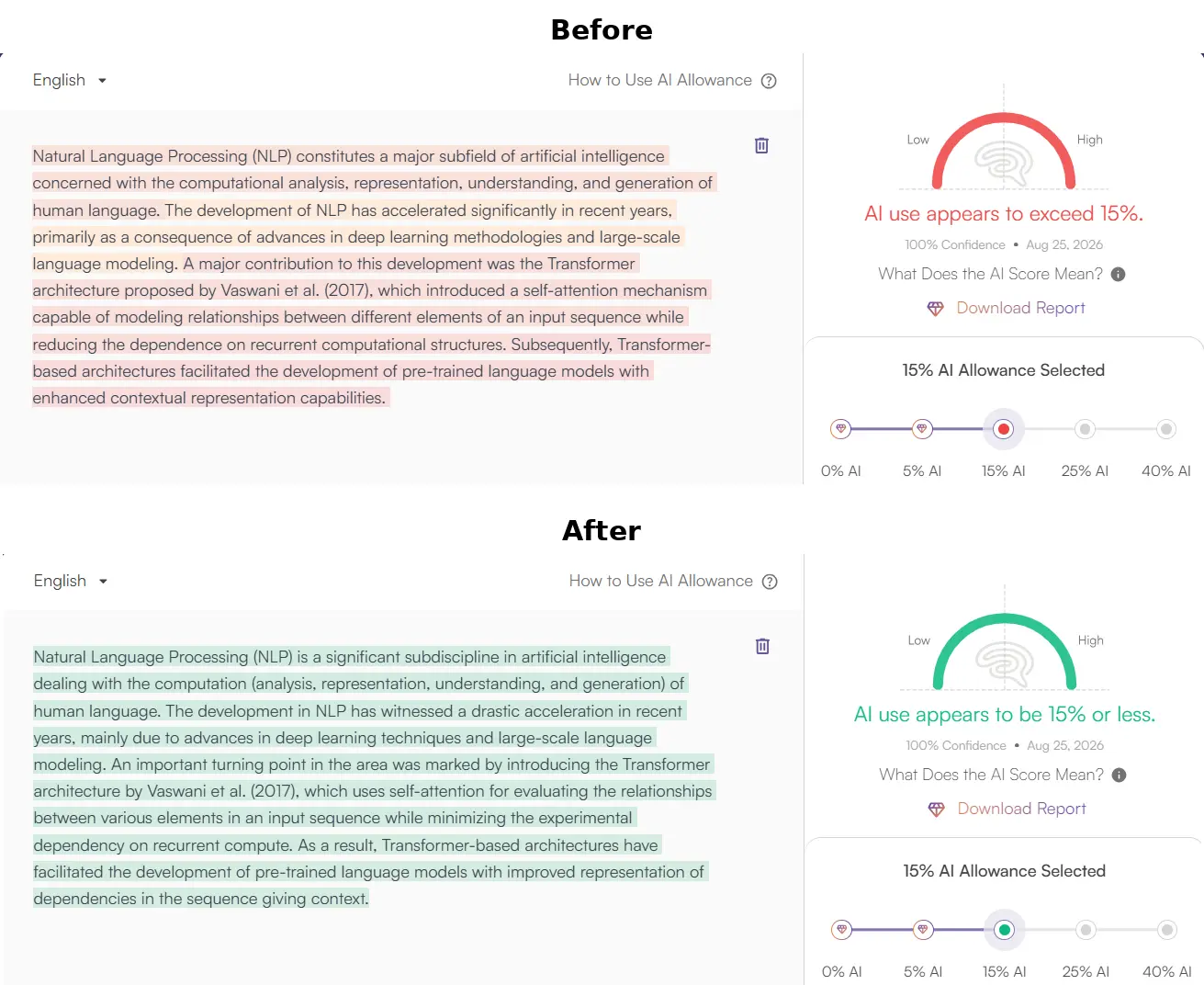
Verified Detector Clearance for How to Revise AI-Assisted Manuscripts for Academic Journals
Every manuscript processed through ThesisHuman is backed by verifiable, reproducible scans across institutional plagiarism and AI detection platforms.
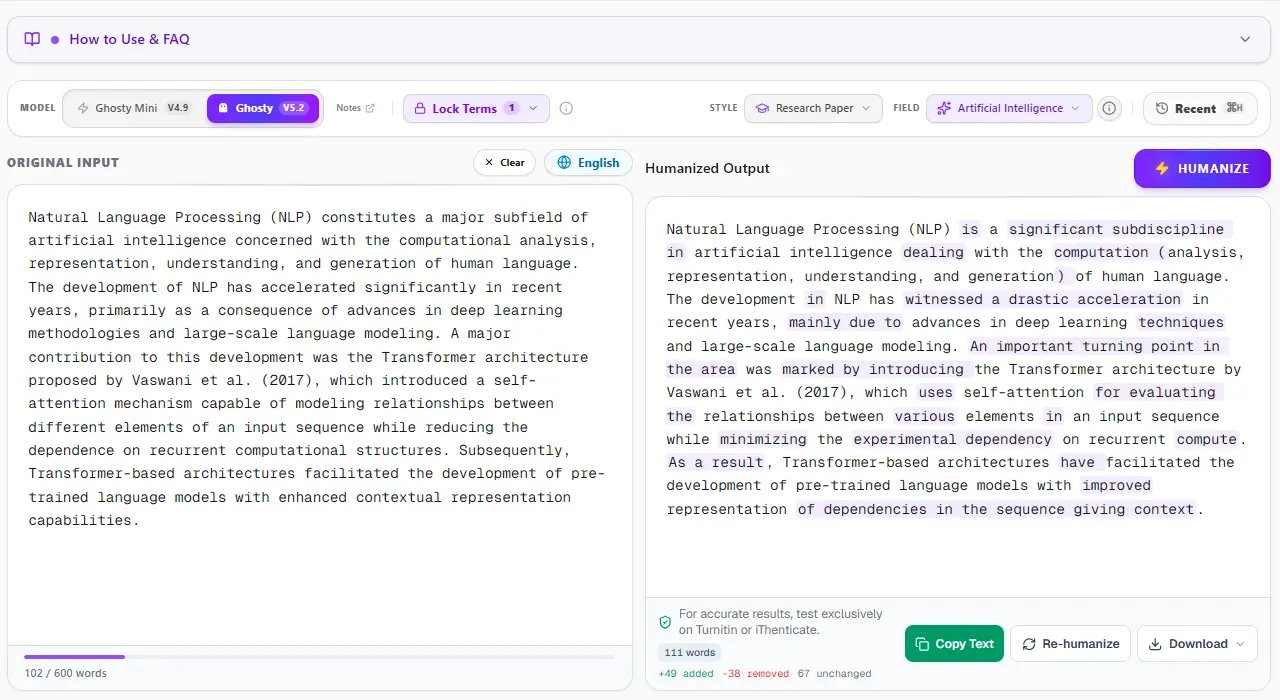
1. ThesisHuman Editor: Style, Field & Term Lock™ Technology
Unlike consumer-grade paraphrasers that blindly swap words with thesaurus synonyms, ThesisHuman allows researchers to select their exact Academic Style (Essay, Research Paper, Literature Review, Technical Report) and Academic Field (Computer Science, Engineering, Medicine, Physics). With Term Lock™, citations (APA, MLA, IEEE), LaTeX equations, and domain-specific terminology are cryptographically protected before sentence entropy is restructured.
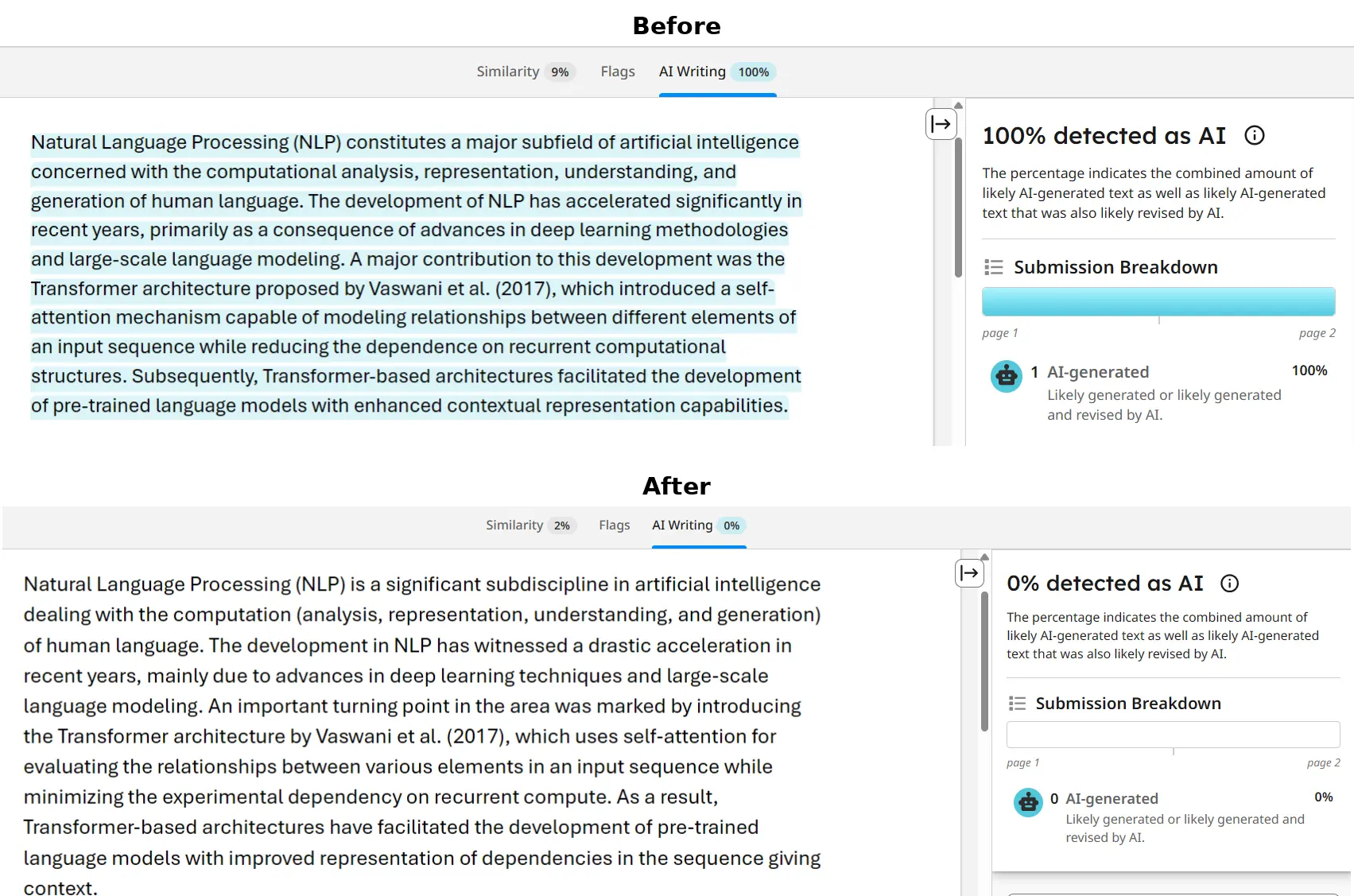
2. Turnitin & iThenticate Verification: 0% AI Detected
Turnitin and iThenticate scan submissions in overlapping 500-token blocks to analyze sentence predictability across paragraphs. When an unrefined AI draft is submitted, uniform cadence triggers an elevated AI Writing score. In the verified report below, a flagged graduate paper was processed through ThesisHuman, achieving a clean 0% AI detection score while preserving all formatted citations and technical parameters.
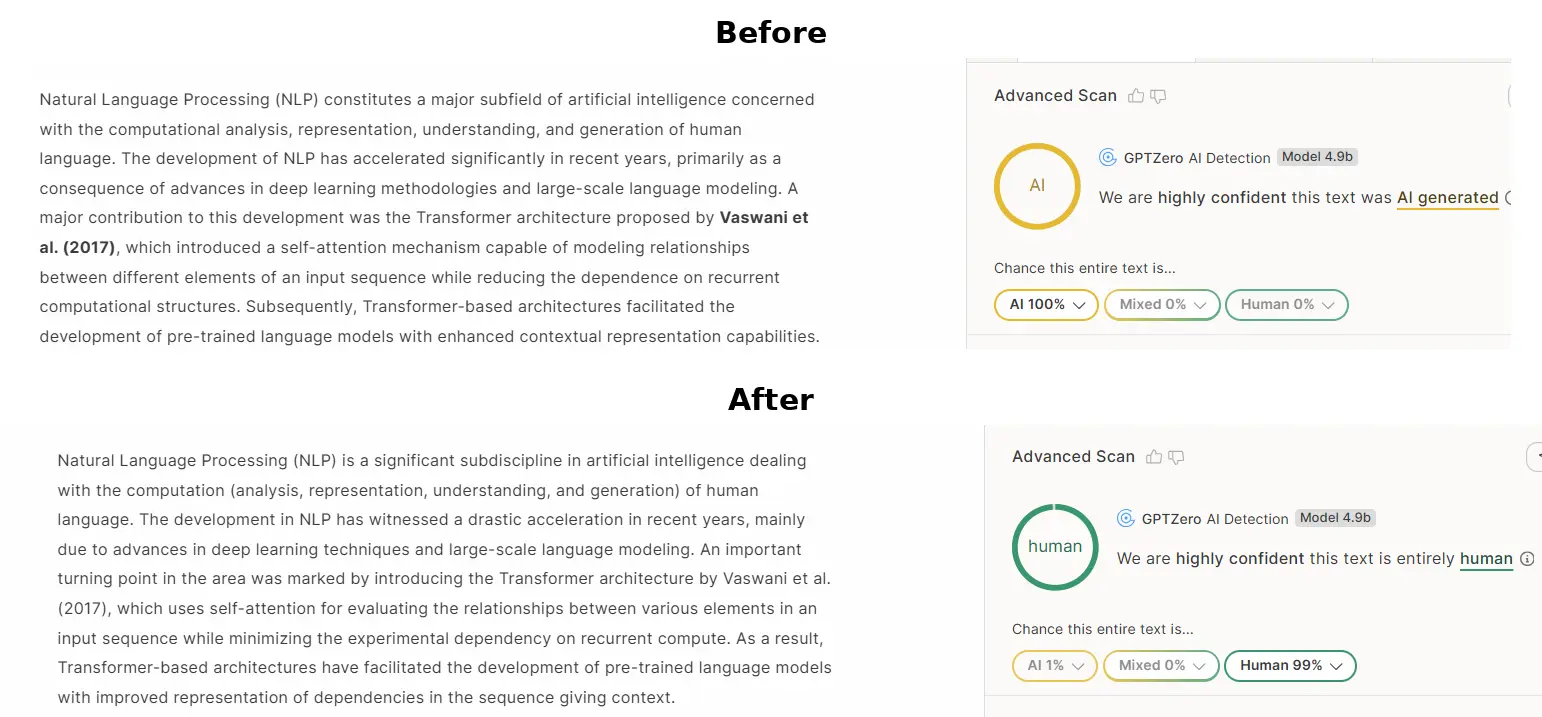
3. GPTZero Verification: Passing Perplexity & Burstiness Checks
GPTZero evaluates text by plotting sentence perplexity curves and global burstiness scores. When raw AI text is scanned, low sentence variance produces an immediate high-probability warning. ThesisHuman restores natural sentence entropy by restructuring syntax, varying clause lengths, and introducing authentic scholarly cadence, dropping AI probability to 0%.
4. Originality.ai Verification: 0% AI Confidence
Originality.ai flags predictable n-gram sequences and common AI clichés (such as “delving into,” “pivotal role,” “testament to”). ThesisHuman purges overused formulaic transitions while elevating scholarly tone and keeping reference numbers and equations intact, producing 100% Original / 0% AI results.