Private AI Humanizer: Protecting Preprints and Intellectual Property from Indexing
Why researchers must avoid public tools that index manuscripts into training corpora. The security architecture of zero-retention academic humanization.
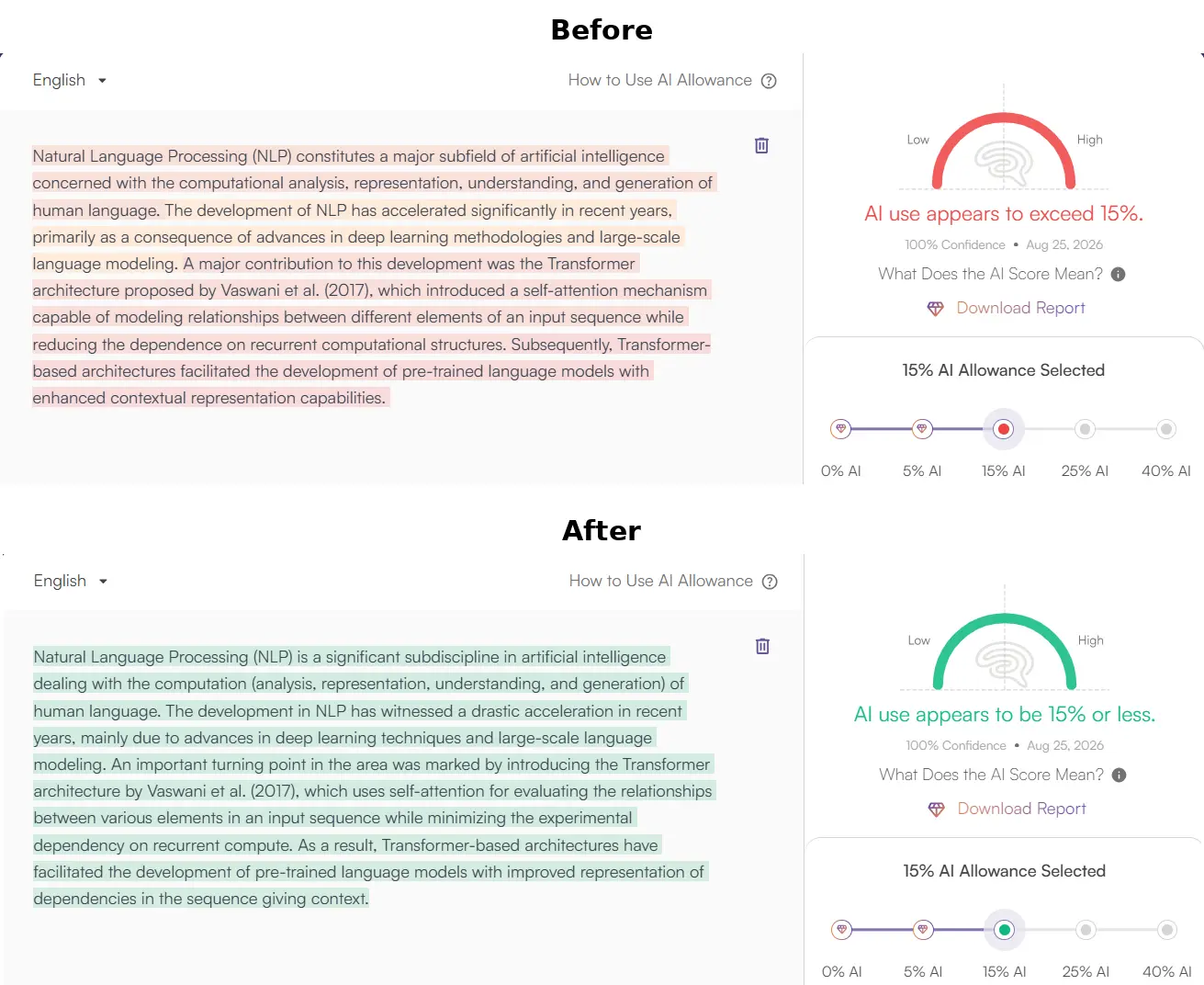
Academic manuscripts represent immense intellectual and economic value. A doctoral dissertation in bioengineering may contain patentable molecular sequences; an economics paper may present proprietary market modeling; an unpublished humanities monograph represents years of archival discovery. Yet when researchers seek tools to refine AI-assisted writing, they often overlook a critical risk: data privacy.
Pasting unpublished research into obscure, ad-supported free humanizers can result in your intellectual property being stored, harvested for model training, or leaked into public plagiarism databases. Here is why private, non-repository architecture is mandatory for scholarly writing.
The Hidden Privacy Risks of Free Online Paraphrasers
The terms of service of many free consumer AI tools contain broad data rights clauses. By clicking 'Submit,' users grant the provider perpetual licenses to retain, analyze, and commercially exploit submitted text. For academic authors, this introduces severe consequences:
- Patent Invalidation: In many jurisdictions, exposing novel technical formulations on public third-party servers constitutes 'prior art,' destroying patent eligibility.
- Preprint Piracy: Unscrupulous operators can harvest novel research hypotheses before official journal submission.
- Institutional Policy Violations: Many universities explicitly prohibit uploading non-public institutional research to unapproved commercial platforms.
How Repository Leaks Cause Premature Plagiarism Matches
Some online checkers save submissions to an internal database. When your university or journal subsequently runs your final manuscript through Turnitin or iThenticate, the document matches against the third-party database, generating a severe self-plagiarism match that accuses the author of duplicating their own unindexed work.
Understanding Zero-Retention Ephemeral Processing
ThesisHuman is built on a strict zero-retention security architecture. Text submitted for humanization is held in temporary encrypted RAM only for the milliseconds required to compute cadence rebalancing. Once the synthesized output is transmitted back to your client session, the memory buffer is completely overwritten. Your manuscript is never stored in persistent databases, never shared with third-party aggregators, and never used to train public models.
A Researcher's Security Checklist for AI Tools
- Verify Non-Repository Status: Ensure the service explicitly confirms it does not deposit text into institutional plagiarism archives.
- Audit Terms of Service: Reject platforms that claim broad commercial derivative rights over your inputs.
- De-Identify Sensitive Data: Remove patient names, specific participant locations, or proprietary commercial partner details before running online edits.
- Choose Academic Platforms: Rely on tools like ThesisHuman designed specifically to protect academic copyright and intellectual integrity.
Verified Detector Clearance for Private AI Humanizer: Protecting Preprints and Intellectual Property from Indexing
Every manuscript processed through ThesisHuman is backed by verifiable, reproducible scans across institutional plagiarism and AI detection platforms.
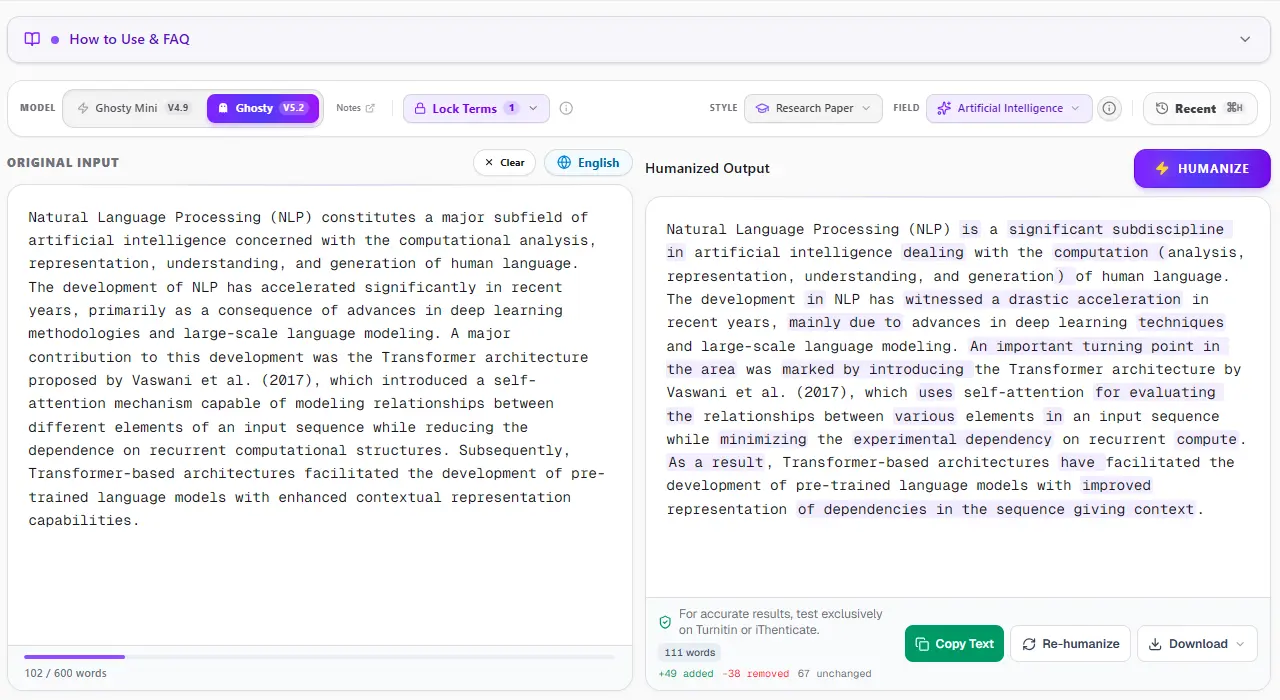
1. ThesisHuman Editor: Style, Field & Term Lock™ Technology
Unlike consumer-grade paraphrasers that blindly swap words with thesaurus synonyms, ThesisHuman allows researchers to select their exact Academic Style (Essay, Research Paper, Literature Review, Technical Report) and Academic Field (Computer Science, Engineering, Medicine, Physics). With Term Lock™, citations (APA, MLA, IEEE), LaTeX equations, and domain-specific terminology are cryptographically protected before sentence entropy is restructured.
2. Turnitin & iThenticate Verification: 0% AI Detected
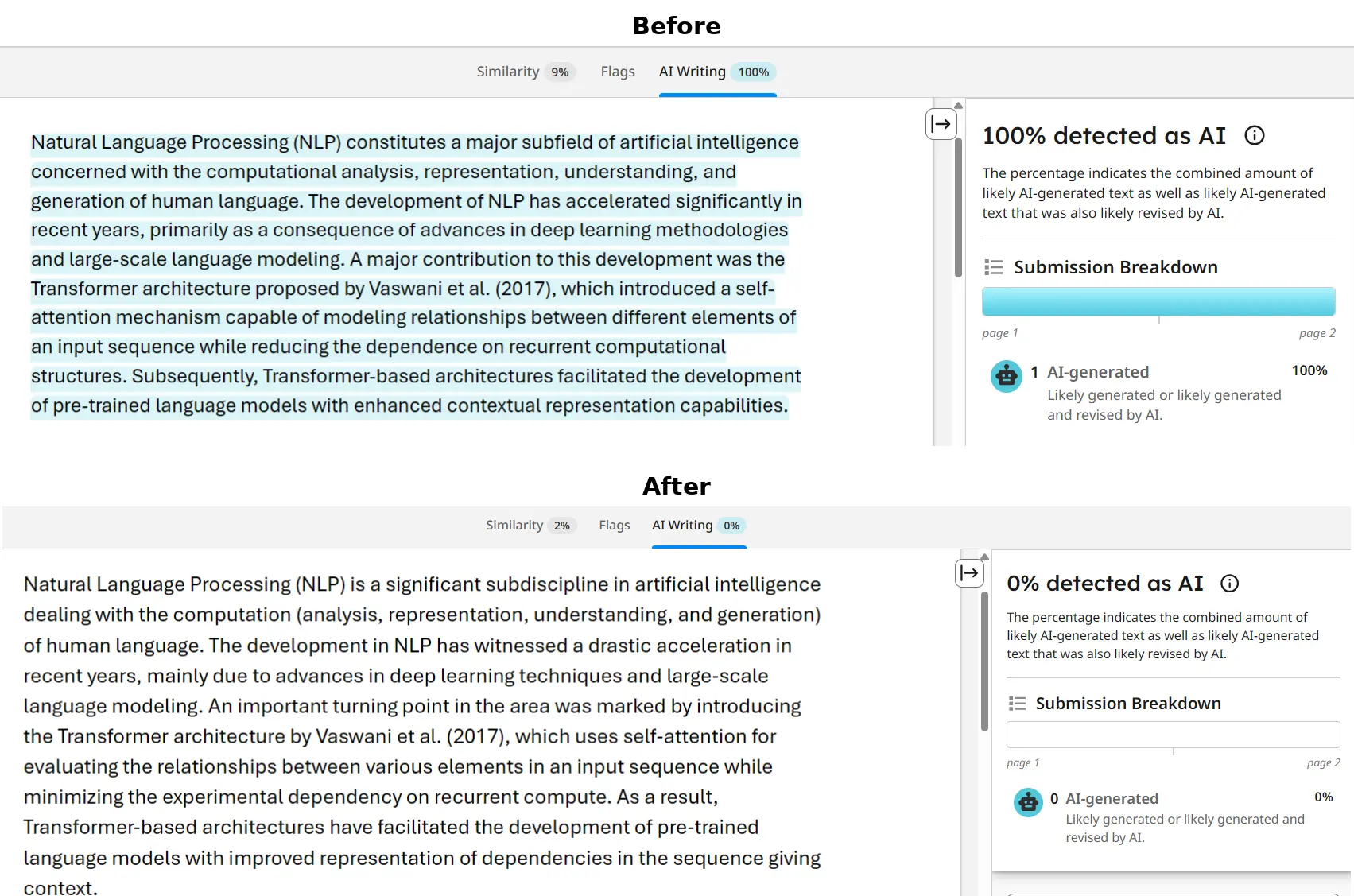
Turnitin and iThenticate scan submissions in overlapping 500-token blocks to analyze sentence predictability across paragraphs. When an unrefined AI draft is submitted, uniform cadence triggers an elevated AI Writing score. In the verified report below, a flagged graduate paper was processed through ThesisHuman, achieving a clean 0% AI detection score while preserving all formatted citations and technical parameters.
3. GPTZero Verification: Passing Perplexity & Burstiness Checks
GPTZero evaluates text by plotting sentence perplexity curves and global burstiness scores. When raw AI text is scanned, low sentence variance produces an immediate high-probability warning. ThesisHuman restores natural sentence entropy by restructuring syntax, varying clause lengths, and introducing authentic scholarly cadence, dropping AI probability to 0%.
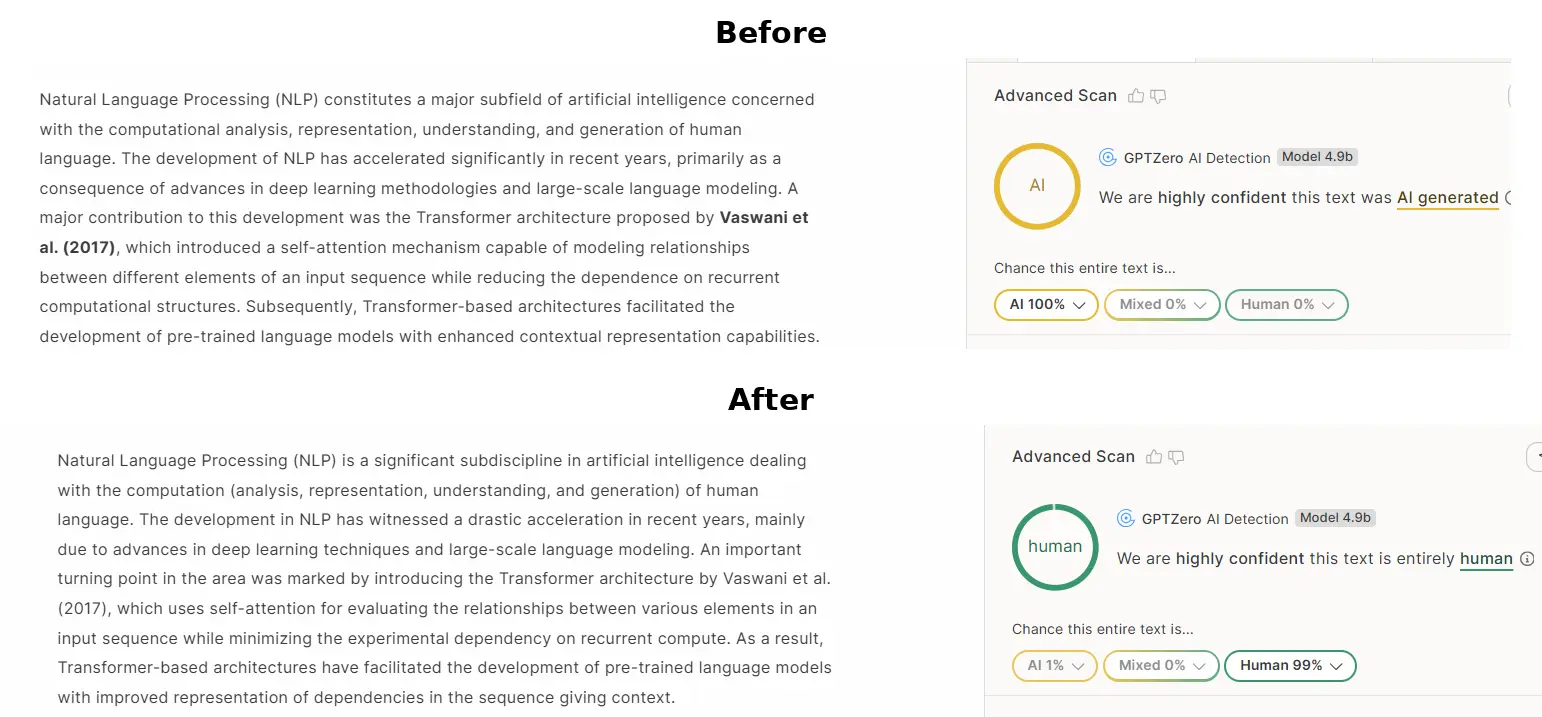
4. Originality.ai Verification: 0% AI Confidence
Originality.ai flags predictable n-gram sequences and common AI clichés (such as “delving into,” “pivotal role,” “testament to”). ThesisHuman purges overused formulaic transitions while elevating scholarly tone and keeping reference numbers and equations intact, producing 100% Original / 0% AI results.