Mastering Burstiness: Sentence-Length Variation Tutorial for Academic Writers
Step-by-step masterclass on sentence burstiness and perplexity. Practical before-and-after exercises to transform mechanical AI cadence into human prose.

Of all the statistical metrics used by modern AI detection engines (including Turnitin, GPTZero, and Copyleaks), none is more influential than burstiness. While perplexity measures vocabulary predictability at the word level, burstiness measures rhythm at the structural level. Understanding burstiness is the single most effective skill an academic writer can master to improve readability and eliminate synthetic detection flags.
This practical tutorial breaks down the mechanics of sentence burstiness with concrete before-and-after exercises, showing you how to turn flat machine drafts into dynamic, authoritative academic prose.
What Is Burstiness in Academic Prose?
Human thought is naturally irregular. When we write, we emphasize critical breakthroughs with concise, punchy assertions. When detailing caveats or theoretical complexities, our syntax expands into multi-clause compound sentences. This variation in sentence length and structure across a document is called burstiness. A passage with sentences measuring 8 words, 32 words, 14 words, and 42 words has high burstiness.
Visualizing the AI Monotony Curve
Large language models are trained to optimize coherence. In academic prompts, this causes them to generate sentences that cluster tightly around an average of 20 to 24 words. An AI paragraph often looks like this:
- Sentence 1: 22 words (overview)
- Sentence 2: 24 words (first observation)
- Sentence 3: 21 words (second observation)
- Sentence 4: 23 words (summary conclusion)
To human readers, this produces a monotonous drone. To detection algorithms, it is an unmistakable statistical signature of machine generation.
Three Hands-On Sentence Combining Rules
To inject burstiness into AI-assisted drafts, apply these three structural combining rules:
- The Short-Anchor Rule: Open or conclude a paragraph with a declarative claim under 10 words. Let it stand as an unadorned intellectual anchor.
- The Clausal Subordination Rule: Combine two medium observations into one complex analytical sentence using subordinate conjunctions ('Whereas,' 'Although,' 'Because').
- The Rhythmic Shift: Never place three consecutive sentences of identical word length next to each other. If sentence A is 25 words and sentence B is 24 words, deliberately edit sentence C to be under 12 words or over 35 words.
Before and After: Paragraph-Level Transformations
Flat AI Draft (Burstiness: 1.2):
'The experimental results demonstrate that the polymer exhibits high thermal resistance under sustained stress (21 words). Furthermore, the tensile strength remained stable across all tested temperature ranges throughout the evaluation (20 words). Consequently, these mechanical characteristics confirm the material's viability for demanding aerospace applications (19 words).'
High-Burstiness Revision (Burstiness: 14.8):
'The polymer withstood sustained thermal stress (6 words). Crucially, even when subjected to peak operational temperatures exceeding 350 degrees Celsius, its tensile strength decayed by less than 2% across forty test cycles (27 words). This stability proves aerospace viability (5 words).'
Notice how the revision creates dynamic cognitive momentum. To apply this burstiness transformation automatically across large drafts, explore ThesisHuman's cadence-calibrated humanizer.
Verified Detector Clearance for Mastering Burstiness: Sentence-Length Variation Tutorial for Academic Writers
Every manuscript processed through ThesisHuman is backed by verifiable, reproducible scans across institutional plagiarism and AI detection platforms.
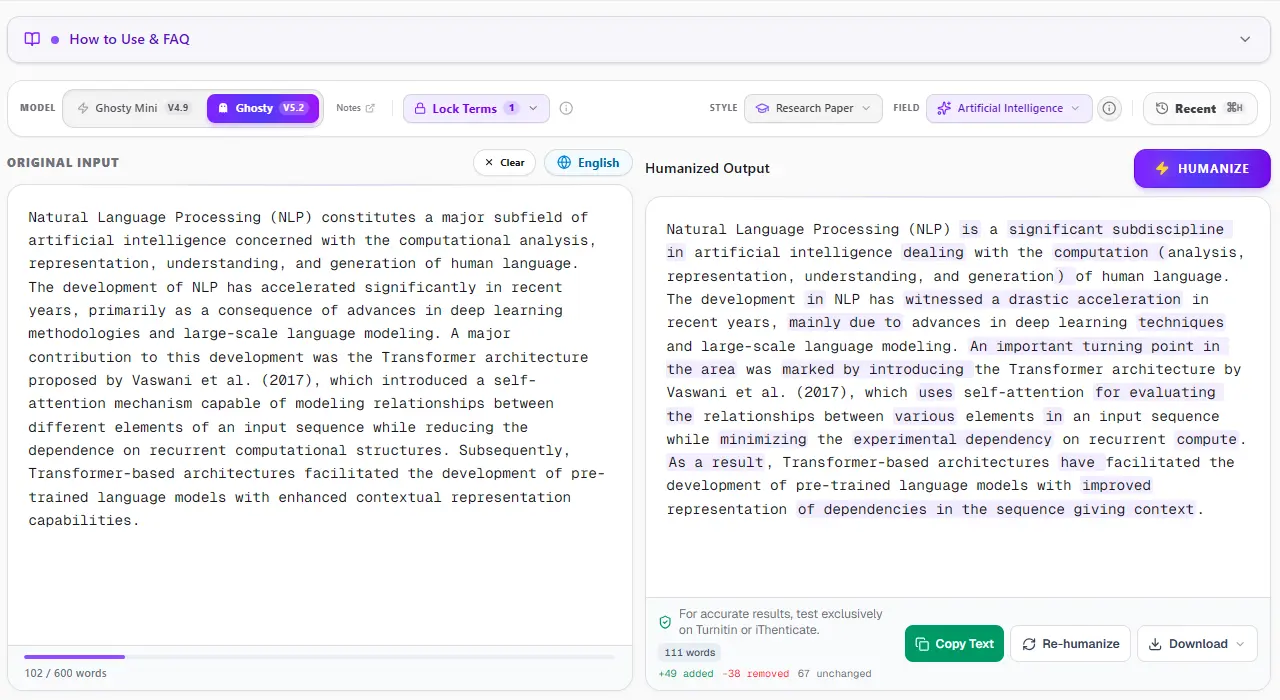
1. ThesisHuman Editor: Style, Field & Term Lock™ Technology
Unlike consumer-grade paraphrasers that blindly swap words with thesaurus synonyms, ThesisHuman allows researchers to select their exact Academic Style (Essay, Research Paper, Literature Review, Technical Report) and Academic Field (Computer Science, Engineering, Medicine, Physics). With Term Lock™, citations (APA, MLA, IEEE), LaTeX equations, and domain-specific terminology are cryptographically protected before sentence entropy is restructured.
2. Turnitin & iThenticate Verification: 0% AI Detected
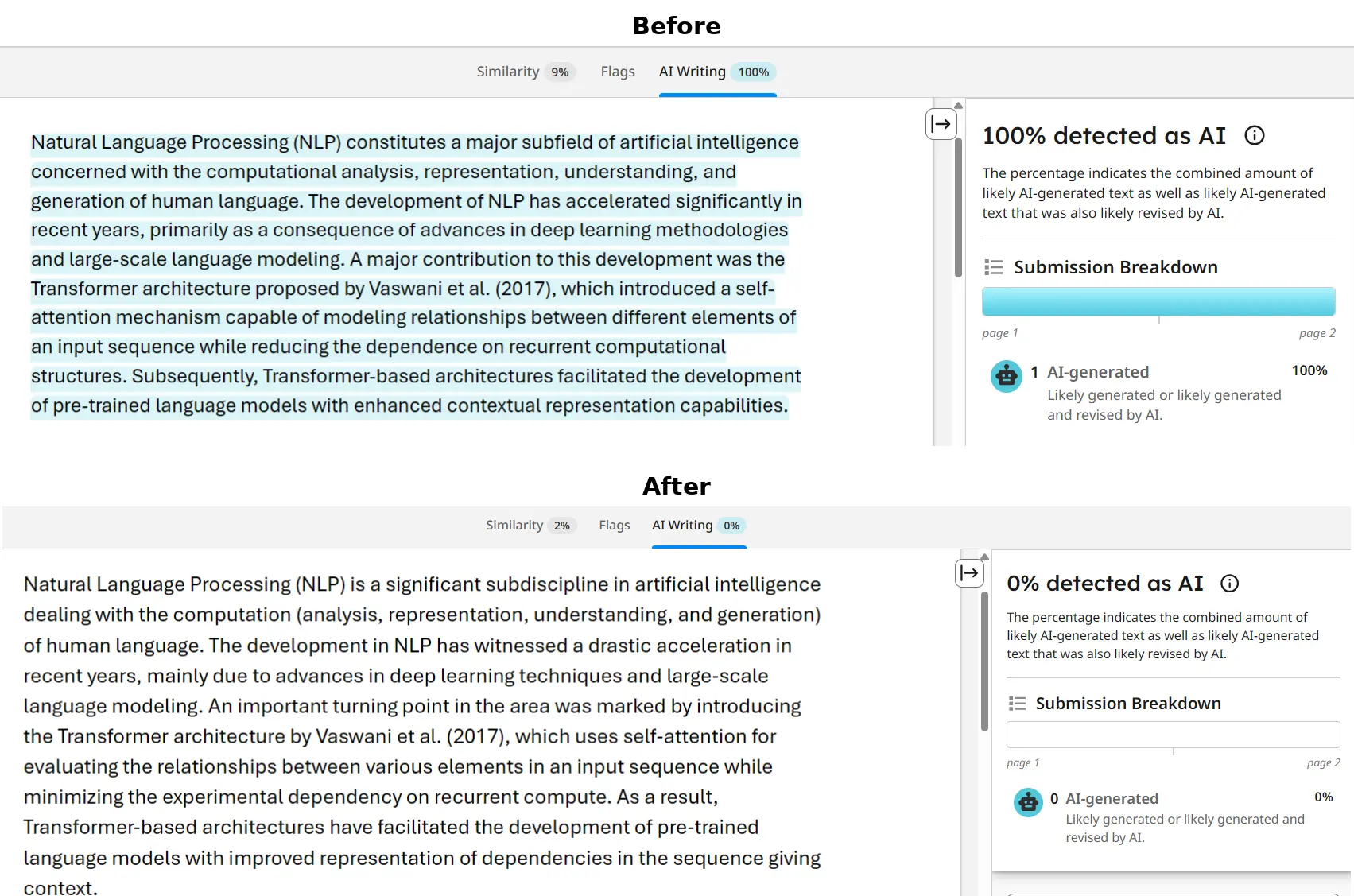
Turnitin and iThenticate scan submissions in overlapping 500-token blocks to analyze sentence predictability across paragraphs. When an unrefined AI draft is submitted, uniform cadence triggers an elevated AI Writing score. In the verified report below, a flagged graduate paper was processed through ThesisHuman, achieving a clean 0% AI detection score while preserving all formatted citations and technical parameters.
3. GPTZero Verification: Passing Perplexity & Burstiness Checks
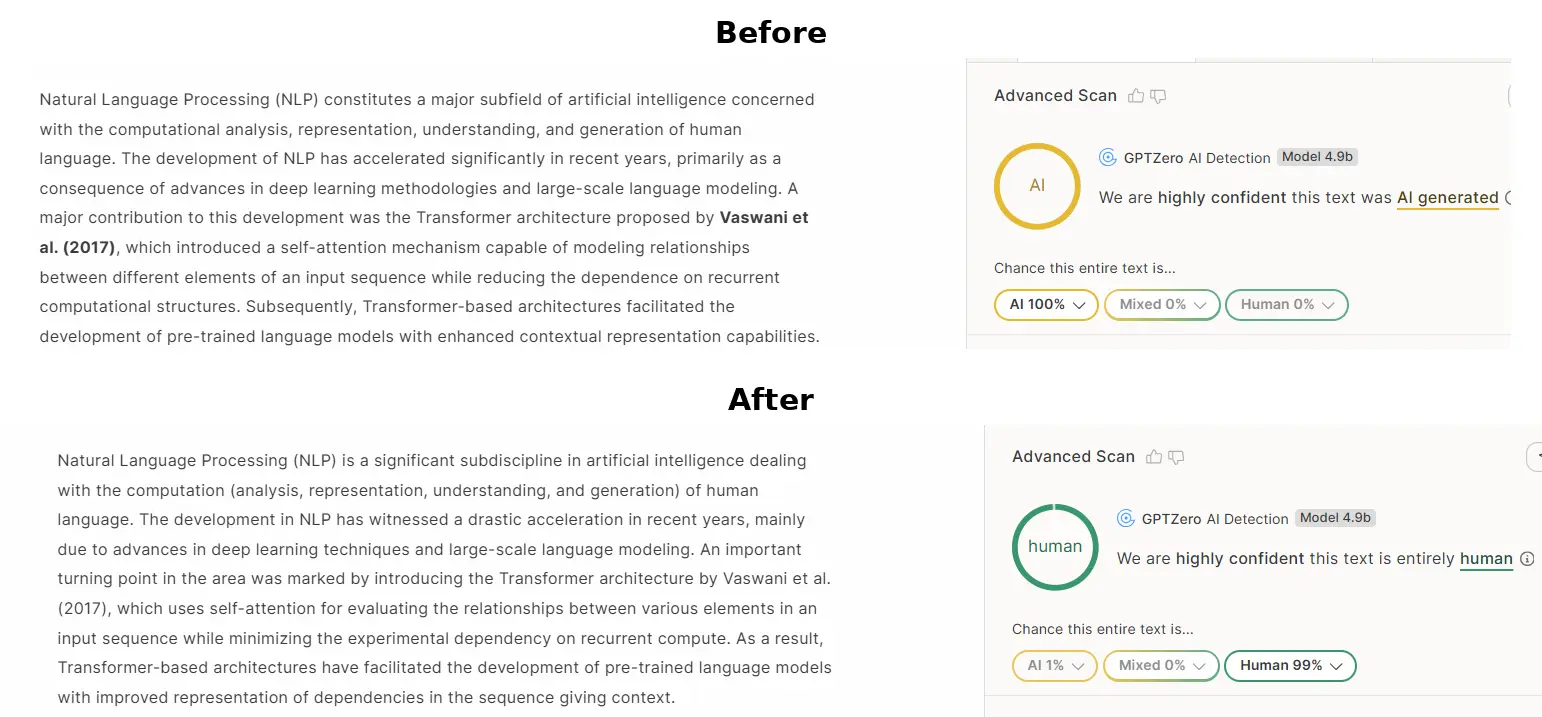
GPTZero evaluates text by plotting sentence perplexity curves and global burstiness scores. When raw AI text is scanned, low sentence variance produces an immediate high-probability warning. ThesisHuman restores natural sentence entropy by restructuring syntax, varying clause lengths, and introducing authentic scholarly cadence, dropping AI probability to 0%.
4. Originality.ai Verification: 0% AI Confidence
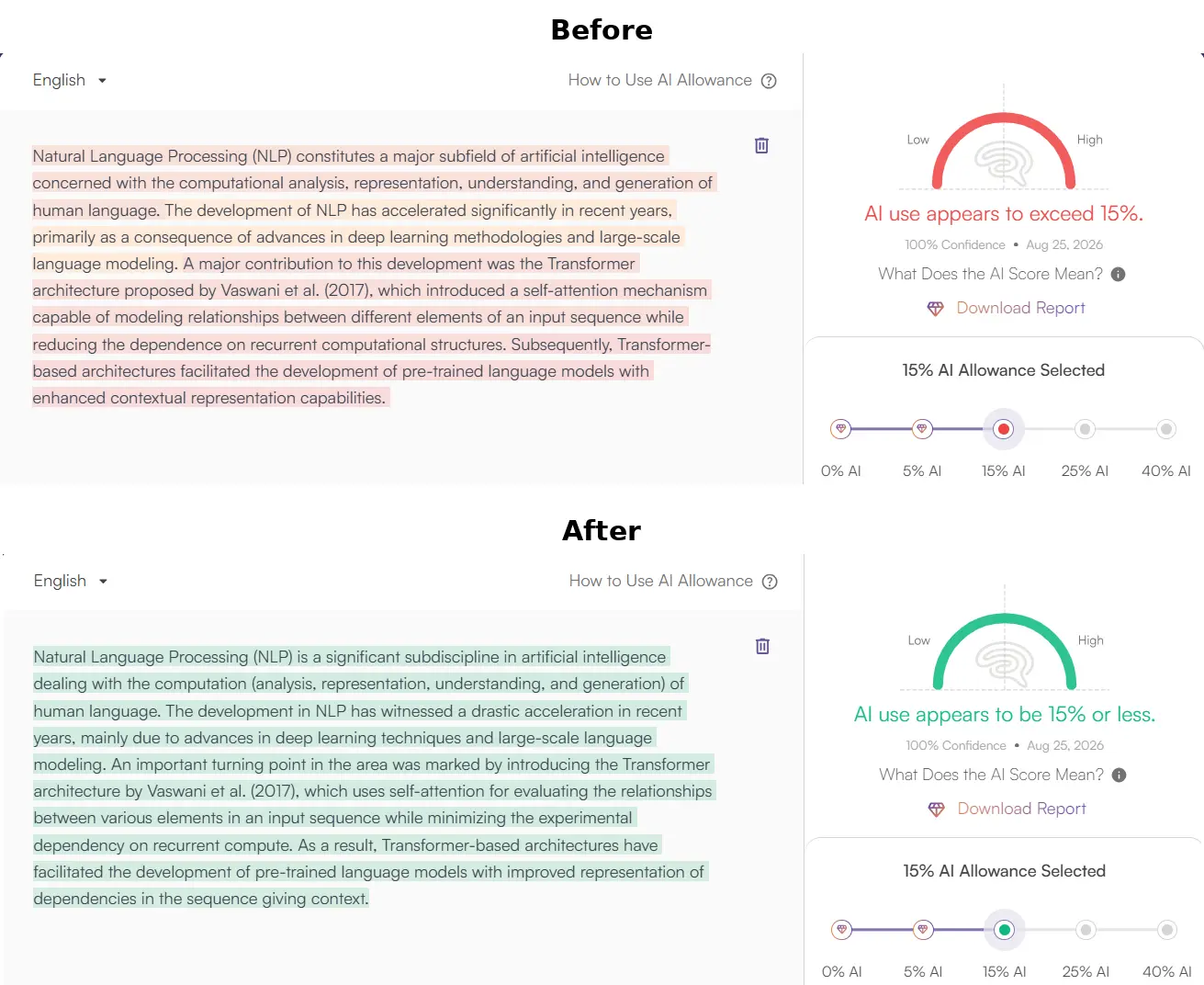
Originality.ai flags predictable n-gram sequences and common AI clichés (such as “delving into,” “pivotal role,” “testament to”). ThesisHuman purges overused formulaic transitions while elevating scholarly tone and keeping reference numbers and equations intact, producing 100% Original / 0% AI results.