AI Humanizer That Preserves Citations: How Term Lock Protects Bibliographies
Deep technical dive into citation preservation. How multi-token parsing and syntax freezing protect APA, MLA, IEEE, and Chicago citations during AI humanization.
For academic researchers, citations are the currency of scholarly communication. A misplaced bracket, an altered author surname, or a separated page citation can lead to accusations of negligent scholarship or academic misconduct. Yet when researchers pass AI-assisted drafts through commercial paraphrasers or generic humanizers, citation corruption is a frequent outcome with generic paraphrasers.
Generic tools fail because their underlying tokenizers treat bibliographic markers as standard vocabulary. To safely humanize research papers, graduate theses, and conference manuscripts, you need an AI humanizer engineered with deterministic citation-locking technology. Here is how modern citation preservation works and why it is indispensable for serious scholarship.
The Citation Corruption Crisis in AI Editing
When a consumer rewriting tool processes a sentence containing an in-text reference like '(Smith & Baker, 2023, p. 112)', several failure modes frequently occur:
- Name Alteration: If an author's name happens to match a common English noun (such as 'Baker,' 'Cook,' or 'White'), the spinner swaps the surname with a synonym (e.g., 'Smith & Chef').
- Disconnection from Claims: The tool rewrites the sentence structure and moves the citation to a completely different clause, falsely attributing an assertion to an author who never made it.
- Bracket Deletion: In numeric citation styles (IEEE, Nature), brackets like
[12, 14]are frequently stripped or converted into ordinary mathematical integers.
How Term Lock Technology Works Under the Hood
ThesisHuman addresses this vulnerability through an architectural feature known as Term Lock. Rather than allowing the neural rewriting engine direct access to the entire string, the text passes through a pre-processing lexical parser:
- Regex Pattern Recognition: The parser scans for known citation architectures, including bracketed integers (
[1],[2-5]), author-date combinations ((Doe et al., 2024)), and superscript footnote markers. - Deterministic Placeholder Substitution: Identified citations are extracted and replaced with protected placeholder tokens (e.g.,
__TH_LOCK_01__). - Cadence Naturalization: The rewriting model transforms the surrounding narrative prose, adjusting clausal weight and burstiness while treating the placeholder as an unalterable structural pillar.
- Precise String Restoration: Post-transformation, the placeholders are restored with the exact original citation strings.
Supported Citation Architectures: APA, IEEE, MLA, Chicago
| Style | Example Syntax | Protection Mechanism |
|---|---|---|
| APA 7th | (Kahneman & Tversky, 1979) | Freezes ampersand, author surnames, and year |
| IEEE | [3], [5]-[8] | Protects bracket enclosures and hyphenated ranges |
| MLA 9th | (Foucault 142) | Preserves surname and page number without comma |
| Chicago (Notes) | Superscript numbers 12 | Shields footnote callouts from clausal merging |
A Zero-Corruption Workflow for Research Papers
To ensure that your manuscript passes both peer review and automated similarity screening without citation issues, process your drafts through ThesisHuman's citation-safe humanizer. By isolating reference syntax before synthesis, you preserve bibliographic fidelity while elevating the natural cadence of your scholarship.
Verified Detector Clearance for AI Humanizer That Preserves Citations: How Term Lock Protects Bibliographies
Every manuscript processed through ThesisHuman is backed by verifiable, reproducible scans across institutional plagiarism and AI detection platforms.
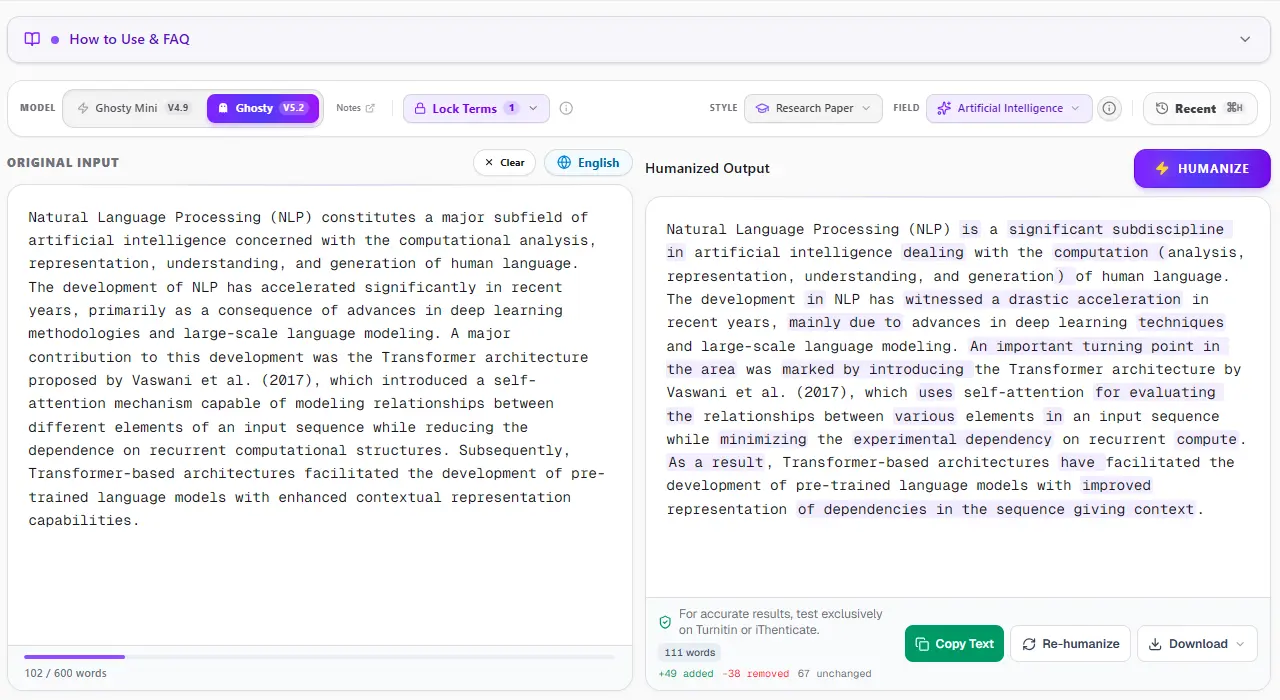
1. ThesisHuman Editor: Style, Field & Term Lock™ Technology
Unlike consumer-grade paraphrasers that blindly swap words with thesaurus synonyms, ThesisHuman allows researchers to select their exact Academic Style (Essay, Research Paper, Literature Review, Technical Report) and Academic Field (Computer Science, Engineering, Medicine, Physics). With Term Lock™, citations (APA, MLA, IEEE), LaTeX equations, and domain-specific terminology are cryptographically protected before sentence entropy is restructured.
2. Turnitin & iThenticate Verification: 0% AI Detected
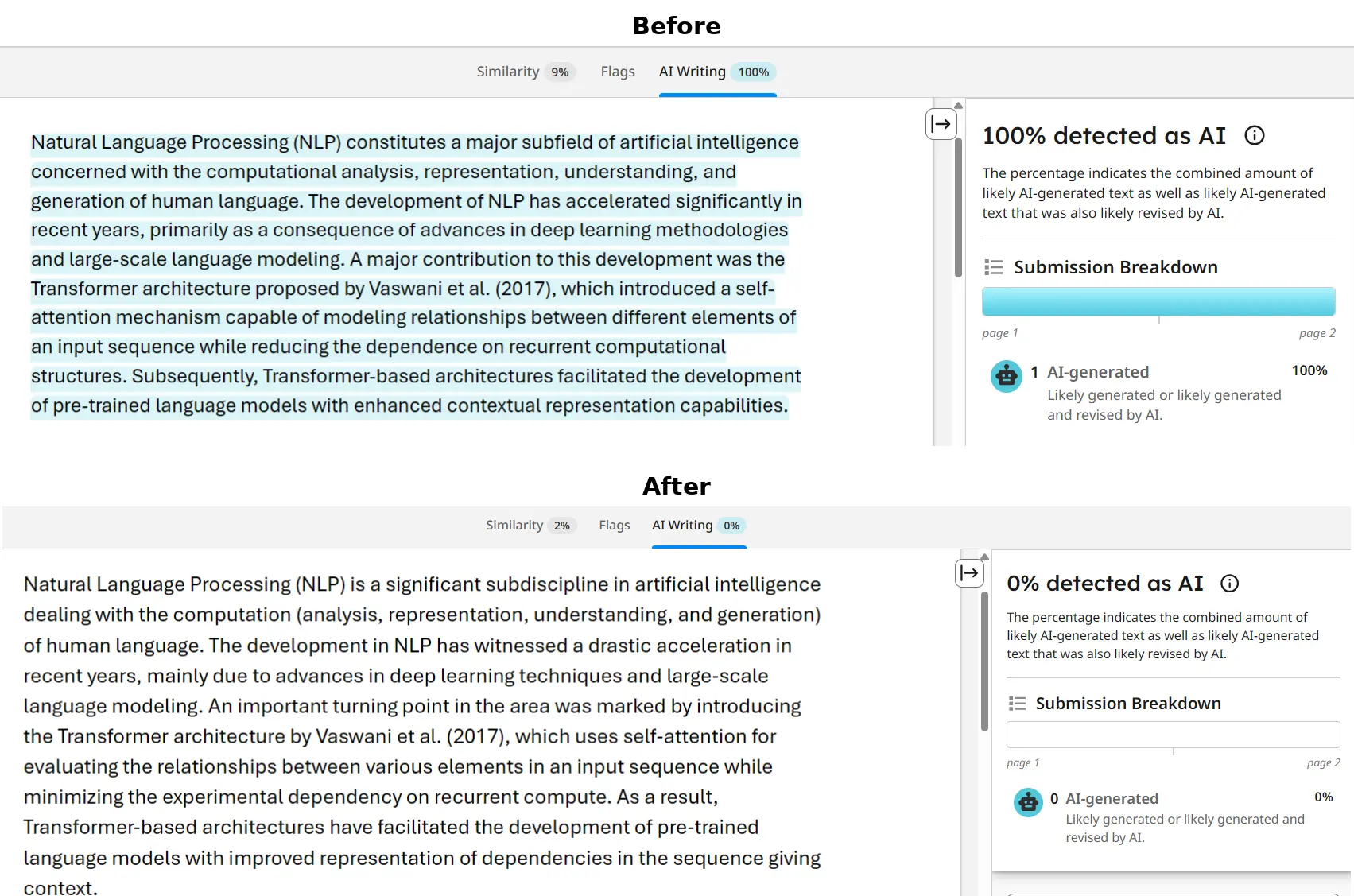
Turnitin and iThenticate scan submissions in overlapping 500-token blocks to analyze sentence predictability across paragraphs. When an unrefined AI draft is submitted, uniform cadence triggers an elevated AI Writing score. In the verified report below, a flagged graduate paper was processed through ThesisHuman, achieving a clean 0% AI detection score while preserving all formatted citations and technical parameters.
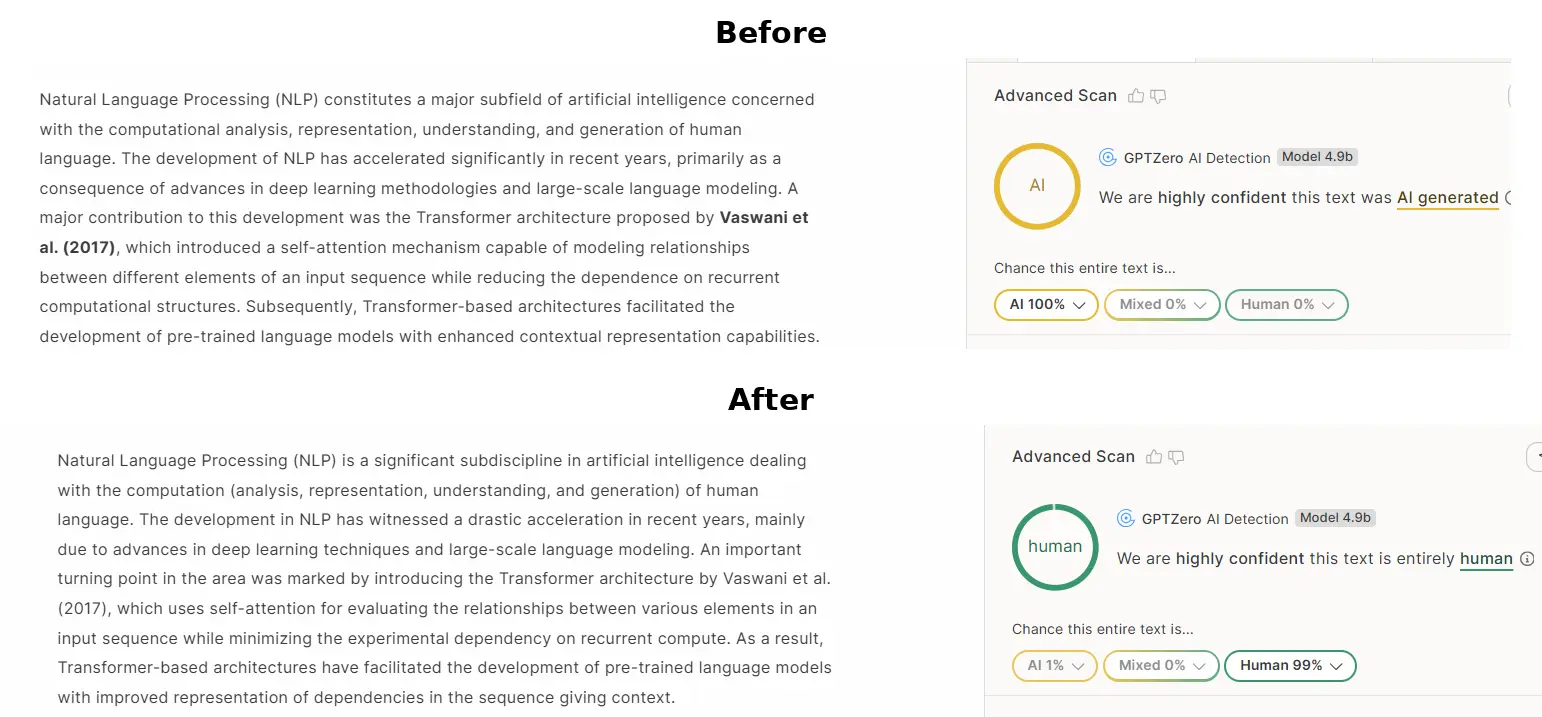
3. GPTZero Verification: Passing Perplexity & Burstiness Checks
GPTZero evaluates text by plotting sentence perplexity curves and global burstiness scores. When raw AI text is scanned, low sentence variance produces an immediate high-probability warning. ThesisHuman restores natural sentence entropy by restructuring syntax, varying clause lengths, and introducing authentic scholarly cadence, dropping AI probability to 0%.
4. Originality.ai Verification: 0% AI Confidence
Originality.ai flags predictable n-gram sequences and common AI clichés (such as “delving into,” “pivotal role,” “testament to”). ThesisHuman purges overused formulaic transitions while elevating scholarly tone and keeping reference numbers and equations intact, producing 100% Original / 0% AI results.