AI Humanizers and Graduate Thesis Integrity: Ethical Boundaries for Masters and PhD Candidates
Navigating the ethical line between permitted language refinement and unauthorized generative authorship in graduate dissertations. Understand committee expectations and institutional integrity standards.

Completing a Master's thesis or doctoral dissertation represents years of rigorous primary research, theoretical synthesis, and methodological execution. In recent academic cycles, graduate students have increasingly adopted artificial intelligence tools to assist with literature summaries, coding assistance, and language polishing. However, this adoption has coincided with heightened scrutiny from graduate school deans, department chairs, and dissertation committees.
When graduate scholars look for ways to refine assisted drafts, the conversation often turns to AI humanizers. To use these technologies safely and ethically, researchers must understand the critical institutional boundary between permitted developmental editing and unauthorized generative authorship.
The Institutional Landscape for Graduate Research
Universities across North America, Europe, and Australasia have evolved from initial blanket bans toward nuanced AI governance frameworks. While policies vary by university and academic department, leading institutions have established clear consensus on several foundational principles:
- Individual Intellectual Responsibility: The graduate candidate alone bears full legal, ethical, and academic responsibility for every assertion, citation, and equation in their dissertation.
- Prohibition of Machine Authorship: Language models cannot be named as authors or co-authors under guidelines from the Committee on Publication Ethics (COPE) and university graduate councils.
- Mandatory Disclosure Frameworks: An increasing number of graduate schools require candidates to include an AI disclosure statement detailing the specific tools used and their precise scope in the dissertation preface.
The Line Between Language Polishing and Ghostwriting
To determine whether an AI editing tool is being used ethically, consider the difference between developmental copyediting and substantive ghostwriting:
Copyediting focuses on syntactic rhythm, clausal clarity, eliminating wordiness, and correcting grammatical inconsistencies. This form of editorial assistance has long been accepted in academia, whether performed by professional human copyeditors or automated tools. Substantive ghostwriting, by contrast, involves asking an automated system to formulate novel hypotheses, synthesize unread literature, or generate empirical interpretations. The former refines the expression of the scholar's ideas; the latter outsources the intellectual work that the degree is intended to evaluate.
Core Elements That Must Remain Strictly Researcher-Authored
To preserve dissertation integrity, ensure that these foundational components remain entirely self-authored:
- Primary Data and Laboratory Measurements: Raw experimental counts, clinical observations, interview transcripts, and statistical models must come directly from your primary investigations.
- Critical Theoretical Positioning: Your analytical critique of existing literature and your defense of your theoretical framework must reflect your own scholarly reasoning.
- Discussion of Limitations and Implications: The nuanced understanding of what your study proves, what it leaves unresolved, and where future research should direct its efforts requires human scholarly judgment.
Thesis Committee Expectations and Defense Scrutiny
During an oral defense, committee members probe deeply into the rationale behind specific methodological choices and theoretical claims. If a candidate relies on generative tools to write sections they cannot personally explain or substantiate from primary literature, the defense quickly unravels.
Furthermore, graduate school thesis offices frequently run submitted electronic theses and dissertations (ETDs) through similarity and text-pattern screening platforms before issuing graduation clearance. A high AI flag or fragmented citation network can delay degree conferral and trigger stressful academic integrity hearings.
A Defensible 4-Step Protocol for Graduate Scholars
Graduate scholars can maintain rigorous integrity while refining their prose by following a defensible four-step drafting protocol:
- Generate Primary Drafts Independently: Begin with your own messy, detailed notes, bulleted outlines, and data tables. Establish your core arguments in your own words.
- Use Assistive Tools Selectively for Style: When using AI for syntax refinement, focus on sentence rhythm and removing repetitive filler words rather than generating new paragraphs.
- Lock Citations and Discipline Terms: Ensure that all bibliographic keys and technical terms are shielded from modification using specialized tools. Explore our dedicated thesis humanizer tool for chapter-by-chapter academic refinement.
- Archive Provenance Records: Maintain an unbroken record of version histories, supervisor feedback, and laboratory notes to corroborate your authentic drafting timeline.
Verified Detector Clearance for AI Humanizers and Graduate Thesis Integrity: Ethical Boundaries for Masters and PhD Candidates
Every manuscript processed through ThesisHuman is backed by verifiable, reproducible scans across institutional plagiarism and AI detection platforms.
1. ThesisHuman Editor: Style, Field & Term Lock™ Technology
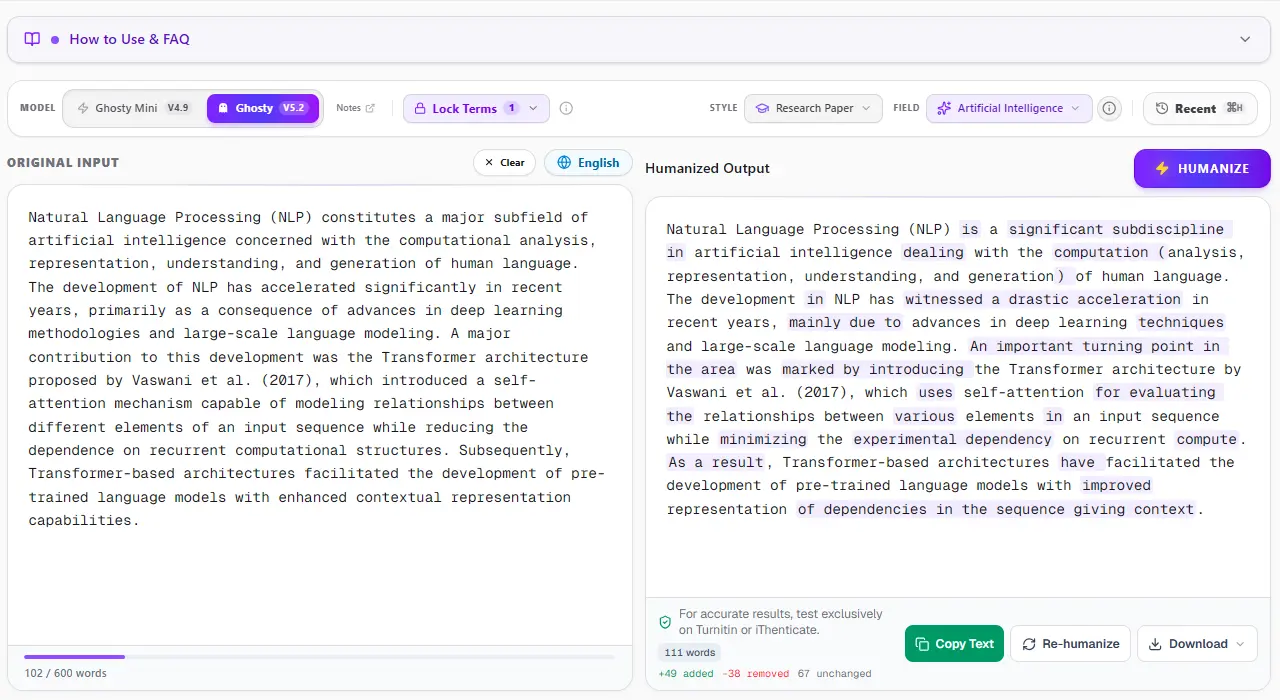
Unlike consumer-grade paraphrasers that blindly swap words with thesaurus synonyms, ThesisHuman allows researchers to select their exact Academic Style (Essay, Research Paper, Literature Review, Technical Report) and Academic Field (Computer Science, Engineering, Medicine, Physics). With Term Lock™, citations (APA, MLA, IEEE), LaTeX equations, and domain-specific terminology are cryptographically protected before sentence entropy is restructured.
2. Turnitin & iThenticate Verification: 0% AI Detected
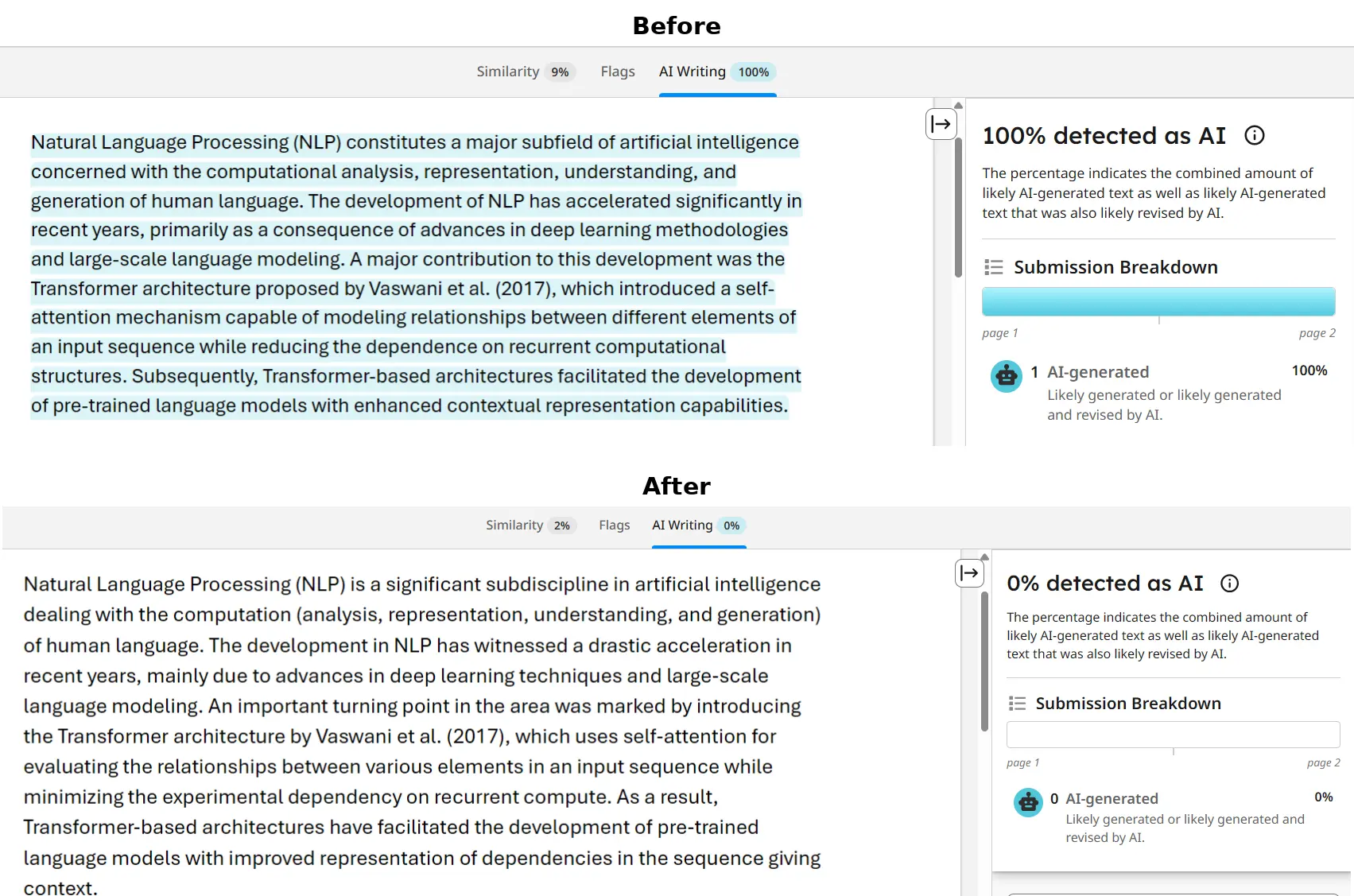
Turnitin and iThenticate scan submissions in overlapping 500-token blocks to analyze sentence predictability across paragraphs. When an unrefined AI draft is submitted, uniform cadence triggers an elevated AI Writing score. In the verified report below, a flagged graduate paper was processed through ThesisHuman, achieving a clean 0% AI detection score while preserving all formatted citations and technical parameters.
3. GPTZero Verification: Passing Perplexity & Burstiness Checks
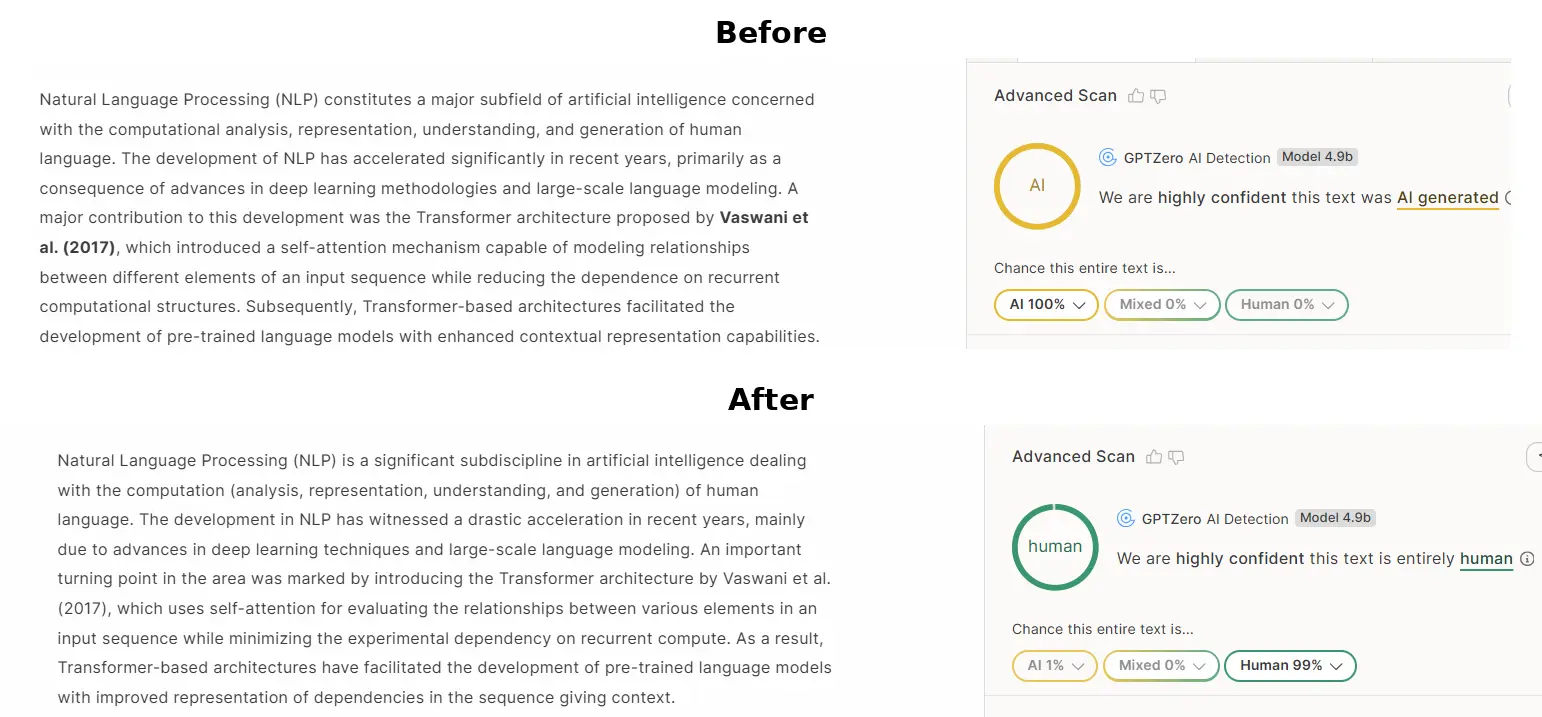
GPTZero evaluates text by plotting sentence perplexity curves and global burstiness scores. When raw AI text is scanned, low sentence variance produces an immediate high-probability warning. ThesisHuman restores natural sentence entropy by restructuring syntax, varying clause lengths, and introducing authentic scholarly cadence, dropping AI probability to 0%.
4. Originality.ai Verification: 0% AI Confidence
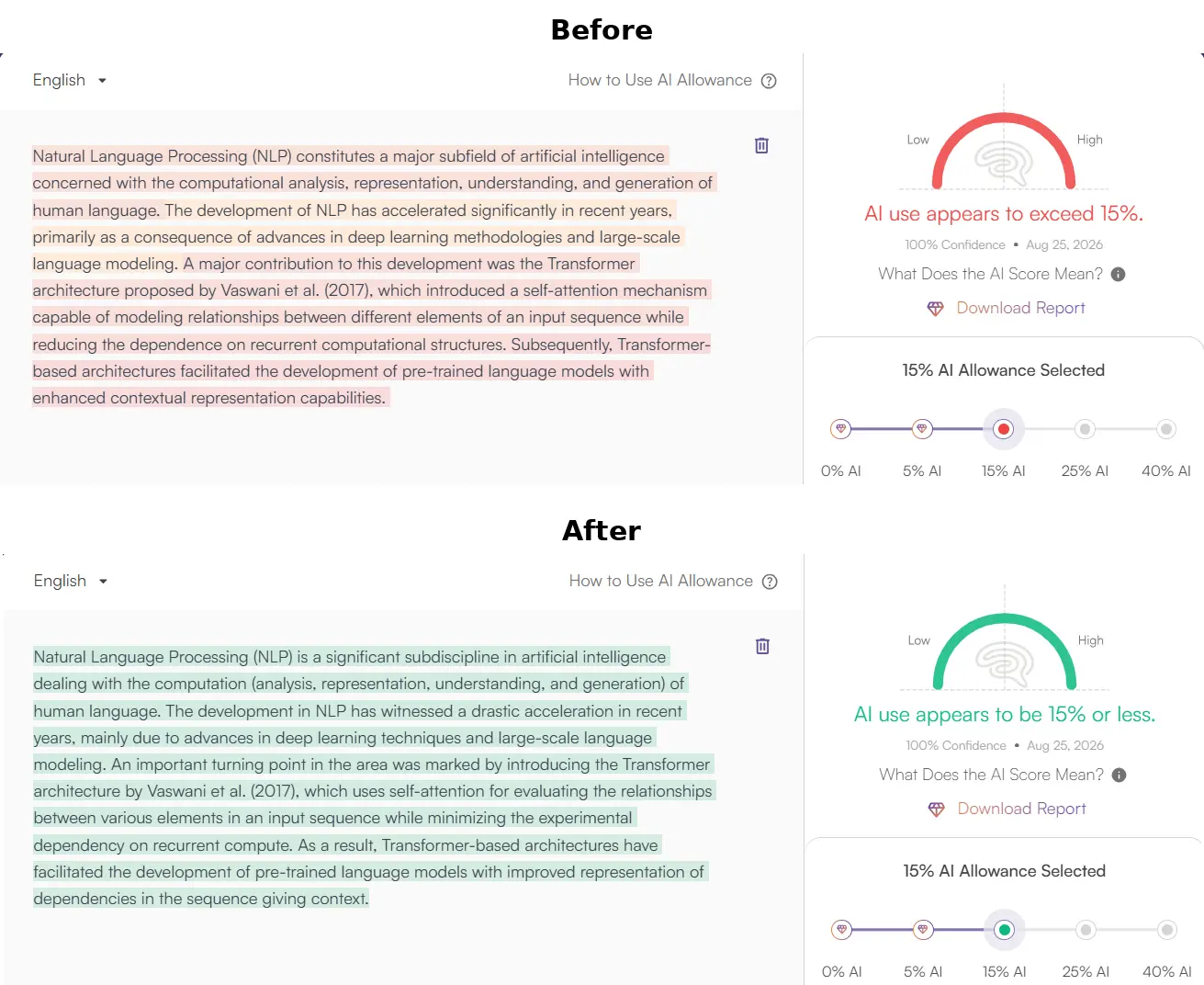
Originality.ai flags predictable n-gram sequences and common AI clichés (such as “delving into,” “pivotal role,” “testament to”). ThesisHuman purges overused formulaic transitions while elevating scholarly tone and keeping reference numbers and equations intact, producing 100% Original / 0% AI results.