AI to Human Text Converter Free: Mechanics, Capabilities, and Academic Limits
How automated AI-to-human text converters transform machine drafts into natural prose. Learn the linguistic principles of token distribution, burstiness, and semantic stability.
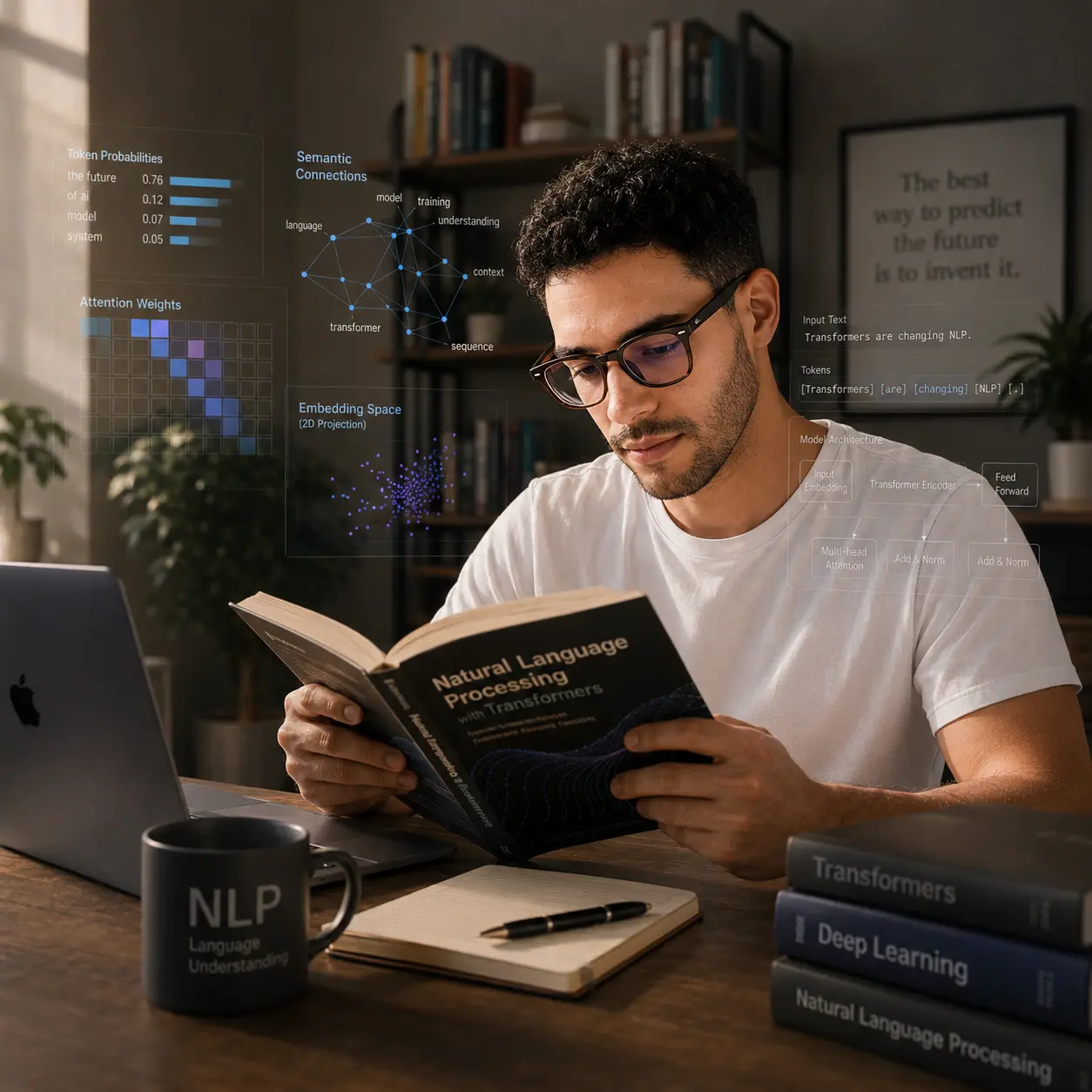
The phrase 'AI to human text converter' has become one of the most common search queries among students, copywriters, and researchers. As universities and publishers implement automated screening systems, authors want tools that can remove machine fingerprints from their writing. However, the quality of available tools varies dramatically.
Understanding how text conversion works at a linguistic and mathematical level allows you to choose effective software and avoid tools that degrade your prose. This guide explains the technical mechanisms behind high-quality conversion and how to evaluate tools for academic use.
What Is an AI to Human Text Converter?
An AI-to-human converter is a specialized natural language rewriting system designed to address the statistical markers left by generative language models. When an LLM writes an essay or literature review, it selects tokens based on probability distributions. This produces prose with consistent sentence lengths, predictable transitional phrases, and minimal vocabulary surprise. Human readers perceive this as monotonous, while detection software flags it as machine-generated.
A converter modifies these statistical regularities. It breaks monotonous compound sentences into varied fragments and complex clauses, substitutes predictable transitions with disciplinary linkages, and restores natural rhythm. When applied correctly, the converted text conveys the author's exact argument while reading as natural human scholarship.
How Language Conversion Works Mathematically
Modern AI detectors do not read text the way human professors do. Instead, they calculate two core statistical metrics:
- Perplexity: A measure of how likely a given word is to follow the preceding words. Raw AI text exhibits low perplexity because it repeatedly selects high-probability tokens. Advanced conversion introduces contextual vocabulary that elevates perplexity naturally.
- Burstiness: The variation in sentence length and structural complexity across a document. Humans naturally write with high burstiness, combining five-word observations with forty-word analytical sentences. Converters systematically dismantle uniform rhythm.
Common Pitfalls of Cheap Online Converters
Many free conversion websites simply wrap basic dictionary spinning scripts. In an academic paper, this leads to severe errors:
- Semantic Inversion: Swapping words like 'significant' with 'notable' may be acceptable, but swapping 'statistically significant' with 'substantially important' destroys scientific precision.
- Garbled Reference Syntax: Bracketed citations like [14] become altered or deleted, causing severe formatting failures.
- Broken Technical Formulations: Mathematical formulas and chemical notations are frequently corrupted when passed through generic spinners.
Evaluating Text Conversion for Scholarly Use
When converting academic drafts, use tools engineered specifically for research standards. ThesisHuman's research paper humanizer uses dedicated Term Lock technology to protect in-text citations and mathematical environments, ensuring that conversion improves readability without compromising academic rigor.
Verified Detector Clearance for AI to Human Text Converter Free: Mechanics, Capabilities, and Academic Limits
Every manuscript processed through ThesisHuman is backed by verifiable, reproducible scans across institutional plagiarism and AI detection platforms.
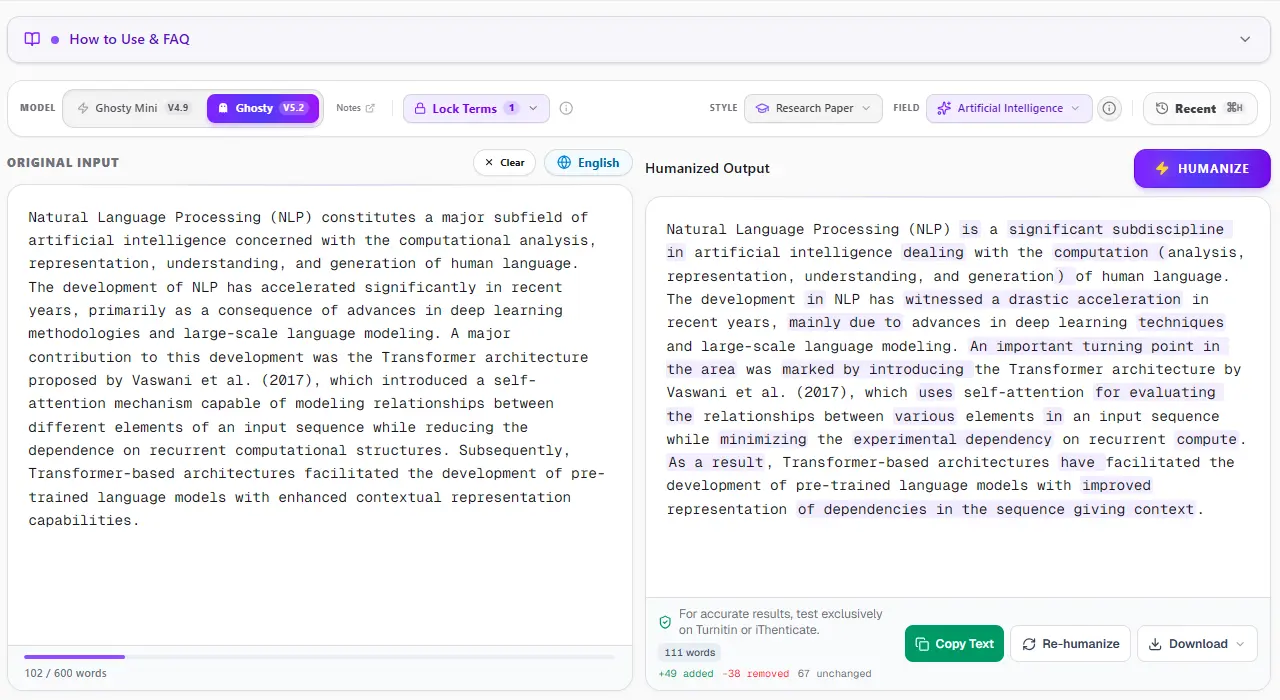
1. ThesisHuman Editor: Style, Field & Term Lock™ Technology
Unlike consumer-grade paraphrasers that blindly swap words with thesaurus synonyms, ThesisHuman allows researchers to select their exact Academic Style (Essay, Research Paper, Literature Review, Technical Report) and Academic Field (Computer Science, Engineering, Medicine, Physics). With Term Lock™, citations (APA, MLA, IEEE), LaTeX equations, and domain-specific terminology are cryptographically protected before sentence entropy is restructured.
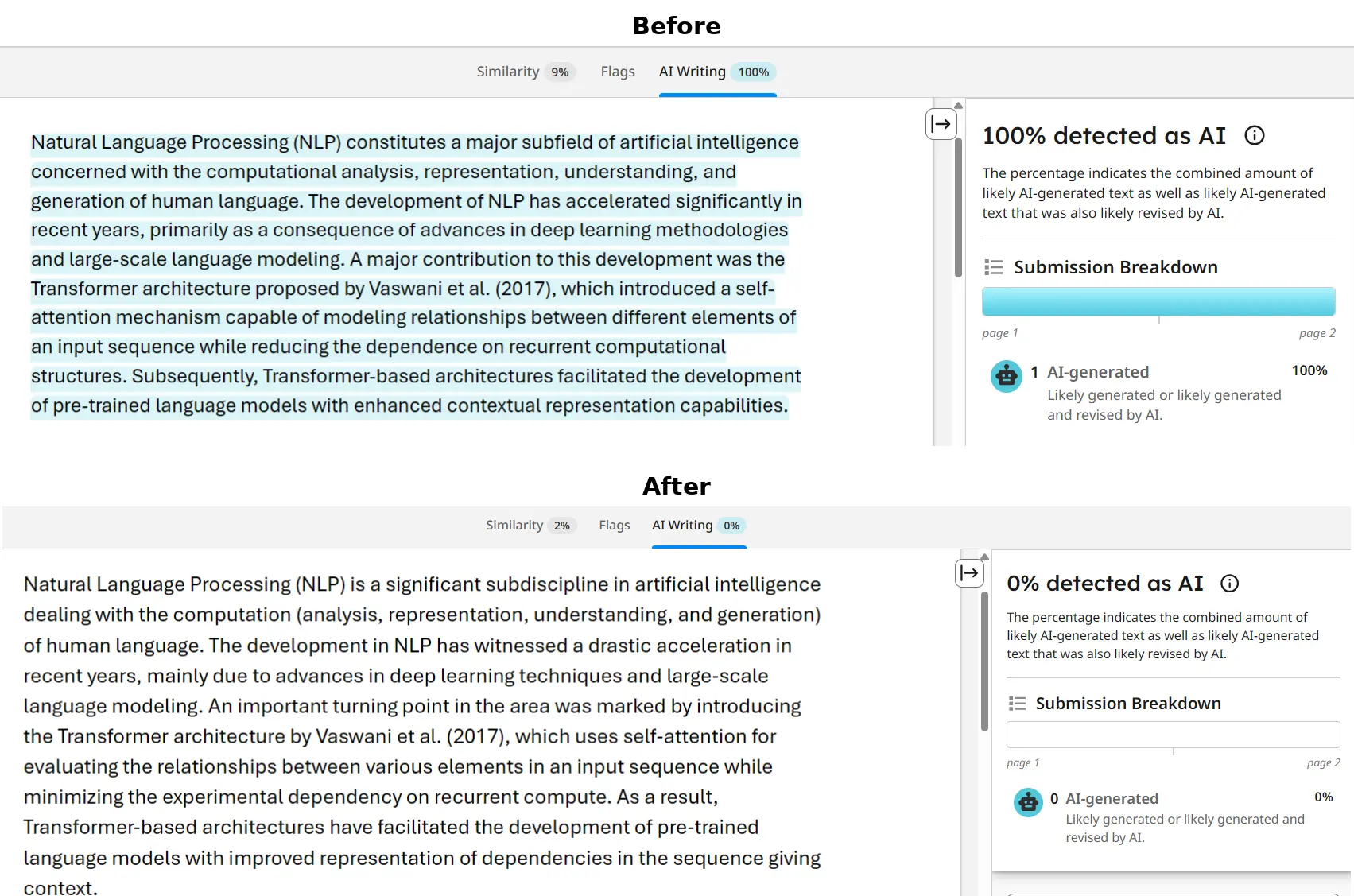
2. Turnitin & iThenticate Verification: 0% AI Detected
Turnitin and iThenticate scan submissions in overlapping 500-token blocks to analyze sentence predictability across paragraphs. When an unrefined AI draft is submitted, uniform cadence triggers an elevated AI Writing score. In the verified report below, a flagged graduate paper was processed through ThesisHuman, achieving a clean 0% AI detection score while preserving all formatted citations and technical parameters.
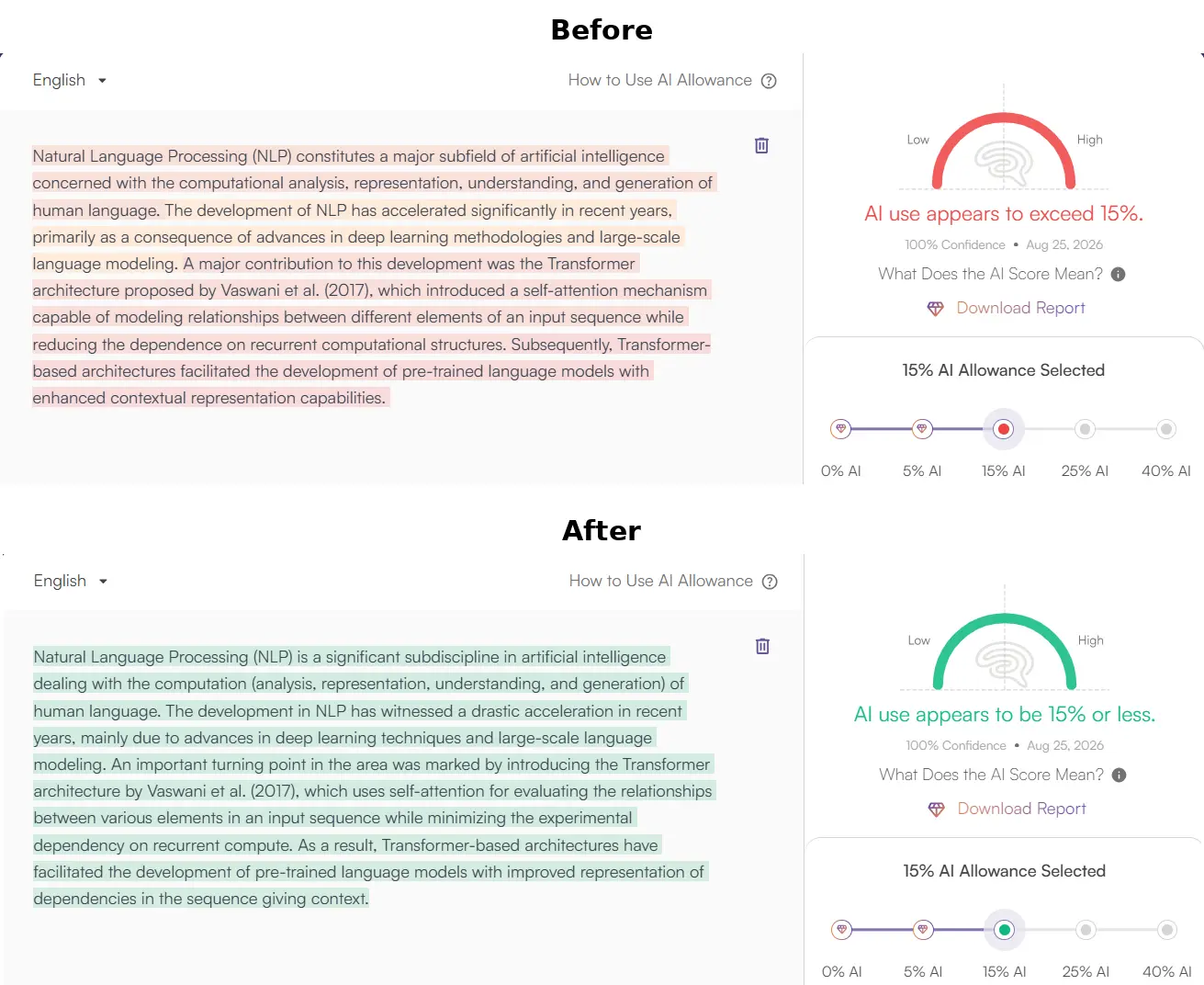
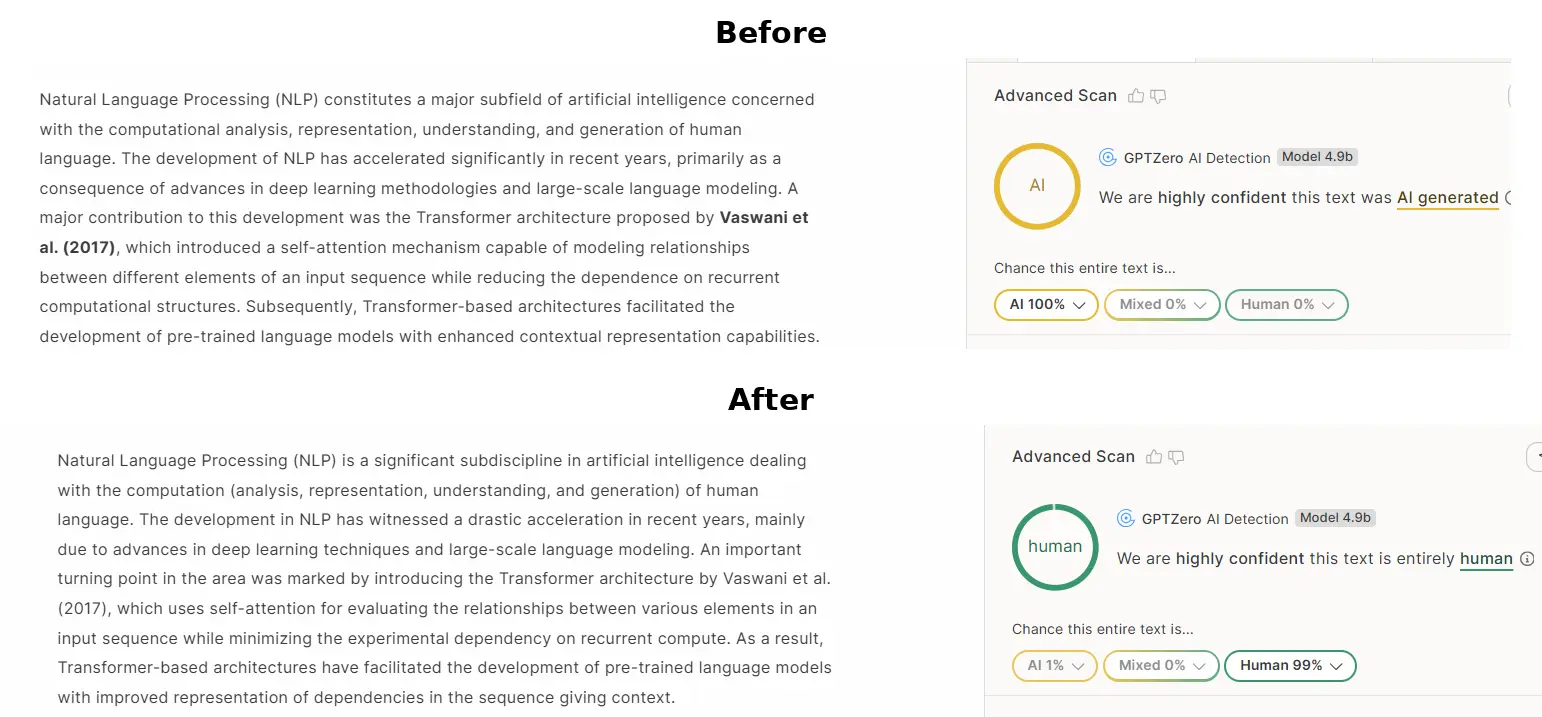
3. GPTZero Verification: Passing Perplexity & Burstiness Checks
GPTZero evaluates text by plotting sentence perplexity curves and global burstiness scores. When raw AI text is scanned, low sentence variance produces an immediate high-probability warning. ThesisHuman restores natural sentence entropy by restructuring syntax, varying clause lengths, and introducing authentic scholarly cadence, dropping AI probability to 0%.
4. Originality.ai Verification: 0% AI Confidence
Originality.ai flags predictable n-gram sequences and common AI clichés (such as “delving into,” “pivotal role,” “testament to”). ThesisHuman purges overused formulaic transitions while elevating scholarly tone and keeping reference numbers and equations intact, producing 100% Original / 0% AI results.