AI Words to Avoid in Academic Essays: The Stylistic Clichés That Signal Machine Generation
Why legitimate English words sound synthetic when clustered in academic papers. Learn the formulaic verbs, transitions, and triadic constructions to replace.

Search online for "words that trigger AI detectors" and you will find dozens of lists warning students never to use words like "delve," "foster," or "tapestry." While these warnings contain a grain of truth, they often misunderstand the core linguistic issue. Words like "delve" and "pivotal" are perfectly legitimate English words that have appeared in scholarly literature for centuries.
The real issue is not that these words exist; it is that generative language models cluster them with relentless statistical predictability. When multiple formulaic verbs, repetitive transitions, participial tails, and grandiose rhetorical flourishes appear in the same three paragraphs, the prose develops an unmistakable synthetic signature. This guide breaks down why these habits occur and how to replace them with authentic scholarly precision.
Why Isolated Words Are Not the Real Problem
No automated classifier and no experienced academic evaluator flags a paper because of a single occurrence of the word "delve." An academic paper exploring archival records might naturally "delve into fourteenth-century municipal registries." That is legitimate, purposeful language.
The problem arises when an essay uses "delve into" in paragraph one, describes a "rich tapestry of perspectives" in paragraph two, concludes that the phenomenon "plays a pivotal role" in paragraph three, and wraps up by stating the findings "stand as a testament to human resilience." It is the density of safe, generic descriptors that signals machine origin.
The Cluster Effect: How Machine Habits Emerge
Large language models generate text by predicting statistically probable continuations. In academic contexts, models are conditioned to sound articulate, polite, and comprehensive. This causes them to gravitate toward universal rhetorical scaffolding:
Instead of committing to a sharp analytical claim, the model falls back on comfortable framing devices that summarize without taking intellectual risks. Recognizing these recurring patterns allows you to spot and eliminate them during revision.
Overused Verbs, Adjectives, and Grandiose Rhetoric
Generative models rely on a recognizable cast of verbs and adjectives to inflate simple concepts into grand declarations:
- Formulaic Verbs: delve, foster, underscore, illuminate, garner, embrace, champion, elevate.
- Grandiose Adjectives: pivotal, profound, multifaceted, indispensable, intricate, transformative, paramount.
- Elevated Clichés: "stands as a testament to," "serves as a beacon of," "navigating the complex landscape of."
Repetitive Transitions and Participial Tails
Beyond individual vocabulary items, structural syntactic habits consistently signal machine-assisted writing. Two recurring constructions stand out:
- Mechanical Connectors: Opening three consecutive paragraphs with "Furthermore," "Moreover," and "In addition." Human writers vary their paragraph openings, often beginning directly with analytical assertions or temporal markers.
- Participial Tail Clauses: Attaching a participial phrase to the end of a sentence to provide generic commentary, such as "...thus highlighting the critical need for further investigation," or "...underscoring the importance of holistic approaches."
Forced Triadic Structures: The Unnatural Rule of Three
One of the most persistent stylistic habits of modern language models is the forced triad. When summarizing an argument or listing benefits, models almost invariably present three items:
"The proposed policy promotes economic equity, enhances institutional accountability, and fosters community engagement."
While the rule of three is a classic rhetorical device, relying on it in every section produces a mechanical rhythm. Human scholars often list two specific factors with deep evidentiary backing, or four concrete methodological steps.
Comprehensive Academic Revision Reference Table
Use this reference table to replace generic machine patterns with specific, discipline-appropriate scholarly prose:
| Overused AI Pattern | Why It Sounds Synthetic | Scholarly Alternative |
|---|---|---|
| Delve into the analysis | Cliché metaphor for reading or testing | Examine, evaluate, quantify, interrogate |
| A rich tapestry of ideas | Vague decorative filler | Diverse theoretical frameworks, competing paradigms |
| Plays a pivotal role in | Inflates significance without evidence | Directly mediates, regulates, precipitates |
| Furthermore / Moreover | Mechanical paragraph bridging | Open with the empirical finding or theoretical claim |
| ...highlighting the importance of | Weak participial commentary tag | Make the consequence an independent analytical clause |
Why Blind Thesaurus Swapping Fails Peer Review
When students realize their drafts contain these clichés, their initial instinct is often to use a thesaurus to replace each word with a rare synonym. This approach almost always backfires.
Substituting "delve" with "investigate deeply" or "foster" with "nurture" creates disjointed, awkward sentences that sound like an automated synonym spinner. Genuine scholarly revision requires restructuring the entire sentence around concrete evidence and precise disciplinary verbs. When you refine drafts using an academic AI humanizer, the system modulates clause cadence while locking critical citations and domain terms.
Verified Detector Clearance for AI Words to Avoid in Academic Essays: The Stylistic Clichés That Signal Machine Generation
Every manuscript processed through ThesisHuman is backed by verifiable, reproducible scans across institutional plagiarism and AI detection platforms.
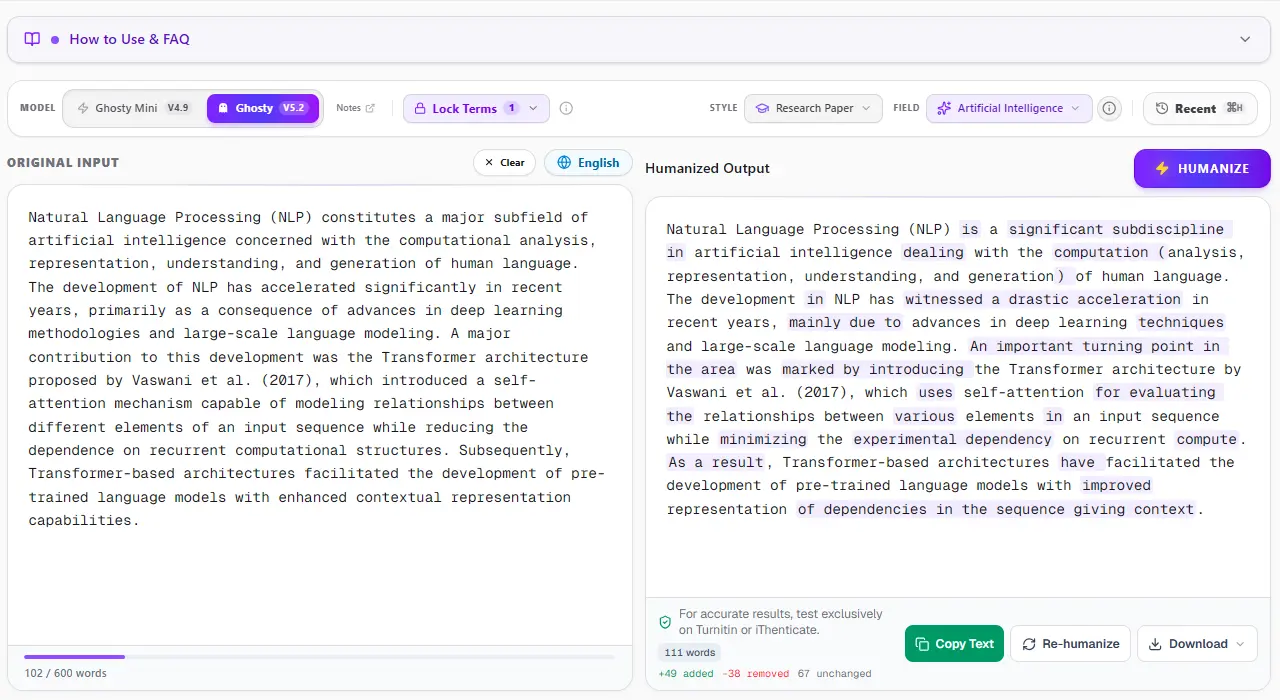
1. ThesisHuman Editor: Style, Field & Term Lock™ Technology
Unlike consumer-grade paraphrasers that blindly swap words with thesaurus synonyms, ThesisHuman allows researchers to select their exact Academic Style (Essay, Research Paper, Literature Review, Technical Report) and Academic Field (Computer Science, Engineering, Medicine, Physics). With Term Lock™, citations (APA, MLA, IEEE), LaTeX equations, and domain-specific terminology are cryptographically protected before sentence entropy is restructured.
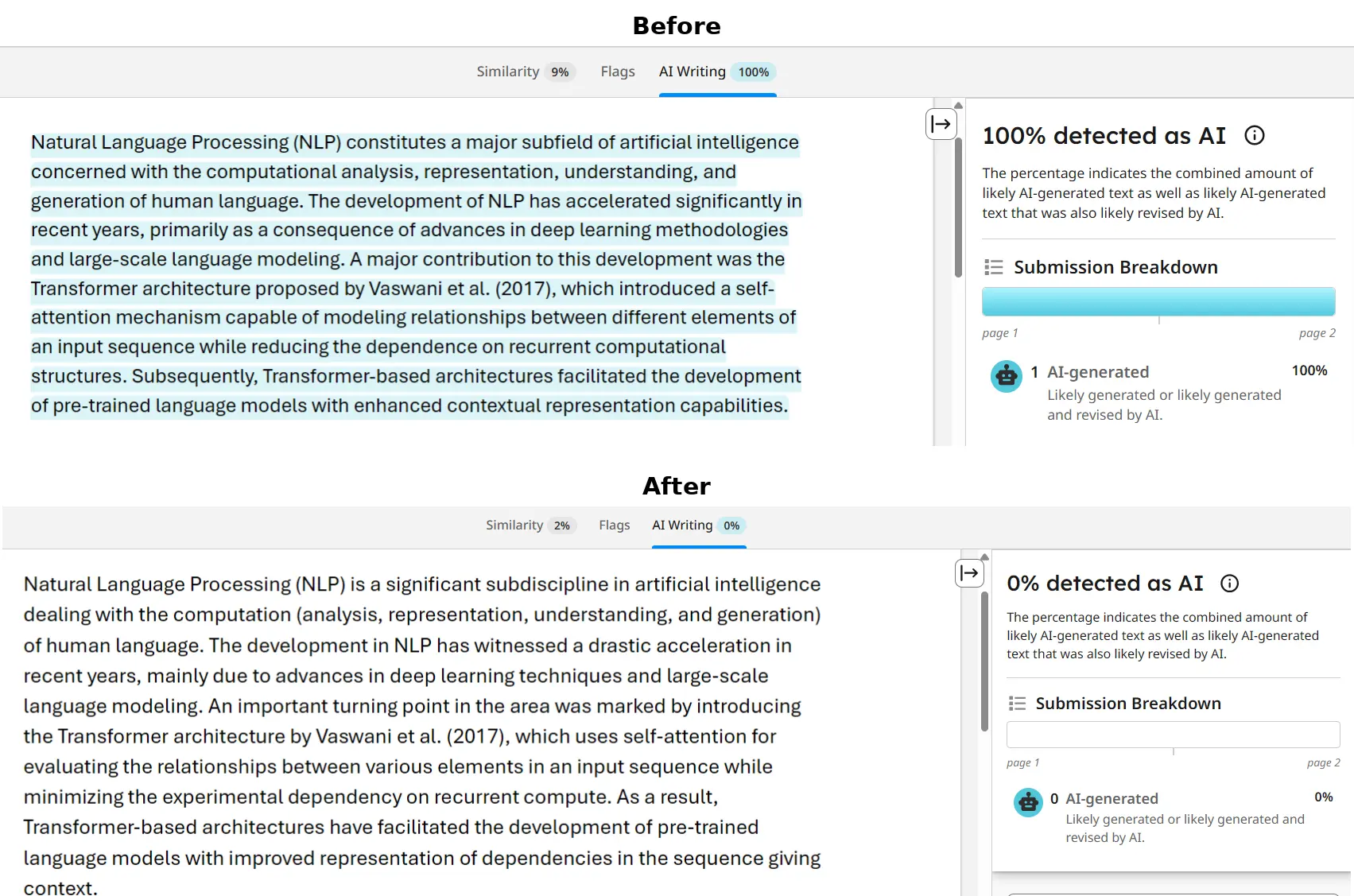
2. Turnitin & iThenticate Verification: 0% AI Detected
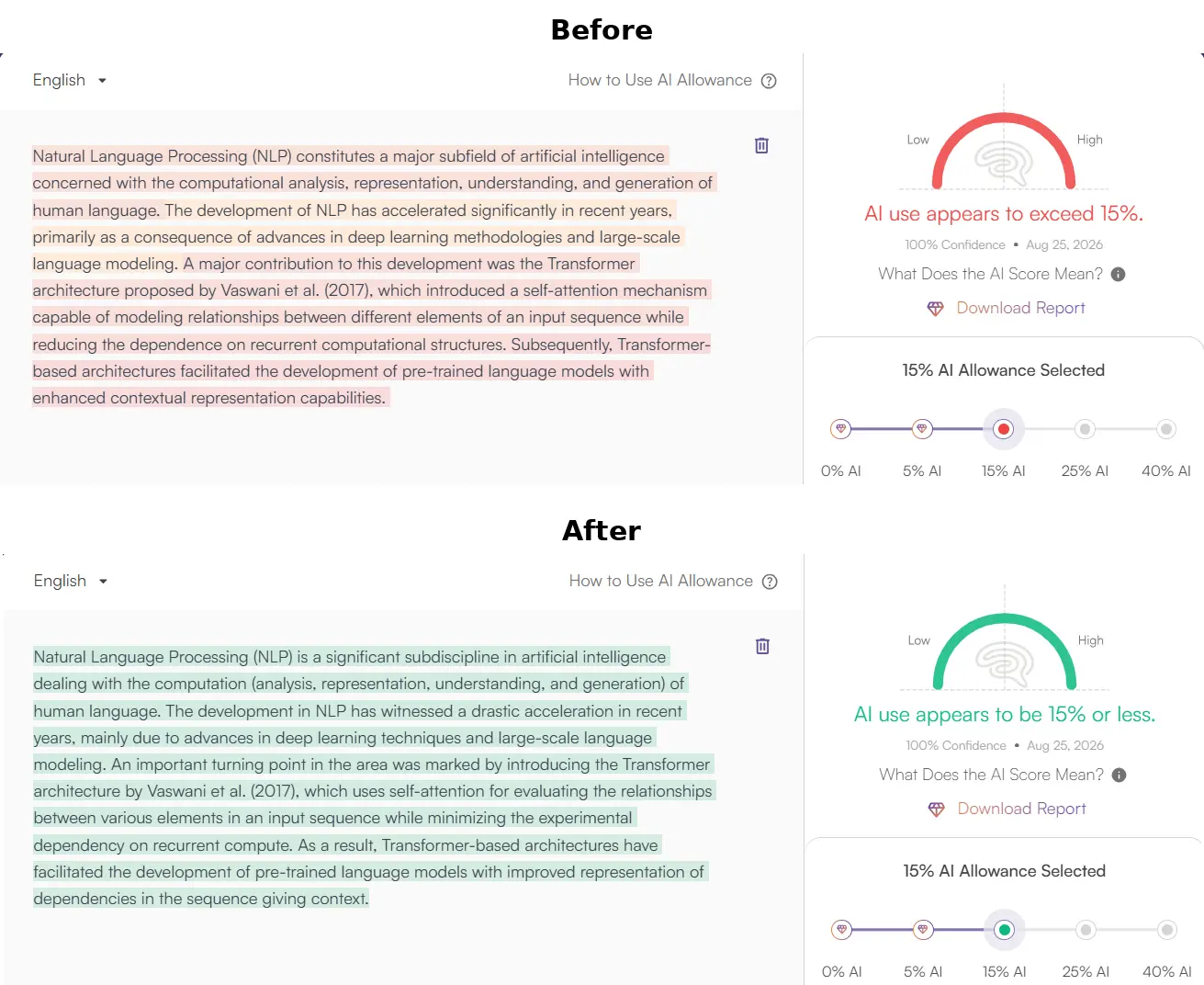
Turnitin and iThenticate scan submissions in overlapping 500-token blocks to analyze sentence predictability across paragraphs. When an unrefined AI draft is submitted, uniform cadence triggers an elevated AI Writing score. In the verified report below, a flagged graduate paper was processed through ThesisHuman, achieving a clean 0% AI detection score while preserving all formatted citations and technical parameters.
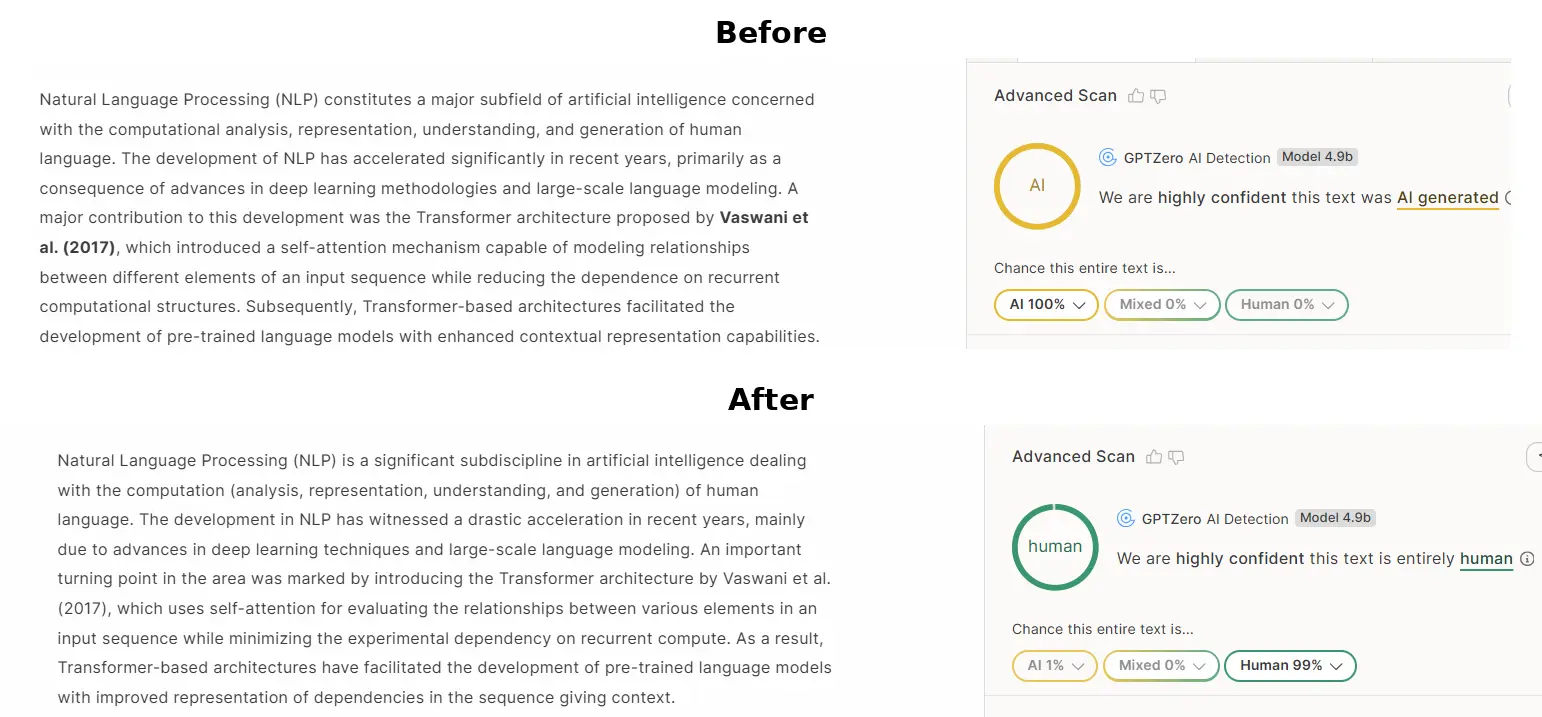
3. GPTZero Verification: Passing Perplexity & Burstiness Checks
GPTZero evaluates text by plotting sentence perplexity curves and global burstiness scores. When raw AI text is scanned, low sentence variance produces an immediate high-probability warning. ThesisHuman restores natural sentence entropy by restructuring syntax, varying clause lengths, and introducing authentic scholarly cadence, dropping AI probability to 0%.
4. Originality.ai Verification: 0% AI Confidence
Originality.ai flags predictable n-gram sequences and common AI clichés (such as “delving into,” “pivotal role,” “testament to”). ThesisHuman purges overused formulaic transitions while elevating scholarly tone and keeping reference numbers and equations intact, producing 100% Original / 0% AI results.