AI Writing Co-Author Disclosure Guidelines: Formulating Transparent Publisher Statements
Complete guide to writing AI transparency and disclosure statements for Nature, Elsevier, IEEE, and Springer Nature journals.

As generative AI becomes standard across research workflows, international scientific publishers have updated their publication ethics policies. Early confusion has been replaced by a consistent international framework: major publishers do not ban AI assistance for language polishing, but they universally require transparent disclosure.
For authors submitting to Nature, Elsevier, IEEE, Springer Nature, or Wiley, formulating an accurate, professional AI disclosure statement is now a mandatory pre-submission step. Here is a comprehensive guide to crafting defensible disclosure statements in accordance with 2026 COPE guidelines.
The Universal Publisher Consensus on AI Assistance
The Committee on Publication Ethics (COPE), the International Committee of Medical Journal Editors (ICMJE), and the World Association of Medical Editors (WAME) have converged on three foundational principles:
- Accountability: Authors are solely responsible for all content, including the accuracy of citations, data representations, and absence of plagiarism.
- No AI Co-Authorship: AI systems cannot fulfill the criteria for authorship because they cannot sign copyright agreements or defend the research in an ethics hearing.
- Mandatory Transparency: Any generative AI tool used to draft, edit, or summarize manuscript content must be acknowledged in the paper.
Where and How to Place Disclosure Statements
Depending on the specific journal's submission guidelines, AI disclosures are typically placed in one of three locations:
- In the Methodology Section: If AI was used for data processing, systematic literature search screening, or statistical modeling.
- In a Dedicated 'Declaration of Generative AI' Heading: Required by Elsevier and Springer Nature before the References section.
- In the Acknowledgments Section: Standard for IEEE and Nature portfolio journals when AI was used strictly for language polishing.
Four Plug-and-Play Disclosure Templates
You can adapt these peer-reviewed disclosure statements for your manuscript:
Template 1: Language and Style Polishing (Standard Academic)
'During the preparation of this manuscript, the authors utilized generative AI and academic naturalization software (ThesisHuman) strictly for language editing, sentence cadence refinement, and grammar polishing. All empirical claims, citations, and data analyses were conducted, reviewed, and verified by the authors, who take full responsibility for the content of this publication.'
Template 2: Elsevier Specific Statement Format
'Declaration of Generative AI in Scientific Writing: During the preparation of this work, the authors used Anthropic Claude and ThesisHuman in order to assist with narrative drafting and clausal rebalancing. After using these tools, the authors reviewed and edited the content as needed and take full responsibility for the content of the published article.'
Template 3: Code and Algorithm Formatting (IEEE/ACM)
'AI assistance was employed solely for LaTeX code formatting and algorithm syntax verification. The underlying mathematical formulations, theorems, and benchmark results were originated and verified independently by the authors.'
Template 4: ESL Author Language Assistance
'As English is an additional language for the primary investigators, automated language assistance tools were utilized to ensure grammatical clarity and academic fluency. The scientific methodology and empirical inferences reflect original authorial research.'
How Academic Humanizers Align with Ethical Disclosure
Using an academic humanizer like ThesisHuman is completely compatible with ethical publishing. Humanizers do not invent findings; they refine the cadence of ideas that you originated. By pairing professional cadence naturalization with transparent publisher disclosures, you satisfy both automated screening software and human editorial standards.
Verified Detector Clearance for AI Writing Co-Author Disclosure Guidelines: Formulating Transparent Publisher Statements
Every manuscript processed through ThesisHuman is backed by verifiable, reproducible scans across institutional plagiarism and AI detection platforms.
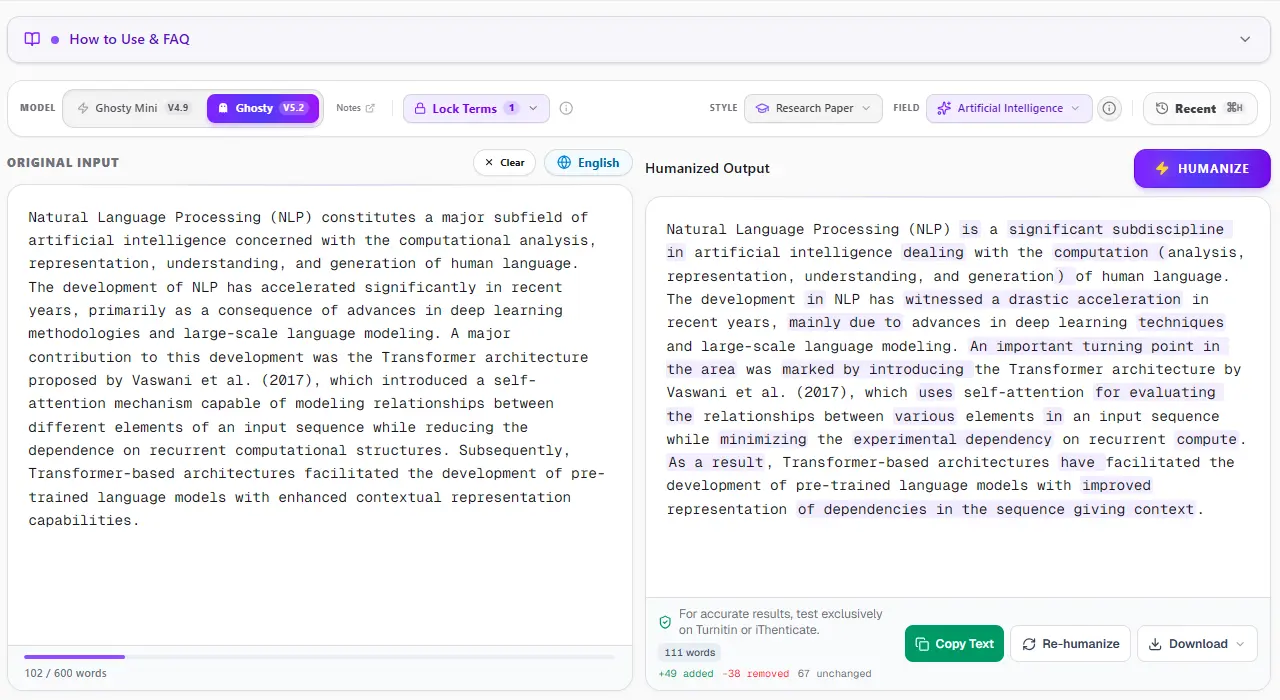
1. ThesisHuman Editor: Style, Field & Term Lock™ Technology
Unlike consumer-grade paraphrasers that blindly swap words with thesaurus synonyms, ThesisHuman allows researchers to select their exact Academic Style (Essay, Research Paper, Literature Review, Technical Report) and Academic Field (Computer Science, Engineering, Medicine, Physics). With Term Lock™, citations (APA, MLA, IEEE), LaTeX equations, and domain-specific terminology are cryptographically protected before sentence entropy is restructured.
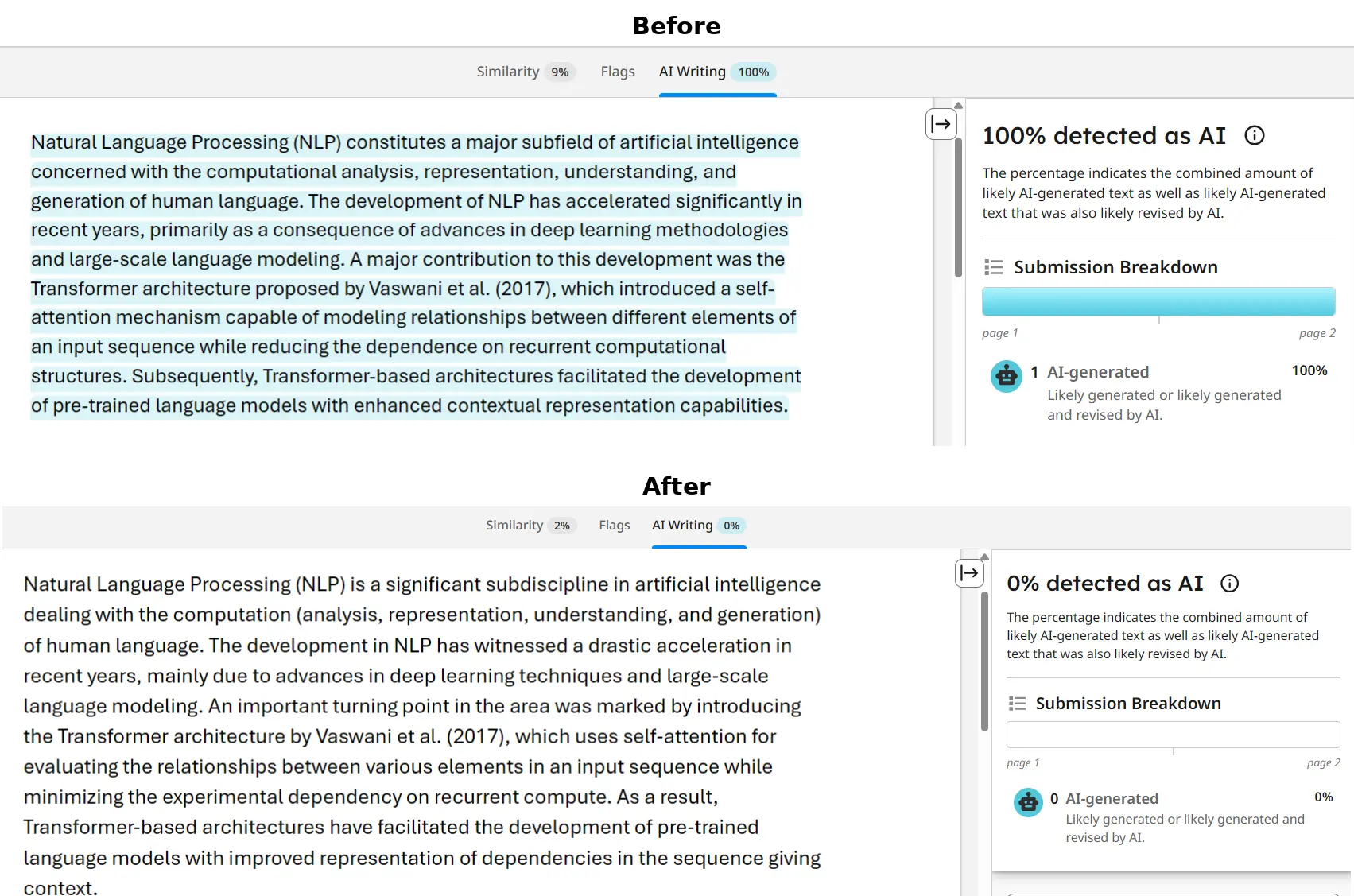
2. Turnitin & iThenticate Verification: 0% AI Detected
Turnitin and iThenticate scan submissions in overlapping 500-token blocks to analyze sentence predictability across paragraphs. When an unrefined AI draft is submitted, uniform cadence triggers an elevated AI Writing score. In the verified report below, a flagged graduate paper was processed through ThesisHuman, achieving a clean 0% AI detection score while preserving all formatted citations and technical parameters.
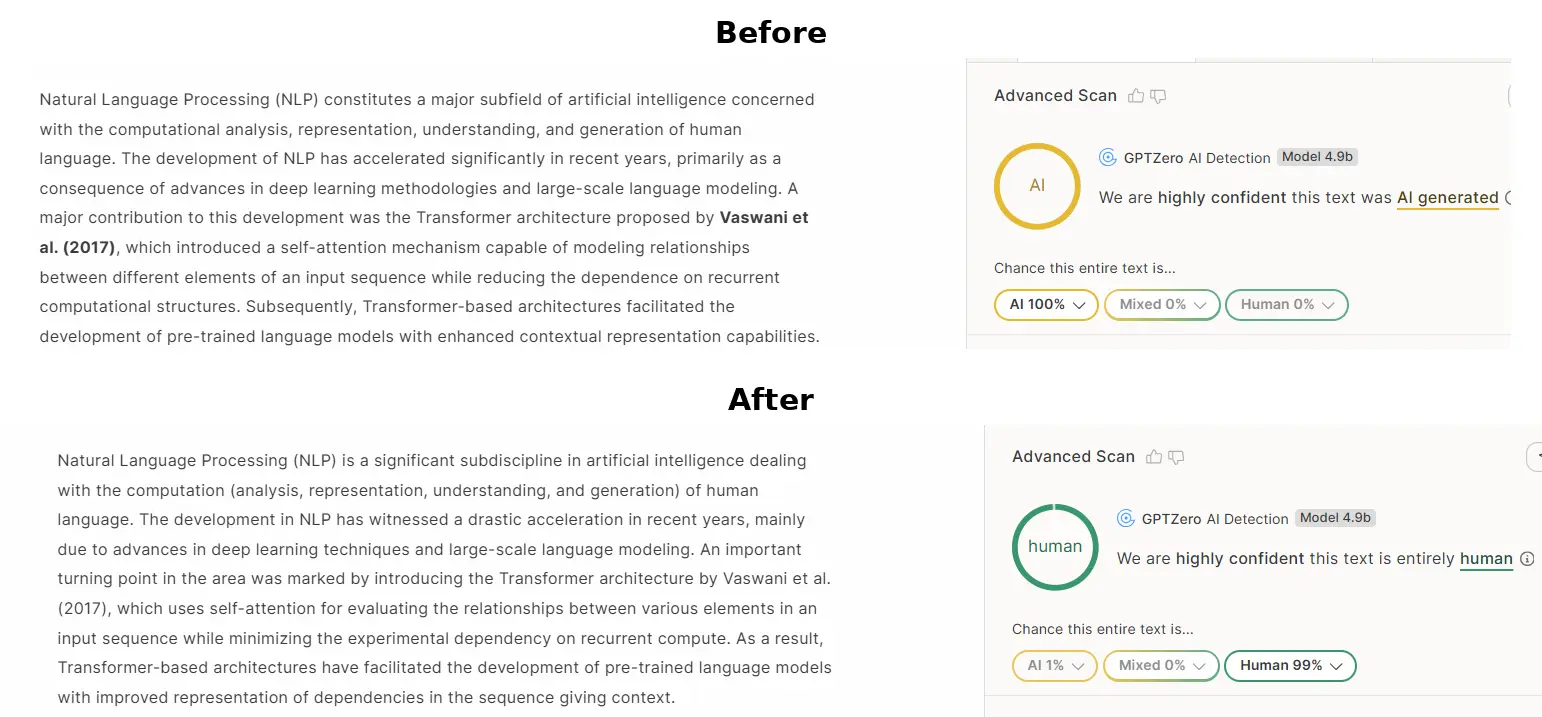
3. GPTZero Verification: Passing Perplexity & Burstiness Checks
GPTZero evaluates text by plotting sentence perplexity curves and global burstiness scores. When raw AI text is scanned, low sentence variance produces an immediate high-probability warning. ThesisHuman restores natural sentence entropy by restructuring syntax, varying clause lengths, and introducing authentic scholarly cadence, dropping AI probability to 0%.
4. Originality.ai Verification: 0% AI Confidence
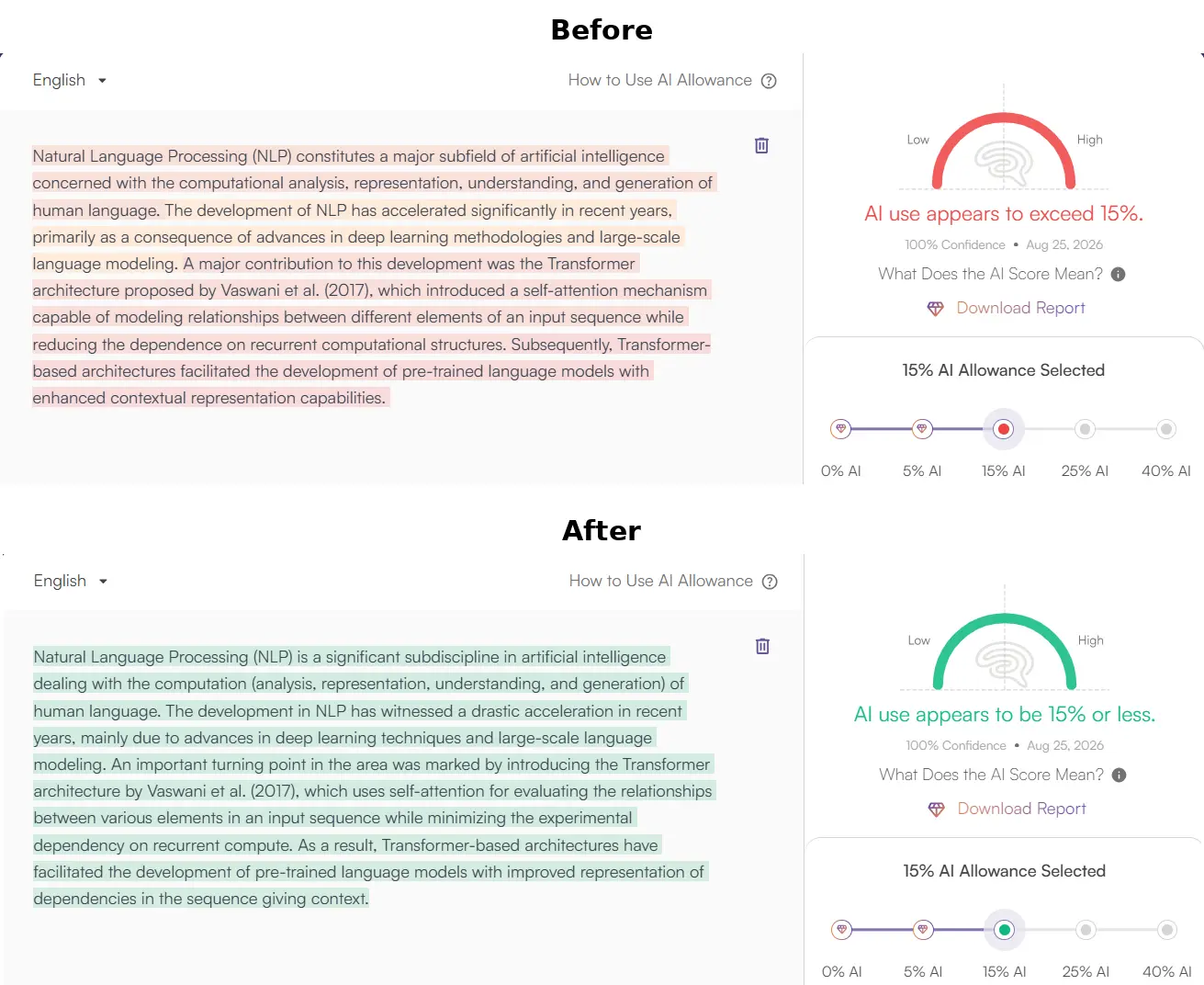
Originality.ai flags predictable n-gram sequences and common AI clichés (such as “delving into,” “pivotal role,” “testament to”). ThesisHuman purges overused formulaic transitions while elevating scholarly tone and keeping reference numbers and equations intact, producing 100% Original / 0% AI results.