Best AI Humanizer for Research Papers Compared: 2026 Academic Evaluation
Comprehensive evaluation of top AI humanizers for research papers. Comparing citation locking, LaTeX safety, data privacy, and peer-review readiness.
The proliferation of automated AI screening tools across scholarly publishers has sparked intense interest in AI humanizers. Researchers preparing manuscripts for Elsevier, IEEE, Springer Nature, and Wiley journals need software that can refine assisted drafts into publication-ready prose. However, most commercial humanizers were created for search engine optimization or casual student essays, not rigorous academic manuscripts.
To help scholars make an informed choice, this guide compares the leading approaches to AI humanization in 2026, evaluating tools across five essential academic criteria.
Five Criteria for Evaluating Academic Humanizers
When evaluating software for research manuscripts, prioritize these technical capabilities:
- Citation Syntax Fidelity: Ability to detect and freeze in-text references (APA, IEEE, Nature, Chicago) without corrupting author names or bracketed keys.
- Mathematical & LaTeX Protection: Complete preservation of math environments, Greek symbols, and Overleaf formatting macros.
- Semantic Preservation: Restructuring syntactic burstiness without altering empirical conclusions, p-values, or technical terminology.
- Zero Repository Retention: Ephemeral in-memory processing that ensures unpublished research is never stored in public plagiarism databases.
- Detector Optimization: Calibrated against institutional screening engines like Turnitin and iThenticate (via Crossref Similarity Check).
Head-to-Head Architectural Comparison
| Feature | Generic Consumer Humanizer | QuillBot / Basic Paraphraser | ThesisHuman Academic Humanizer |
|---|---|---|---|
| Primary Purpose | SEO blog rewriting | Synonym replacement | Peer-reviewed academic research |
| Citation Locking | None (scrambles citations) | Manual phrase freeze | Automatic multi-style Term Lock |
| LaTeX Support | Breaks TeX macros | Strips backslashes | Full AMS-LaTeX & Overleaf safe |
| Cadence Mechanism | Random sentence fragmentation | Word-level substitution | Ghosty V6 burstiness calibration |
| Data Privacy | May log or train on inputs | Account history stored | Ephemeral memory, zero indexing |
Data Privacy and Non-Repository Architecture
For researchers working on patentable technology or unpublished doctoral findings, data security is paramount. Passing a draft through an ad-supported free humanizer risks leaking your intellectual property into commercial training corpora. ThesisHuman's dedicated research humanizer uses an encrypted, non-repository pipeline: your manuscript is processed in temporary RAM and purged immediately upon delivery.
The Verdict: Selecting the Right Tool for Your Manuscript
If you are writing casual marketing content, consumer paraphrasers are adequate. But for journal manuscripts, Master's theses, and doctoral dissertations, ThesisHuman provides the dedicated citation locks, LaTeX preservation, and scholarly cadence calibration necessary to navigate peer review safely.
Verified Detector Clearance for Best AI Humanizer for Research Papers Compared: 2026 Academic Evaluation
Every manuscript processed through ThesisHuman is backed by verifiable, reproducible scans across institutional plagiarism and AI detection platforms.
1. ThesisHuman Editor: Style, Field & Term Lock™ Technology
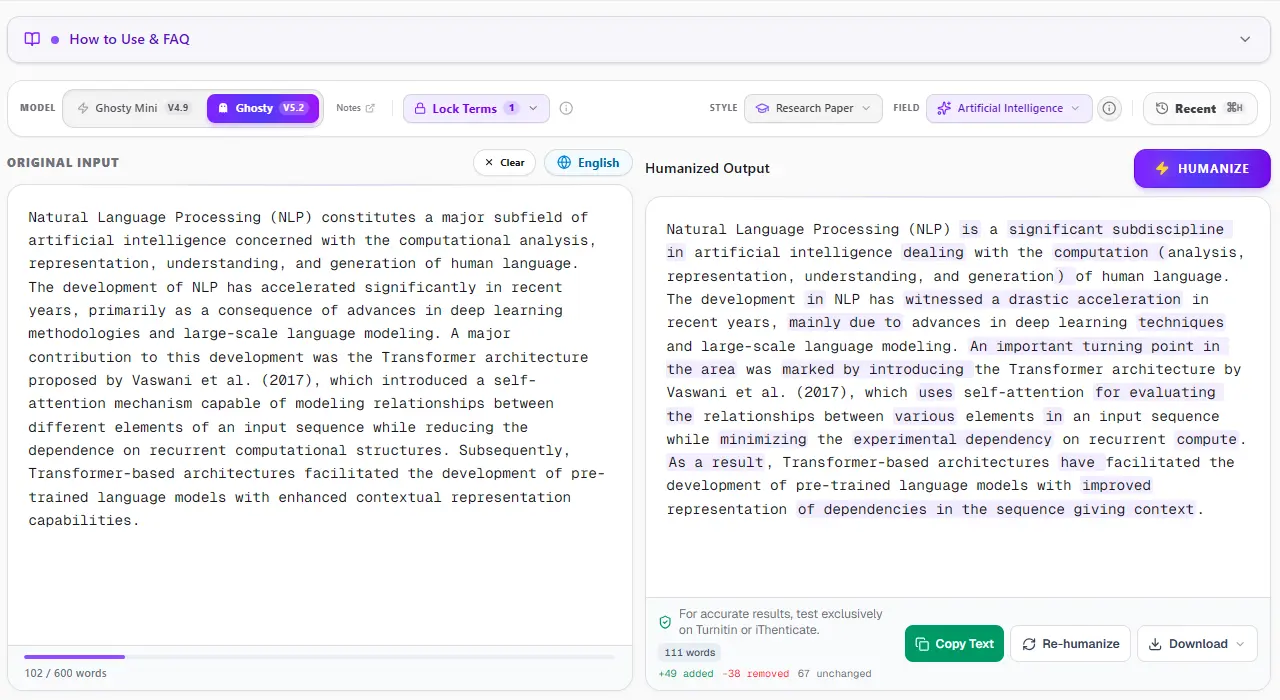
Unlike consumer-grade paraphrasers that blindly swap words with thesaurus synonyms, ThesisHuman allows researchers to select their exact Academic Style (Essay, Research Paper, Literature Review, Technical Report) and Academic Field (Computer Science, Engineering, Medicine, Physics). With Term Lock™, citations (APA, MLA, IEEE), LaTeX equations, and domain-specific terminology are cryptographically protected before sentence entropy is restructured.
2. Turnitin & iThenticate Verification: 0% AI Detected
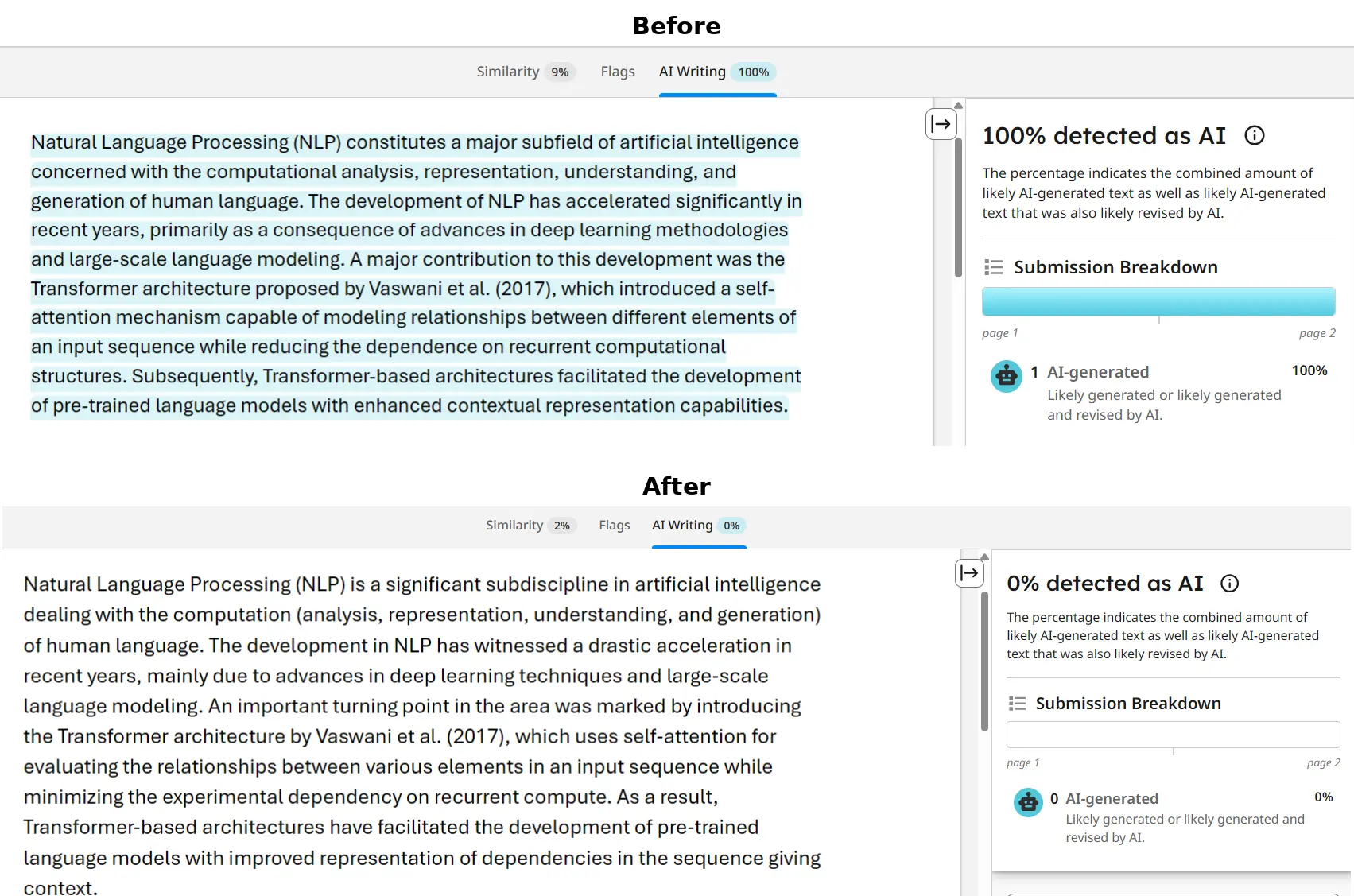
Turnitin and iThenticate scan submissions in overlapping 500-token blocks to analyze sentence predictability across paragraphs. When an unrefined AI draft is submitted, uniform cadence triggers an elevated AI Writing score. In the verified report below, a flagged graduate paper was processed through ThesisHuman, achieving a clean 0% AI detection score while preserving all formatted citations and technical parameters.
3. GPTZero Verification: Passing Perplexity & Burstiness Checks
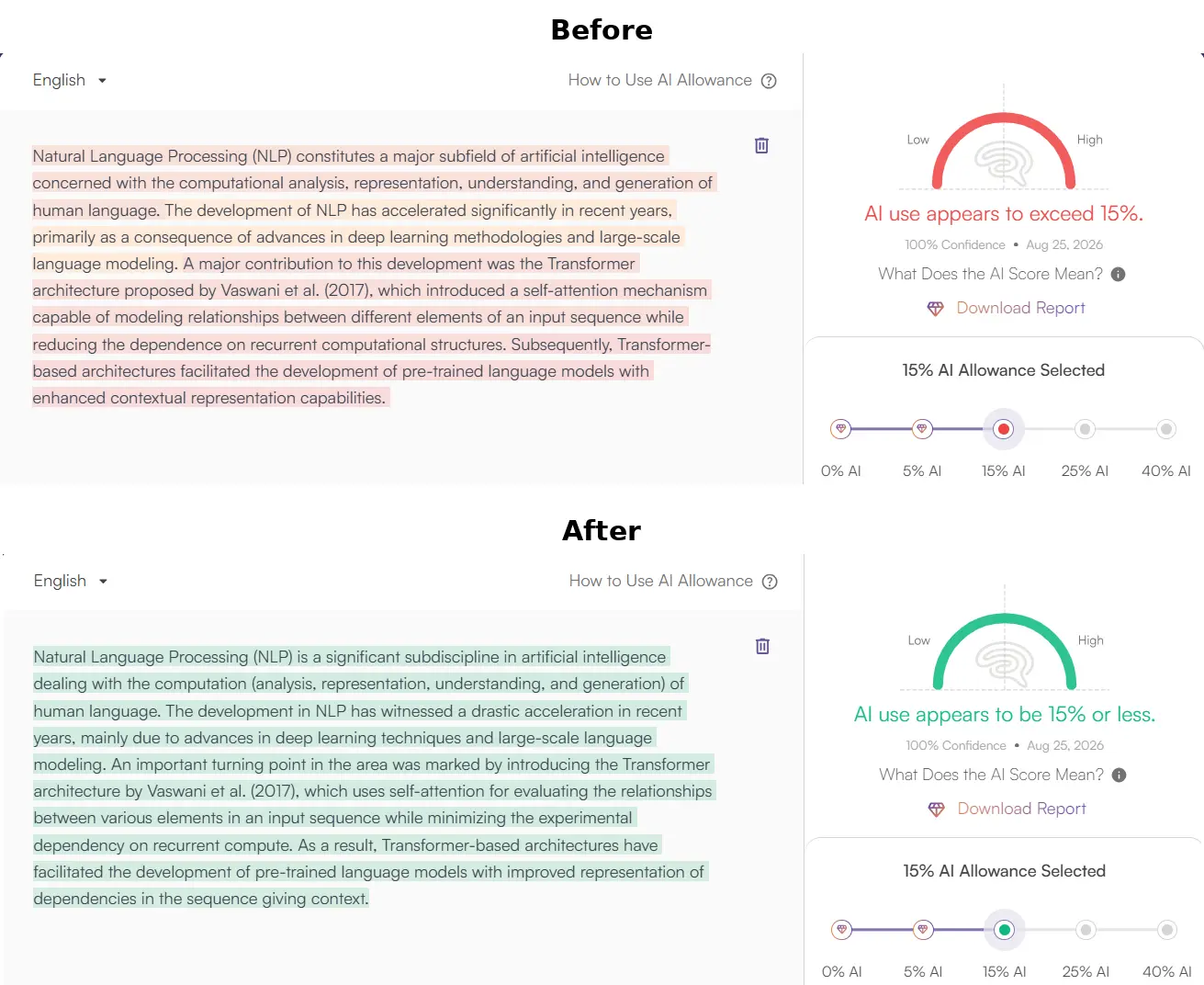
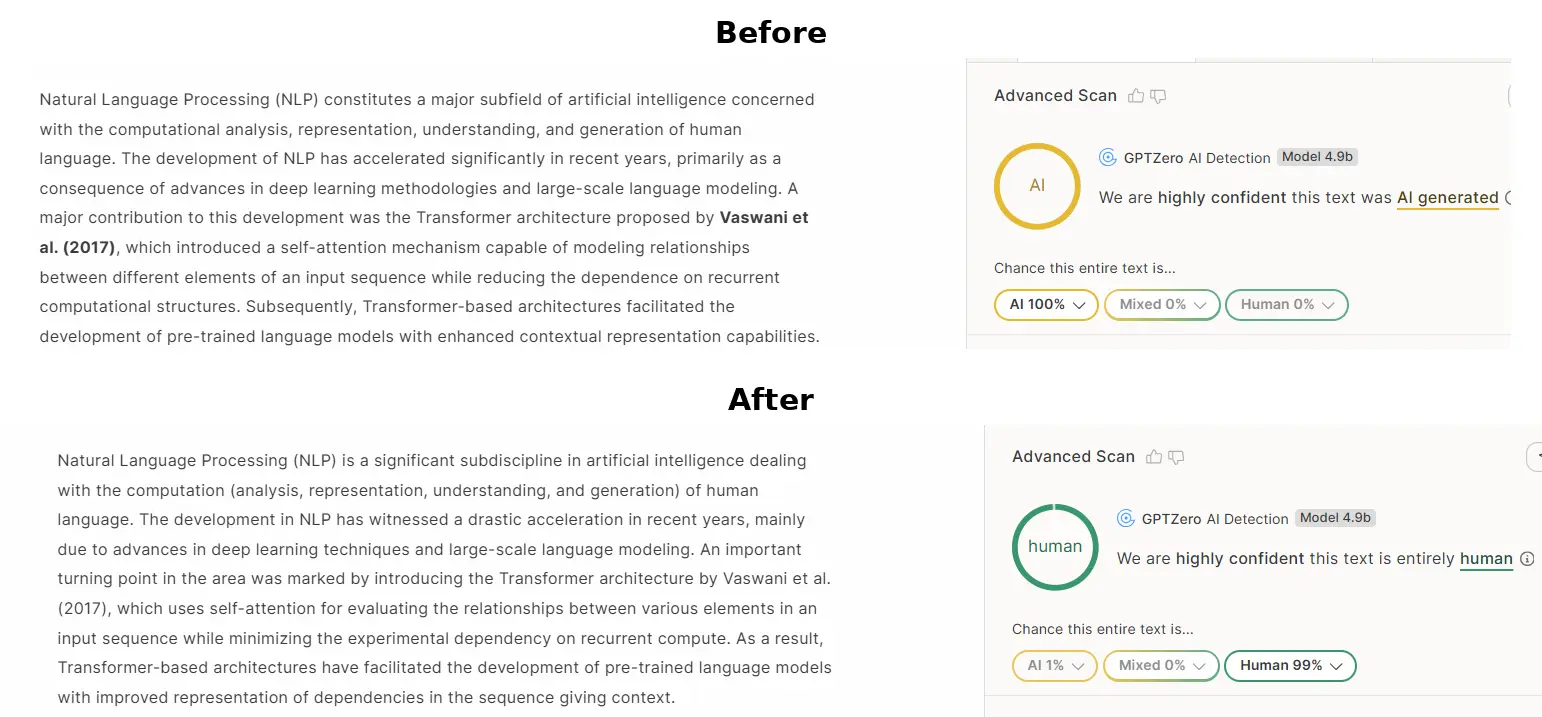
GPTZero evaluates text by plotting sentence perplexity curves and global burstiness scores. When raw AI text is scanned, low sentence variance produces an immediate high-probability warning. ThesisHuman restores natural sentence entropy by restructuring syntax, varying clause lengths, and introducing authentic scholarly cadence, dropping AI probability to 0%.
4. Originality.ai Verification: 0% AI Confidence
Originality.ai flags predictable n-gram sequences and common AI clichés (such as “delving into,” “pivotal role,” “testament to”). ThesisHuman purges overused formulaic transitions while elevating scholarly tone and keeping reference numbers and equations intact, producing 100% Original / 0% AI results.