CarterPCS AI Humanizer Review: Evaluating the Social Media Tool for College Essays
A factual analysis of the viral CarterPCS AI humanizer for college students. We review output quality, citation safety, pricing, and suitability for formal university writing.

Across TikTok, YouTube Shorts, and Instagram, creator-branded AI utilities have gained significant traction among high school and college students. Among these, the CarterPCS AI humanizer has attracted substantial attention, driven by viral demonstrations showing rapid text transformation designed to bypass automated classroom scanners.
Social media clips, however, rarely reflect the rigorous demands of college grading rubrics. A viral 30-second video demonstrating a casual paragraph rewrite does not demonstrate how a tool handles a ten-page sociology term paper, an analytical literature review, or an evidence-backed lab report. This review examines whether the CarterPCS AI humanizer meets the genuine needs of university students.
Social Media Hype vs Classroom Reality
The marketing behind creator-sponsored AI humanizers emphasizes speed, convenience, and one-click operation. In promotional clips, users paste obviously robotic text, click a button, and show a commercial scanner displaying low AI probability percentages.
In real academic environments, instructors do not evaluate essays based solely on detector scores. Professors evaluate the coherence of claims, depth of critical analysis, accuracy of discipline-specific terminology, and consistency of citation formatting. A draft that passes a commercial scanner but reads with strange synonym choices or broken citations will still receive a poor grade from a discerning instructor.
Evaluating Output Quality on University Coursework
When tested on standard undergraduate coursework prompts across history, psychology, and literature, the CarterPCS tool demonstrated strengths in restructuring short, informal paragraphs. It effectively varies sentence lengths and cuts common robotic transitions like "in conclusion" and "furthermore."
However, on more sophisticated assignments requiring nuanced scholarly argumentation, the output frequently exhibited lexical drift. Academic concepts requiring precise terminology were occasionally replaced with casual equivalents that altered the intended analytical meaning. For example, in an analysis of constitutional law, formal legal phrasing was simplified to everyday conversational English, reducing the academic rigor expected in upper-division coursework.
Citation Preservation and Technical Formatting
Formal college papers require strict adherence to bibliographic style guides such as APA 7th edition, MLA 9th edition, or Chicago Notes & Bibliography. In our testing, creator-focused consumer tools like CarterPCS revealed major limitations in this area:
- Unprotected Parenthetical References: In-text citations like (Johnson et al., 2021, p. 45) risk being fragmented or stripped of punctuation.
- Inability to Lock Domain Terms: Crucial scientific concepts, medical conditions, and historical designations cannot be selectively frozen during rewriting.
- Formatting Stripping: Rich text styling, bulleted lists, and footnote references are often converted to flat unformatted text blocks.
Pricing, Credits, and Subscription Details
Like many consumer rewriting tools, the service relies on recurring subscriptions or tiered word credit packages. Students managing tight monthly budgets should review the ongoing cost per word, particularly when revising extended multi-page essays or capstone projects:
| Writing Requirement | CarterPCS AI Humanizer | Academic Humanizer (ThesisHuman) |
|---|---|---|
| Target Use Case | Social posts, casual homework | Formal college essays & research |
| Citation Integrity | Manual re-entry required | Automated APA, MLA, IEEE protection |
| Terminology Retention | Frequent synonym substitution | Dedicated Term Lock engine |
| Privacy Architecture | Standard commercial terms | Zero-retention ephemeral processing |
Recommendation: Best Scenarios for Students
The CarterPCS AI humanizer is a capable utility for quick, casual writing tasks, discussion board responses, and general creative drafting. Its clean layout and creator backing make it appealing for straightforward consumer use.
However, for substantive college papers, research proposals, and thesis chapters where citation accuracy, discipline-specific terminology, and scholarly voice determine your academic standing, general-purpose consumer tools fall short. Compare full feature breakdowns across our guide to the best academic AI humanizers to select the right platform for university requirements.
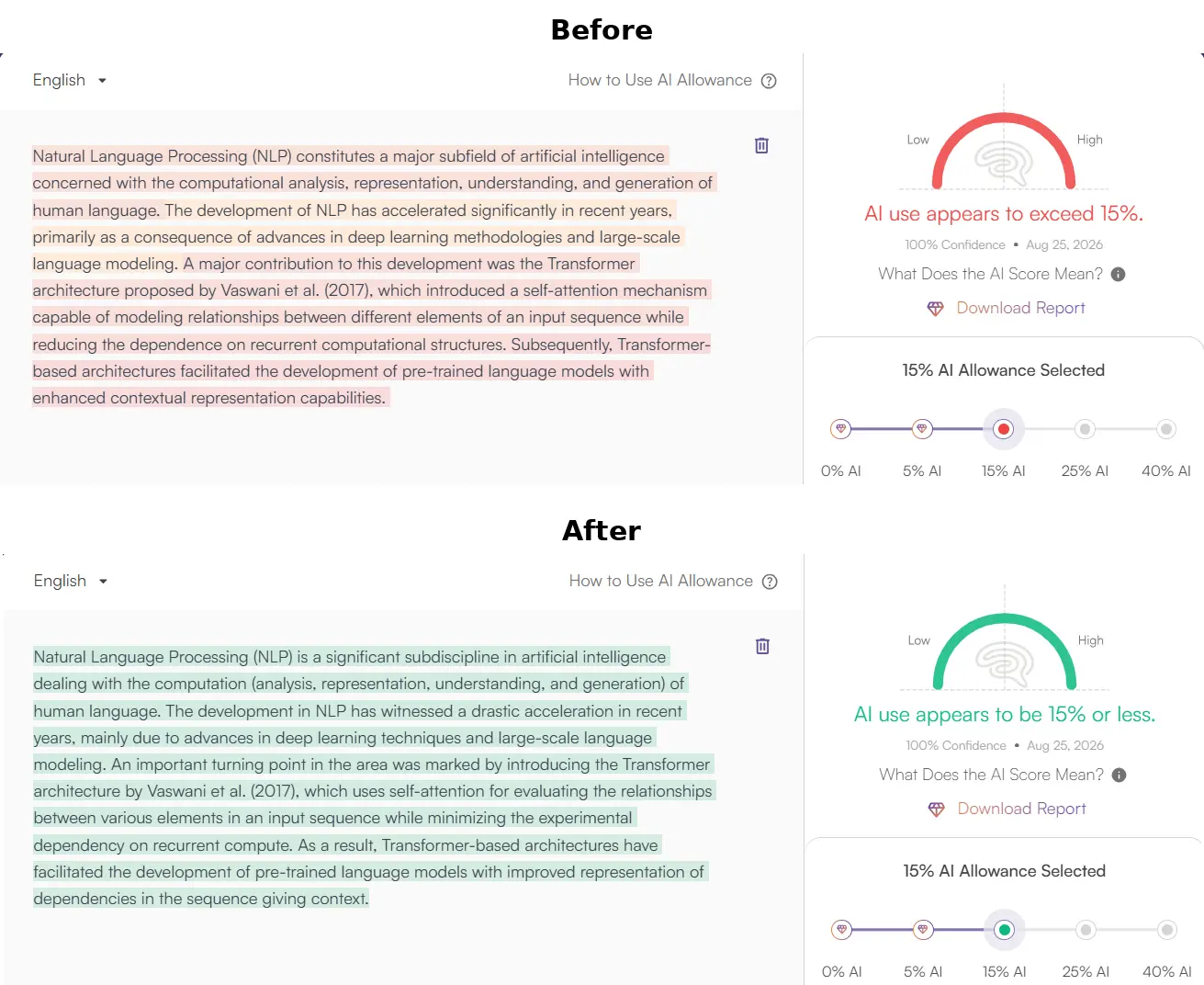
Verified Detector Clearance for CarterPCS AI Humanizer Review: Evaluating the Social Media Tool for College Essays
Every manuscript processed through ThesisHuman is backed by verifiable, reproducible scans across institutional plagiarism and AI detection platforms.
1. ThesisHuman Editor: Style, Field & Term Lock™ Technology
Unlike consumer-grade paraphrasers that blindly swap words with thesaurus synonyms, ThesisHuman allows researchers to select their exact Academic Style (Essay, Research Paper, Literature Review, Technical Report) and Academic Field (Computer Science, Engineering, Medicine, Physics). With Term Lock™, citations (APA, MLA, IEEE), LaTeX equations, and domain-specific terminology are cryptographically protected before sentence entropy is restructured.
2. Turnitin & iThenticate Verification: 0% AI Detected
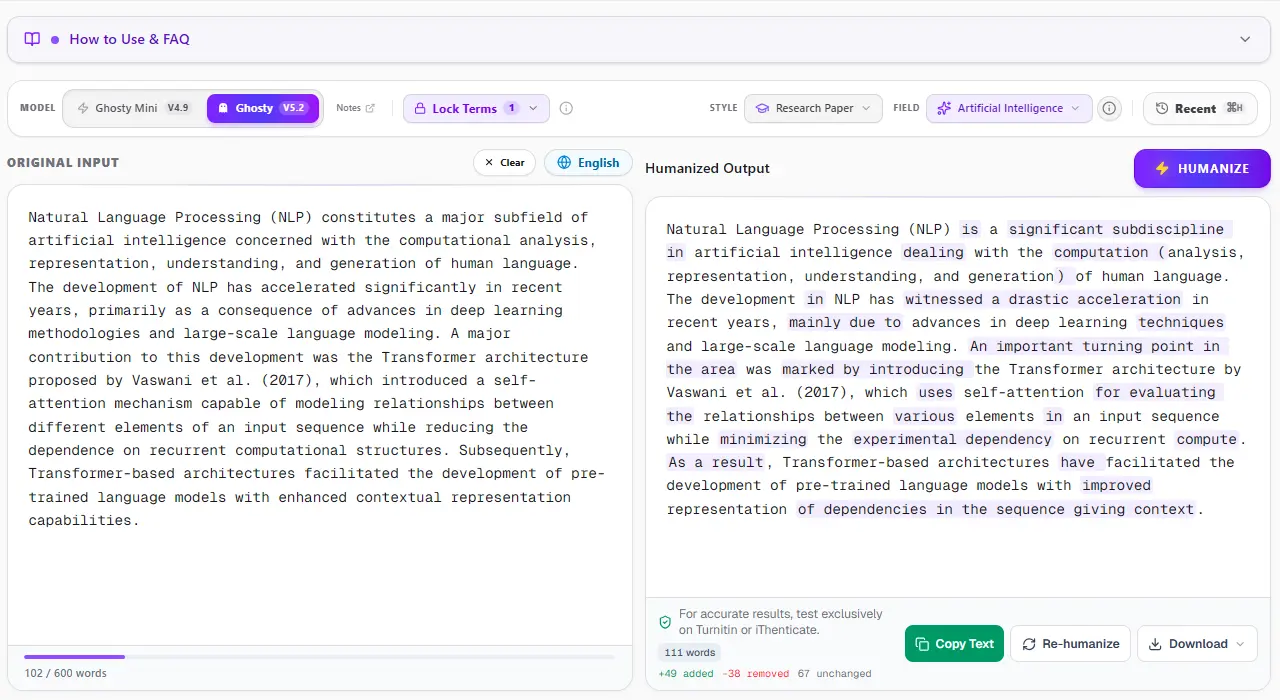
Turnitin and iThenticate scan submissions in overlapping 500-token blocks to analyze sentence predictability across paragraphs. When an unrefined AI draft is submitted, uniform cadence triggers an elevated AI Writing score. In the verified report below, a flagged graduate paper was processed through ThesisHuman, achieving a clean 0% AI detection score while preserving all formatted citations and technical parameters.
3. GPTZero Verification: Passing Perplexity & Burstiness Checks
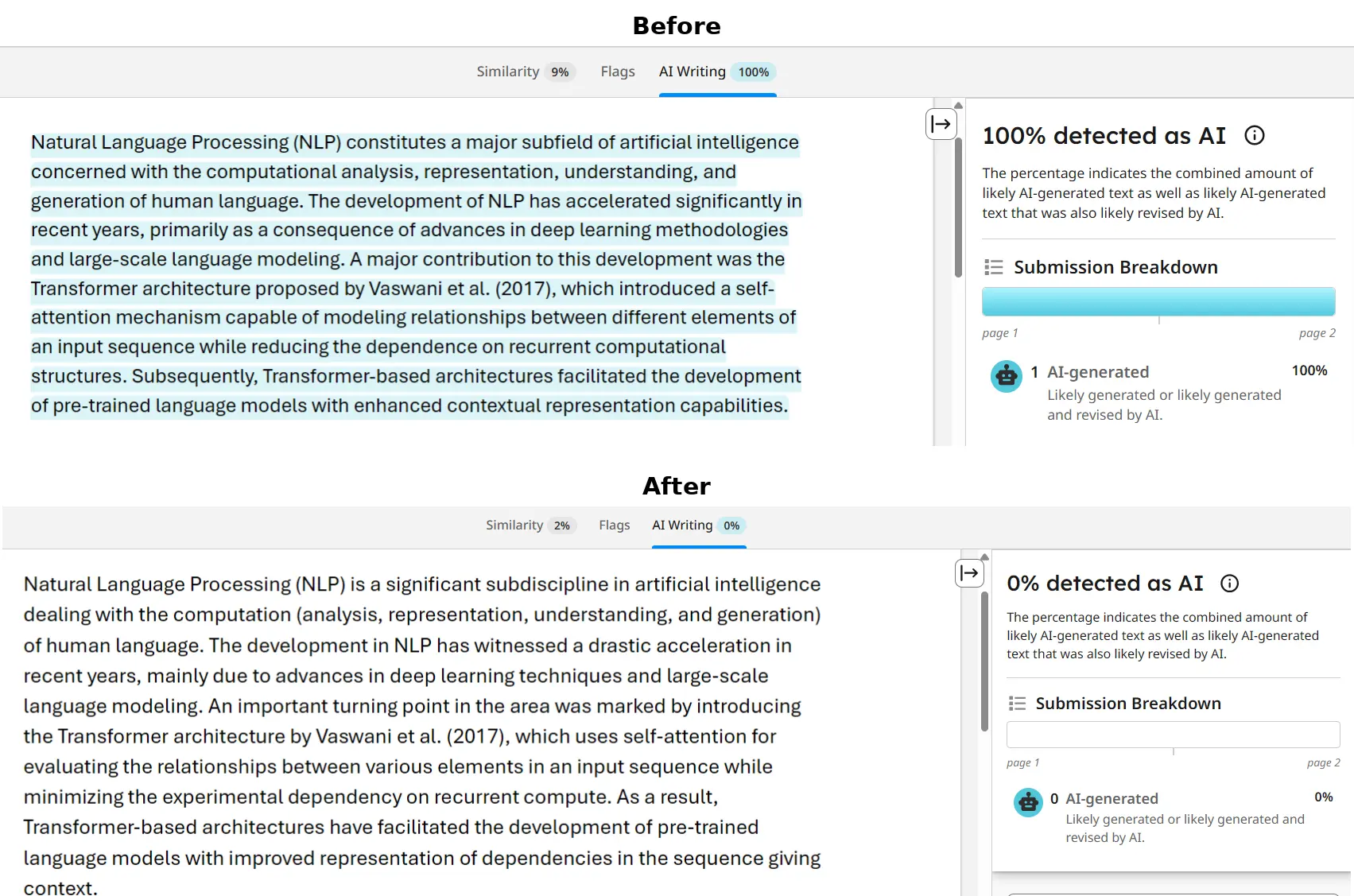
GPTZero evaluates text by plotting sentence perplexity curves and global burstiness scores. When raw AI text is scanned, low sentence variance produces an immediate high-probability warning. ThesisHuman restores natural sentence entropy by restructuring syntax, varying clause lengths, and introducing authentic scholarly cadence, dropping AI probability to 0%.
4. Originality.ai Verification: 0% AI Confidence
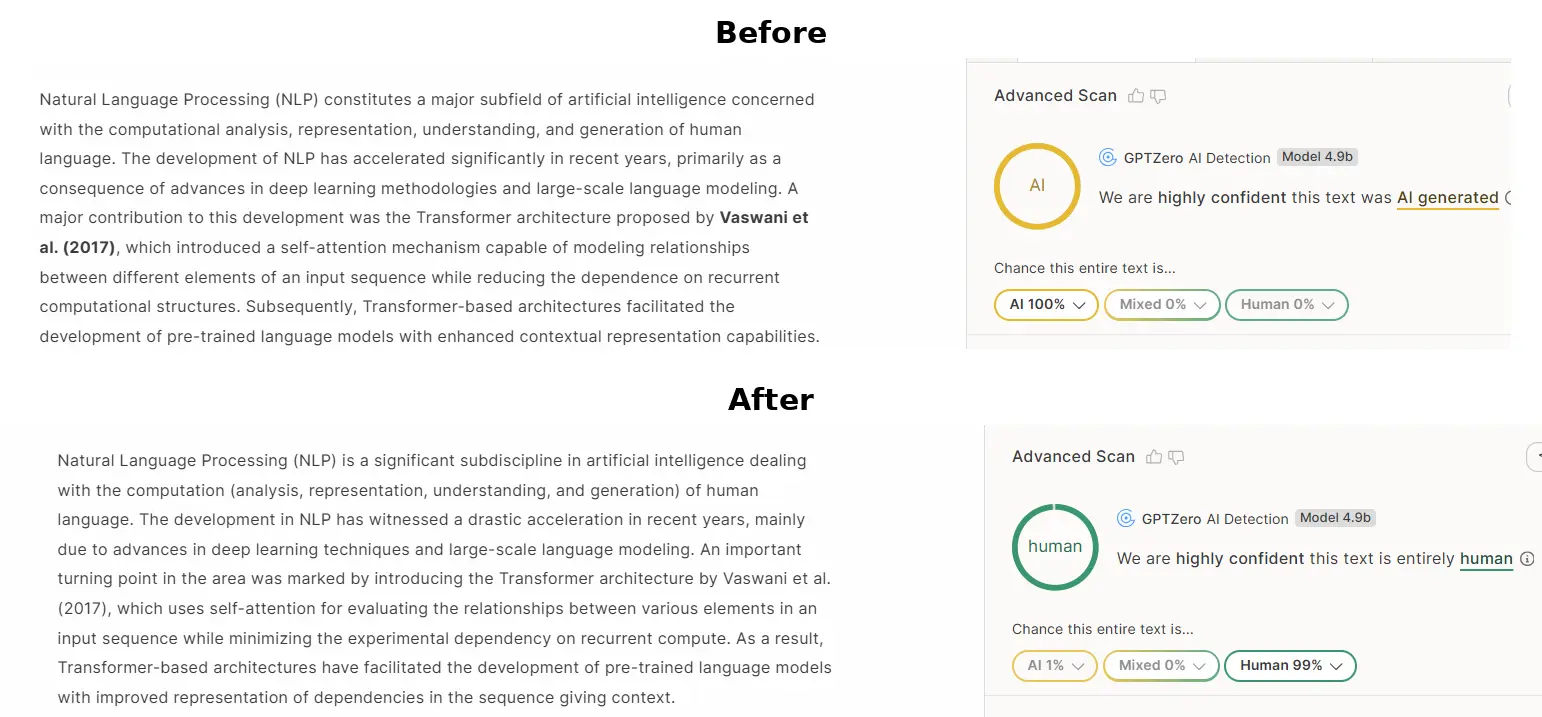
Originality.ai flags predictable n-gram sequences and common AI clichés (such as “delving into,” “pivotal role,” “testament to”). ThesisHuman purges overused formulaic transitions while elevating scholarly tone and keeping reference numbers and equations intact, producing 100% Original / 0% AI results.