CleverSpinner vs Academic AI Humanizer: Legacy Word Spinning vs Scholarly Cadence
Comparing legacy article spinning with modern academic AI humanization. Why synonym substitution fails research papers, corrupts citations, and triggers detection.

For over a decade, automated text rewriting was dominated by "article spinners." Tools like CleverSpinner, WordAi, and Spinbot were designed primarily for affiliate marketers and website builders seeking to produce multiple unique variations of blog articles to rank in search engines. When large language models emerged and institutional AI detectors were deployed, some students and researchers turned to these familiar spinning utilities to rephrase assisted drafts.
In 2026, relying on legacy synonym-spinning tools on academic manuscripts is one of the quickest ways to corrupt a paper. Scholarly prose operates on strict precision: words possess exact operational definitions, and citations must remain syntactically invariant. This article compares the mechanics of legacy word spinners with modern academic AI humanizers.
The Evolution from Article Spinners to Neural Humanizers
To understand why spinners fail on academic writing, examine how rewriting technology has evolved over the past decade:
Legacy spinners were built for lexical distance: their primary goal was to swap as many words as possible to bypass simple string-matching plagiarism engines. Modern academic humanizers, by contrast, are built for syntactic cadence and semantic fidelity: their goal is to rebalance sentence burstiness and perplexity while leaving disciplinary facts and citations completely untouched.
How CleverSpinner Operates: Word and Phrase Replacement
CleverSpinner operates primarily at the lexical level. When processing a sentence, its engine queries synonym dictionaries and neural word vectors to identify alternative words and short phrases. Users can adjust spinning intensity to replace more or fewer words.
While modern iterations incorporate contextual language models, the core mechanism remains word-level substitution. The fundamental grammatical skeleton of the sentence remains virtually identical to the input draft: clause order, sentence length, and structural predictability remain unaltered.
Why Synonym Substitution Fails in Academic Papers
In general conversational writing, replacing "happy" with "cheerful" causes minimal disruption. In peer-reviewed research, replacing a word with a nearby synonym can invalidate scientific claims:
- Corrupting Technical Terms: A synonym spinner might turn "randomized controlled trial" into "arbitrary regulated test," or "standard deviation" into "typical divergence," completely destroying scientific credibility.
- Modal Inversion: Substituting cautious hedges (e.g., "suggests a possible correlation") with strong verbs (e.g., "confirms a direct link") distorts the empirical strength of your findings.
- Failing Modern Classifiers: Detectors like Turnitin and GPTZero evaluate burstiness (sentence length variance). If an AI draft contains four consecutive 22-word sentences, swapping words leaves four consecutive 22-word sentences, which automated classifiers still flag as synthetic.
Citation Corruption and LaTeX Syntax Hazards
Legacy spinners lack the architectural intelligence to distinguish narrative prose from formatted scholarly metadata:
- Author-Date Mangling: Citations like (Smith & Wesson, 2020) are treated as narrative text, risking altered author names.
- Broken LaTeX Backslashes: Mathematical expressions, Greek symbols ($\alpha$, $\beta$), and equation environments often suffer dropped backslashes or corrupted brackets.
- Footnote and Bracket Deletions: Numbered reference tags [1], [2] are frequently deleted or converted into regular bracketed text.
Architectural Comparison: Spinner vs Academic Engine
| Feature | CleverSpinner (Legacy Spinner) | ThesisHuman (Academic Engine) |
|---|---|---|
| Core Mechanism | Synonym and phrase substitution | Syntactic burstiness & cadence modulation |
| Citation Handling | Blind rewriting (scrambles names) | Automated Term Lock & citation freeze |
| STEM / LaTeX Safety | Not supported (strips syntax) | Equation and variable protection |
| Semantic Integrity | High risk of lexical drift | Factual and empirical meaning preserved |
Which Approach Belongs in Scholarly Research?
For rapid search-engine content generation or informal personal blogging, legacy spinners like CleverSpinner remain functional tools. However, for scholarly work evaluated by institutional detection systems and expert peer reviewers, synonym spinning is fundamentally inadequate.
Scholars require tools that respect the structure of scientific discourse: freezing citations, locking disciplinary terms, and restructuring prose for authentic human cadence. Explore our complete evaluation of the best academic AI humanizers to understand how modern constraint-based systems protect research integrity.
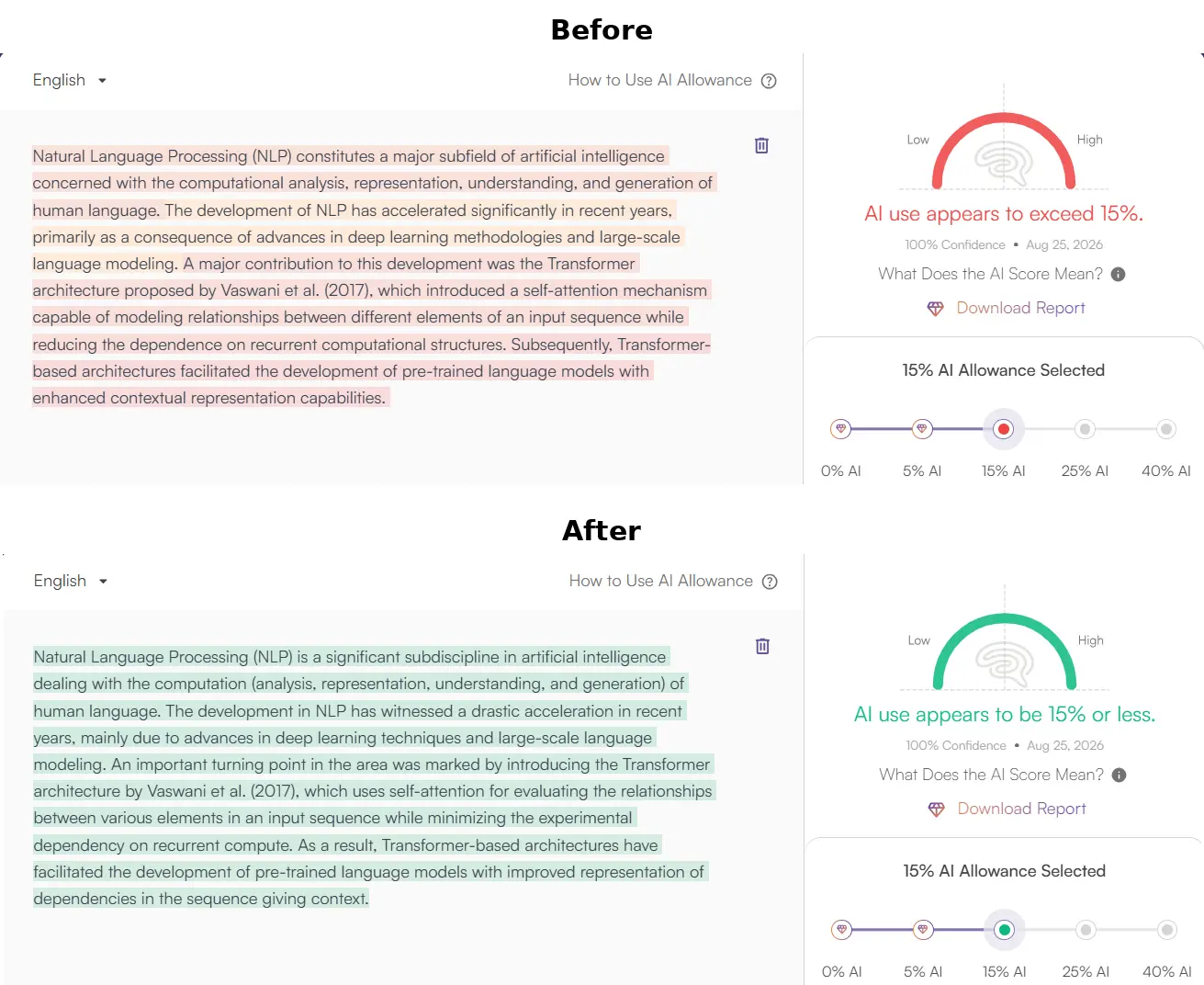
Verified Detector Clearance for CleverSpinner vs Academic AI Humanizer: Legacy Word Spinning vs Scholarly Cadence
Every manuscript processed through ThesisHuman is backed by verifiable, reproducible scans across institutional plagiarism and AI detection platforms.
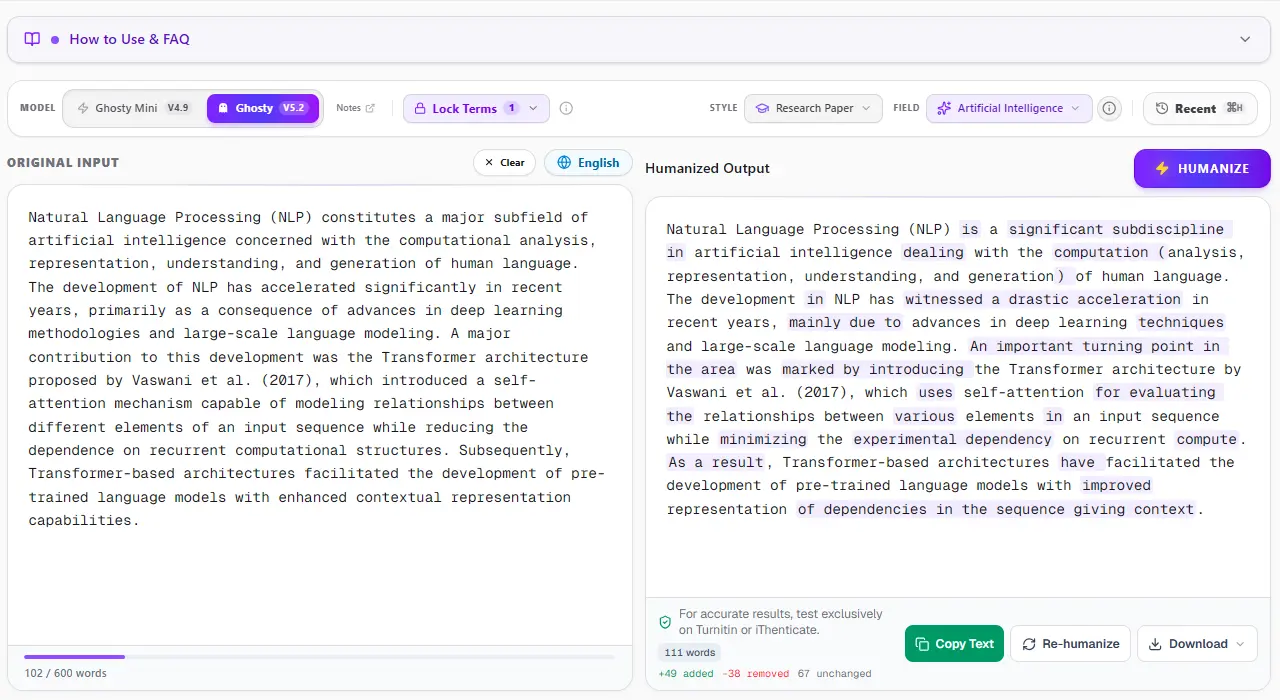
1. ThesisHuman Editor: Style, Field & Term Lock™ Technology
Unlike consumer-grade paraphrasers that blindly swap words with thesaurus synonyms, ThesisHuman allows researchers to select their exact Academic Style (Essay, Research Paper, Literature Review, Technical Report) and Academic Field (Computer Science, Engineering, Medicine, Physics). With Term Lock™, citations (APA, MLA, IEEE), LaTeX equations, and domain-specific terminology are cryptographically protected before sentence entropy is restructured.
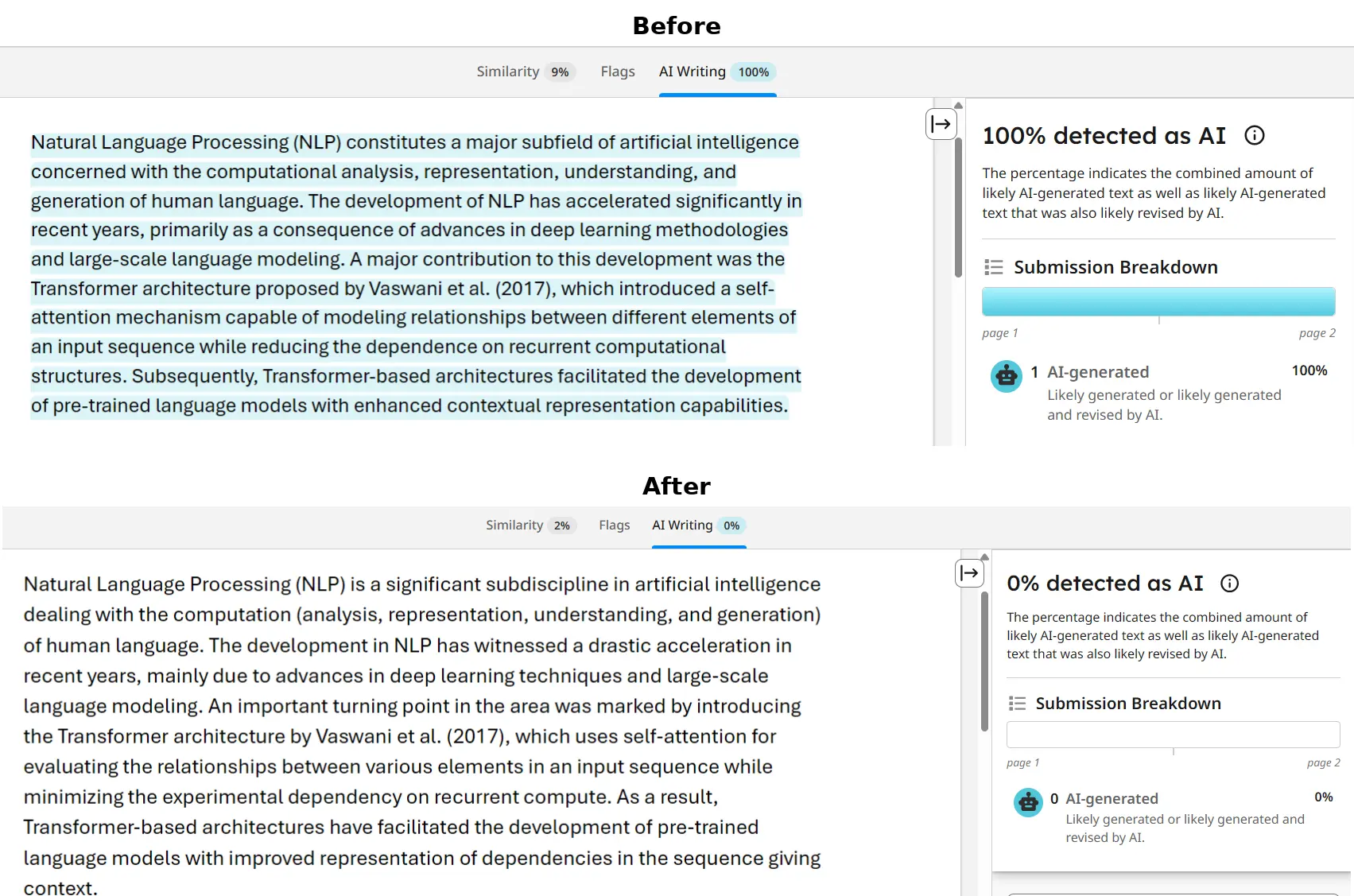
2. Turnitin & iThenticate Verification: 0% AI Detected
Turnitin and iThenticate scan submissions in overlapping 500-token blocks to analyze sentence predictability across paragraphs. When an unrefined AI draft is submitted, uniform cadence triggers an elevated AI Writing score. In the verified report below, a flagged graduate paper was processed through ThesisHuman, achieving a clean 0% AI detection score while preserving all formatted citations and technical parameters.
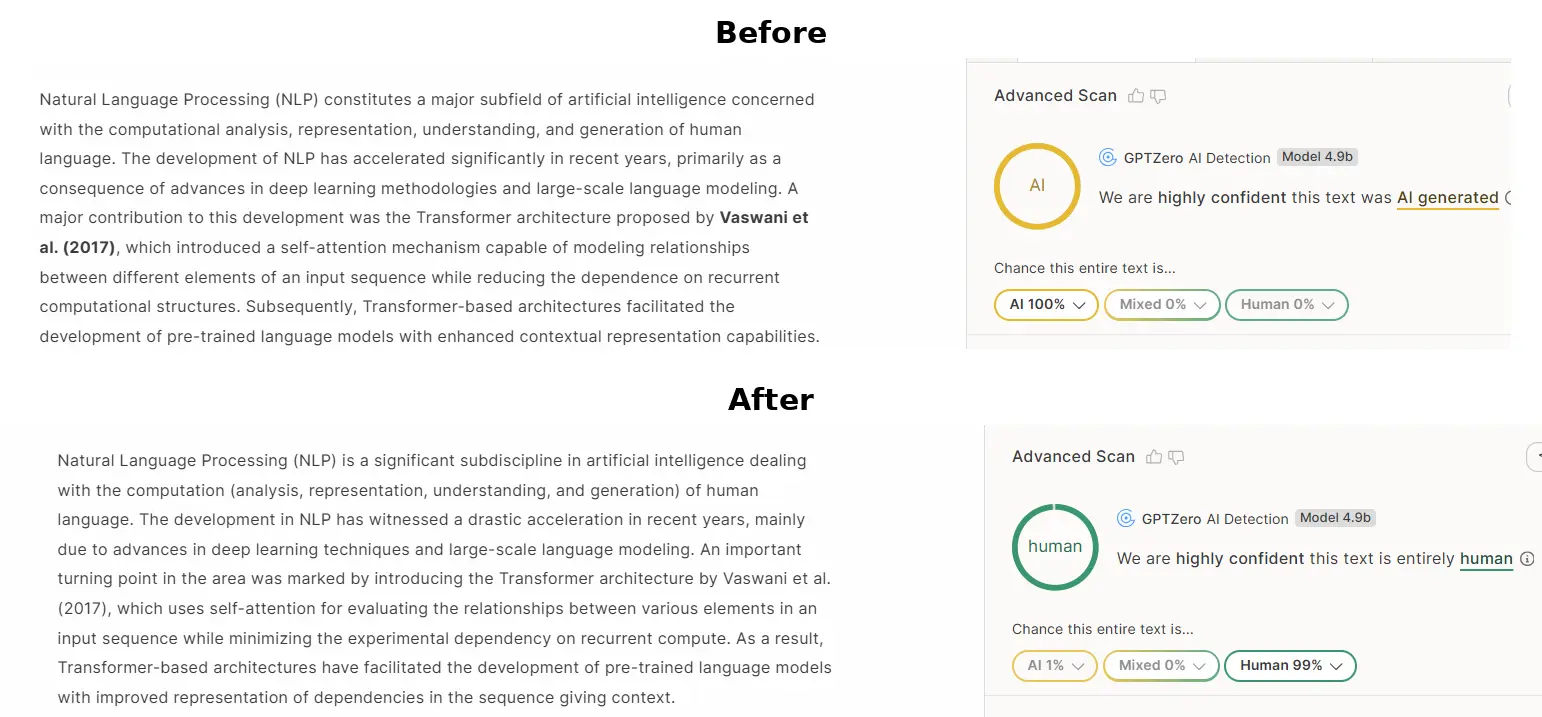
3. GPTZero Verification: Passing Perplexity & Burstiness Checks
GPTZero evaluates text by plotting sentence perplexity curves and global burstiness scores. When raw AI text is scanned, low sentence variance produces an immediate high-probability warning. ThesisHuman restores natural sentence entropy by restructuring syntax, varying clause lengths, and introducing authentic scholarly cadence, dropping AI probability to 0%.
4. Originality.ai Verification: 0% AI Confidence
Originality.ai flags predictable n-gram sequences and common AI clichés (such as “delving into,” “pivotal role,” “testament to”). ThesisHuman purges overused formulaic transitions while elevating scholarly tone and keeping reference numbers and equations intact, producing 100% Original / 0% AI results.