Dissertation AI Humanizer: Safeguarding 50,000+ Word Doctoral Manuscripts
Managing high-stakes doctoral dissertation screening. How to humanize lengthy PhD dissertations, handle co-authored chapters, and prepare for institutional scrutiny.

A doctoral dissertation represents years of original investigation, data collection, and theoretical modeling. Spanning 40,000 to over 80,000 words across multiple empirical chapters, it is the most substantial academic document a scholar produces. However, the sheer length of a PhD dissertation creates unique vulnerabilities under modern institutional screening.
When university graduate schools and library archiving systems process doctoral deposits through enterprise iThenticate and Turnitin engines, the classifiers analyze token distributions across massive textual spans. If AI tools were used to help draft literature summaries, format chapter introductions, or polish technical descriptions, the document displays an accumulated statistical uniformity that triggers serious institutional scrutiny. Here is how doctoral candidates can safely humanize dissertation manuscripts.
The Scale Challenge of 50,000+ Word Dissertations
Short documents often suffer from high statistical variance where detectors produce false positives due to insufficient sample size. Dissertations present the opposite challenge: statistical convergence. When an engine evaluates 60,000 words, brief humanized passages are easily overwhelmed if the surrounding connective prose maintains flat machine perplexity. The entire chapter becomes shaded with elevated AI probability.
Cumulative Statistical Signatures in Long Texts
Generative models exhibit distinct lexical and syntactic habits that become glaringly apparent over 200 pages. In a 1,000-word essay, repeating 'delve,' 'crucial,' or 'multifaceted' three times might pass unnoticed. Across six dissertation chapters, encountering these exact n-grams fifty times provides an unmistakable algorithmic fingerprint. A specialized dissertation humanizer systematically maps and varies these recurring transitional crutches.
Managing Co-Authored Papers and Prior Preprint Indexing
Most contemporary PhD dissertations adopt a 'sandwich' or 'three-paper' format, incorporating published journal articles or arXiv/bioRxiv preprints as core chapters. This introduces complex overlap challenges. Ensure that your dissertation includes formal copyright permissions and introductory footnotes clarifying that the candidate was primary author. Then, focus your humanization efforts on the synthesizing overarching chapters: the General Introduction and the General Discussion.
Comprehensive PhD Dissertation Naturalization Workflow
- Establish Chapter Term Locks: Catalogue every primary theoretical construct, mathematical symbol, and experimental variable in ThesisHuman's dissertation suite before running transformations.
- Process Section by Section: Never feed an entire 60,000-word file at once. Process logical subsections (Theoretical Framework, Empirical Findings, Limitations) so you can review rhythm adjustments closely.
- Restore Disciplinary Cadence: Inject the precise analytical tensions of your sub-discipline, replacing generic transitions with direct engagements with opposing scholarly schools.
- Verify Invariant Citations: Audit your BibTeX or EndNote reference strings to ensure no author-date combinations were altered.
Preparing for the Oral Defense and Provenance Inquiries
Your best defense in an oral examination (viva) is complete intellectual ownership of your text. When your dissertation reads with your genuine scholarly voice rather than homogenized algorithmic prose, you can confidently explain and defend every methodological choice, theoretical assumption, and empirical inference before your committee.
Verified Detector Clearance for Dissertation AI Humanizer: Safeguarding 50,000+ Word Doctoral Manuscripts
Every manuscript processed through ThesisHuman is backed by verifiable, reproducible scans across institutional plagiarism and AI detection platforms.
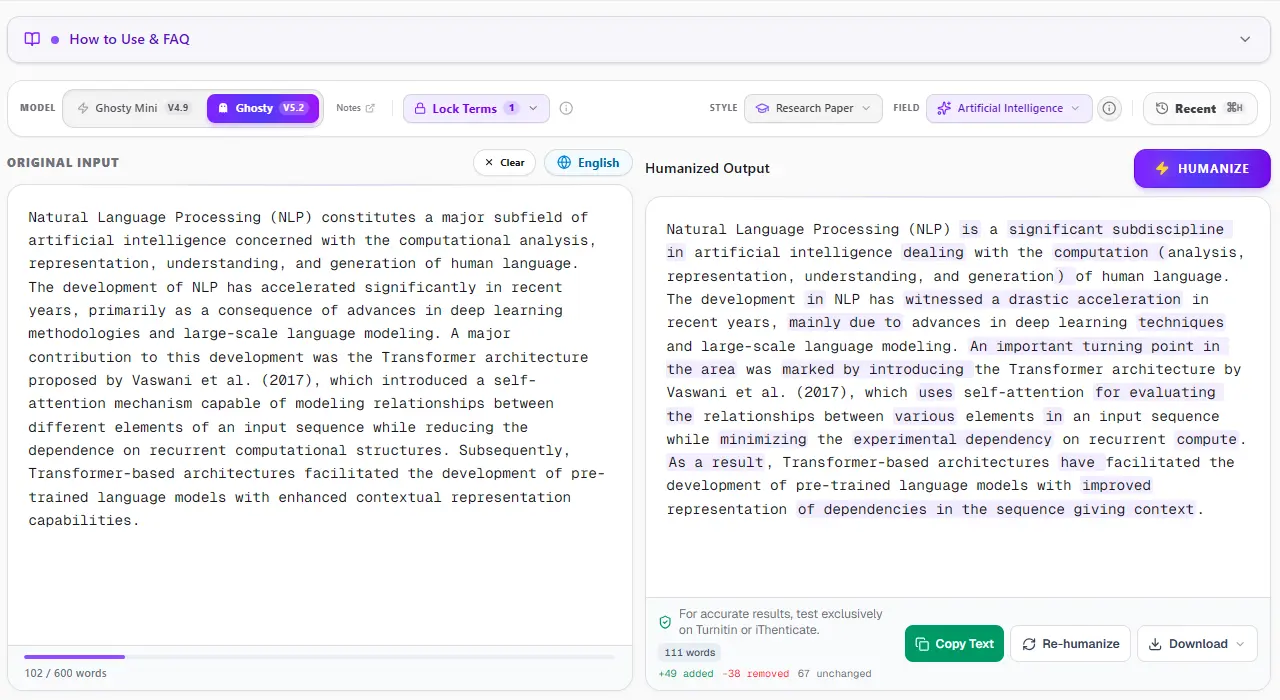
1. ThesisHuman Editor: Style, Field & Term Lock™ Technology
Unlike consumer-grade paraphrasers that blindly swap words with thesaurus synonyms, ThesisHuman allows researchers to select their exact Academic Style (Essay, Research Paper, Literature Review, Technical Report) and Academic Field (Computer Science, Engineering, Medicine, Physics). With Term Lock™, citations (APA, MLA, IEEE), LaTeX equations, and domain-specific terminology are cryptographically protected before sentence entropy is restructured.
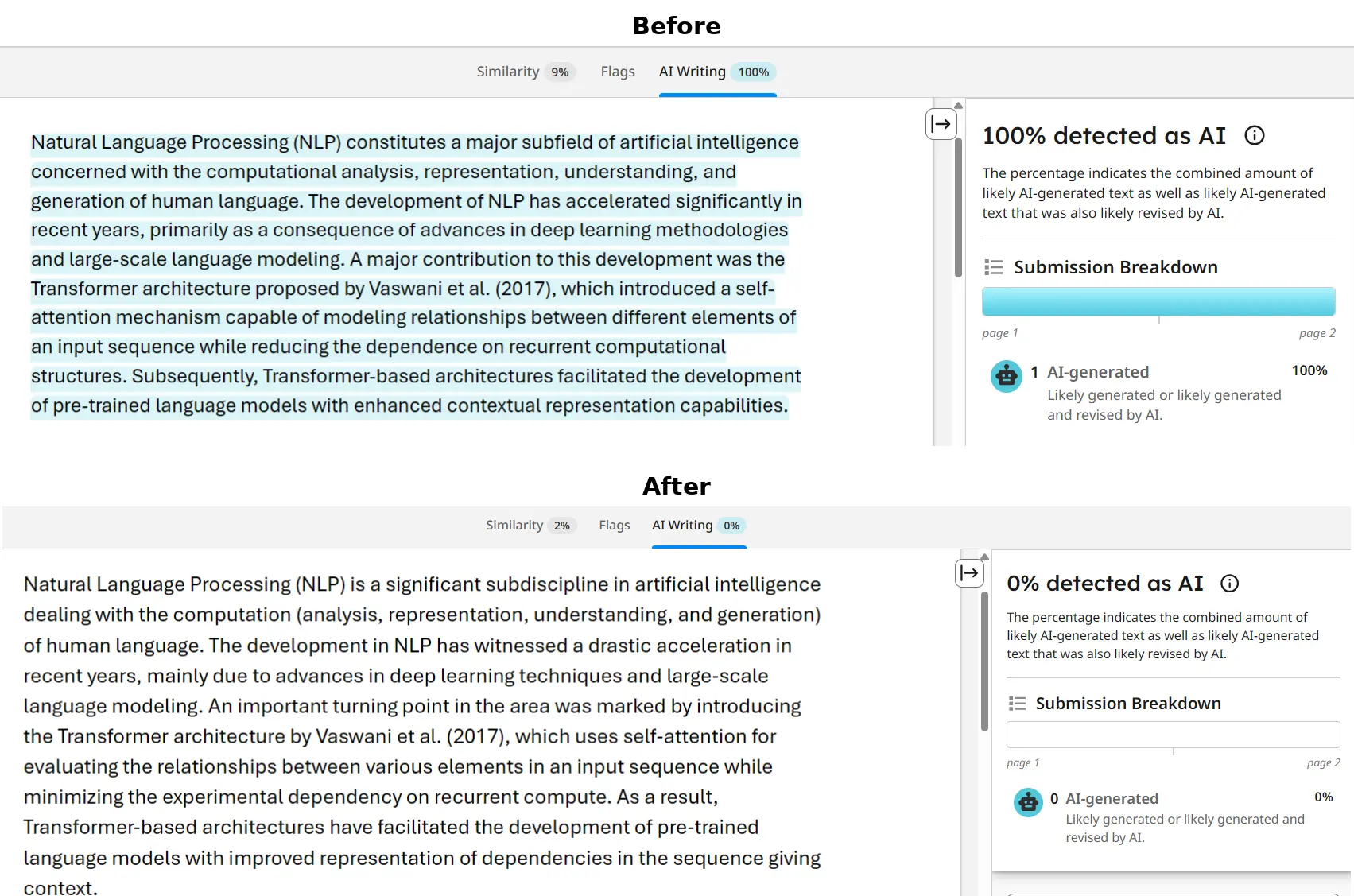
2. Turnitin & iThenticate Verification: 0% AI Detected
Turnitin and iThenticate scan submissions in overlapping 500-token blocks to analyze sentence predictability across paragraphs. When an unrefined AI draft is submitted, uniform cadence triggers an elevated AI Writing score. In the verified report below, a flagged graduate paper was processed through ThesisHuman, achieving a clean 0% AI detection score while preserving all formatted citations and technical parameters.
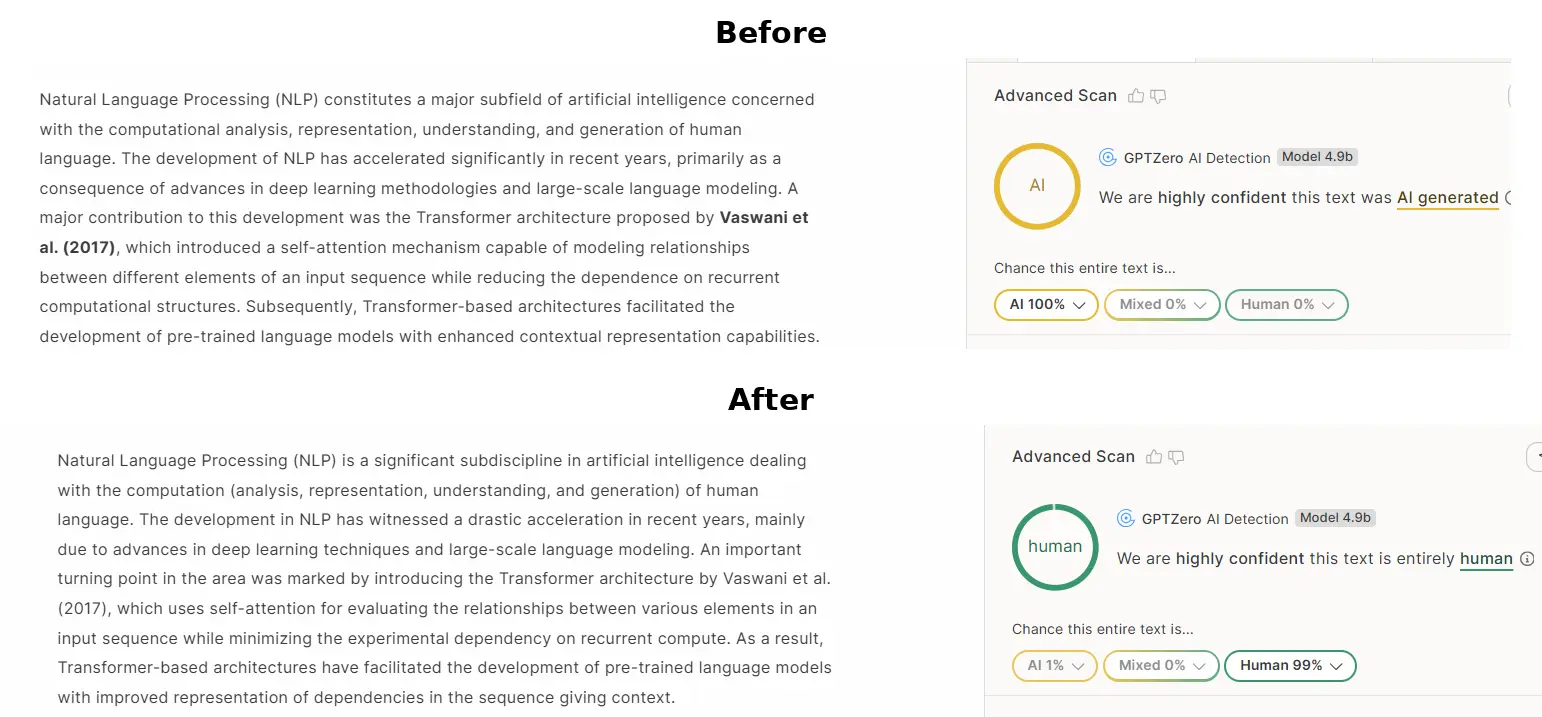
3. GPTZero Verification: Passing Perplexity & Burstiness Checks
GPTZero evaluates text by plotting sentence perplexity curves and global burstiness scores. When raw AI text is scanned, low sentence variance produces an immediate high-probability warning. ThesisHuman restores natural sentence entropy by restructuring syntax, varying clause lengths, and introducing authentic scholarly cadence, dropping AI probability to 0%.
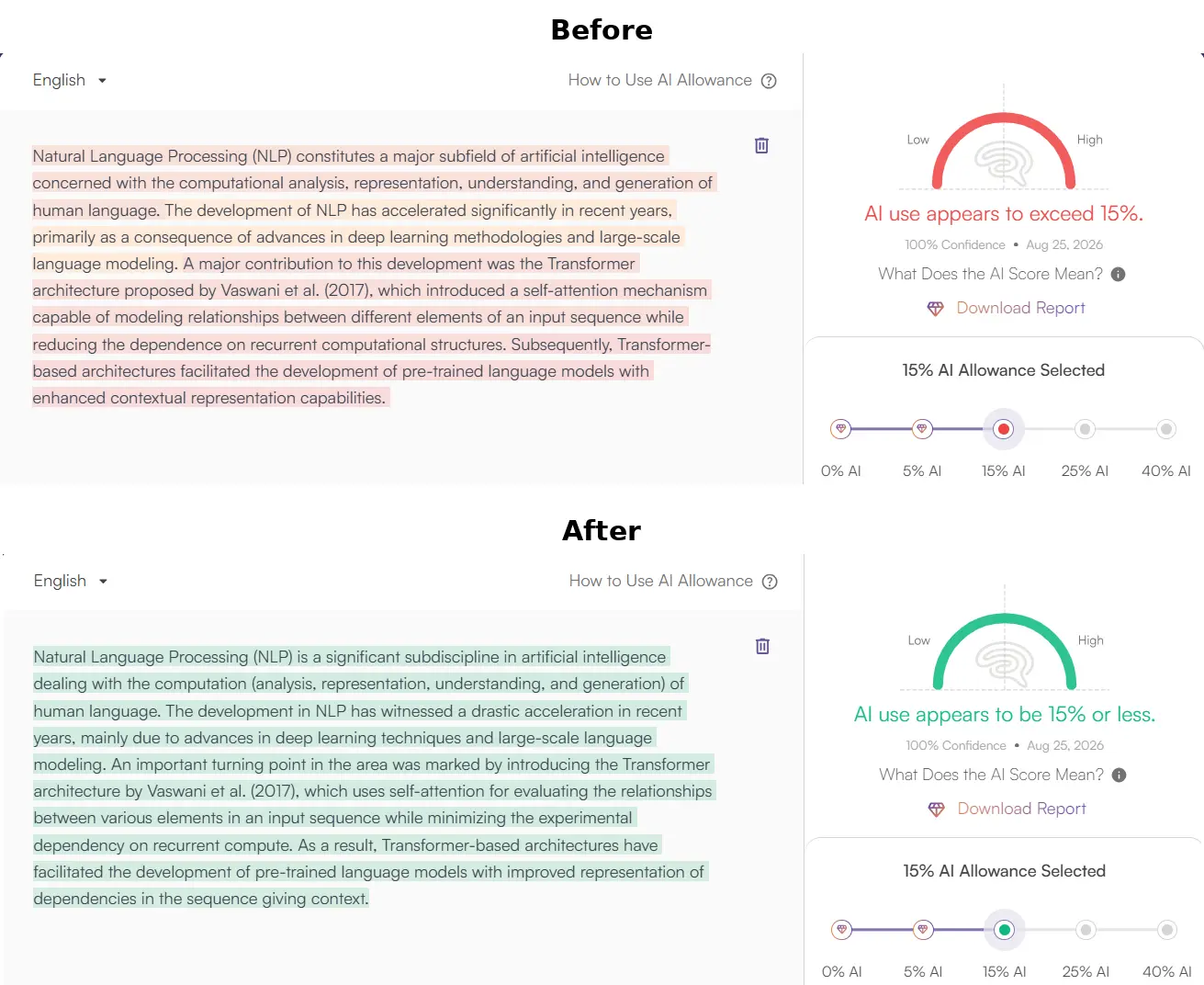
4. Originality.ai Verification: 0% AI Confidence
Originality.ai flags predictable n-gram sequences and common AI clichés (such as “delving into,” “pivotal role,” “testament to”). ThesisHuman purges overused formulaic transitions while elevating scholarly tone and keeping reference numbers and equations intact, producing 100% Original / 0% AI results.