ESL Researcher AI Humanizer: Overcoming False Positives in Non-Native English
Why international scholars writing in English as an additional language face severe AI detector bias, and how to protect legitimate manuscripts ethically.

English is the global lingua franca of scholarly publishing. Over 90% of indexed scientific literature is published in English, requiring hundreds of thousands of international researchers to communicate complex technical discoveries in a second, third, or fourth language. In recent years, generative AI has become an indispensable linguistic bridge, helping non-native English scholars polish grammar and sentence structure.
However, this advancement has collided with a punitive obstacle: the widespread deployment of automated AI detection software. Mounting peer-reviewed evidence demonstrates that AI detectors exhibit profound, systemic bias against non-native English writers. Here is why this bias occurs and how ESL scholars can protect their legitimate academic writing.
The Proven Algorithmic Bias Against ESL Scholars
In a landmark 2023 study conducted by Stanford researchers, popular commercial AI detectors were evaluated against TOEFL essays written by non-native students and eighth-grade essays written by native speakers. The results were startling: while native writing was classified accurately, over 60% of human-written TOEFL essays were falsely flagged as AI-generated. Subsequent studies across academic journal submissions have documented the same pattern.
The Linguistic Mechanism: Why Caution Looks Like AI
Detectors do not evaluate authorial intent; they measure token perplexity. A non-native writer naturally exercises caution, relying on well-established syntactic templates ('In this study, we investigated the effect of...') and common formal vocabulary. That linguistic discipline is good communication, but to an algorithm that equates predictability with machine generation, safe human writing looks identical to language model output.
How an Academic Humanizer Levels the Playing Field
Using ThesisHuman's academic humanizer serves as an equalizer for international researchers. Rather than leaving drafts in a low-perplexity danger zone, the system restructures syntactic cadence, varies clausal lengths, and introduces rich scholarly transitions while strictly preserving technical accuracy and citations.
A Complete Defense Protocol for International Authors
- Keep Raw Drafting Archives: Maintain early drafts written in your native language or initial rough English notes showing chronological thought progression.
- Document Grammar Assistance: When using AI tools for language polishing, state this openly in your manuscript acknowledgments in accordance with journal policies.
- Inject Disciplinary Voice: Ensure your empirical findings are communicated with varied, bursty sentence structures.
- Reference Detector Bias Literature: If falsely accused by an editor or committee, formally cite published studies on ESL detector bias to challenge the allegation objectively.
Verified Detector Clearance for ESL Researcher AI Humanizer: Overcoming False Positives in Non-Native English
Every manuscript processed through ThesisHuman is backed by verifiable, reproducible scans across institutional plagiarism and AI detection platforms.
1. ThesisHuman Editor: Style, Field & Term Lock™ Technology
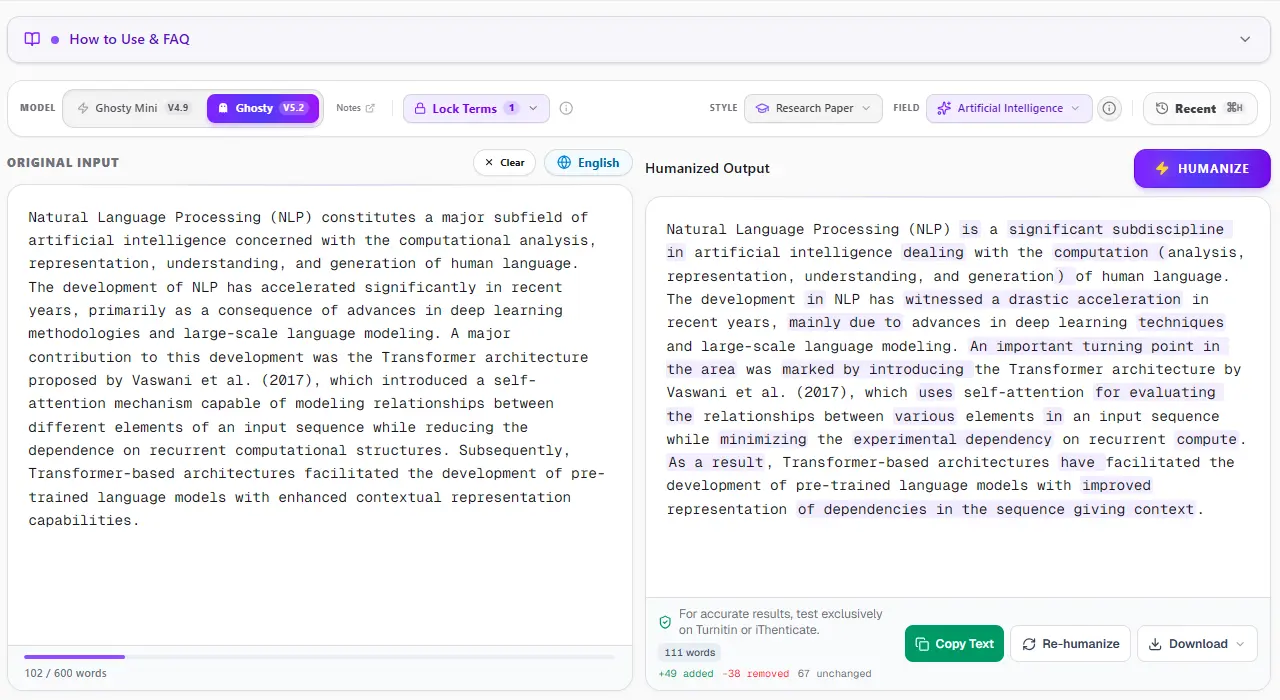
Unlike consumer-grade paraphrasers that blindly swap words with thesaurus synonyms, ThesisHuman allows researchers to select their exact Academic Style (Essay, Research Paper, Literature Review, Technical Report) and Academic Field (Computer Science, Engineering, Medicine, Physics). With Term Lock™, citations (APA, MLA, IEEE), LaTeX equations, and domain-specific terminology are cryptographically protected before sentence entropy is restructured.
2. Turnitin & iThenticate Verification: 0% AI Detected
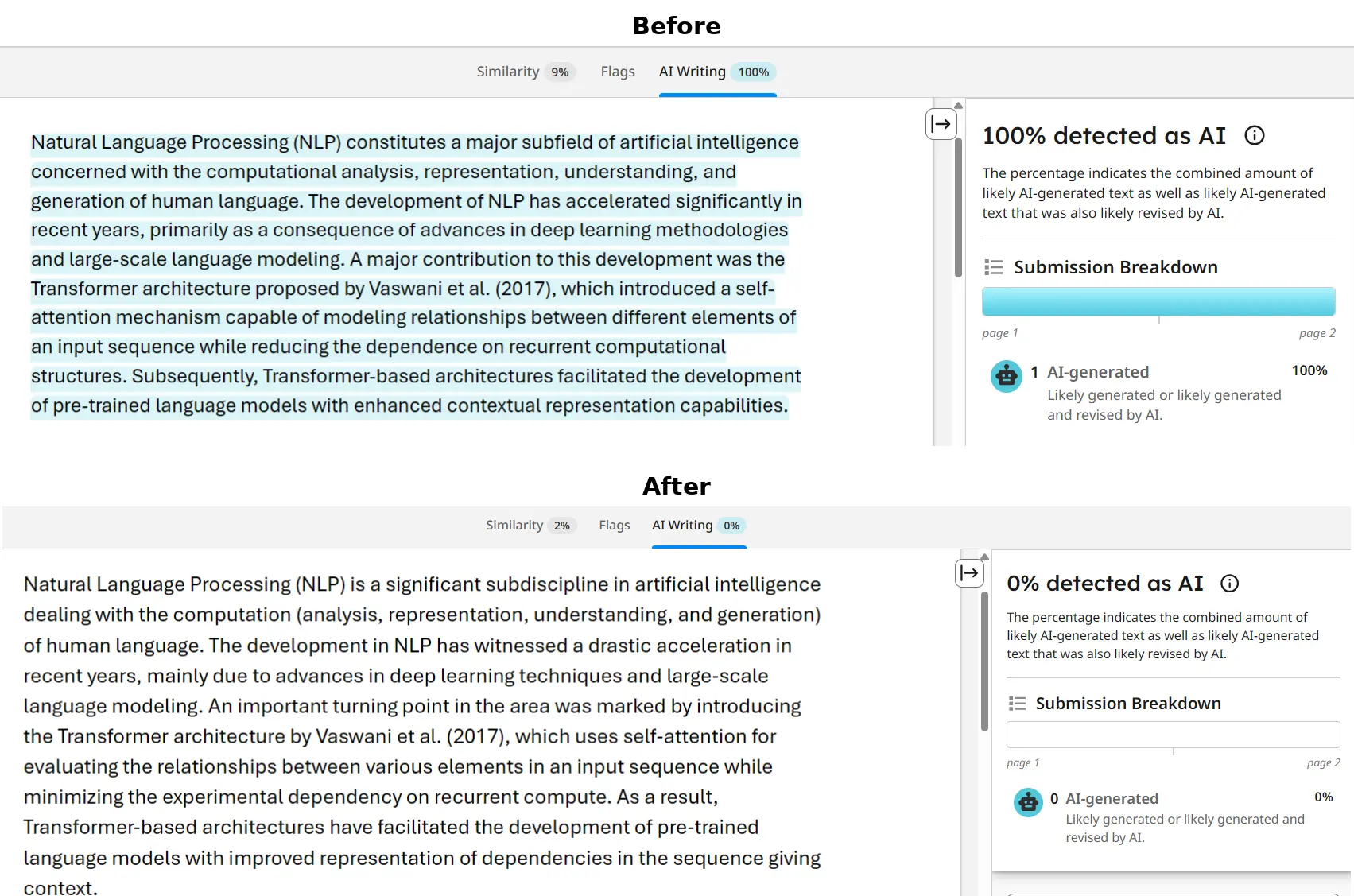
Turnitin and iThenticate scan submissions in overlapping 500-token blocks to analyze sentence predictability across paragraphs. When an unrefined AI draft is submitted, uniform cadence triggers an elevated AI Writing score. In the verified report below, a flagged graduate paper was processed through ThesisHuman, achieving a clean 0% AI detection score while preserving all formatted citations and technical parameters.
3. GPTZero Verification: Passing Perplexity & Burstiness Checks
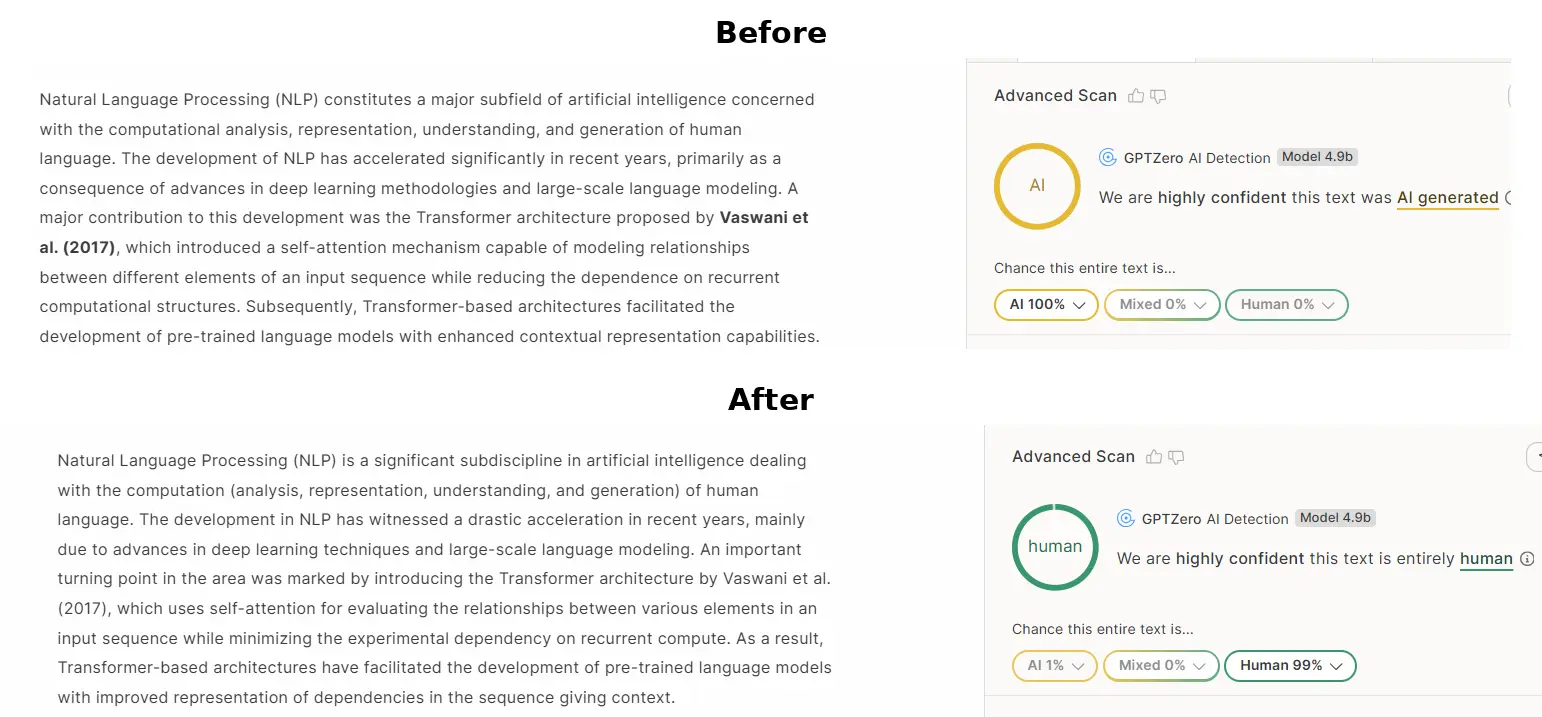
GPTZero evaluates text by plotting sentence perplexity curves and global burstiness scores. When raw AI text is scanned, low sentence variance produces an immediate high-probability warning. ThesisHuman restores natural sentence entropy by restructuring syntax, varying clause lengths, and introducing authentic scholarly cadence, dropping AI probability to 0%.
4. Originality.ai Verification: 0% AI Confidence
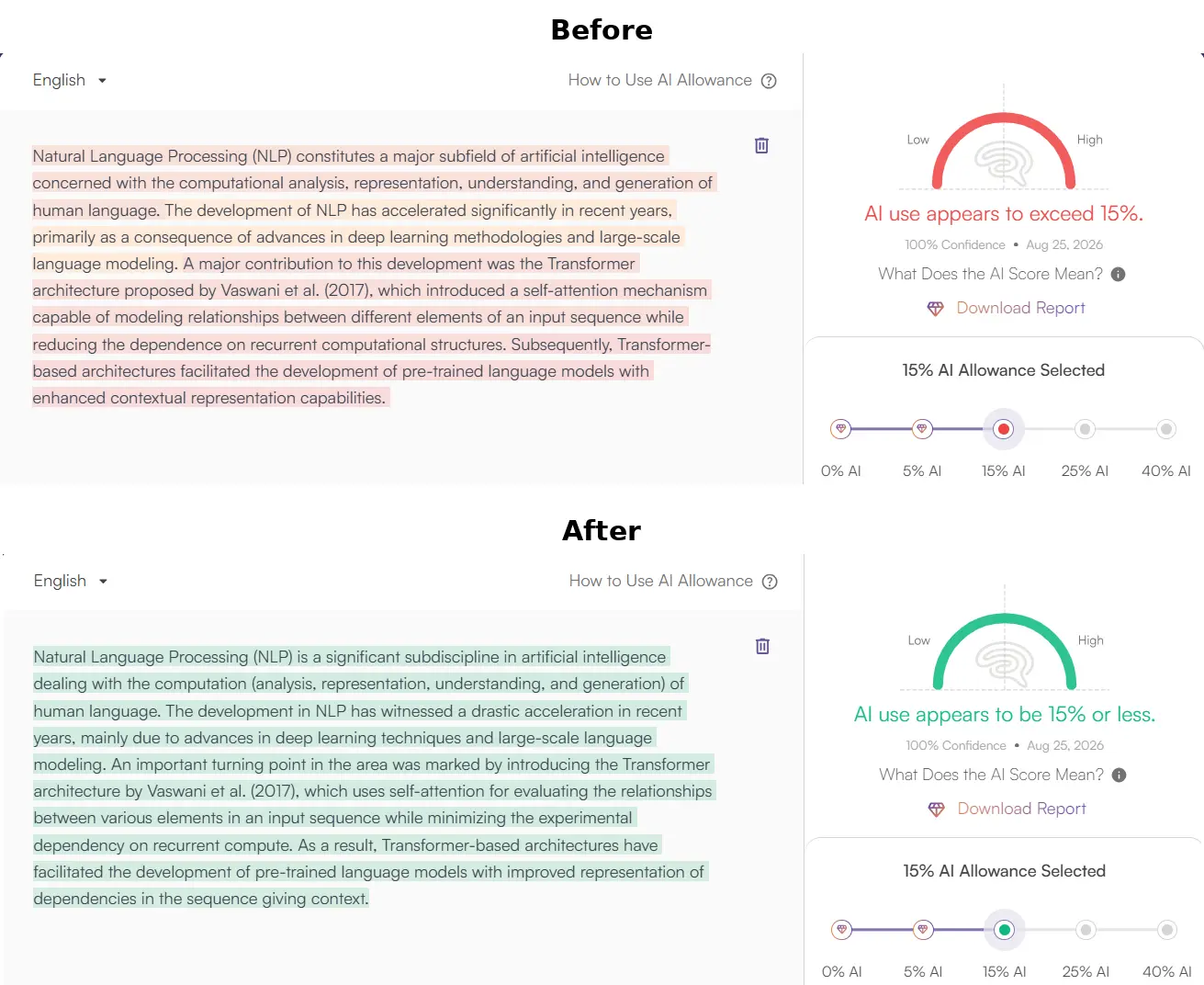
Originality.ai flags predictable n-gram sequences and common AI clichés (such as “delving into,” “pivotal role,” “testament to”). ThesisHuman purges overused formulaic transitions while elevating scholarly tone and keeping reference numbers and equations intact, producing 100% Original / 0% AI results.