Free ChatGPT Humanizer for Academic Drafts: Neutralizing Stylistic Flags Safely
How to humanize OpenAI ChatGPT drafts for academic submissions without paying for enterprise software. Learn the specific token quirks of ChatGPT and how to resolve them.

ChatGPT remains the most widely used conversational assistant among university students and researchers. Whether assisting with an initial outline, drafting an introductory paragraph, or summarizing a complex theory, ChatGPT offers immense speed. However, submitting unedited or poorly edited ChatGPT drafts into university LMS portals or publisher submission systems has become an acute academic hazard.
Classifiers such as Turnitin, GPTZero, and Copyleaks flag unedited ChatGPT prose with high confidence. To submit your work safely and ethically, you need a reliable method to humanize ChatGPT drafts without distorting facts or corrupting your citations.
Why Raw ChatGPT Text Triggers Academic Detectors
ChatGPT outputs possess distinct linguistic habits that detection models easily identify. First is vocabulary selection: words like 'testament,' 'multifaceted,' 'crucial,' and 'foster' appear with unnatural frequency across diverse disciplines. Second is rhetorical symmetry: paragraphs routinely consist of four or five sentences of almost identical length, opening with an overview, presenting two balanced examples, and closing with an evaluative summary.
This structural uniformity produces a flat perplexity profile. Detection engines calculate the mathematical probability of each word given the previous words; in ChatGPT drafts, the model consistently picks top-probability words, producing a distinct algorithmic signature.
Why Re-Prompting ChatGPT Fails to Humanize It
A common student belief is that you can humanize ChatGPT by giving it instructions like 'Rewrite this to bypass AI detection and sound like an authentic graduate student.' In practice, this instruction fails. While ChatGPT may inject informal adjectives or add sentence fragments, its underlying token selection engine still optimizes for high probability. Furthermore, asking ChatGPT to aggressively rewrite existing drafts often leads to subtle factual hallucinations where dates, sample sizes, or theoretical frameworks are modified without notice.
The Free Academic ChatGPT Humanization Protocol
To clean a ChatGPT-assisted academic draft without purchasing expensive enterprise subscriptions, follow this four-step sequence:
- Strip Conversational Fluff: Manually delete opening introductory filler like 'In recent years, the intersection of...' Open immediately with your primary research question.
- Inject Real Scholarly Citations: Replace generic claims with precise citations to published literature, using proper APA or IEEE bracketed formatting.
- Run Free ThesisHuman Synthesis: Process high-risk sections through ThesisHuman's ChatGPT watermark remover, which restructures clause cadence and breaks predictable n-grams.
- Perform a Peer-Voice Read-Aloud: Read the humanized paragraph out loud. If any sentence sounds unnatural when spoken, adjust the rhythm manually.
Preserving Technical Truth and Citations
Never compromise scientific accuracy for the sake of lowering an AI score. An effective academic humanizer preserves your data points, statistical test names, and bibliographic keys. Using tools equipped with Term Lock ensures that your academic contributions remain scientifically sound while reading with natural scholarly voice.
Verified Detector Clearance for Free ChatGPT Humanizer for Academic Drafts: Neutralizing Stylistic Flags Safely
Every manuscript processed through ThesisHuman is backed by verifiable, reproducible scans across institutional plagiarism and AI detection platforms.
1. ThesisHuman Editor: Style, Field & Term Lock™ Technology
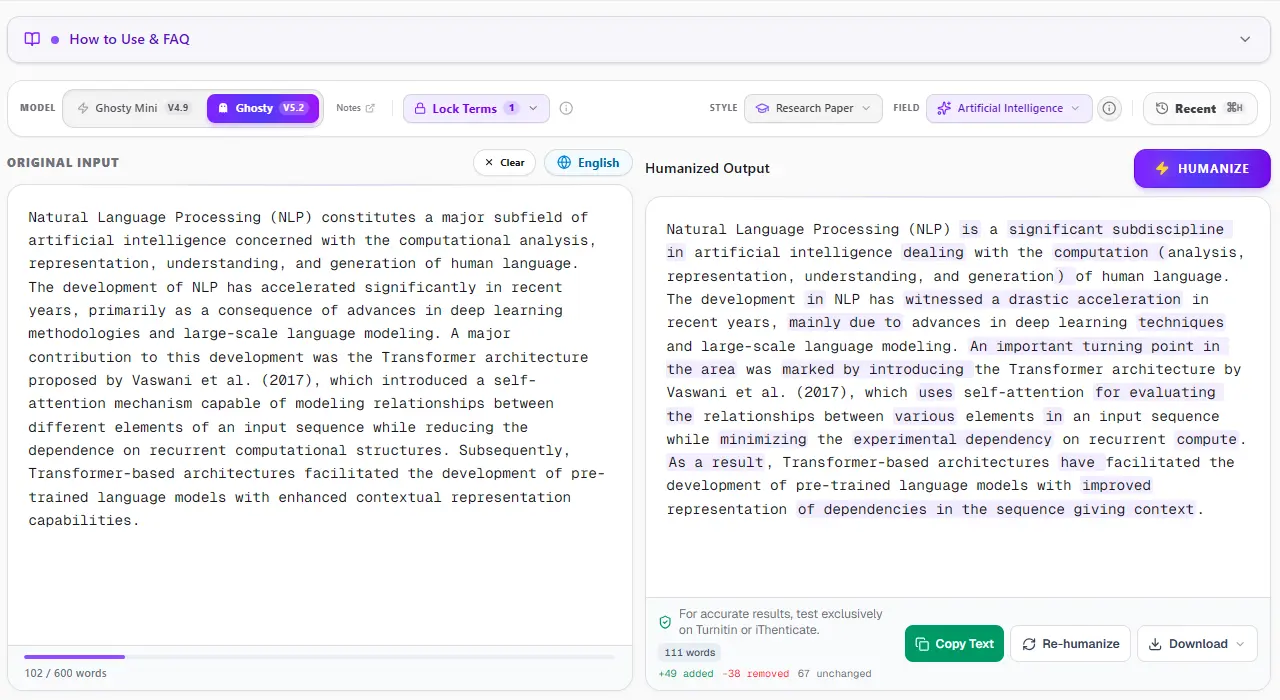
Unlike consumer-grade paraphrasers that blindly swap words with thesaurus synonyms, ThesisHuman allows researchers to select their exact Academic Style (Essay, Research Paper, Literature Review, Technical Report) and Academic Field (Computer Science, Engineering, Medicine, Physics). With Term Lock™, citations (APA, MLA, IEEE), LaTeX equations, and domain-specific terminology are cryptographically protected before sentence entropy is restructured.
2. Turnitin & iThenticate Verification: 0% AI Detected
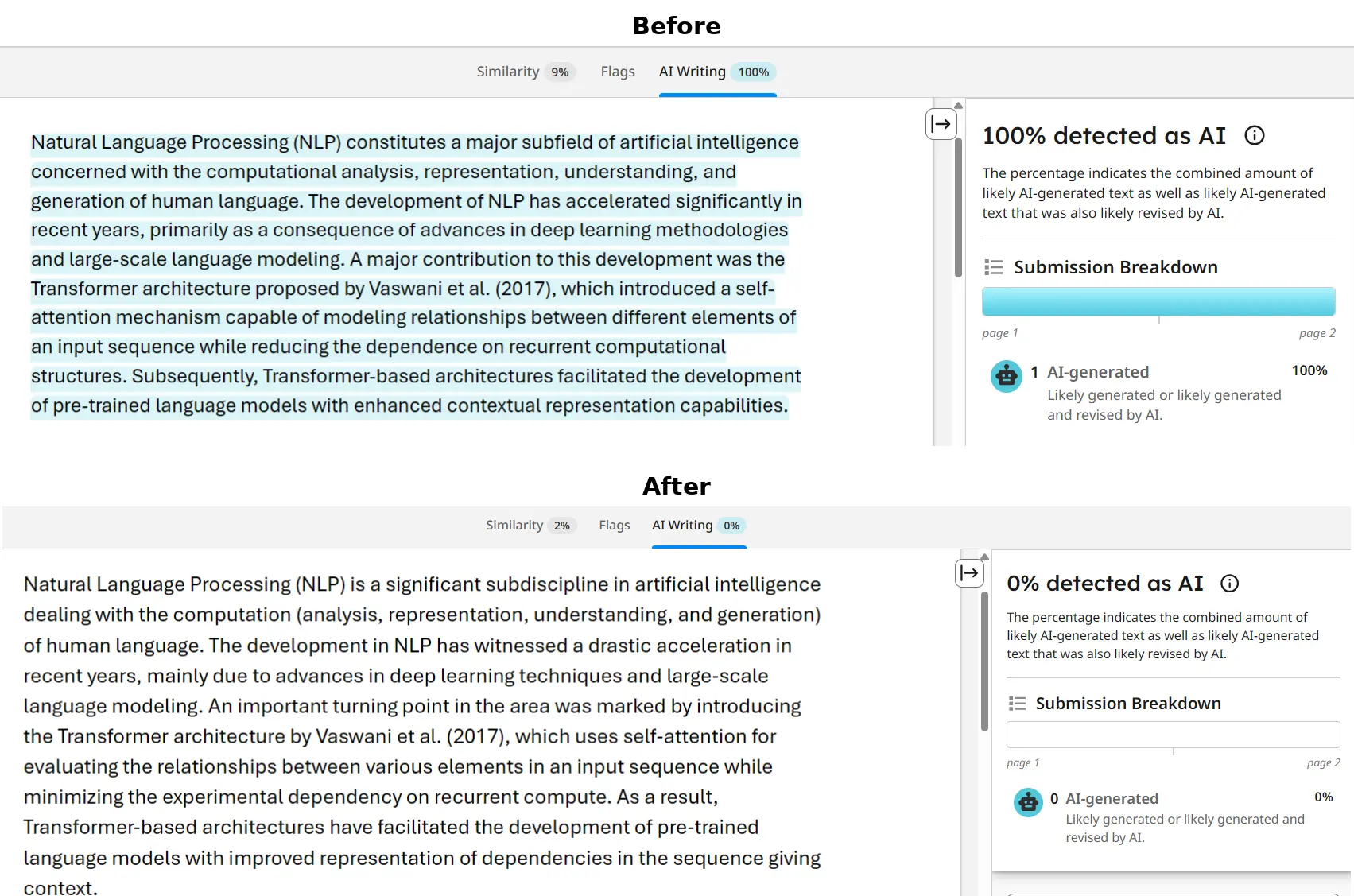
Turnitin and iThenticate scan submissions in overlapping 500-token blocks to analyze sentence predictability across paragraphs. When an unrefined AI draft is submitted, uniform cadence triggers an elevated AI Writing score. In the verified report below, a flagged graduate paper was processed through ThesisHuman, achieving a clean 0% AI detection score while preserving all formatted citations and technical parameters.
3. GPTZero Verification: Passing Perplexity & Burstiness Checks
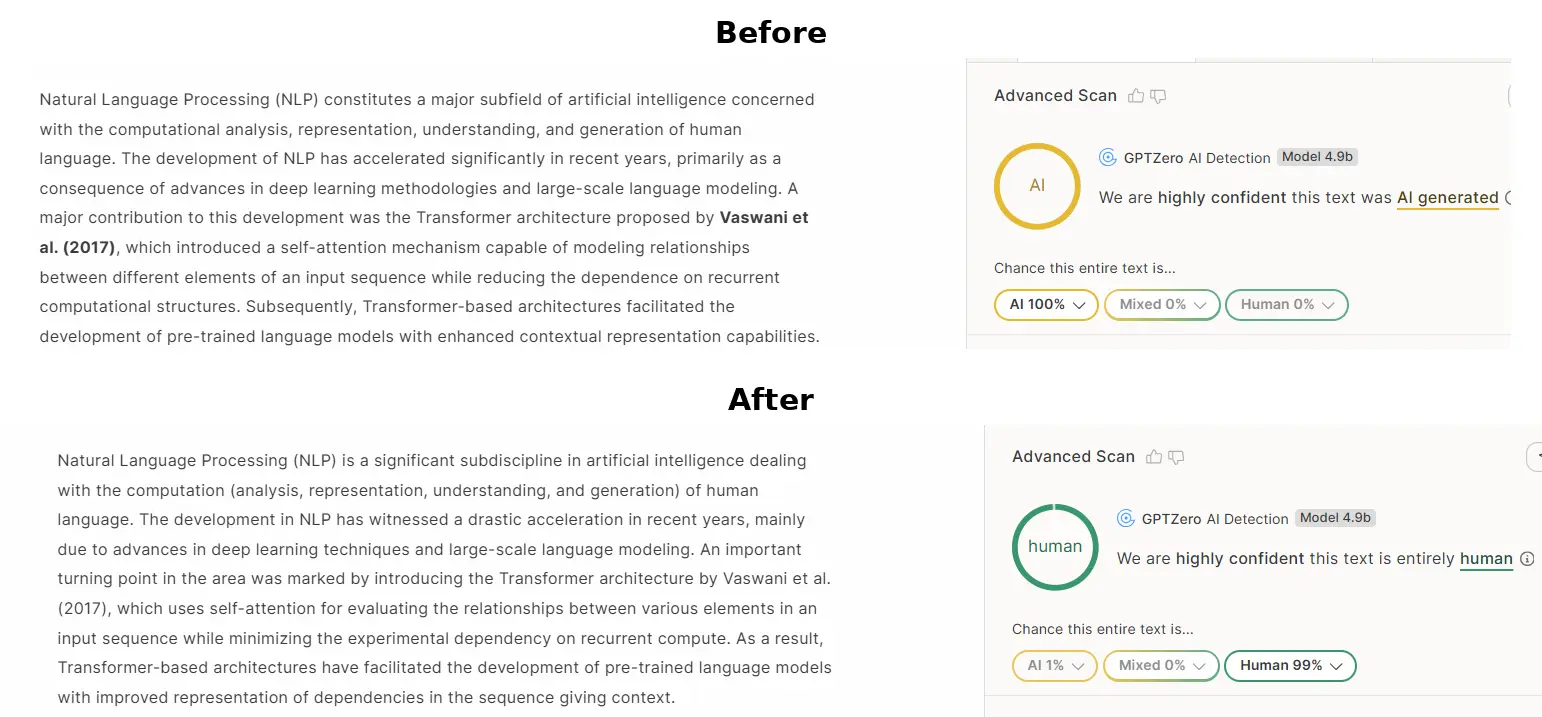
GPTZero evaluates text by plotting sentence perplexity curves and global burstiness scores. When raw AI text is scanned, low sentence variance produces an immediate high-probability warning. ThesisHuman restores natural sentence entropy by restructuring syntax, varying clause lengths, and introducing authentic scholarly cadence, dropping AI probability to 0%.
4. Originality.ai Verification: 0% AI Confidence
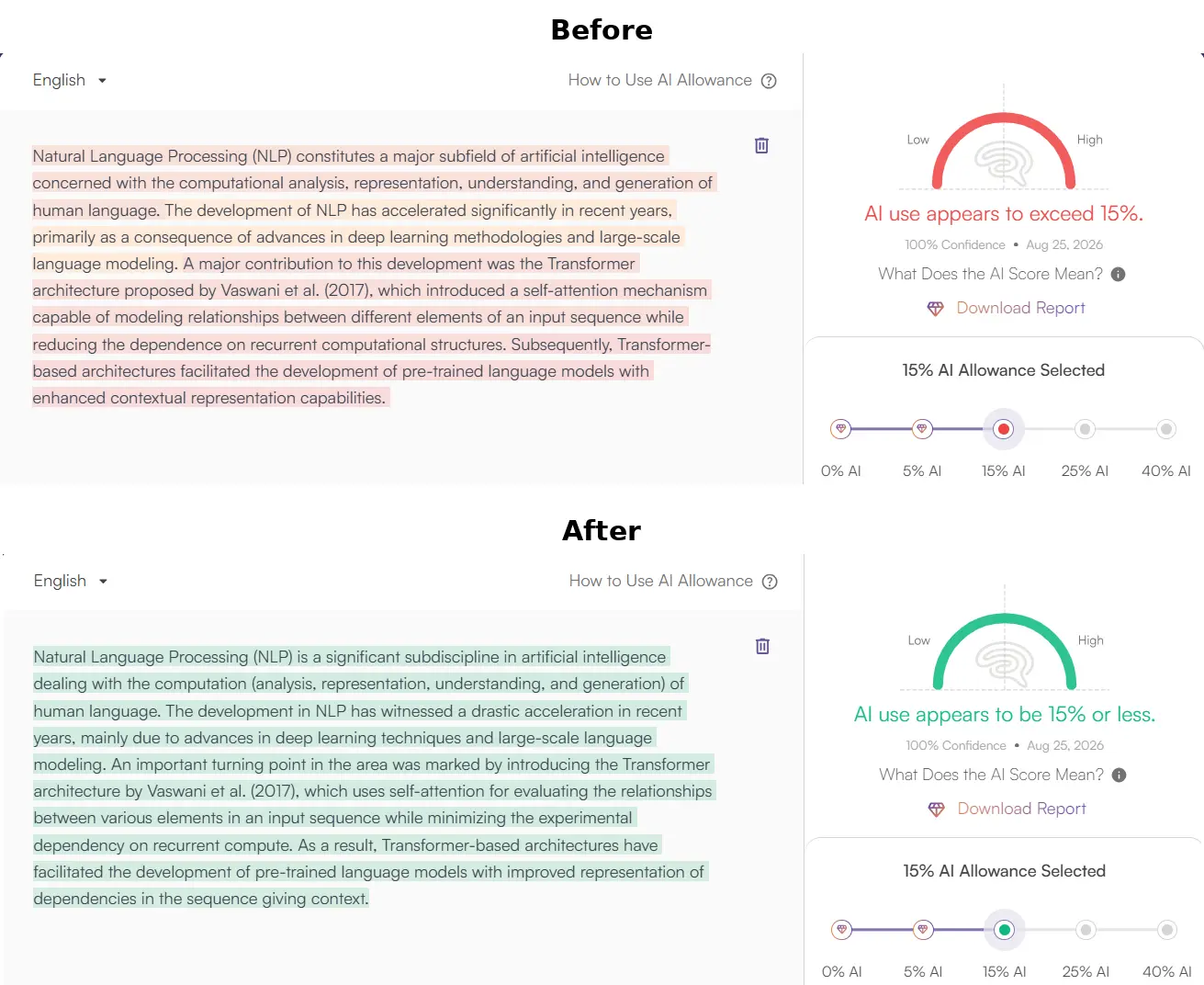
Originality.ai flags predictable n-gram sequences and common AI clichés (such as “delving into,” “pivotal role,” “testament to”). ThesisHuman purges overused formulaic transitions while elevating scholarly tone and keeping reference numbers and equations intact, producing 100% Original / 0% AI results.