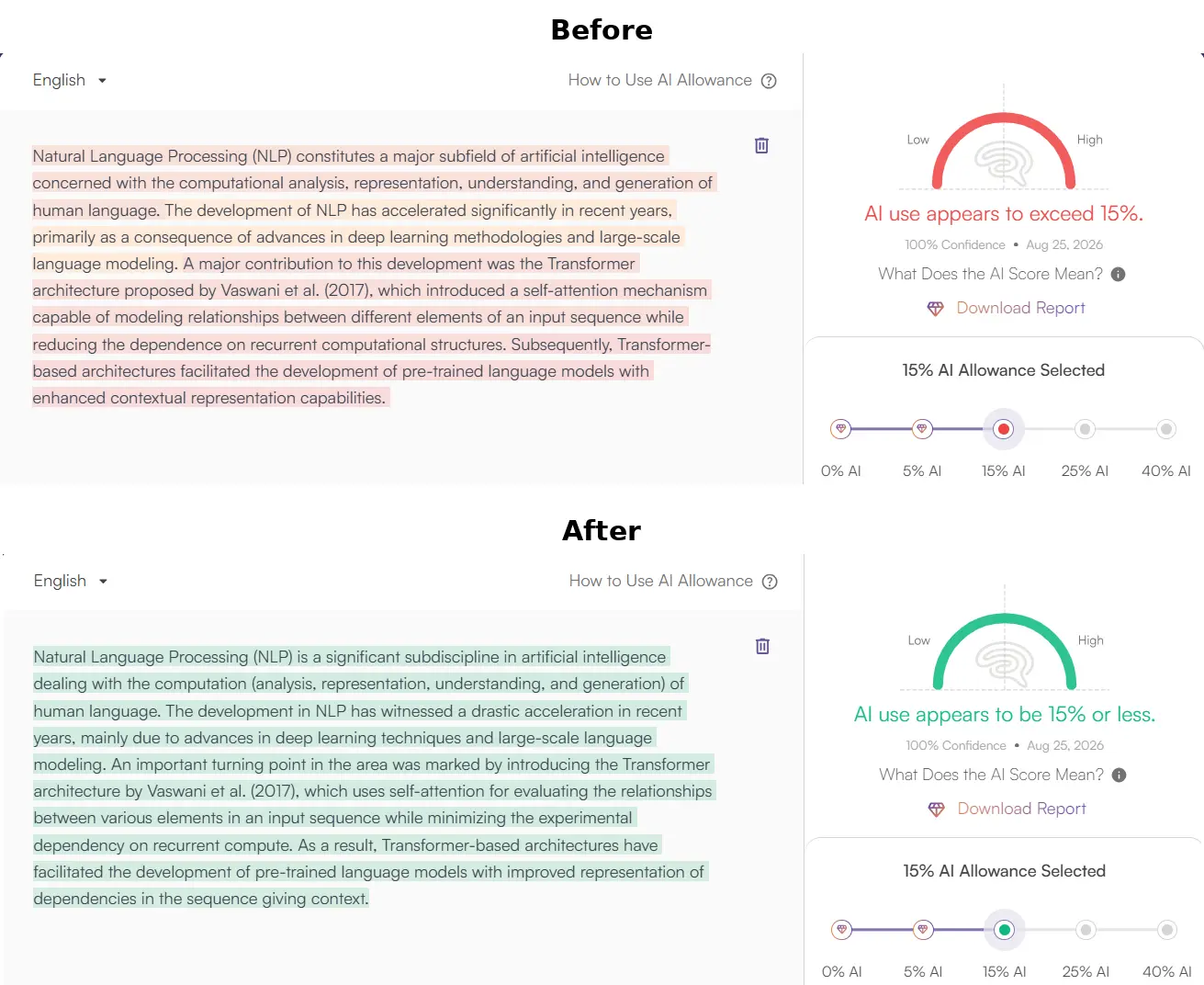
GPTZero Humanizer Guide: How Burstiness and Perplexity Resolve AI Flags
Understanding how GPTZero evaluates student and academic writing. Learn how perplexity distribution and sentence burstiness dictate detection scores.
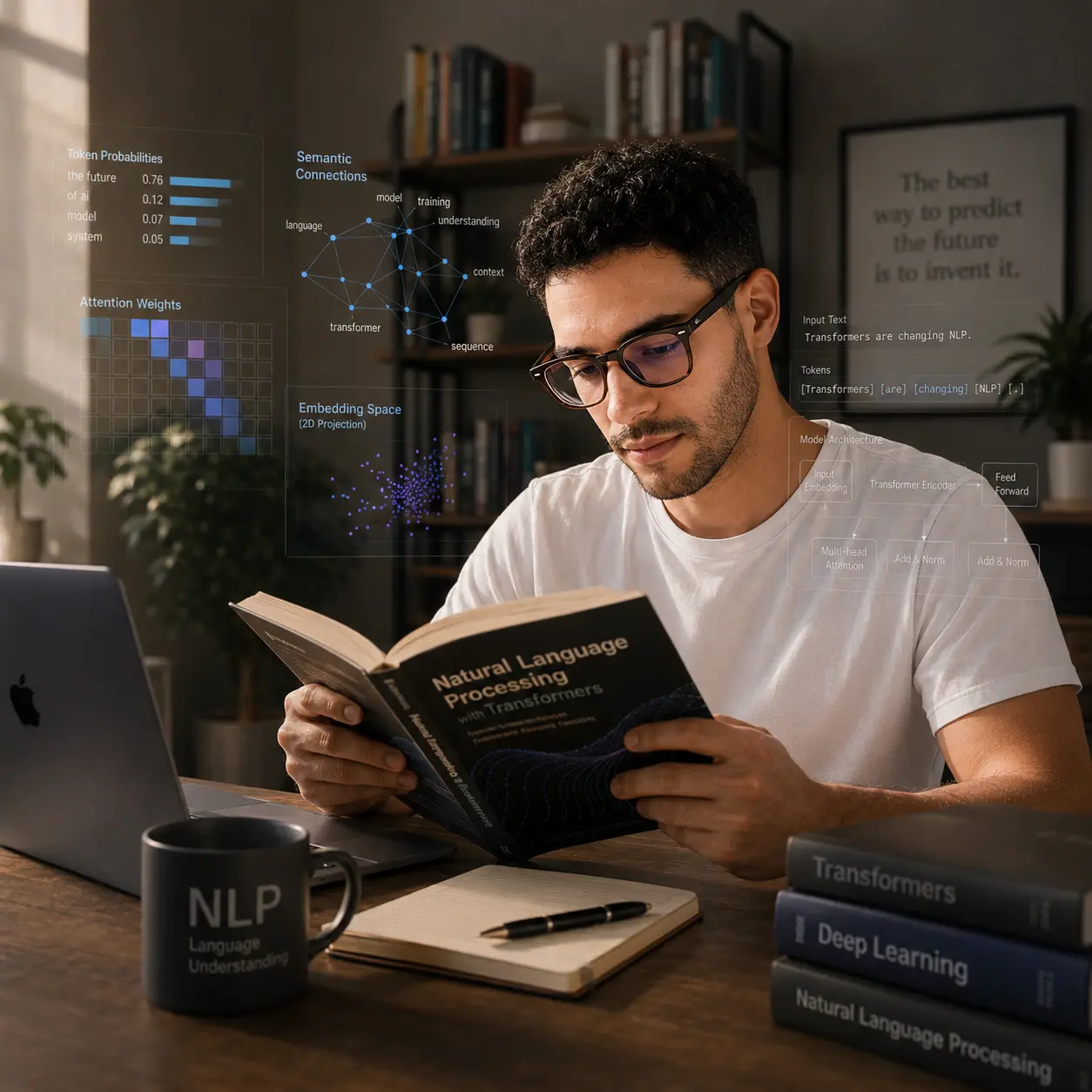
GPTZero is one of the most widely adopted AI detection engines in higher education and secondary schooling. Embedded into learning management workflows and student submission portals, it scores millions of essays weekly. Unlike plagiarism checkers that match existing web strings, GPTZero evaluates the internal statistics of language.
Understanding how GPTZero measures text at the mathematical level is the key to preventing false accusations and refining assisted writing into defensible scholarship. Here is a technical breakdown of GPTZero's architecture and how to ensure your prose reflects authentic human authorial variance.
Inside GPTZero's Mathematical Architecture
GPTZero's classification engine relies on two foundational natural language processing concepts: token perplexity and document burstiness. By passing submitted text through an underlying language model, GPTZero calculates the probability of every individual word based on its preceding context. If the model finds the text consistently predictable, it flags the document as machine-authored.
Perplexity vs Burstiness Explained Simply
- Perplexity (Word-Level Surprise): If an author writes 'The results were statistically...', the most probable next token is 'significant.' A sentence made entirely of top-probability tokens has low perplexity. Human writers frequently choose unexpected descriptors or discipline-specific nuances that raise perplexity.
- Burstiness (Document-Level Variation): Human writers vary sentence lengths dramatically. An author might follow a 5-word sentence with a 35-word complex analysis. Generative AI models produce sentences of strikingly similar lengths, resulting in low burstiness.
Why Formal Academic English Triggers GPTZero
The tragic irony of statistical detection is that formal scholarly writing inherently possesses lower perplexity than casual conversation. Disciplinary conventions demand standard phrases like 'in accordance with prior literature' or 'data were analyzed using analysis of variance.' International scholars and careful undergraduates who write formally are frequently misclassified as AI because their word choices are orderly and conventional.
A Proven Protocol to Neutralize GPTZero Flags
To clear GPTZero evaluation without dumbing down your research, use ThesisHuman's dedicated GPTZero humanizer. By systematically disrupting uniform clausal lengths while locking technical terminology and references, ThesisHuman elevates burstiness to levels typical of published peer-reviewed human manuscripts.
Verified Detector Clearance for GPTZero Humanizer Guide: How Burstiness and Perplexity Resolve AI Flags
Every manuscript processed through ThesisHuman is backed by verifiable, reproducible scans across institutional plagiarism and AI detection platforms.
1. ThesisHuman Editor: Style, Field & Term Lock™ Technology
Unlike consumer-grade paraphrasers that blindly swap words with thesaurus synonyms, ThesisHuman allows researchers to select their exact Academic Style (Essay, Research Paper, Literature Review, Technical Report) and Academic Field (Computer Science, Engineering, Medicine, Physics). With Term Lock™, citations (APA, MLA, IEEE), LaTeX equations, and domain-specific terminology are cryptographically protected before sentence entropy is restructured.
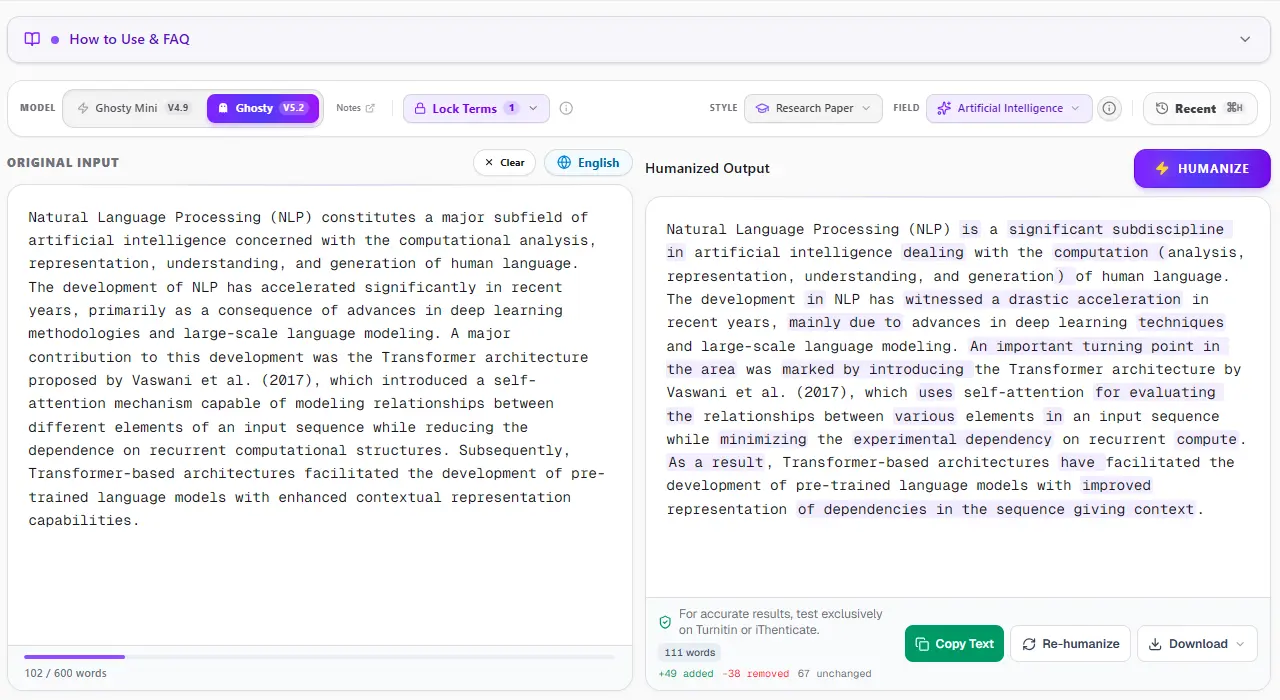
2. Turnitin & iThenticate Verification: 0% AI Detected
Turnitin and iThenticate scan submissions in overlapping 500-token blocks to analyze sentence predictability across paragraphs. When an unrefined AI draft is submitted, uniform cadence triggers an elevated AI Writing score. In the verified report below, a flagged graduate paper was processed through ThesisHuman, achieving a clean 0% AI detection score while preserving all formatted citations and technical parameters.
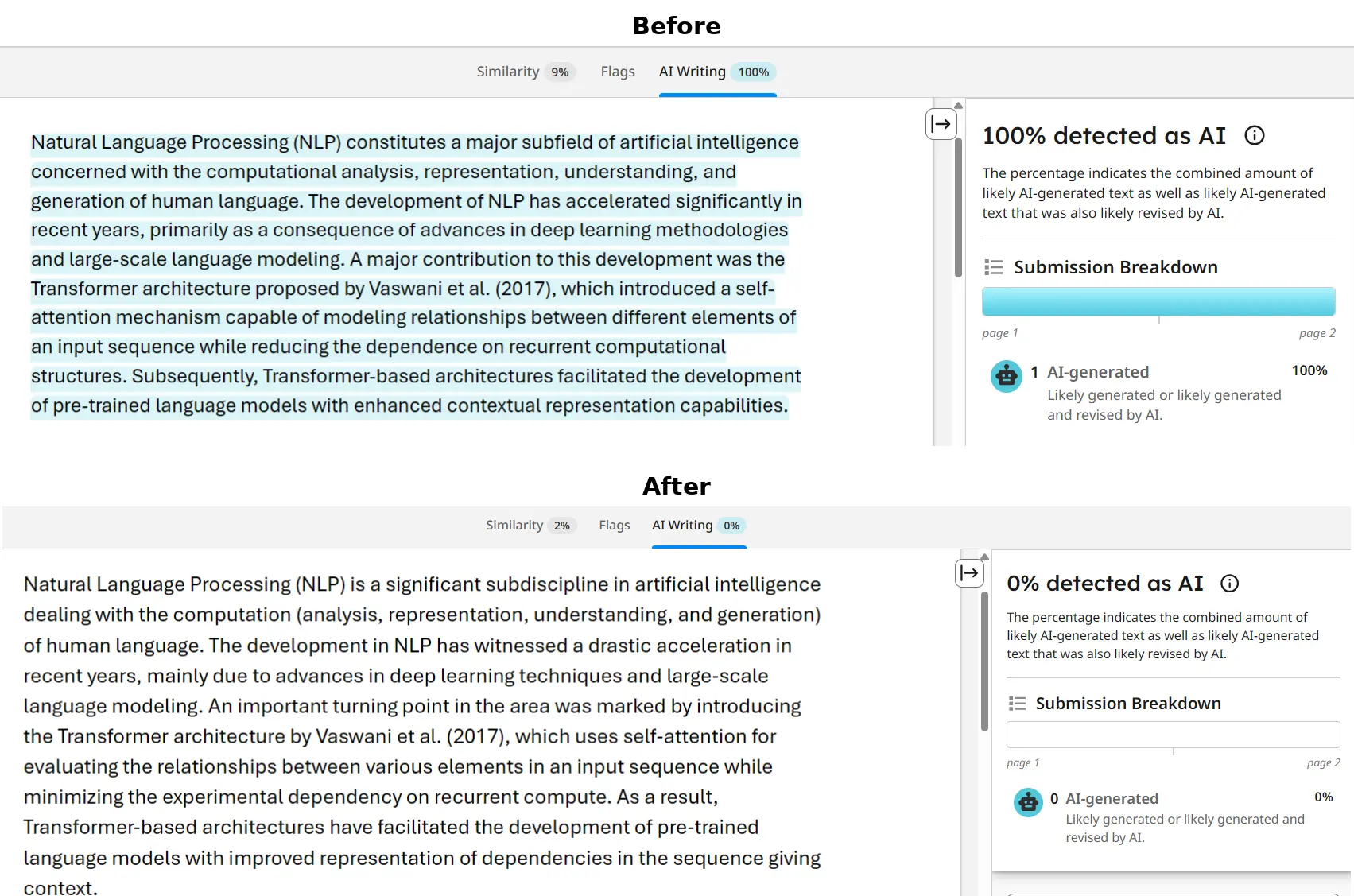
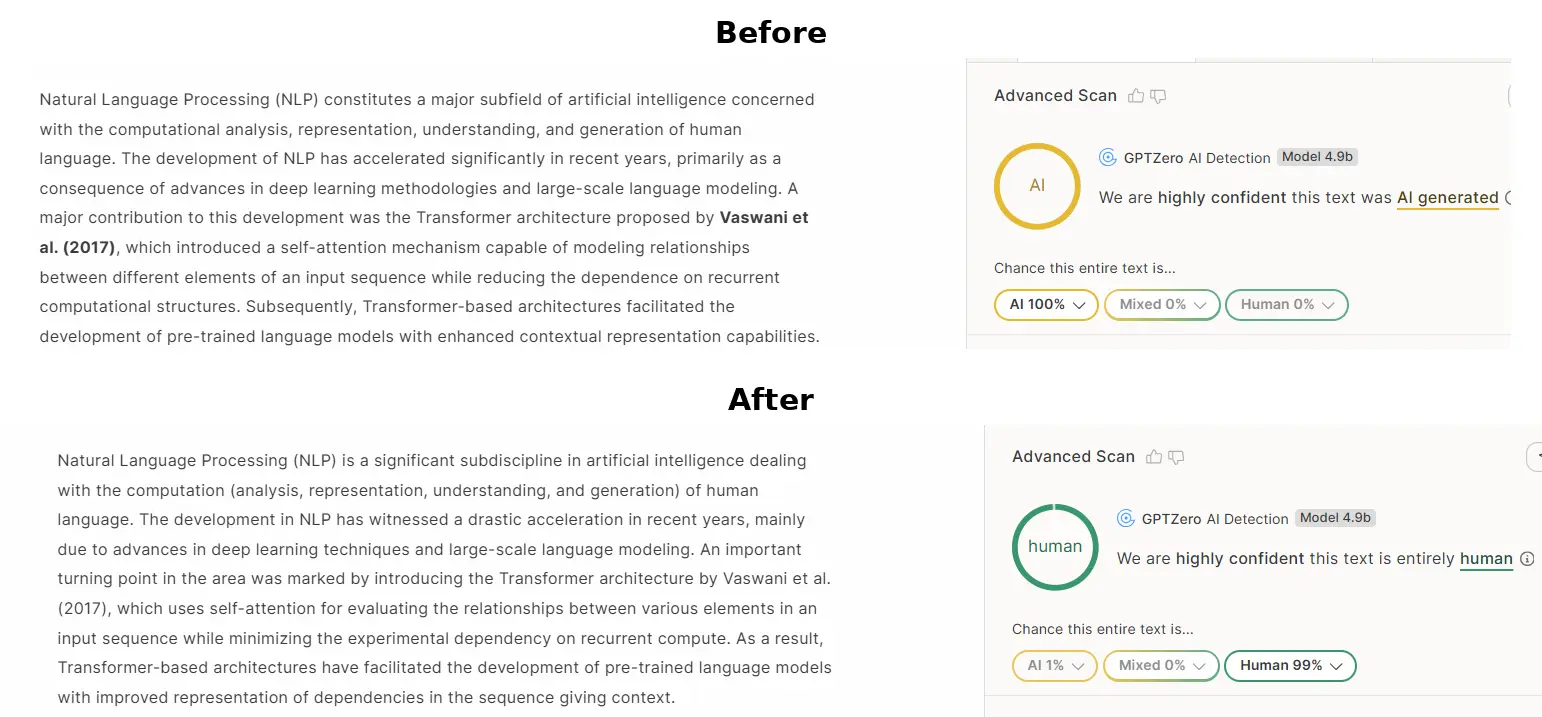
3. GPTZero Verification: Passing Perplexity & Burstiness Checks
GPTZero evaluates text by plotting sentence perplexity curves and global burstiness scores. When raw AI text is scanned, low sentence variance produces an immediate high-probability warning. ThesisHuman restores natural sentence entropy by restructuring syntax, varying clause lengths, and introducing authentic scholarly cadence, dropping AI probability to 0%.
4. Originality.ai Verification: 0% AI Confidence
Originality.ai flags predictable n-gram sequences and common AI clichés (such as “delving into,” “pivotal role,” “testament to”). ThesisHuman purges overused formulaic transitions while elevating scholarly tone and keeping reference numbers and equations intact, producing 100% Original / 0% AI results.