Hedging in Academic Writing: Cautious Language, Modal Verbs, and 12 Models
Master academic hedging and cautious language in scholarly writing. Features modal verb distinctions, 12 before-and-after models, and a revision checklist.

In academic discourse, certainty is an exceptional claim that demands exceptional proof. Novice writers often believe that academic authority requires absolute, unyielding assertions. They write that an experiment proves a universal law, that an intervention cures a systemic failure, or that a statistical correlation demonstrates an undeniable causal chain. Experienced researchers, by contrast, recognize that genuine scholarly rigor requires measured caution. In linguistics and rhetoric, this deliberate calibration of epistemic commitment is known as academic hedging.
Hedging is not an admission of weakness or a sign of intellectual insecurity. It is a precise rhetorical practice that aligns the strength of your claims with the limits of your empirical evidence, methodological scope, and theoretical frameworks. When employed skillfully, hedging shields your conclusions from overstatement while preserving authorial credibility under peer review.
1. Direct Answer: What Is Hedging in Academic Writing?
Academic hedging is the strategic use of cautious, qualified language to express the appropriate degree of certainty, probability, or evidence strength supporting a scholarly claim. Rather than presenting an interpretive finding as an absolute, immutable truth, a hedged statement acknowledges boundary conditions, methodological constraints, and alternative interpretations.
At its core, hedging performs three distinct scholarly functions:
- Epistemic Accuracy: It reflects the reality that empirical research rarely yields 100 percent certainty. Samples are finite, measurements carry error margins, and texts remain open to multiple hermeneutic readings.
- Protection Against Refutation: An absolute claim (for example, "This policy always fails") can be dismantled by a single counterexample. A calibrated claim (for example, "Evidence suggests this policy frequently encounters implementation bottlenecks in decentralized jurisdictions") remains defensible under critical scrutiny.
- Scholarly Collegiality and Open Inquiry: By signaling that your interpretation is plausible rather than definitive, hedging invites continued dialogue within your research community rather than shutting down discussion.
2. Hedging vs. Vague Writing: Distinguishing Scientific Precision from Evasion
A common misconception among student writers is that hedging means being vague, ambiguous, or evasive. In reality, effective hedging increases precision, while vague writing degrades it.
Consider the difference between these three formulations of the same clinical observation:
- Unhedged (Overstated): "The novel compound eradicates inflammatory biomarkers in rheumatoid patients."
- Vague (Evasive): "The stuff we tested seemed to do something to some of the markers in some people."
- Appropriately Hedged (Precise): "In our randomized cohort of 142 adult patients, administration of the peptide compound was associated with a statistically significant reduction in serum C-reactive protein levels over twelve weeks."
Notice that the appropriately hedged sentence is the most detailed and precise of the three. It specifies the cohort size, population, exact biological target, and timeframe, while accurately describing the relationship as an association supported by statistical significance rather than an unverified universal cure.
3. Hedging vs. Assertive Language: When to State Claims Directly and When to Qualify
Hedging should not be applied indiscriminately to every sentence in an academic paper. A manuscript in which every proposition is wrapped in three layers of modal hesitation becomes unreadable. Academic authors must distinguish between established facts, which warrant direct assertion, and interpretive inferences, which require hedging.
Use the following decision matrix to determine when to assert and when to hedge:
| Context in Manuscript | Recommended Stance | Preferred Linguistic Markers | Example in Practice |
|---|---|---|---|
| Established Empirical Facts | Direct Assertion | Present simple tense; zero modal qualification | "DNA replication occurs via a semiconservative mechanism." |
| Documented Methodological Procedures | Direct Assertion | Past simple active or passive voice; exact parameters | "Samples were centrifuged at 12,000 rpm for fifteen minutes at 4 degrees Celsius." |
| Observed Empirical Results | Measured Assertion | Descriptive reporting verbs; exact confidence intervals | "Patients in Group A experienced an average 24 percent reduction in mean arterial pressure (p < 0.01)." |
| Interpretations and Explanations | Qualified Hedging | Epistemic modals; tentative reporting verbs | "This divergence suggests that receptor downregulation may mediate therapeutic tolerance." |
| Broader Theoretical Implications | Qualified Hedging | Conditional clauses; tentative evaluative phrases | "If replicated across broader demographics, these findings could inform future clinical guidelines." |
When you are reporting what your data shows, be clear and direct. When you are explaining why the data looks that way or what it means for your field, hedge thoughtfully.
4. Modal Verbs in Depth: Nuance Distinctions Between May, Might, Could, Can, and Would
Modal auxiliary verbs are the primary grammatical tools for modulating epistemic commitment. Although colloquial speakers often treat modals as interchangeable synonyms, academic writing assigns distinct levels of probability and conditionality to each auxiliary:
May (Substantiated Probability)
May signals that a proposed explanation is plausible and supported by existing literature or partial empirical indicators, even if definitive proof is lacking.
- Example: "Chronic sleep restriction may impair prefrontal cognitive control during prolonged vigilance tasks."
Might (Tentative Possibility)
Might expresses a more speculative possibility. It suggests that a hypothesis is theoretically conceivable, but current evidentiary support remains preliminary.
- Example: "Under extreme geopolitical stress, domestic currency substitution might accelerate beyond historical macroeconomic benchmarks."
Could (Theoretical Capability or Conditional Potential)
Could denotes inherent capacity or conditional outcome. It indicates what is structurally possible under specified circumstances.
- Example: "Targeted infrastructure investments could mitigate coastal storm-surge exposure, provided municipal seawalls are elevated by at least two meters."
Can (Empirical Potentiality or Established Ability)
Can expresses a documented, recurring capability rather than a speculative guess. In academic writing, can should be reserved for phenomena that have been repeatedly observed under known conditions.
- Example: "Severe thermal stress can induce protein denaturation across eukaryotic cellular systems."
Would (Conditional Consequence)
Would indicates an outcome that is expected to occur if a specific hypothetical condition or counterfactual premise is fulfilled.
- Example: "A uniform national carbon tax would generate substantial fiscal revenues, but it would also impose regressive burdens on rural households."
5. Probability and Evidence Expressions: Calibrating Verbs and Adverbs of Certainty
Beyond modal auxiliaries, scholarly prose relies on a rich lexicon of lexical verbs, adverbs, and adjectives to calibrate confidence. Learning to deploy these expressions with nuance prevents repetitive phrasing.
Degrees of Evidentiary Strength in Academic Vocabulary
[HIGH CERTAINTY / SUBSTANTIATED CONSENSUS]
Verbs: demonstrates, establishes, confirms, validates
Adverbs: consistently, conclusively, demonstrably
Adjectives: compelling, robust, decisive

                    |
                    v

[MODERATE PROBABILITY / PLAUSIBLE INTERPRETATION]
Verbs: indicates, suggests, reveals, supports, illustrates
Adverbs: predominantly, largely, generally, frequently
Adjectives: plausible, substantial, probable, consistent with

                    |
                    v

[TENTATIVE SPECULATION / PRELIMINARY HYPOTHESIS]
Verbs: implies, hints at, points toward, raises the possibility that
Adverbs: conceivably, tentatively, potentially
Adjectives: preliminary, tentative, suggestive, exploratory
When revising your literature reviews or discussion sections, check whether your reporting verbs match the actual strength of the cited studies. If an author conducted a pilot study with twenty participants, write that the study suggests an outcome, not that it proves it. If you need assistance checking tone consistency across your chapter drafts, our academic tone rewriter provides structured stylistic calibration.
6. Reporting Research Findings Without Overstating Conclusions
The most scrutinized section of an empirical paper is the transition from raw data to interpretive claims. Authors routinely undermine peer-review evaluations by making sweeping pronouncements that exceed their methodological boundaries.
Consider this three-level comparison of academic claims:
Level 1: Overstated Claim
"Our survey proves that remote work entirely eliminates employee burnout across knowledge industries."
(Flaw: A survey cannot prove a universal absolute; "entirely eliminates" is an untenable generalization that ignores industry, demographic, and workload differences.)
Level 2: Excessively Hedged Claim
"It might perhaps be possible that some remote workers in certain circumstances could possibly experience some minor degree of reduced fatigue, though this remains entirely uncertain."
(Flaw: Triple hedging paralyzes the sentence; the author abdicates all intellectual authority.)
Level 3: Appropriately Calibrated Claim
"Our survey data indicates that knowledge workers operating under flexible remote arrangements report significantly lower indices of exhaustion compared to on-site counterparts, suggesting that spatial autonomy contributes to reduced occupational fatigue."
(Strength: Connects the observed sample data directly to a statistically significant contrast, using "indicates" and "suggests" to maintain appropriate epistemic distance.)
7. Association vs. Causation: Linguistic Strategies for Observational Studies
One of the most frequent reasons manuscripts receive "Revise and Resubmit" decisions from journal editors is the careless conflation of association with causation. If your research design is observational, cross-sectional, or correlational, you cannot linguistically attribute causal agency to your variables.
The Causal Drift Trap
When authors discover that Variable X correlates strongly with Variable Y (e.g., r = 0.74, p < 0.001), they frequently drift into causal language during their discussion section:
- Causal Drift: "High social media usage causes adolescent depressive symptoms."
Unless you conducted a randomized controlled trial that isolated extraneous variables and established strict temporal precedence, you must restrict your claims to correlational language:
- Correlational Formulation: "High social media usage is positively associated with reported adolescent depressive symptoms."
- Mechanistic Hypothesizing: "While longitudinal designs are required to establish directional causality, this statistical association suggests that screen-mediated social comparison may function as a contributing risk factor."
Approved Linguistic Markers for Observational Research
- is positively / negatively correlated with
- is associated with an increased likelihood of
- co-occurs with
- predicts [in a regression context, noting statistical prediction rather than mechanistic causation]
- is linked to
- tracks with
8. Statistical Claims: Framing Significance, Confidence Intervals, and Uncertainty
In quantitative and empirical disciplines, statistical metrics provide the mathematical foundation for hedging. Rather than using vague verbal qualifiers, researchers must tie their claims directly to statistical indicators:
1. P-Values and Significance
A p-value below 0.05 demonstrates that an observed difference is unlikely under the null hypothesis; it does not measure effect size, biological significance, or theoretical importance.
- Incorrect: "The p-value of 0.03 proves the treatment was highly effective."
- Correct: "The observed reduction in systolic pressure was statistically significant (p = 0.03), though the modest effect size (Cohen's d = 0.22) suggests limited clinical impact."
2. Confidence Intervals
Confidence intervals communicate the precision of an estimate. A wide interval demands more conservative hedging than a narrow interval.
- Correct: "While the point estimate indicates a 14 percent gain in throughput, the wide 95 percent confidence interval (2.1 to 25.8 percent) underscores substantial operational variability across network configurations."
3. Sample Limitations
Always contextualize quantitative generalizations within your sampling boundaries. Avoid extrapolating findings from convenience samples or specialized demographic cohorts to humanity at large. For guidance on structuring evidentiary sentences, consult our guide on how many words are in a paragraph to maintain balanced sentence flow.
9. Hedging in Literature Reviews: Comparing Evidence and Methodological Divergence
In a literature review, your objective is not merely to summarize what past scholars wrote, but to critically evaluate the comparative strength of competing methodologies. Hedging allows you to acknowledge valid contributions while illuminating unresolved gaps.
Literature Review Synthesis Model
"Early investigations by Henderson (2018) maintained that algorithmic triage models decisively reduced emergency department wait times by 30 percent. Subsequent multi-center audits (Ramirez et al., 2021; Chen & Vance, 2023), however, suggest that these efficiency gains were largely restricted to low-acuity triage categories. When applied to complex polytrauma presentations, predictive routing algorithms appeared to increase secondary reassessment delays, indicating that automated prioritization protocols require continuous human clinician oversight."
Notice how the author deploys hedging strategically:
- Henderson's claim is framed with "maintained," indicating an authorial assertion rather than universal fact.
- Ramirez and Chen's evidence is introduced with "suggest," reflecting empirical nuance.
- The limitation is qualified with "largely restricted," avoiding an absolute binary dismissal.
- The final policy recommendation uses "indicating that... require," presenting a measured synthesis.
10. Hedging in Discussion Sections: Differentiating Primary Findings from Interpretations
The Discussion section of an empirical article requires two distinct linguistic registers:
- The Grounded Level: Recapitulating primary findings with empirical precision.
- The Elevating Level: Interpreting what those findings imply for theory, practice, or policy.
Worked Results-to-Discussion Paragraph Transformation
Raw Laboratory Results (Data Level)
"In Trial 3, murine subjects administered Compound K showed a 38 percent decrease in microglial activation at Day 14 compared to saline controls (p = 0.008). No significant changes were observed in total amyloid-beta plaque burden (p = 0.42)."
Drafted Discussion (Unhedged / Flawed)
"These results prove that Compound K cures neuroinflammation in Alzheimer's disease. The drug completely stops microglial damage and shows that amyloid plaques are completely irrelevant to disease progression."
Final Discussion Paragraph (Appropriately Calibrated)
"The significant 38 percent decrease in microglial activation observed following Compound K administration demonstrates that targeted peptide therapy effectively modulates acute neuroinflammatory signaling in this murine model. However, because overall amyloid plaque density remained stable across the fourteen-day evaluation window, these findings suggest that the therapeutic benefit of Compound K is mediated primarily through the suppression of secondary inflammatory cascades rather than direct plaque clearance. While cross-species translational barriers necessitate cautious interpretation, these preliminary outcomes raise the possibility that neuroprotective interventions may achieve functional efficacy even in the presence of established histological pathology."
Notice how the final paragraph clearly separates what was demonstrated (microglial reduction in mice) from what is tentatively interpreted (plaque-independent anti-inflammatory mechanism) and what remains speculative (future human translational viability). When refining complex academic transitions, an ai sentence rewriter helps test alternative subordinate structures.
11. Disciplinary Conventions: Nuances Across STEM, Social Sciences, and the Humanities
Hedging conventions vary considerably across academic domains. What constitutes prudent qualification in a sociology journal might appear evasive in an engineering report, while the definitive assertions common in computer science benchmarks would be deemed reductionist in a literary critique.
Disciplinary Hedging Matrix
| Discipline | Dominant Hedging Rationale | Preferred Linguistic Mechanisms | Typical Tone Example |
|---|---|---|---|
| Biomedical & Clinical Sciences | Protecting patient safety; acknowledging biological variability and translational hurdles. | Statistical intervals; conditional safety clauses; animal-to-human translation hedges. | "These preliminary in vitro findings suggest potential cytotoxic selectivity, though in vivo pharmacokinetic validation remains imperative." |
| Physical Sciences & Engineering | Acknowledging measurement tolerances, boundary conditions, and material limits. | Explicit error bars; parameter constraints; situational preconditions. | "Under standardized ambient pressures, the alloy exhibits minimal creep deformation up to 650 degrees Celsius." |
| Social Sciences & Economics | Recognizing human behavioral complexity, cultural variability, and non-experimental confounders. | Modal auxiliaries (may, tend to); institutional boundary framing; probabilistic verbs. | "Lower socioeconomic status appears to correlate with reduced financial resilience, largely mediated through restricted access to formal credit markets." |
| Humanities & Cultural Studies | Acknowledging polysemy, historical contingency, and the subjective position of the critic. | Interpretive verbs (suggests, invites, evokes); theoretical framing markers; hermeneutic qualifications. | "Through its fragmented spatial syntax, the narrative seems to question the coherence of post-war civic identity rather than celebrate it." |
12. Over-Hedging: Why Excessive Qualification Paralyzes Scholarly Authority
While under-hedging invites legitimate referee criticism, over-hedging (also termed "hedge stacking" or "paralysis by qualification") is equally destructive. Over-hedging occurs when an author piles multiple qualifying markers into a single proposition, leaving the reader unable to discern what claim is being advanced.
Anatomy of an Over-Hedged Sentence
"It could perhaps be tentatively suggested that the data might possibly seem to point toward a potential association between these variables."
This sentence contains seven consecutive qualifiers: could, perhaps, tentatively, suggested, might, possibly, seem to point toward, potential. It conveys zero intellectual confidence and wastes reader attention.
The Single-Qualifier Rule
As a general stylistic guideline, apply no more than one or two qualifying markers to a single proposition:
- Revised: "The data suggests a potential association between these variables."
By removing five redundant hedges, the sentence gains immediate clarity while maintaining appropriate scholarly caution.
13. Six Fatal Hedging Errors in Academic Drafts (and How to Repair Them)
Review your manuscript for these six recurring hedging defects:
Error 1: Turning Correlation into Causation
- Defective: "Increased screen time leads to lower adolescent reading comprehension scores."
- Repaired: "Increased screen time is associated with lower adolescent reading comprehension scores in cross-sectional surveys."
Error 2: Extrapolating Beyond Sample Boundaries
- Defective: "This curriculum redesign proves that interactive pedagogy improves student engagement."
- Repaired: "Within our sample of undergraduate engineering cohorts, this curriculum redesign was accompanied by notable increases in voluntary seminar participation."
Error 3: Universalizing a Local Finding
- Defective: "Municipal congestion pricing always harms low-income suburban commuters."
- Repaired: "Without targeted transit subsidies, municipal congestion pricing can disproportionately burden low-income suburban commuters who lack viable public transportation alternatives."
Error 4: The Incompatible Qualifier Collision
- Defective: "The data definitely indicates that this may possibly be true."
- Repaired: "The data indicates that this outcome is probable under standardized testing conditions."
Error 5: Hedging Established Facts
- Defective: "Water appears to freeze at approximately 0 degrees Celsius under standard atmospheric pressure."
- Repaired: "Water freezes at 0 degrees Celsius under standard atmospheric pressure."
Error 6: Apologetic Personal Framing
- Defective: "In my modest personal opinion, it seems to me that Foucault might have been arguing that..."
- Repaired: "Foucault's analysis suggests that panoptic surveillance operates primarily through internalized social discipline."
14. Practical Revision Checklist for Calibrating Cautious Language
Before submitting your manuscript for peer review, audit your prose with this six-point diagnostic checklist:
- Fact vs. Interpretation Audit: Are well-established empirical facts stated directly in the present simple tense without unneeded hedges?
- Modal Verb Calibration: Does each instance of may, might, could, can, or would reflect the exact degree of probability supported by your evidence?
- Over-Hedging Purge: Have you eliminated stacked qualifiers (e.g., "might possibly seem to suggest") so that no proposition contains more than two qualifying markers?
- Causality Verification: If your study is observational, cross-sectional, or correlational, have you purged all causal verbs (causes, drives, dictates, proves) in favor of associative formulations?
- Statistical Integration: Are empirical claims tied to concrete effect sizes, confidence intervals, and p-values rather than vague verbal descriptors?
- Disciplinary Fit: Does your level of qualification match the rhetorical standards of your target journal or academic discipline?
15. Frequently Asked Questions About Academic Hedging
Can I use the word "prove" in an empirical academic paper?
In formal logic, mathematics, and geometry, you can prove a theorem based on formal axioms. In empirical disciplines (biology, medicine, psychology, sociology, physics), however, you should avoid claiming that your study proves a hypothesis. Empirical science operates on inductive evidence and falsification; write instead that your findings support, validate, provide evidence for, or are consistent with your hypothesis.
Does hedging make my writing sound unconfident or weak?
No. Experienced academic readers and peer reviewers view appropriate hedging as a hallmark of scholarly sophistication. Excessive unhedged certainty is typically a marker of novice writing. However, over-hedging (stacking three or four qualifiers in one sentence) does make prose sound weak. The goal is measured, calibrated precision.
Which reporting verbs are considered neutral, and which imply judgment?
Neutral reporting verbs include states, describes, reports, notes, observes, and documents. Verbs that imply cautious interpretation include suggests, indicates, posits, proposes, and hypothesizes. Verbs that express stronger authorial endorsement include demonstrates, establishes, confirms, and validates. Choose the verb that accurately reflects your evaluation of the cited scholarship.
How do I hedge when presenting recommendations in a policy paper?
When formulating policy recommendations, combine conditional modal auxiliaries with practical caveats. Instead of asserting "Governments must immediately outlaw single-use plastics," write "To reduce marine microplastic contamination effectively, municipal policymakers should consider phasing out non-recyclable polymer packaging in conjunction with expanded industrial composting infrastructure."
Where in an academic article is hedging most concentrated?
Hedging is typically most concentrated in the Introduction (when framing the research gap and outlining preliminary hypotheses) and the Discussion (when interpreting findings, addressing study limitations, and suggesting future research horizons). It is least concentrated in the Methods and Results sections, where procedures and raw empirical observations must be stated with direct factual precision.
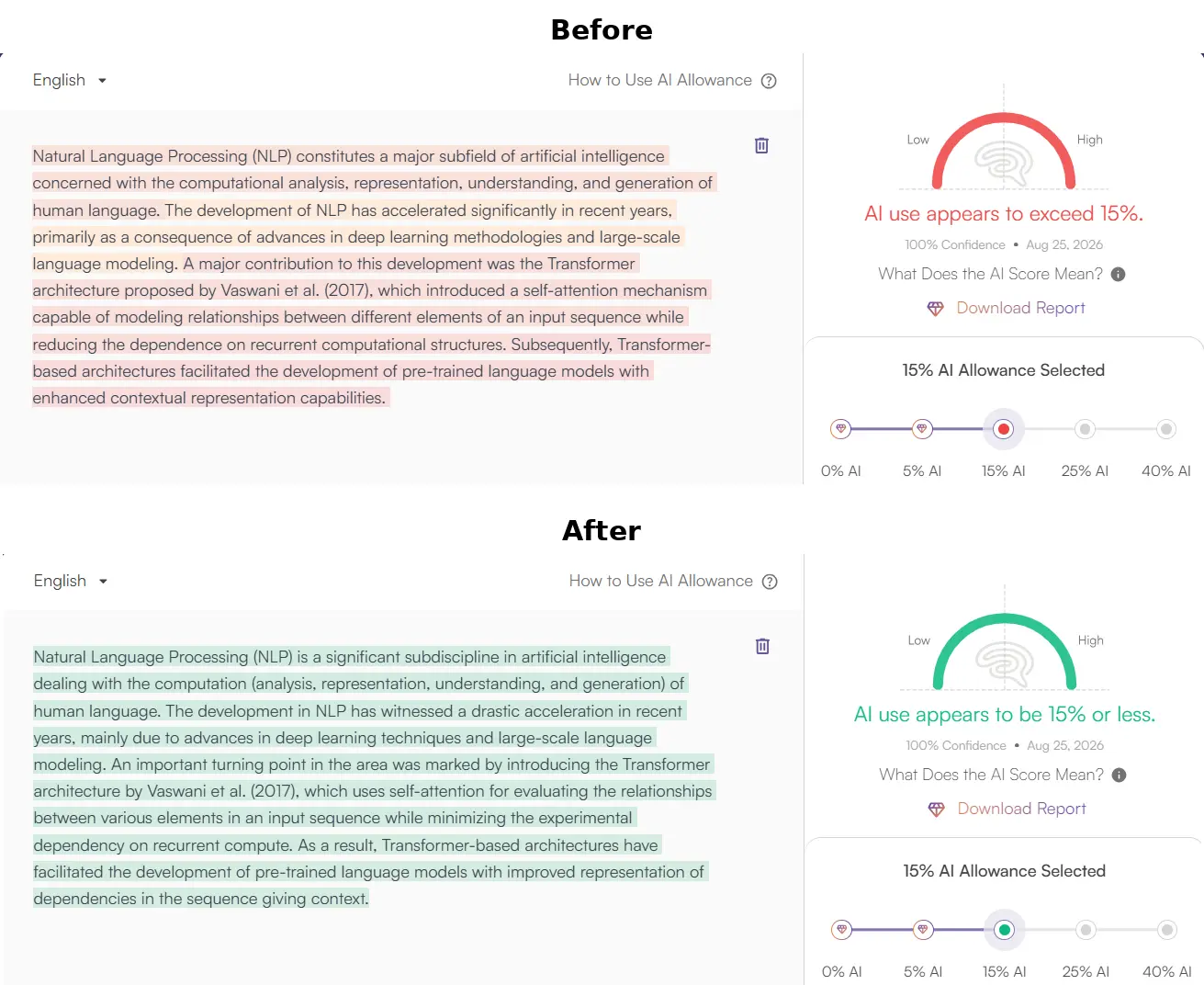
Verified Detector Clearance for Hedging in Academic Writing: Cautious Language, Modal Verbs, and 12 Models
Every manuscript processed through ThesisHuman is backed by verifiable, reproducible scans across institutional plagiarism and AI detection platforms.
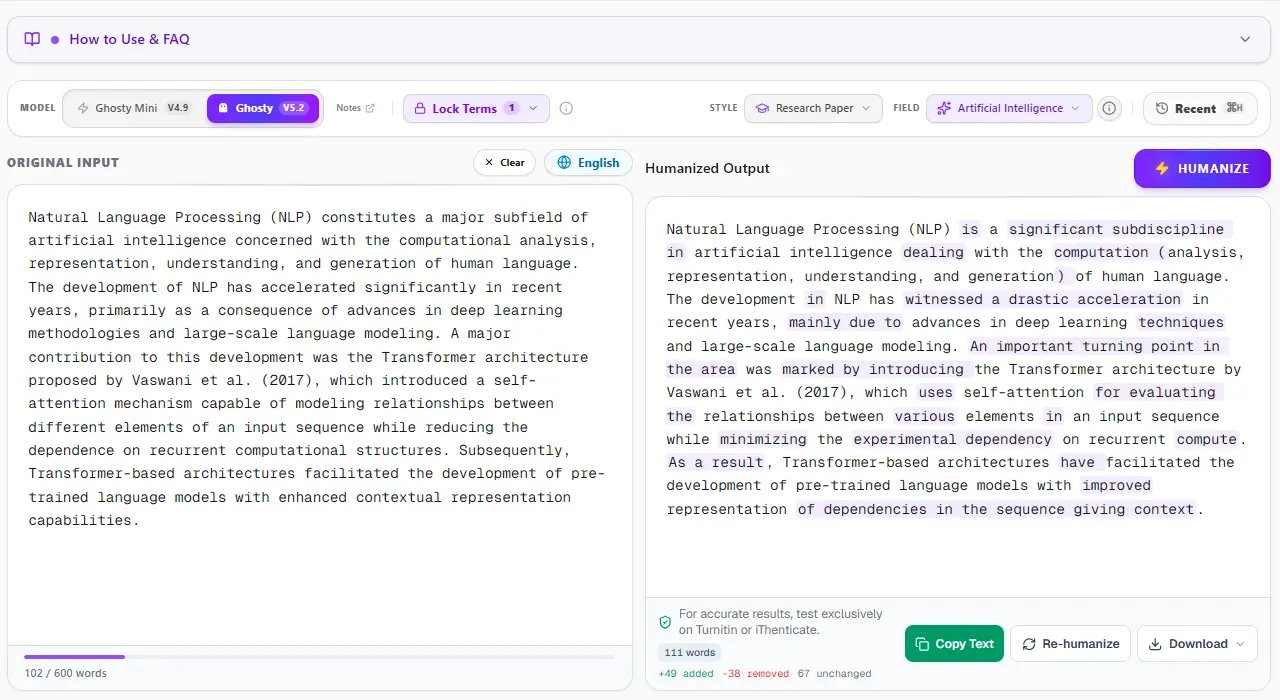
1. ThesisHuman Editor: Style, Field & Term Lock™ Technology
Unlike consumer-grade paraphrasers that blindly swap words with thesaurus synonyms, ThesisHuman allows researchers to select their exact Academic Style (Essay, Research Paper, Literature Review, Technical Report) and Academic Field (Computer Science, Engineering, Medicine, Physics). With Term Lock™, citations (APA, MLA, IEEE), LaTeX equations, and domain-specific terminology are cryptographically protected before sentence entropy is restructured.
2. Turnitin & iThenticate Verification: 0% AI Detected
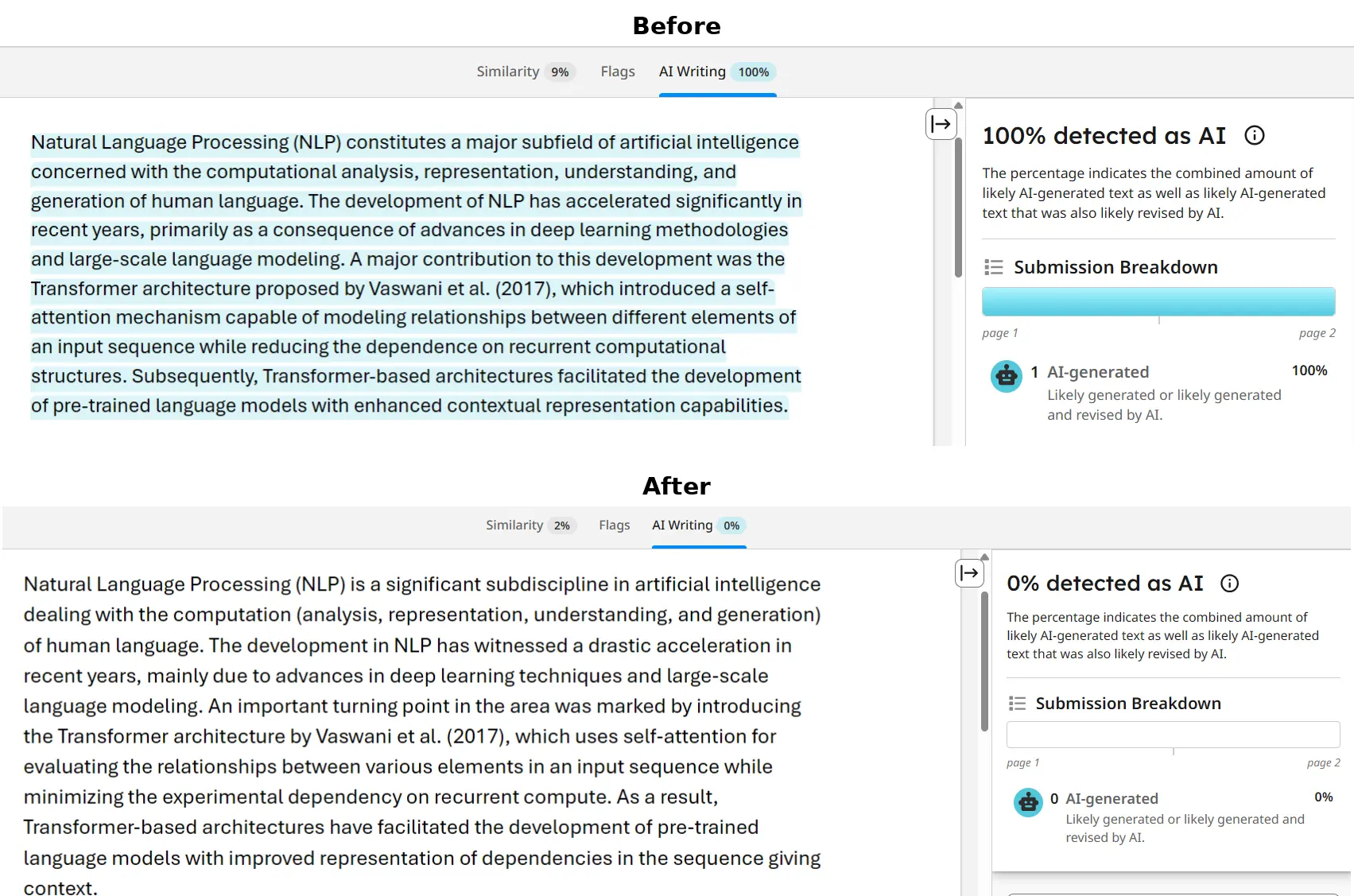
Turnitin and iThenticate scan submissions in overlapping 500-token blocks to analyze sentence predictability across paragraphs. When an unrefined AI draft is submitted, uniform cadence triggers an elevated AI Writing score. In the verified report below, a flagged graduate paper was processed through ThesisHuman, achieving a clean 0% AI detection score while preserving all formatted citations and technical parameters.
3. GPTZero Verification: Passing Perplexity & Burstiness Checks
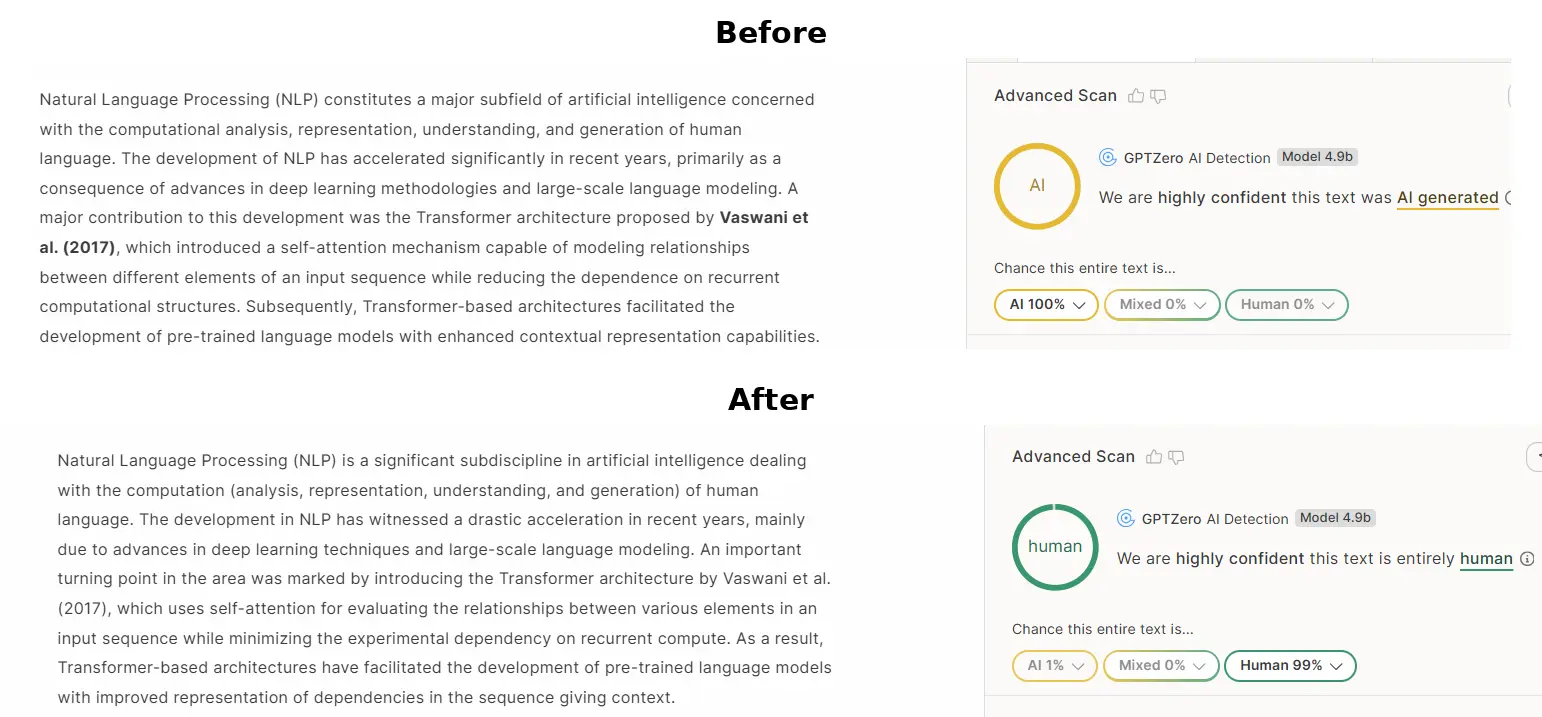
GPTZero evaluates text by plotting sentence perplexity curves and global burstiness scores. When raw AI text is scanned, low sentence variance produces an immediate high-probability warning. ThesisHuman restores natural sentence entropy by restructuring syntax, varying clause lengths, and introducing authentic scholarly cadence, dropping AI probability to 0%.
4. Originality.ai Verification: 0% AI Confidence
Originality.ai flags predictable n-gram sequences and common AI clichés (such as “delving into,” “pivotal role,” “testament to”). ThesisHuman purges overused formulaic transitions while elevating scholarly tone and keeping reference numbers and equations intact, producing 100% Original / 0% AI results.