How to Make AI Writing Sound Human: 6 Structural Edits for Academic Prose
Practical guide to making AI-assisted research text sound natural and scholarly. Learn six concrete structural edits to remove robotic cadence without changing your research claims.

When researchers use generative models to help draft literature reviews or organize complex methodology sections, the resulting text often sounds articulate yet strangely lifeless. Academics and journal editors immediately recognize this tone: perfectly balanced clauses, predictable transitions, and a cautious passivity that refuses to take a strong position.
Making AI writing sound human does not mean inserting informal slang or deliberate grammatical mistakes. In a research context, making text sound human means restoring intellectual vitality, clausal variation, and direct scholarly argument. Here are six concrete structural edits to transform robotic drafts into authoritative academic writing.
The Cadence Problem in Machine Prose
Large language models are trained to optimize coherence and minimize risk. In academic prompts, this causes models to produce sentences that hover around 20 to 25 words with matching subordinate clauses. A human scholar, by contrast, naturally varies rhythm: an eight-word thesis statement is followed by a thirty-word qualification, followed by a crisp factual summary. Dismantling this rhythmic uniformity is the foundation of genuine humanization.
Edit 1: Break Clausal Symmetry
Examine your paragraphs for matching compound sentences. AI models routinely generate sentences with balanced halves: 'While the algorithm improves latency, it also introduces memory overhead.' Restructure these into asymmetrical units:
- Raw AI Draft: 'Although the initial dataset exhibited minor anomalies, subsequent normalization resolved these discrepancies, and the final results remained statistically significant.'
- Humanized Revision: 'Initial data anomalies disappeared following normalization. Crucially, the resulting treatment effect remained statistically significant across all observed cohorts.'
Edit 2: Replace Formulaic Hedging
Machine drafts constantly overuse recursive hedging: 'It is important to remember,' 'One must acknowledge that,' 'It can be tentatively argued.' Replace these conversational crutches with direct disciplinary claims. If your data supports a finding, state the finding clearly.
Edit 3: Eliminate Robotic Transition Scaffolding
Cut ordinal sequences like 'Firstly, Secondly, Furthermore, In conclusion.' Published papers connect ideas through conceptual linkages rather than mechanical enumeration. Use substantive thematic openings that reference your specific variables.
Edit 4: Re-establish Scholarly Agency
AI text often relies on passive constructions to avoid making definitive assertions. Reclaim your authorial voice by clearly specifying methodological choices: 'We isolated the control cohort' rather than 'The control cohort was deemed to be isolated.'
Edit 5: Contextualize In-Text Citations
Generic AI drops citations at the very end of sentences as an afterthought. Weave references into the logical fabric of your claims, explaining why a specific study matters rather than merely stating that it exists.
Edit 6: Apply Automated Academic Polishing
For large dissertation chapters or lengthy journal submissions, manual sentence-by-sentence editing can take days. Purpose-built tools like ThesisHuman's academic humanizer automate clausal restructuring while safeguarding LaTeX equations and citations.
Verified Detector Clearance for How to Make AI Writing Sound Human: 6 Structural Edits for Academic Prose
Every manuscript processed through ThesisHuman is backed by verifiable, reproducible scans across institutional plagiarism and AI detection platforms.
1. ThesisHuman Editor: Style, Field & Term Lock™ Technology
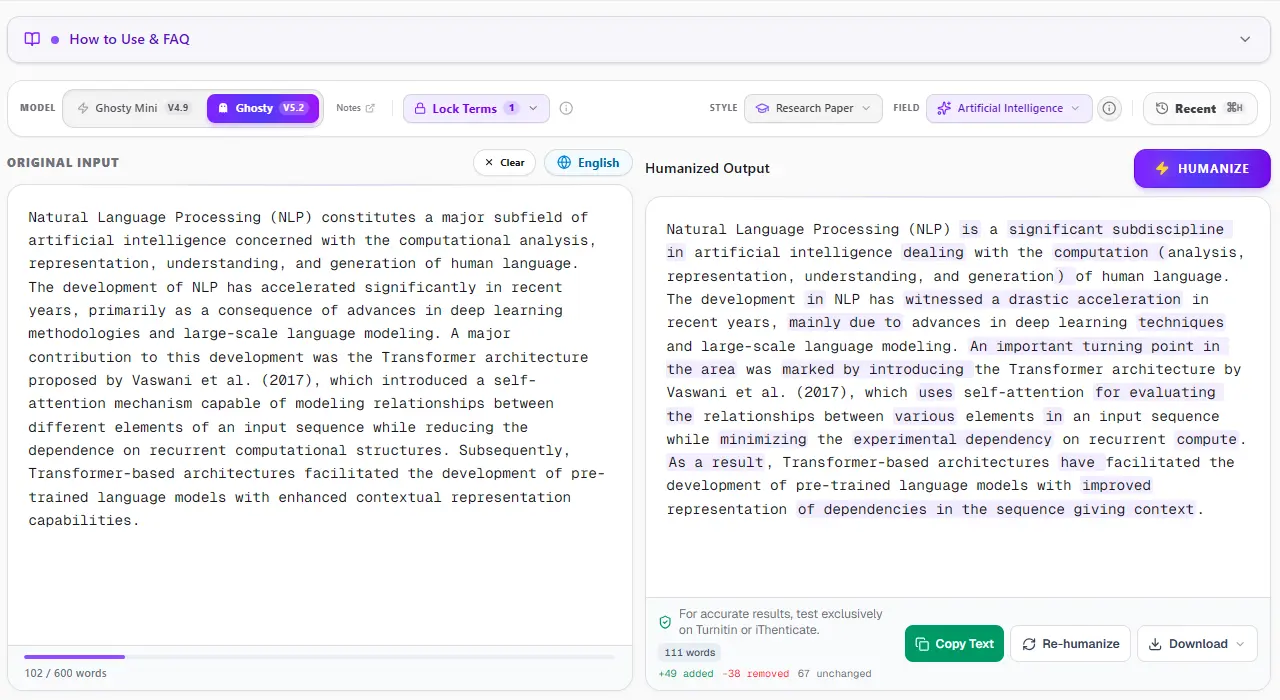
Unlike consumer-grade paraphrasers that blindly swap words with thesaurus synonyms, ThesisHuman allows researchers to select their exact Academic Style (Essay, Research Paper, Literature Review, Technical Report) and Academic Field (Computer Science, Engineering, Medicine, Physics). With Term Lock™, citations (APA, MLA, IEEE), LaTeX equations, and domain-specific terminology are cryptographically protected before sentence entropy is restructured.
2. Turnitin & iThenticate Verification: 0% AI Detected
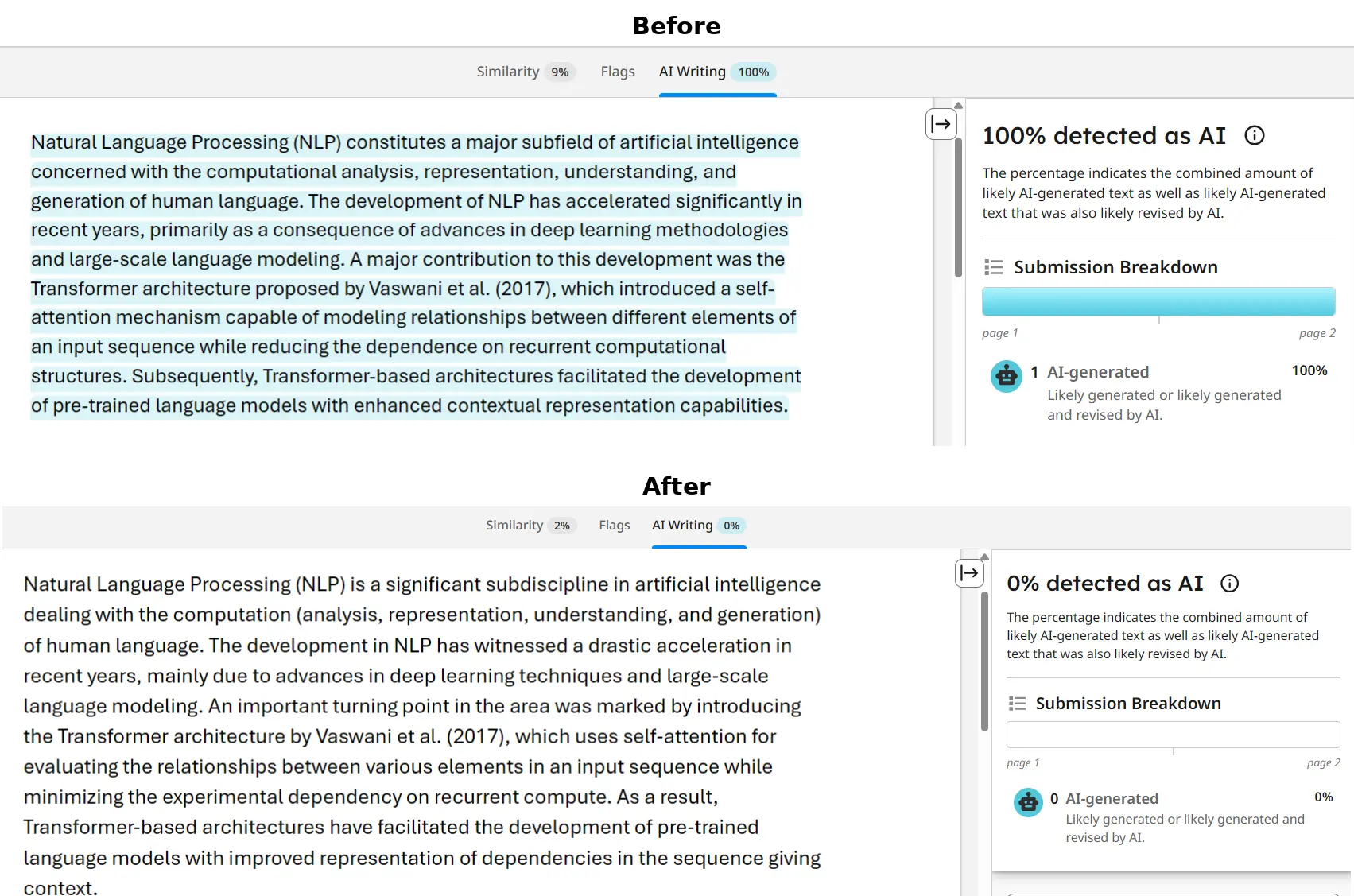
Turnitin and iThenticate scan submissions in overlapping 500-token blocks to analyze sentence predictability across paragraphs. When an unrefined AI draft is submitted, uniform cadence triggers an elevated AI Writing score. In the verified report below, a flagged graduate paper was processed through ThesisHuman, achieving a clean 0% AI detection score while preserving all formatted citations and technical parameters.
3. GPTZero Verification: Passing Perplexity & Burstiness Checks
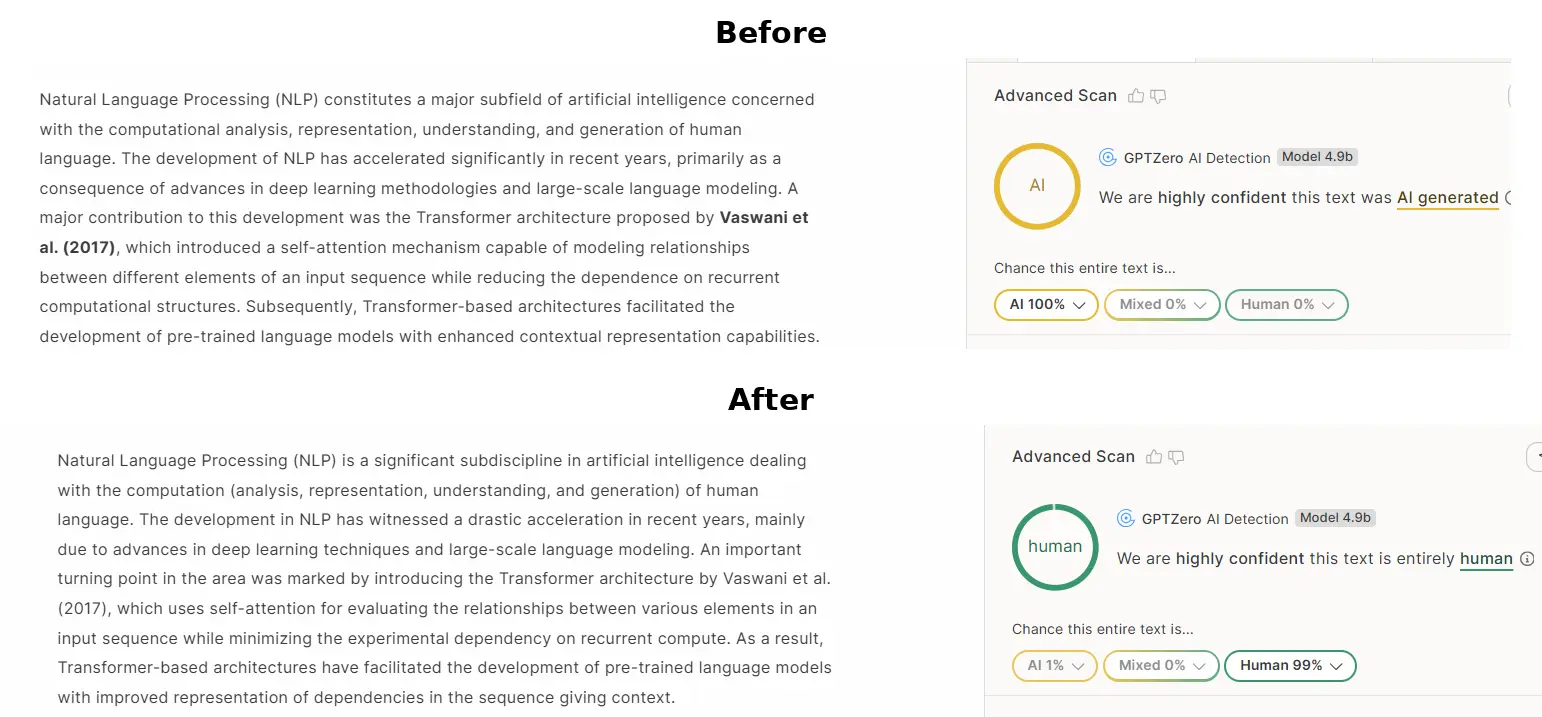
GPTZero evaluates text by plotting sentence perplexity curves and global burstiness scores. When raw AI text is scanned, low sentence variance produces an immediate high-probability warning. ThesisHuman restores natural sentence entropy by restructuring syntax, varying clause lengths, and introducing authentic scholarly cadence, dropping AI probability to 0%.
4. Originality.ai Verification: 0% AI Confidence
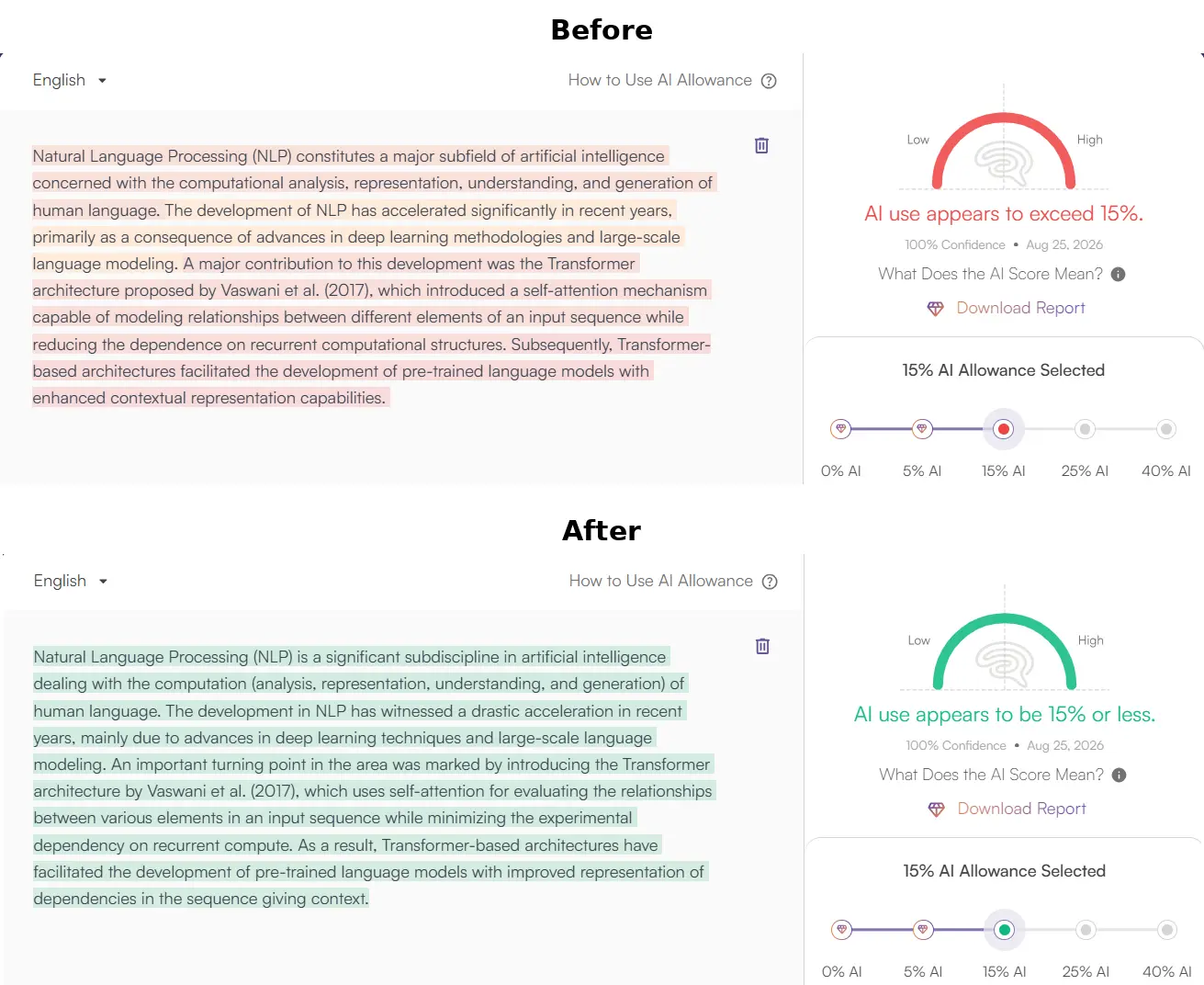
Originality.ai flags predictable n-gram sequences and common AI clichés (such as “delving into,” “pivotal role,” “testament to”). ThesisHuman purges overused formulaic transitions while elevating scholarly tone and keeping reference numbers and equations intact, producing 100% Original / 0% AI results.