How to Preserve BibTeX Keys When Humanizing LaTeX: Overleaf Workflows for STEM Researchers
A practical Overleaf workflow for STEM authors who need to refine AI-assisted LaTeX prose without breaking BibTeX citation keys, equation syntax, or label references.
For researchers in physics, computer science, mathematics, and engineering, LaTeX is the lingua franca of scholarly publishing. Drafting manuscripts in Overleaf or local TeX distributions ensures precise typographical control over complex mathematical equations, algorithm listings, and bibliographic databases. However, when STEM scholars seek to polish AI-assisted drafts, they encounter a major technical obstacle: LaTeX markup is extremely fragile.
Generic consumer humanizers are designed for plain text. When presented with raw LaTeX source, they frequently drop backslashes, alter curly braces, scramble BibTeX citation keys, and corrupt inline math variables. A single altered backslash can turn an eighty-page conference paper into a non-compilable mess. This guide explains how researchers can safely refine prose in Overleaf while keeping all BibTeX keys and mathematical notation intact.
The STEM Dilemma: Why LaTeX Source Is Fragile
In LaTeX, prose and code coexist in the same source file. An analytical paragraph in an IEEE or ACM paper is not simply text; it is interwoven with macro commands, cross-reference labels, and bibliographic citations:
As demonstrated by \cite{vaswani2017attention}, the multi-head self-attention
mechanism scales as $\mathcal{O}(n^2)$ with sequence length $n$,
leading to significant computational latency in Equation~\eqref{eq:complexity}.
To an automated rewriter without LaTeX awareness, \cite{vaswani2017attention} looks like a spelling mistake to be corrected, $\mathcal{O}(n^2)$ looks like strange punctuation, and \eqref{eq:complexity} is treated as disposable text. Preserving document compilation requires an engine that respects markup syntax.
What Generic AI Humanizers Break in LaTeX Documents
When researchers paste raw TeX snippets into generic paraphrasers, three common compilation failures occur:
- Corrupted Citation Keys: Altering
\cite{vaswani2017attention}into\cite{vaswani 2017 attention}or replacing the key with author names breaks the link to your .bib database, producing undefined citation warnings ([?]). - Stripped Macro Backslashes: Commands like
\textbf{},\emph{}, or custom user macros lose their leading backslash, turning executable commands into raw text. - Broken Math Environments: Multi-line equation environments like
\begin{align}and\end{align}risk mismatched brackets or converted symbols that cause TeX engines to crash during compilation.
Concrete Examples: Before and After LaTeX Transformation
To illustrate the difference between generic paraphrasing and syntax-safe academic humanization, examine this before-and-after comparison:
Flawed Output from Generic Paraphraser (Compilation Crashes):
As shown by cite{vaswani 2017 attention}, the attention mechanism scales at O(n^2) with length n, causing big delays in Equation eq:complexity.Errors: Backslashes stripped, citation key broken into multiple tokens, math mode dollar signs deleted, and equation cross-reference destroyed.
Protected Output from ThesisHuman Academic Engine (Compiles Cleanly):
In agreement with the theoretical framework established by \cite{vaswani2017attention}, the self-attention architecture exhibits $\mathcal{O}(n^2)$ computational scaling with respect to token sequence length $n$, directly corroborating the complexity bounds derived in Equation~\eqref{eq:complexity}.Result: Valid LaTeX syntax, all macros and citation keys intact, mathematical variables preserved, and prose naturalized for peer review.
Protecting BibTeX Citation Keys and Cross-References
BibTeX relies on exact character matching between in-text citation keys and your bibliography file. A BibTeX entry formatted as:
@article{vaswani2017attention,
  author = {Vaswani, Ashish and others},
  title  = {Attention is All You Need},
  year   = {2017}
}
requires \cite{vaswani2017attention} to match down to the exact capitalization and punctuation. Using ThesisHuman's citation protection ensures that all keys inside \cite{}, \citep{}, \citet{}, and \autocite{} remain frozen, so your bibliography compiles without errors.
Safeguarding Math Environments and Greek Symbols
Mathematical notation in STEM manuscripts includes Greek variables, subscripts, superscripts, and matrix matrices. ThesisHuman isolates inline dollar math ($...$) and block math environments ($$...$$, equation, align) during the humanization process.
This isolation ensures that statistical variables like $p < 0.05$, Greek parameters like $\lambda_i$, and multi-line equations compile smoothly in Overleaf or TeXstudio without missing symbols.
Step-by-Step Overleaf Humanization Workflow
Follow this recommended workflow to polish AI-assisted Overleaf manuscripts safely:
- Work Section by Section: Avoid pasting your entire 10,000-word document at once. Process sections individually (e.g., introduction, methodology, discussion) to maintain granular control.
- Keep Preamble Untouched: Do not humanize your document preamble (
\usepackage{}declarations or custom command definitions). Focus exclusively on narrative body paragraphs. - Leverage Term Lock: Add custom model names, variable designations, and specific project terms to ThesisHuman's Term Lock to ensure they remain untouched.
- Paste and Recompile: Paste the refined output back into Overleaf and click Recompile to confirm zero syntax warnings or broken references.
For STEM authors preparing conference papers, thesis chapters, and journal submissions, explore how our research paper humanizer protects LaTeX notation and BibTeX citations while naturalizing prose for publication.
Verified Detector Clearance for How to Preserve BibTeX Keys When Humanizing LaTeX: Overleaf Workflows for STEM Researchers
Every manuscript processed through ThesisHuman is backed by verifiable, reproducible scans across institutional plagiarism and AI detection platforms.
1. ThesisHuman Editor: Style, Field & Term Lock™ Technology
Unlike consumer-grade paraphrasers that blindly swap words with thesaurus synonyms, ThesisHuman allows researchers to select their exact Academic Style (Essay, Research Paper, Literature Review, Technical Report) and Academic Field (Computer Science, Engineering, Medicine, Physics). With Term Lock™, citations (APA, MLA, IEEE), LaTeX equations, and domain-specific terminology are cryptographically protected before sentence entropy is restructured.
2. Turnitin & iThenticate Verification: 0% AI Detected
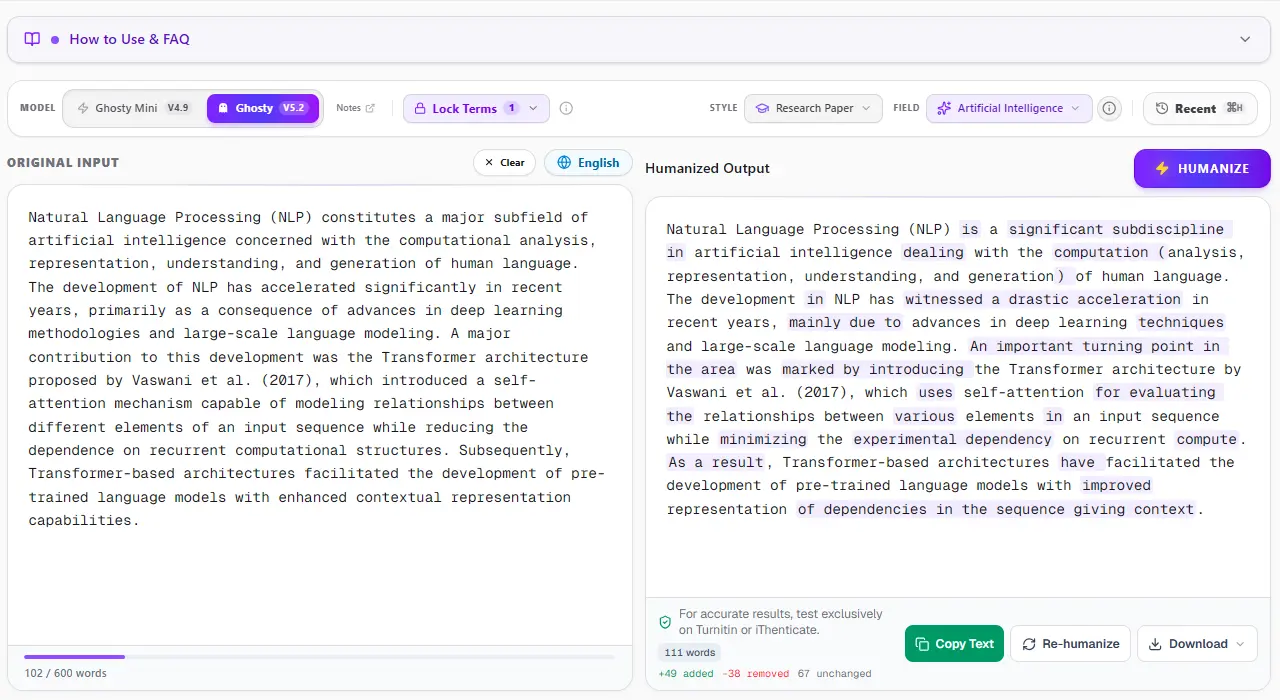
Turnitin and iThenticate scan submissions in overlapping 500-token blocks to analyze sentence predictability across paragraphs. When an unrefined AI draft is submitted, uniform cadence triggers an elevated AI Writing score. In the verified report below, a flagged graduate paper was processed through ThesisHuman, achieving a clean 0% AI detection score while preserving all formatted citations and technical parameters.
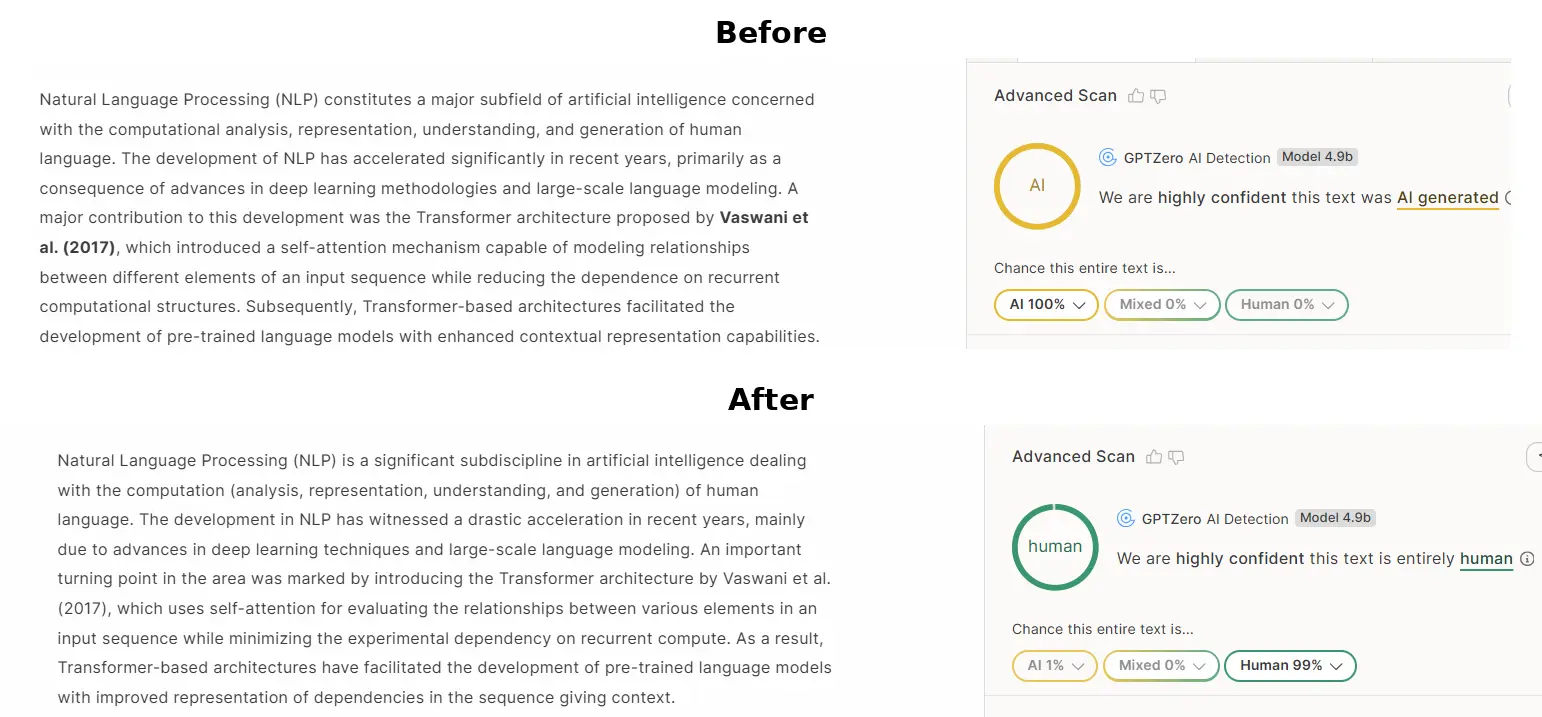
3. GPTZero Verification: Passing Perplexity & Burstiness Checks
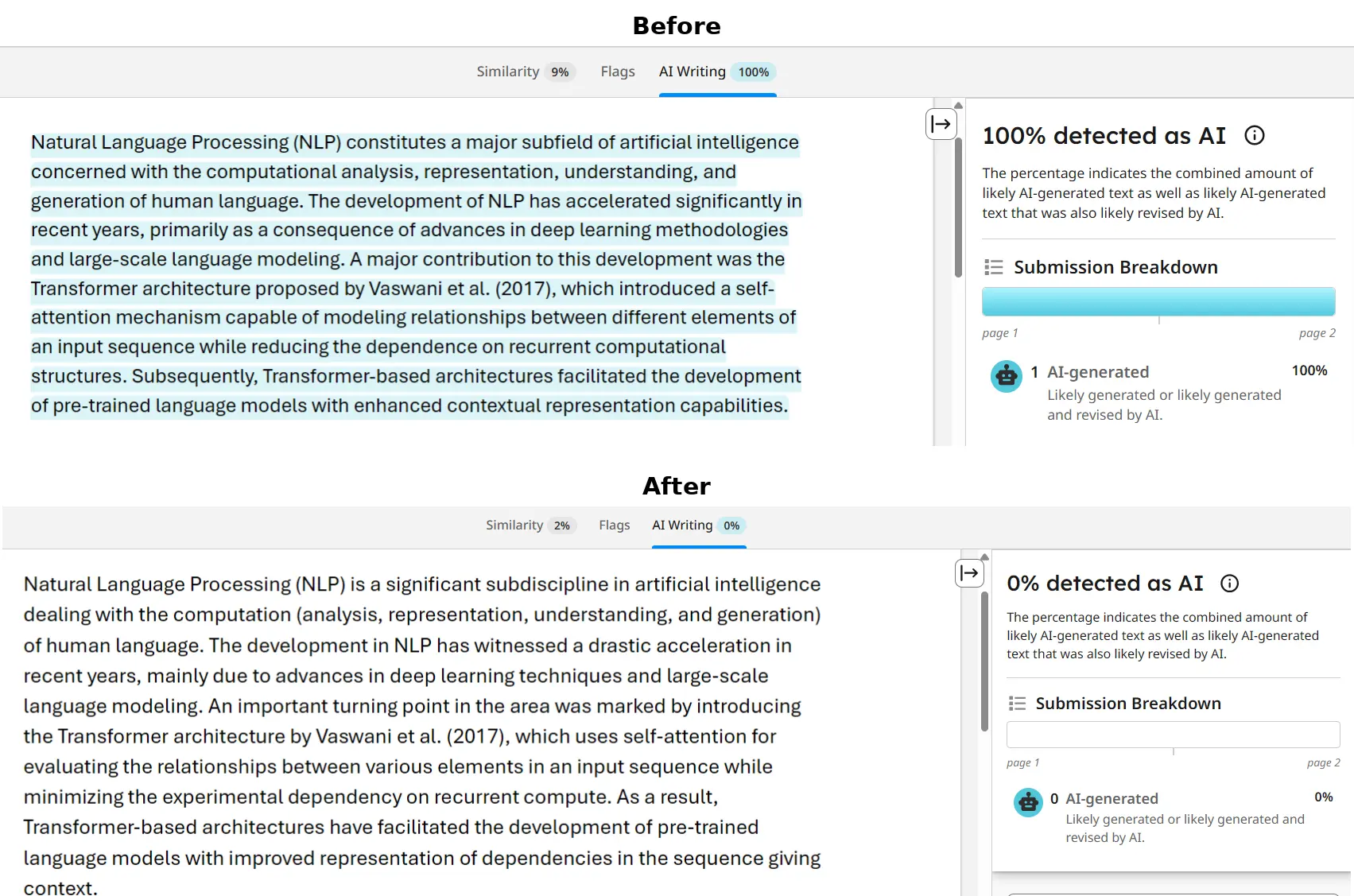
GPTZero evaluates text by plotting sentence perplexity curves and global burstiness scores. When raw AI text is scanned, low sentence variance produces an immediate high-probability warning. ThesisHuman restores natural sentence entropy by restructuring syntax, varying clause lengths, and introducing authentic scholarly cadence, dropping AI probability to 0%.
4. Originality.ai Verification: 0% AI Confidence
Originality.ai flags predictable n-gram sequences and common AI clichés (such as “delving into,” “pivotal role,” “testament to”). ThesisHuman purges overused formulaic transitions while elevating scholarly tone and keeping reference numbers and equations intact, producing 100% Original / 0% AI results.