How to Revise a Research Abstract: Step-by-Step Manuscript Alignment and Concision
Learn how to revise an existing research abstract for strict word limits, factual alignment, and high information density. Includes step-by-step models and checklists.

The abstract is often the single most critical section of your academic manuscript. Journal editors evaluate it to decide whether your paper merits peer review, conference organizers scan it to allocate podium slots, and fellow researchers read it to determine whether to cite your work. Despite this decisive importance, many authors treat the abstract as a rushed afterthought, hastily copying disjointed sentences from the introduction and conclusion minutes before submission.
The resulting first drafts are frequently bloated with introductory background, deficient in methodology parameters, misaligned with the final results tables, and over journal word ceilings. Revising a research abstract requires a structured, multi-pass editing methodology that enforces strict factual fidelity, compresses verbose phrasing, and maximizes information density.
1. Direct Answer: The Four-Stage Abstract Revision Process
To revise an existing research abstract effectively, execute a systematic four-stage revision process:
- Stage 1 (Manuscript Alignment Audit): Verify every factual claim, statistical number, sample size, and conclusion in your abstract directly against your final manuscript tables and text to eliminate phantom findings and numerical discrepancies.
- Stage 2 (Macro-Structural Balancing): Reallocate word counts across the five standard rhetorical moves (Background, Problem, Methods, Results, Implications) according to your target journal's disciplinary expectations.
- Stage 3 (Micro-Concision Line Editing): Purge throat-clearing introductory filler, eliminate bureaucratic nominalizations, combine fragmented dependent clauses, and replace vague qualitative descriptors with concrete functional verbs.
- Stage 4 (Word-Limit Compliance & Polish): Enforce strict compliance with journal word ceilings (typically 150 to 250 words) without sacrificing vital experimental parameters or statistical confidence intervals.
2. Stage 1: Isolating the Core Intellectual Contribution
Before editing individual sentences, identify the single overarching finding or theoretical contribution that justifies the publication of your paper.
Ask yourself three diagnostic questions:
- If a reader remembers only one empirical result or theoretical conclusion from this paper twelve months from now, what must that takeaway be?
- What specific knowledge gap or practical problem does this finding resolve?
- How does this outcome change current disciplinary understanding or clinical practice?
If your draft abstract spreads its emphasis equally across four secondary observations, your revision must recenter the narrative around the primary breakthrough, subordinating or excising minor secondary metrics.
3. Stage 2: Cross-Referencing the Abstract Against the Full Manuscript (Eliminating Phantom Findings)
A frequent reason for desk rejections during journal triage is factual drift between the abstract and the manuscript body. Over multiple revisions of the main text, authors frequently update sample sizes, recalculate p-values, or soften discussion conclusions without updating the abstract.
The Line-by-Line Verification Protocol
- Sample Size Check: Does the abstract report the initial recruited cohort ($n = 500$) or the final analyzed cohort ($n = 432$)? Ensure you report the analyzed sample.
- Statistical Fidelity Check: Do p-values, odds ratios, and confidence intervals in the abstract match the final printed tables exactly?
- Conclusion Concordance Check: Does the abstract claim an outcome was "proven" when your Discussion section conservatively noted an "associative trend"?
Any claim appearing in the abstract that cannot be located in the main text is a "phantom finding" that peer reviewers will penalize immediately.
4. Structured versus Unstructured Abstracts: Disciplinary Architectures
Abstract formats vary significantly across scholarly domains. Understanding your venue's structural conventions prevents immediate formatting rejections.
Structured Abstracts (Clinical, Biomedical, and Health Sciences)
Standardized by journals following CONSORT, PRISMA, or ICMJE guidelines. Typically organized under explicit bolded headers:
- Background / Objectives: The explicit question addressed (20 to 30 words).
- Methods: Design, setting, participants, intervention, and primary outcome measures (50 to 70 words).
- Results: Primary quantitative findings with effect sizes, 95% CIs, and p-values (70 to 100 words).
- Conclusions: Primary inference directly supported by the data (30 to 40 words).
Unstructured Narrative Abstracts (Physical Sciences, Engineering, and Humanities)
Written as a single, unified paragraph of 150 to 250 words that weaves the five core moves together through seamless transitional syntax without explicit section headings.
| Disciplinary Family | Typical Word Limit | Format Style | Primary Rhetorical Focus |
|---|---|---|---|
| Clinical Medicine & Public Health | 250 - 300 words | Structured (IMRaD) | Quantitative outcomes, trial registration, risk metrics |
| Engineering & Computer Science | 150 - 200 words | Unstructured Narrative | Architecture, benchmark comparisons, operational latency |
| Social & Behavioral Sciences | 150 - 250 words | Unstructured or Structured | Sample demographics, theoretical framework, policy relevance |
| Pure Mathematics & Physics | 100 - 150 words | Single Paragraph | Theorem statement, mathematical proof scope, boundary conditions |
| Humanities & Literary Studies | 150 - 250 words | Narrative Argument | Historiographical debate, textual evidence, critical thesis |
5. Stage 3A: Streamlining the Problem Statement and Background (Deleting Introductory Fluff)
First drafts almost always squander word count on broad, textbook background statements. Phrases like "Climate change is one of the most critical global challenges facing humanity today" or "Cancer remains a leading cause of mortality worldwide" add zero evidential value for an expert readership.
The Surgical Pruning Rule
Eliminate generic background completely. Start directly with the specific, unsolved empirical bottleneck that your study addresses:
- Weak First Draft: "In the modern digital age, mobile applications have become ubiquitous across educational institutions. Many researchers have pointed out that smartphones can either distract students or help them study. Understanding how mobile apps affect study habits is very important for educators." (41 words)
- Revised Version: "Although mobile educational applications are widely deployed in secondary classrooms, their longitudinal impact on working memory retention remains unquantified." (19 words)
By replacing three vague sentences with one focused problem statement, you save 22 words that can now be allocated to your actual results.
6. Stage 3B: Tightening Research Objectives and Primary Hypotheses
State the objective in a single concise sentence using an active functional verb (evaluate, quantify, isolate, benchmark, characterize) rather than passive throat-clearing.
- Weak: "The aim and purpose of the current research investigation was to attempt to carry out an evaluation of whether..." (20 words)
- Revised: "This study quantified..." (3 words)
7. Stage 3C: Condensing Methodological Descriptions Without Omitting Vital Parameters
Authors often swing between two extremes when revising methods in abstracts: either dumping exhaustive laboratory protocols or omitting essential study design parameters entirely.
An effective abstract methods summary must preserve five parameters in 40 to 60 words:
- Study design (e.g., randomized double-blind trial, cross-sectional survey, prospective cohort).
- Participant or sample cohort size ($n$).
- Target intervention or independent variable.
- Primary outcome measure or benchmark metric.
- Analytical framework (e.g., multivariable logistic regression, difference-in-differences).
Methods Compression Example
- Bloated Draft (68 words): "To test our hypothesis, we gathered a cohort of participants consisting of 250 undergraduate students from a large Midwestern university. The students were divided randomly into two groups, where one group received training in spaced repetition techniques over six weeks and the other group studied normally. Memory retention was tested every week using standardized reading comprehension tests and computerized recall quizzes."
- Compressed Revision (39 words): "In a randomized trial, 250 undergraduate students completed six weeks of spaced repetition training or self-directed study. Long-term memory retention was evaluated weekly using standardized reading comprehension assessments and computerized recall metrics."
8. Stage 3D: Reporting Empirical Results with Numerical Precision
The Results section is the evidentiary anchor of the abstract. General qualitative claims ("the results showed significant improvement") must be replaced with concrete numerical measurements and statistical thresholds.
Guidelines for Abstract Results
- Report Effect Sizes, Not Just P-Values: State the percentage change, mean difference, or odds ratio alongside the significance marker.
- Provide Directionality: State whether metrics increased, declined, or reached plateau thresholds.
- Report Primary Outcomes First: State your pre-registered primary endpoint before mentioning exploratory subgroup findings.
Results Precision Example
- Vague Draft: "Results indicated that the algorithm achieved superior efficiency and outperformed previous baseline models substantially across all test datasets."
- Revised Precision: "The proposed algorithm reduced computational latency by 34% (p < .001) and improved classification accuracy from 82.4% to 91.1% on standard benchmark datasets."
9. Stage 3E: Calibrating Conclusions and Preventing Speculative Overstatement
The concluding sentence of your abstract must express the direct implications of your findings without projecting unverified extrapolations.
- Overstated: "These findings revolutionize psychiatric medicine and guarantee that depression will be eliminated within the decade."
- Calibrated Revision: "These observations demonstrate that targeting neuroinflammatory pathways offers a plausible therapeutic mechanism for treatment-resistant depressive symptoms."
10. Stage 4: Managing Strict Journal Word Limits (The Word-Budget Allocation Framework)
When facing a strict 200 or 250-word ceiling, allocate your words deliberately across the five moves rather than trimming haphazardly.
Review the standard 200-word budget allocation matrix:
| Abstract Component | Recommended Word Budget | Percentage of Abstract | Primary Focus |
|---|---|---|---|
| Background / Problem | 25 - 35 words | 15% | Specific unsolved knowledge gap |
| Research Objective | 15 - 20 words | 10% | Clear research question or core hypothesis |
| Methodology | 40 - 50 words | 25% | Design, sample size, primary metric |
| Results & Findings | 70 - 85 words | 40% | Quantitative measurements, effect sizes, p-values |
| Conclusions / Implications | 25 - 35 words | 10% | Direct theoretical or practical consequence |
| Total Target | 175 - 225 words | 100% | Leaves safety margin below journal ceiling |
11. Eliminating Redundancy and Nominalizations for Maximum Density
Converting abstract nouns back into functional verbs is the single fastest way to compress abstract word counts while improving reading energy.
| Verbose Nominalization | Words | Direct Functional Verb | Words Saved |
|---|---|---|---|
| "conducted an investigation into" | 4 | "investigated" | 3 |
| "achieved a reduction of" | 4 | "reduced" | 3 |
| "made an assumption that" | 4 | "assumed" | 3 |
| "was in agreement with" | 4 | "agreed with" | 3 |
| "provide an explanation for" | 4 | "explain" | 3 |
| "in close proximity to" | 4 | "near" | 3 |
| "due to the fact that" | 5 | "because" | 4 |
| "it is interesting to note that" | 6 | [Delete entirely] | 6 |
12. Verb Tense Consistency and Academic Stylistic Register Across Abstract Moves
Inconsistent verb tenses disorient the reader. Follow standard tense sequencing across your abstract's rhetorical moves:
- Background: Present simple tense ("Cardiac fibrosis affects millions of patients worldwide.")
- Objective: Past simple tense ("This study evaluated...") or present simple ("This paper investigates...")
- Methods: Past simple tense ("We randomized 120 participants..." or "One hundred twenty participants were randomized...")
- Results: Past simple tense ("The intervention decreased systolic pressure by 12 mmHg...")
- Conclusions: Present simple tense ("These findings indicate that targeted dietary protocols improve vascular compliance.")
13. Preserving Statistical Integrity and Mathematical Notations During Line Editing
When trimming an abstract to fit word constraints, never sacrifice critical statistical notation:
- Keep the degree of freedom notation in ANOVA reports: F(2, 85) = 14.2, p < .001.
- Keep 95% confidence intervals intact: OR = 1.62, 95% CI [1.14, 2.31].
- Keep chemical and mathematical symbols intact: CO2, H2SO4, chi^2, R^2.
14. Eight Catastrophic Abstract Revision Mistakes (and Their Remedies)
Review these eight common pitfalls in draft abstracts:
- The Phantom Claim: Stating a conclusion or statistic that does not appear in the manuscript text.
- The Missing Result: Spending 180 words describing background and methods, leaving only one vague sentence for findings.
- The Acronym Trap: Introducing ten undefined disciplinary acronyms that turn the text into unintelligible alphabet soup.
- The Direct Quotation: Inserting a block quotation into an abstract (abstracts should almost never contain direct quotes).
- The Citation Dump: Including multiple in-text bibliographic citations in the abstract (unless explicitly mandated by journal policy for replication studies).
- The Uncalibrated Miracle: Claiming your study "proves conclusively" or "revolutionizes" an entire scientific field.
- The Word-Count Disregard: Submitting a 310-word abstract to a journal with a strict 250-word statutory ceiling.
- The Passive Labyrinth: Drafting the entire abstract in dense, multi-layered passive voice with separated subjects and verbs.
15. Ten-Point Post-Draft Abstract Revision Checklist
Run your final abstract revision through this ten-point diagnostic check before submitting:
- Is the abstract word count strictly below the target journal's ceiling (including title and headers if counted)?
- Does the background section occupy no more than two concise sentences focusing on the specific knowledge gap?
- Is the primary research objective stated clearly with a strong functional verb?
- Does the methods summary include study design, sample size ($n$), and primary outcome measures?
- Are empirical findings reported with concrete numerical values, effect sizes, and p-values?
- Have all numbers and percentages been verified against the final manuscript tables?
- Are conclusions directly supported by the data without speculative overstatement?
- Have all unnecessary nominalizations and filler phrases (it should be noted that) been purged?
- Does each section use the correct verb tense (past for methods and results, present for conclusions)?
- Can an expert outside your sub-specialty understand the study's central contribution within 60 seconds?
16. Frequently Asked Questions About Revising Research Abstracts
Can an abstract exceed the journal word limit by five or ten words?
No. Automated editorial submission systems (such as ScholarOne, Editorial Manager, or Evise) enforce rigid programmatic word-count limits. If your abstract exceeds the ceiling by even three words, the portal will either block manuscript upload or automatically truncate your final sentence, leading to immediate technical rejection.
Should I include in-text citations in my abstract?
Under standard publication conventions across nearly all academic disciplines, abstracts should not contain in-text citations, bibliographic references, or footnote numbers. Because abstracts are indexed independently in databases like PubMed, Scopus, and Web of Science, citations cannot link to a bibliography. The rare exception is when your entire manuscript is a direct replication or critique of a specific seminal publication.
How does a structured abstract differ from an unstructured abstract?
A structured abstract separates content into explicit labeled subheadings (typically Background, Methods, Results, and Conclusions), which is mandatory in clinical medicine and public health journals. An unstructured abstract presents the identical information as a single, unified narrative paragraph without headings, which is standard in physics, engineering, social sciences, and the humanities.
What is the ideal balance between background and findings in a 200-word abstract?
Aim for 15% background (approximately 30 words) and 40% findings (approximately 80 words). The most frequent flaw in rejected abstracts is devoting 120 words to introductory context and only 40 words to original empirical results. Peer reviewers and editors read your abstract to discover what you found, not to re-read textbook summaries of the field.
When in the manuscript writing process should I revise the abstract?
You should draft a preliminary working abstract early to guide your writing, but your final comprehensive revision must occur after the entire manuscript is complete. Revising the abstract last ensures that all numbers, sample sizes, confidence intervals, and conclusions match the final finalized tables and Discussion text.
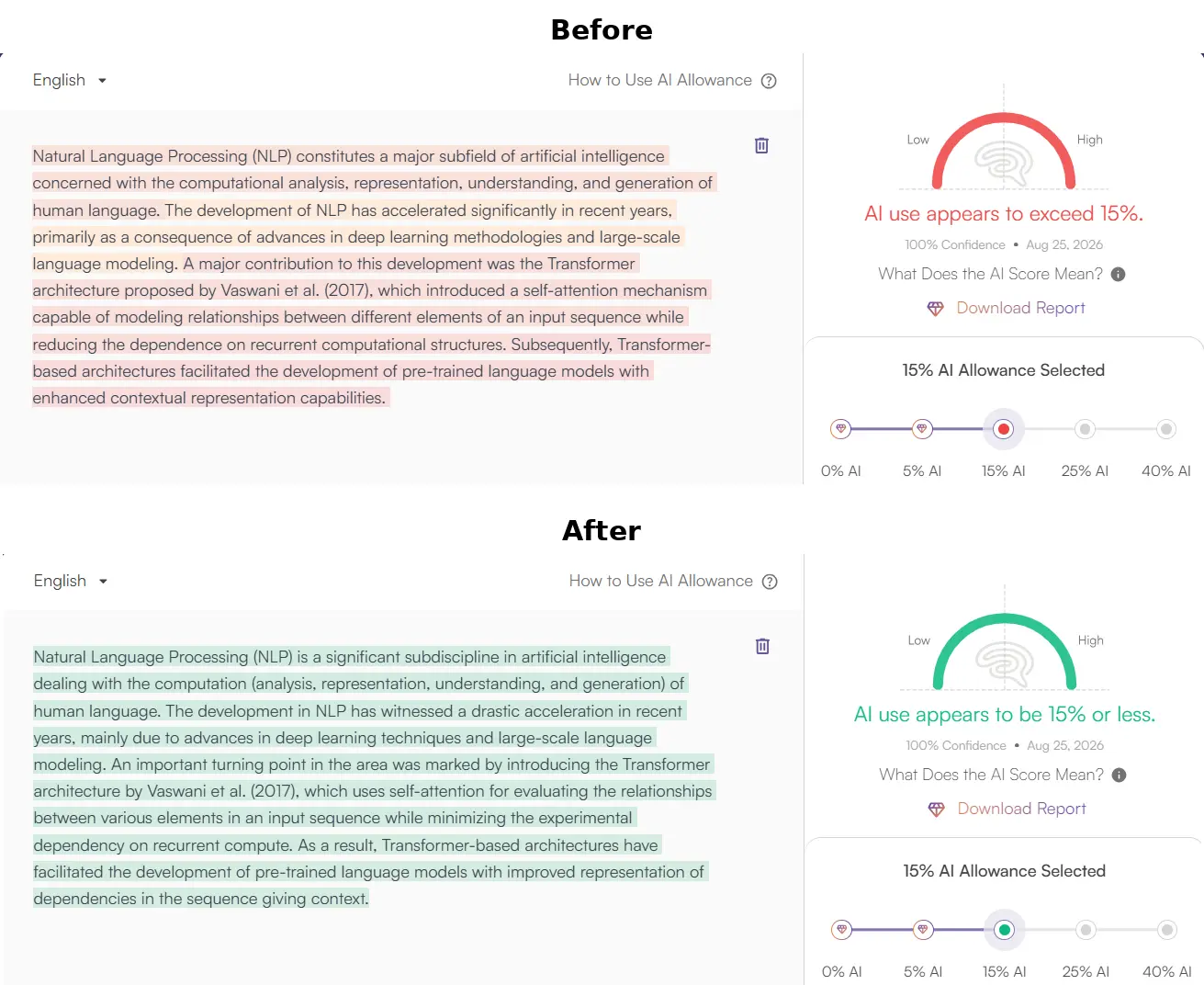
Verified Detector Clearance for How to Revise a Research Abstract: Step-by-Step Manuscript Alignment and Concision
Every manuscript processed through ThesisHuman is backed by verifiable, reproducible scans across institutional plagiarism and AI detection platforms.
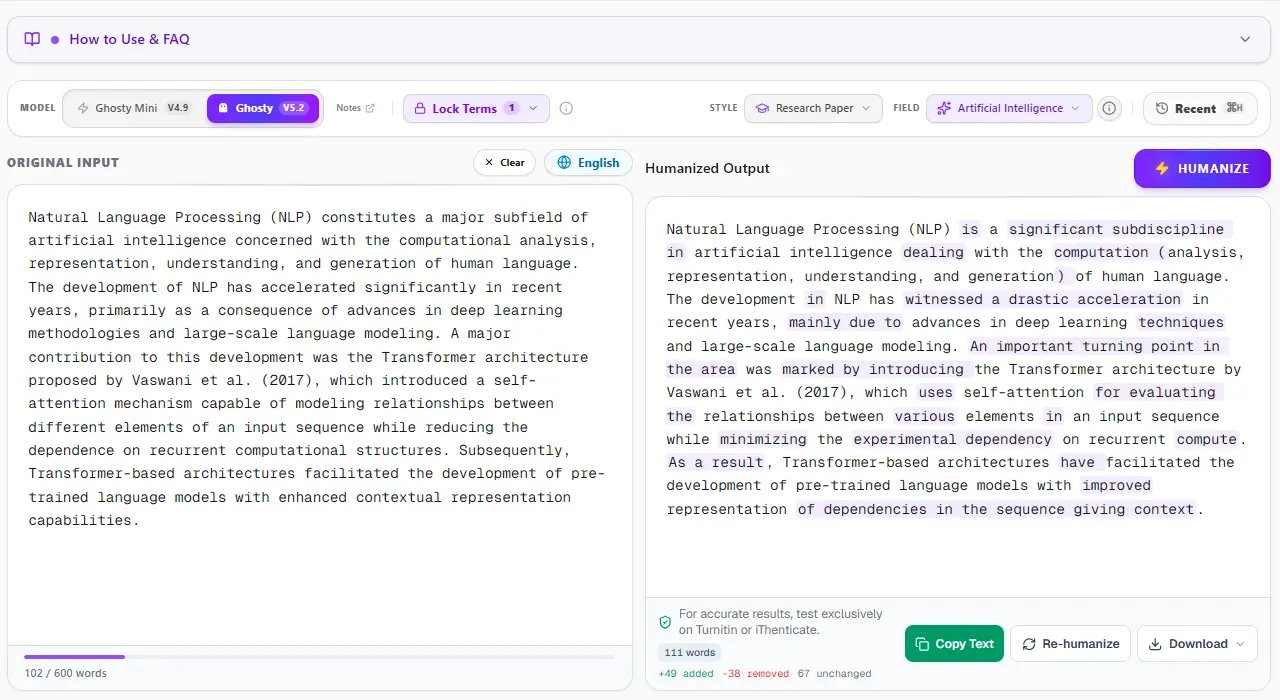
1. ThesisHuman Editor: Style, Field & Term Lock™ Technology
Unlike consumer-grade paraphrasers that blindly swap words with thesaurus synonyms, ThesisHuman allows researchers to select their exact Academic Style (Essay, Research Paper, Literature Review, Technical Report) and Academic Field (Computer Science, Engineering, Medicine, Physics). With Term Lock™, citations (APA, MLA, IEEE), LaTeX equations, and domain-specific terminology are cryptographically protected before sentence entropy is restructured.
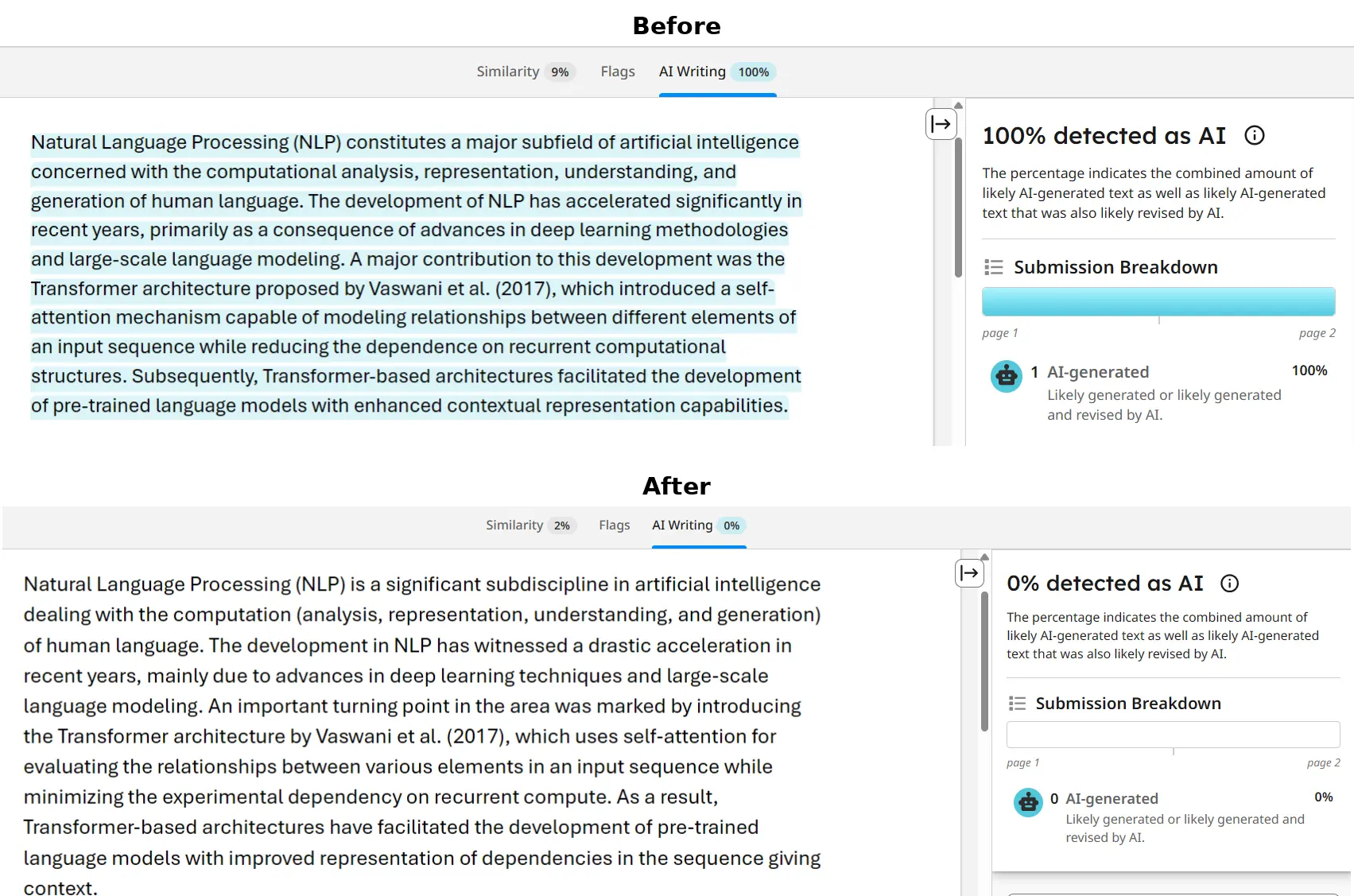
2. Turnitin & iThenticate Verification: 0% AI Detected
Turnitin and iThenticate scan submissions in overlapping 500-token blocks to analyze sentence predictability across paragraphs. When an unrefined AI draft is submitted, uniform cadence triggers an elevated AI Writing score. In the verified report below, a flagged graduate paper was processed through ThesisHuman, achieving a clean 0% AI detection score while preserving all formatted citations and technical parameters.
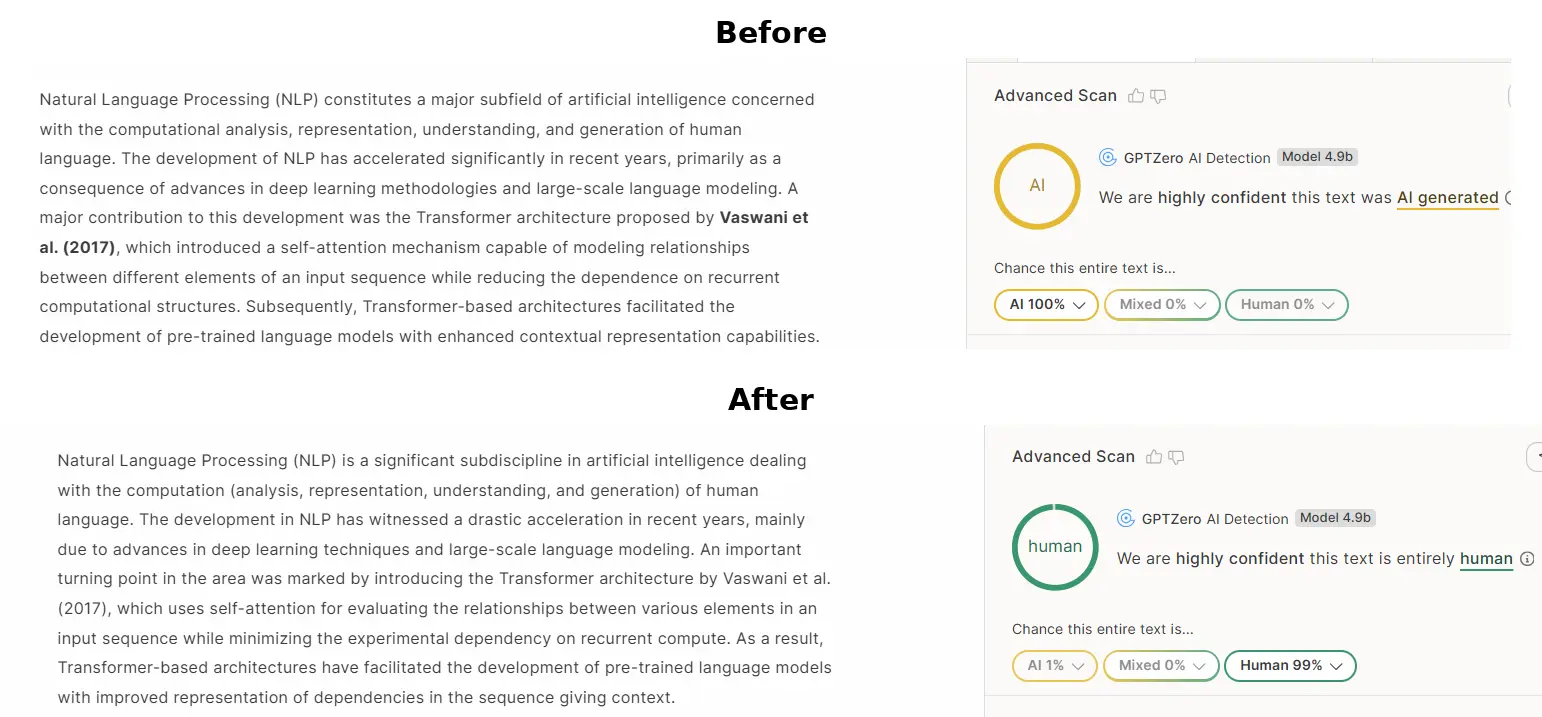
3. GPTZero Verification: Passing Perplexity & Burstiness Checks
GPTZero evaluates text by plotting sentence perplexity curves and global burstiness scores. When raw AI text is scanned, low sentence variance produces an immediate high-probability warning. ThesisHuman restores natural sentence entropy by restructuring syntax, varying clause lengths, and introducing authentic scholarly cadence, dropping AI probability to 0%.
4. Originality.ai Verification: 0% AI Confidence
Originality.ai flags predictable n-gram sequences and common AI clichés (such as “delving into,” “pivotal role,” “testament to”). ThesisHuman purges overused formulaic transitions while elevating scholarly tone and keeping reference numbers and equations intact, producing 100% Original / 0% AI results.