How to Simplify Complex Sentences in Academic Writing: Step-by-Step Method
Learn how to simplify complex academic sentences without losing nuance or precision. Includes step-by-step revision methods, 10 before-and-after models, and checklists.

Dense, convoluted prose is one of the most persistent obstacles to effective scholarly communication. Many researchers believe that profound ideas require labyrinthine sentence architecture, with three embedded relative clauses, five prepositional phrases, and heavy abstract nominalizations. The result is prose that exhausts the evaluator and obscures original intellectual contributions. In reality, intellectual rigor is demonstrated not through syntactic obscurity, but through architectural clarity.
Simplifying complex sentences does not mean dumbing down your research or converting your manuscript into an elementary sequence of short declarative statements. Rather, sentence simplification is the disciplined craft of removing unnecessary cognitive drag while preserving theoretical nuance, technical accuracy, and quantitative precision.
1. Direct Answer: The Principle of Sentence Simplification in Academic Writing
To simplify a complex academic sentence, isolate the core agent and primary action, eliminate bureaucratic nominalizations, reduce the spatial distance between the grammatical subject and main verb, and unbundle competing propositions into coordinated or distinct sentences.
Effective sentence simplification follows three foundational rules:
- One Primary Proposition Per Sentence: If a single sentence attempts to introduce a historical background condition, describe an experimental intervention, report a numerical result, and interpret theoretical implications, it must be untangled into two or three focused clausal units.
- Subject-Verb Proximity: The human working memory processes information most efficiently when the grammatical subject and its controlling verb appear in close proximity. Interrupting a subject and verb with forty words of parenthetical qualification forces the reader to hold an incomplete grammatical thought in cognitive suspension.
- Preservation of Disciplinary Integrity: Never sacrifice specialized terminology, mathematical formulas, chemical nomenclature, statistical confidence intervals, or conditional boundaries in the name of casual brevity. True academic simplification refines the syntax surrounding technical terms, not the technical terms themselves.
2. Why Academic Sentences Become Incomprehensible: The Seven Structural Culprits
Sentences rarely break down because of simple grammatical errors like subject-verb disagreement. In graduate and post-doctoral manuscripts, incomprehensibility is almost always driven by systemic syntactic over-engineering.
Review the seven structural culprits responsible for academic sentence bloat:
- Clause Nesting (Russian Doll Syntax): Subordinate clauses embedded within subordinate clauses, producing multiple layers of dependency before reaching a main verb.
- Excessive Nominalization (Smothered Verbs): Converting active verbs into abstract Latinate nouns ending in -tion, -ment, -ance, or -ity (e.g., changing "we analyzed" into "we conducted an analysis of").
- Subject-Verb Estrangement: Placing extended modifying phrases, appositives, or non-restrictive relative clauses between the main subject and its predicate.
- Noun Stringing (Nominal Compounding): Piling four or five nouns together as adjectival modifiers without prepositional disambiguation (e.g., "infant respiratory distress syndrome management protocol guidelines").
- Throat-Clearing Openings: Wasting initial sentence real estate on empty meta-commentary (e.g., "It is interesting and worthwhile to take into consideration the noteworthy fact that...").
- False Coordination: Joining two logically unrelated thoughts with coordinating conjunctions like and or furthermore, obscuring the causal or hierarchical relationship between them.
- Pronoun Ambiguity: Deploying pronouns like it, this, that, or which without an unambiguous textual antecedent, leaving the reader guessing what phenomenon is acting.
3. Complex Sentences vs. Complicated Sentences: Grammatical Form vs. Cognitive Drag
In English grammar, a complex sentence has a precise structural definition: an independent clause joined to at least one dependent (subordinate) clause. Complex sentences are not inherently flawed; in fact, they are indispensable for academic writing because subordinating conjunctions (although, because, while, since, whereas) establish hierarchical relationships between evidence and argument.
A complicated sentence, by contrast, is a stylistic defect characterized by excessive length, misplaced modifiers, and redundant verbiage.
The Contrast in Action
- Grammatically Complex, Stylistically Elegant: "Although initial clinical trials verified high enzymatic affinity, the drug was discontinued because metabolic clearance rates exceeded acceptable pharmacokinetic safety thresholds."
(Analysis: Two dependent clauses, one independent clause. Total clarity. Causal and concessive relationships are unmistakable.) - Unnecessarily Complicated: "Notwithstanding the verifiable circumstance that previous investigative endeavors in clinical environments had effectively established substantial enzymatic affinity regarding the compound in question, the decision was ultimately arrived at to discontinue further testing by reason of the reality that metabolic clearance rates were observed to be operating at levels exceeding safety parameters."
(Analysis: Expresses the exact same empirical fact, but suffocates the reader under 58 words of passive nominalizations and empty prepositional padding.)
When revising, your objective is not to eradicate complex sentences, but to eradicate complicated sentences.
4. Step 1: Identifying the Core Proposition (Subject, Verb, Object)
The first step in untangling an overgrown sentence is syntactic triage: identify the primary grammatical spine. Ask two diagnostic questions:
- Who or what is performing the real-world action? (The true agent)
- What action are they actually performing? (The true verb)
Diagnostic Walkthrough 1
Consider this bloated draft sentence from an administrative policy report:
"The implementation of systematic cost-reduction strategies across departmental subdivisions by executive leadership resulted in the realization of substantial budgetary efficiencies."
Let's locate the spine:
- What is the grammatical subject in the draft? "The implementation" (an abstract nominalization).
- What is the main verb? "resulted in" (a weak link).
- Who is the real-world agent? "Executive leadership."
- What action did they actually take? "Reduced costs."
- What was the real outcome? "Saved money / improved efficiency."
Rewritten Sentence
"By systematically reducing departmental costs, executive leadership improved overall budget efficiency." (Length reduced from 22 words to 11 words. Sentence momentum restored instantly.)
5. Step 2: Uncoupling Unnecessary Clauses and Creating Clean Compound-Complex Structures
When a single sentence contains multiple distinct analytical points, do not force them into a single continuous syntactic unit. Split the sentence at its natural logical joints.
Diagnostic Walkthrough 2
"The proposed neural network architecture incorporates convolutional layers for feature extraction and recurrent LSTM units for temporal sequence modeling, but while this hybrid pipeline achieves state-of-the-art accuracy across benchmark audio datasets, its training latency remains prohibitive on commodity hardware configurations, which restricts its viability for real-time edge processing."
Why This Fails
This 55-word sentence forces four separate technical concepts into a single run-on thought: architecture description, benchmark accuracy, training latency, and deployment restrictions.
Rewritten Structure (Two Coordinated Sentences)
"The proposed neural network combines convolutional layers for feature extraction with LSTM units for temporal modeling. While this hybrid architecture achieves state-of-the-art benchmark accuracy, its high training latency restricts real-time deployment on edge devices."
Notice how the revision creates two balanced, readable sentences. Sentence 1 describes the architecture; Sentence 2 balances the performance achievement against the hardware trade-off.
6. Step 3: Reducing Subordinate Clutter and Nominalizations
Nominalization turns dynamic actions into static Latinate nouns. When you nominalize verbs, you are forced to add weak helper verbs (make, conduct, perform, achieve, provide) and prepositional glue (of, in, to, for) to hold the sentence together.
Nominalization Translation Table
| Nominalized Phrase (Wordy & Weak) | Restored Verb Form (Clear & Direct) |
|---|---|
| conducted an investigation into | investigated |
| arrived at the conclusion that | concluded that |
| provided a demonstration of | demonstrated |
| effectuated an improvement in | improved |
| is dependent upon the presence of | depends on |
| made an assumption regarding | assumed |
| undertook an evaluation of | evaluated |
| was in agreement with | agreed with / matched |
By actively converting abstract nouns back into functional verbs, you cut 20 to 30 percent of your sentence length without losing a single grain of academic meaning. For automated syntactic restructuring, tools like our ai text simplifier help detect buried verbs across dense paragraphs.
7. Step 4: Minimizing Subject-to-Verb Distance for Immediate Comprehension
Readers comprehend English sentences by locating the subject, finding the verb, and connecting the action to its object. When an author inserts lengthy modifying clauses between the subject and the verb, the sentence suffers from subject-verb estrangement.
The Strangled Subject
"The authors, having analyzed the historical archives of the municipal council and cross-referenced trade records across four coastal provinces over three decades, concluded that mercantile guilds controlled port tariffs."
(Distance between subject "The authors" and verb "concluded": 25 intervening words! The reader must wait an entire paragraph block just to learn what the authors did.)
Repaired (Moving the Interruption to an Introductory Clause)
"After analyzing municipal council archives and cross-referencing regional trade records over three decades, the authors concluded that mercantile guilds controlled port tariffs."
(The subject "the authors" and verb "concluded" are now immediately adjacent, allowing instant cognitive processing.)
8. Step 5: Eliminating Redundant Academic Wordiness (Concision Without Content Loss)
Academic prose frequently accumulates deadwood phrases that serve no communicative purpose. These phrases mimic scholarly seriousness, but in reality they dilute emphasis.
Redundant Phrase Elimination Guide
- due to the fact that -> because
- in the event that -> if
- in close proximity to -> near
- for the purpose of -> to
- at this point in time -> currently / now
- in a significant number of cases -> often / frequently
- with the exception of -> except for
- a substantial majority of -> most
- it is crucial to recognize that -> delete entirely
- in terms of -> rephrase with direct preposition
9. Step 6: Replacing Vague Modifiers with Concrete Functional Verbs
Inexperienced writers lean heavily on generic adjectives and adverbs to artificially boost sentence significance (very important, highly impactful, extremely interesting). Academic authority is communicated through specific functional verbs, not promotional intensifiers.
Before-and-After Transformations
- Weak: "This factor played a very important role in changing the outcome."
- Strong: "This variable mediated the shift in terminal outcomes."
- Weak: "The experiment was extremely helpful in showing the reaction."
- Strong: "The experiment isolated the kinetic reaction pathway."
10. When Passive Voice Is Legitimate in Scientific and Academic Writing
While popular style manuals prescribe an absolute ban on passive voice, academic and scientific writing operates under different pragmatic rules. In scientific research, the passive voice is frequently preferred because the object of the investigation is more important than the personal identity of the researcher.
Legitimate Passive vs. Unnecessary Passive
Legitimate Passive (Methods and Procedures)
"The solution was heated to 80 degrees Celsius and stirred continuously for twenty minutes."
(Justification: It does not matter which graduate student turned the heating dial; the experimental condition is the sole relevant scientific variable. Writing "I heated the solution" introduces irrelevant personal agency.)
Legitimate Passive (Theme-Rheme Information Flow)
"Ancient Roman aqueducts transported water across massive geographic distances. These engineering monuments were constructed using Pozzolana volcanic concrete."
(Justification: The passive "were constructed" allows "these engineering monuments" to remain the grammatical subject at the beginning of Sentence 2, maintaining smooth clausal cohesion with Sentence 1.)
Illegitimate Passive (Evasion of Responsibility)
"Mistakes were made in data collection, and several outliers were deleted from the final spreadsheet."
(Flaw: Hides researcher agency and obscures methodological irregularities.)
11. Unpacking Dense Noun Strings in Technical and Scientific Drafts
Technical disciplines frequently string four, five, or six nouns together to create impromptu compound terms. While this practice saves space on a lab whiteboard, it produces immense ambiguity in formal prose because the reader cannot tell which noun modifies which.
Untangling Noun Strings
- Dense Noun String: "Automated surface water quality monitoring network data analysis algorithms." (8 nouns in a row!)
- Unpacked Revision: "Algorithms designed to analyze data from automated networks that monitor surface water quality."
Notice that while the revised version contains four additional words, it can be understood on first reading without cognitive stumbling.
12. Preserving Essential Logical Connectors (Causation, Contrast, Condition, Concession)
A major danger during sentence simplification is stripping away vital logical markers. If you shorten a sentence by simply deleting words, you risk turning a nuanced conditional argument into a false categorical assertion.
The Over-Simplification Trap
Original Qualified Sentence
"Although early solar cell prototypes demonstrated high laboratory efficiency, commercial scaling remains unviable unless manufacturing plants can eliminate toxic lead halide precursors."
Destructively Oversimplified Sentence (Meaning Lost)
"Early solar cells had high efficiency. Commercial manufacturing is unviable. Factories use toxic chemicals."
(Catastrophe: The causal and conditional connection between laboratory efficiency, commercial scaling, and chemical precursors has been completely severed. The revised version reads like disconnected bullet points.)
Properly Simplified Sentence (Logic Preserved)
"While early solar prototypes achieved high laboratory efficiency, commercial scaling remains unviable until manufacturers replace toxic lead halide precursors."
Always ensure that your simplified syntax explicitly preserves:
- Condition: if, provided that, unless
- Concession: although, while, despite
- Causality: because, since, consequently
- Contrast: whereas, however, in contrast
13. Simplifying Syntax While Protecting Equations, Units, and Disciplinary Terminology
When simplifying scientific or mathematical prose, your target is exclusively the syntactic scaffolding surrounding technical variables, not the variables themselves.
Scientific Preservation Model
Convoluted Technical Sentence
"Upon the administration of the lyophilized recombinant human growth hormone preparation at a dosage concentration of exactly 0.05 mg/kg per day over a sequential chronological timeframe consisting of 180 consecutive calendar days, there was observed to be an elevation in serum insulin-like growth factor 1 (IGF-1) standard deviation scores from an initial pre-treatment baseline measurement of -2.84 +/- 0.41 to a post-treatment terminal outcome of +0.32 +/- 0.28 (p < 0.001)."
Simplified Version (Preserving All Quantitative Integrity)
"Daily administration of recombinant human growth hormone (0.05 mg/kg/day) over 180 days increased serum IGF-1 standard deviation scores from -2.84 +/- 0.41 to +0.32 +/- 0.28 (p < 0.001)."
Analysis of Changes
- Dropped bureaucratic verbiage (lyophilized preparation, sequential chronological timeframe consisting of consecutive calendar days, there was observed to be an elevation).
- Preserved every dosage parameter, unit, plus-or-minus value, and p-value with 100 percent fidelity.
- Word count reduced from 64 words to 26 words (a 59 percent reduction in reading time).
If you are revising technical research papers with LaTeX formatting or in-text citations, our academic paper rewriter ensures that formulas, citation keys, and variables remain completely frozen while the prose syntax is refined.
14. Seven Catastrophic Errors in Sentence Simplification (and How to Avoid Them)
When undertaking sentence revision, beware of these seven fatal traps:
- The Choppy Monotony Trap: Splitting every sentence into five-word subject-verb-object units, destroying rhythmic variety and academic burstiness.
- The Ambiguous Pronoun Introduction: Shortening a sentence by replacing a concrete noun with it or this, forcing the reader to guess the antecedent.
- The Unintentional Causality Shift: Replacing a correlational connector like associated with with a causal verb like caused merely to save syllables.
- The Technical Jargon Purge: Deleting essential domain terms (e.g., replacing asymptotic convergence with getting closer) and forfeiting scientific precision.
- The Comma Splice Creation: Attempting to shorten a sentence by replacing semicolons or coordinating conjunctions with commas.
- The Dangling Modifier Accident: Moving a modifying clause to the front of a sentence without ensuring it logically modifies the immediate subject.
- The Loss of Authorial Stance: Eliminating calibrated hedging markers (suggests, may, indicates) and turning cautious hypotheses into unsupportable dogmatic claims.
15. The Sentence Simplification Diagnostic Checklist
Run your revised sentences through this ten-point structural audit:
- Can you identify the true real-world agent and main functional verb within the first eight words of the sentence?
- Is the grammatical subject separated from its verb by no more than five intervening words?
- Have you eliminated bureaucratic nominalizations (conducted an analysis of -> analyzed)?
- Have you pruned throat-clearing filler (it is important to note that, due to the fact that)?
- Does the sentence contain no more than two dependent clauses?
- If the sentence exceeds 35 words, can it be cleanly unbundled into two logically distinct sentences?
- Are all technical parameters, numerical units, and mathematical symbols completely intact?
- Does the sentence preserve explicit logical connectors showing cause, contrast, or concession?
- If passive voice is used, is it justified by focus on the object of inquiry rather than evasion of responsibility?
- Does the simplified sentence read aloud naturally with varied cadence rather than robotic monotony?
16. Frequently Asked Questions About Simplifying Complex Sentences
What is the maximum recommended word count for an academic sentence?
While there is no rigid statutory maximum, cognitive reading studies demonstrate that comprehension drops sharply when an English sentence exceeds 35 to 40 words. As a rule of thumb, aim for an average sentence length of 20 to 25 words across your manuscript, mixing 12-word declarative statements with 30-word compound-complex explanations to maintain rhythmic burstiness.
Does simplifying sentences lower the academic rigor of my research paper?
No. Academic rigor is measured by the originality of your research questions, the validity of your methodology, the depth of your analysis, and the accuracy of your evidence. Unnecessary syntactic complexity obscures rigor. Peer reviewers frequently reject manuscripts because dense, convoluted prose prevents them from evaluating the underlying contribution.
How do I simplify a sentence without losing in-text citations?
Keep the citation markers (such as APA parentheticals or IEEE numeric brackets) anchored directly to the specific claim they support. When unbundling a 60-word compound sentence into two sentences, ensure that each resulting sentence retains its appropriate attribution so you do not introduce ambiguity regarding which finding originates from which source.
Should I avoid the word "that" to make my sentences shorter?
Only when "that" functions as an optional relative pronoun where omission does not produce reading ambiguity (e.g., "the data [that] we collected"). However, when "that" introduces an essential noun clause following reporting verbs (e.g., "the authors concluded that the hypothesis was valid"), retaining "that" prevents the reader from temporarily misinterpreting the clause subject as the direct object of the verb.
How does sentence simplification relate to active vs. passive voice?
Converting unnecessary passive constructions into active voice is one of the fastest methods for simplifying sentences because active voice naturally places the agent before the action and eliminates auxiliary helper verbs (was evaluated by -> evaluated). However, preserve passive voice in scientific methods sections where the experimental procedure, rather than the researcher, is the primary focal point.
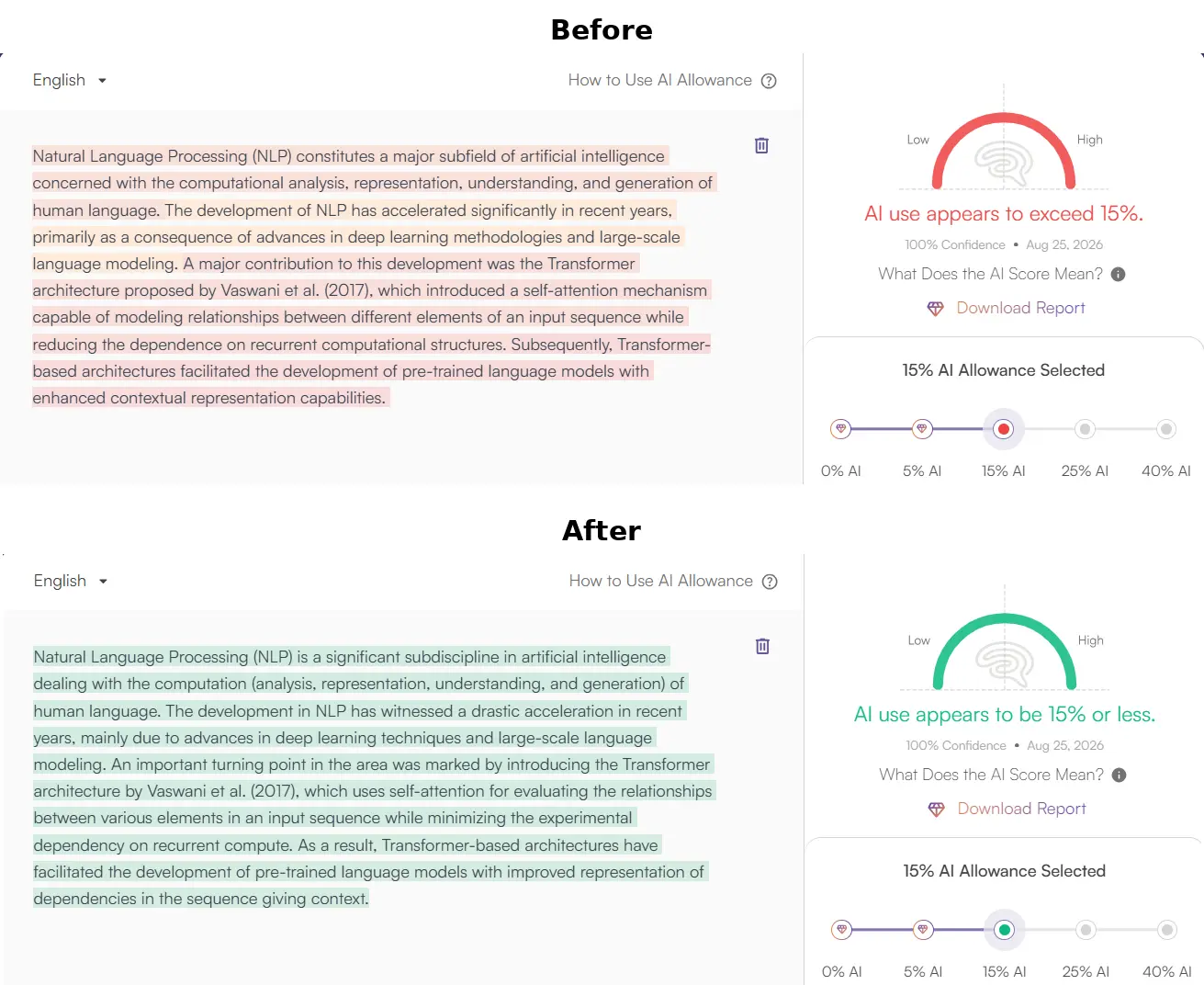
Verified Detector Clearance for How to Simplify Complex Sentences in Academic Writing: Step-by-Step Method
Every manuscript processed through ThesisHuman is backed by verifiable, reproducible scans across institutional plagiarism and AI detection platforms.
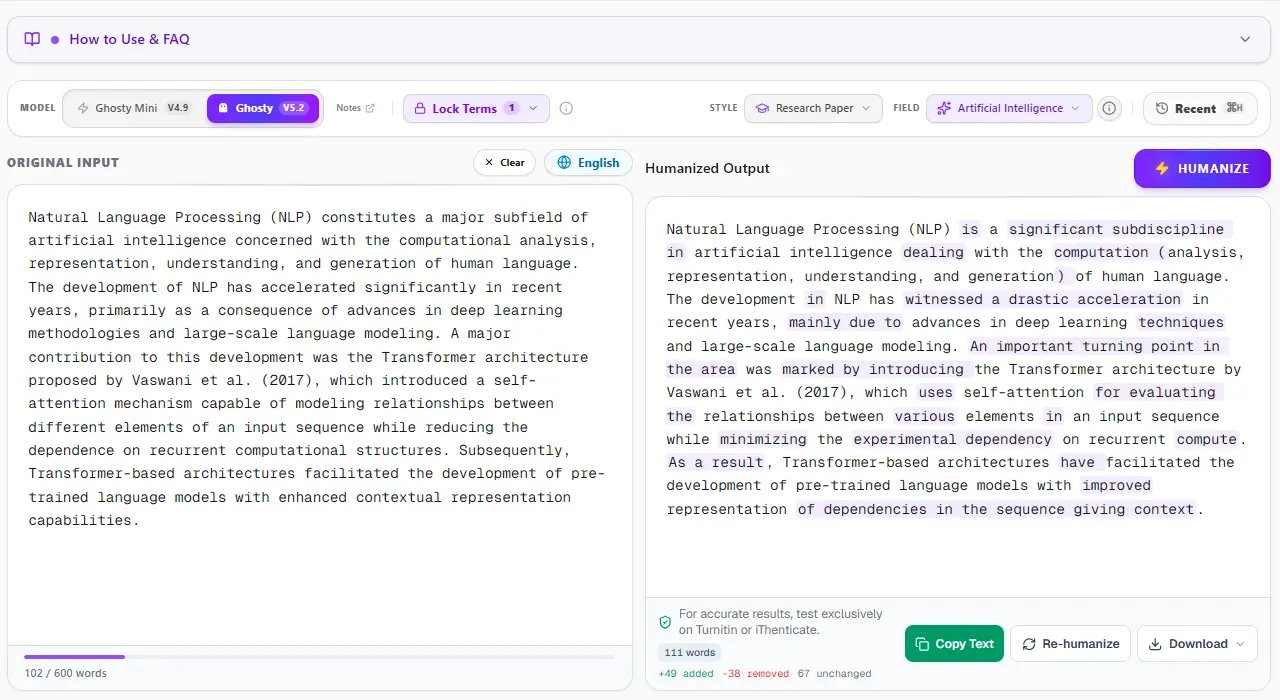
1. ThesisHuman Editor: Style, Field & Term Lock™ Technology
Unlike consumer-grade paraphrasers that blindly swap words with thesaurus synonyms, ThesisHuman allows researchers to select their exact Academic Style (Essay, Research Paper, Literature Review, Technical Report) and Academic Field (Computer Science, Engineering, Medicine, Physics). With Term Lock™, citations (APA, MLA, IEEE), LaTeX equations, and domain-specific terminology are cryptographically protected before sentence entropy is restructured.
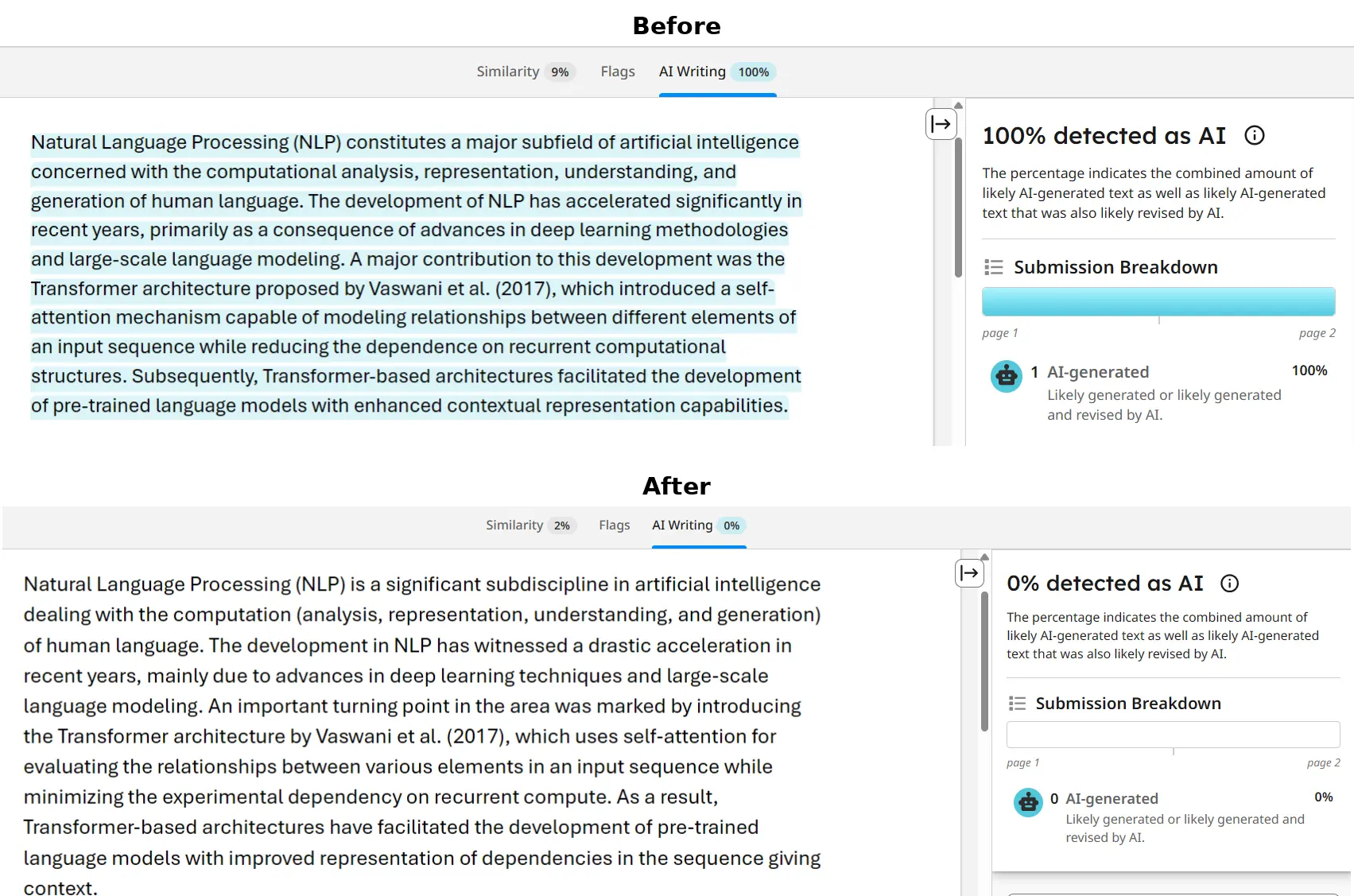
2. Turnitin & iThenticate Verification: 0% AI Detected
Turnitin and iThenticate scan submissions in overlapping 500-token blocks to analyze sentence predictability across paragraphs. When an unrefined AI draft is submitted, uniform cadence triggers an elevated AI Writing score. In the verified report below, a flagged graduate paper was processed through ThesisHuman, achieving a clean 0% AI detection score while preserving all formatted citations and technical parameters.
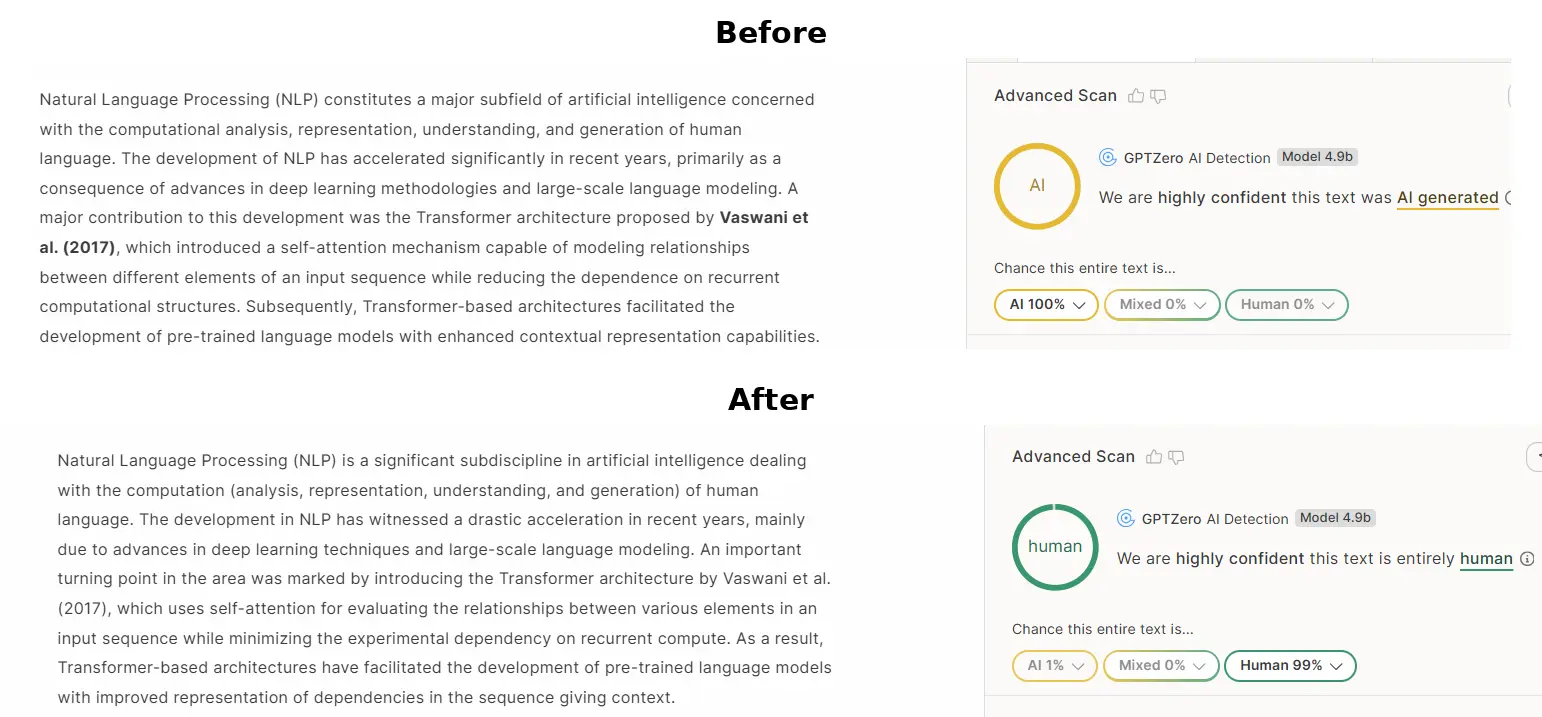
3. GPTZero Verification: Passing Perplexity & Burstiness Checks
GPTZero evaluates text by plotting sentence perplexity curves and global burstiness scores. When raw AI text is scanned, low sentence variance produces an immediate high-probability warning. ThesisHuman restores natural sentence entropy by restructuring syntax, varying clause lengths, and introducing authentic scholarly cadence, dropping AI probability to 0%.
4. Originality.ai Verification: 0% AI Confidence
Originality.ai flags predictable n-gram sequences and common AI clichés (such as “delving into,” “pivotal role,” “testament to”). ThesisHuman purges overused formulaic transitions while elevating scholarly tone and keeping reference numbers and equations intact, producing 100% Original / 0% AI results.