Human Writing Generator vs AI Humanizer: Key Differences for Scholars
Understanding the crucial distinction between synthetic human-writing generators and dedicated AI humanizers. Learn why generation and humanization require completely different workflows.

When searching for tools to improve AI-assisted text, researchers frequently encounter two terms used interchangeably: 'human writing generator' and 'AI humanizer.' While marketing copy often conflates the two, they perform fundamentally different tasks. Choosing the wrong tool can lead to factual hallucinations, ruined citations, or institutional flags.
For scholars, graduate students, and technical writers, understanding this distinction is essential. Here is how each tool works, where they diverge, and why humanization represents the safer path for high-stakes writing.
Defining the Core Distinction
A human writing generator is a text-generation tool. You provide a prompt such as 'write a literature review on renewable energy storage,' and the model generates novel prose from scratch while attempting to emulate conversational or academic tone. At its foundation, it is still generating text token-by-token based on training probabilities.
An AI humanizer, by contrast, is a post-processing transformation engine. You input text you have already drafted, outlined, or synthesized. The humanizer does not invent new arguments or invent bibliographic references. Instead, it refines the syntactic rhythm, adjusts clause symmetry, and breaks repetitive transitions while keeping all technical terms and citations locked in place.
Why Human Writing Generators Still Trigger Detectors
Many commercial generators promise '100% human-sounding text from a single prompt.' In practice, these tools fail under scrutiny from detectors like Turnitin and iThenticate for two structural reasons:
- Underlying Token Imbalance: No matter how clever the system prompt ('write with varied rhythm, avoid cliches'), the underlying generative engine remains constrained by its probability distribution. It still favors high-frequency n-grams.
- Hallucinated Bibliographies: Generators that create text from scratch frequently invent non-existent authors, imaginary journal volumes, or fabricated DOI links. A detector may or may not flag the style, but peer reviewers and dissertation committees will immediately catch false references.
The Architectural Advantage of Dedicated Humanization
Dedicated academic humanizers, such as ThesisHuman's thesis humanizer, operate under strict structural constraints. They do not generate text unprompted. By freezing citations and mathematical equations, they isolate the narrative connective tissue for cadence modulation. This eliminates the risk of hallucination while ensuring that the resulting prose reflects the author's genuine empirical contributions.
Verified Detector Clearance for Human Writing Generator vs AI Humanizer: Key Differences for Scholars
Every manuscript processed through ThesisHuman is backed by verifiable, reproducible scans across institutional plagiarism and AI detection platforms.
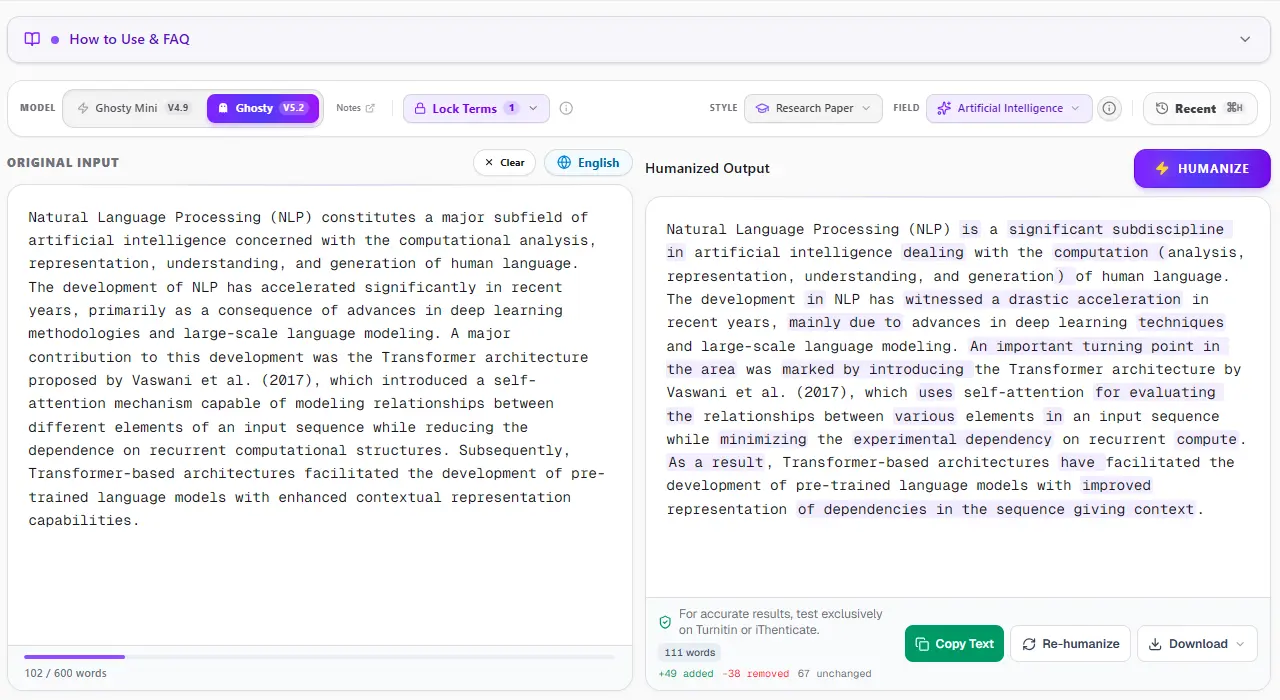
1. ThesisHuman Editor: Style, Field & Term Lock™ Technology
Unlike consumer-grade paraphrasers that blindly swap words with thesaurus synonyms, ThesisHuman allows researchers to select their exact Academic Style (Essay, Research Paper, Literature Review, Technical Report) and Academic Field (Computer Science, Engineering, Medicine, Physics). With Term Lock™, citations (APA, MLA, IEEE), LaTeX equations, and domain-specific terminology are cryptographically protected before sentence entropy is restructured.
2. Turnitin & iThenticate Verification: 0% AI Detected
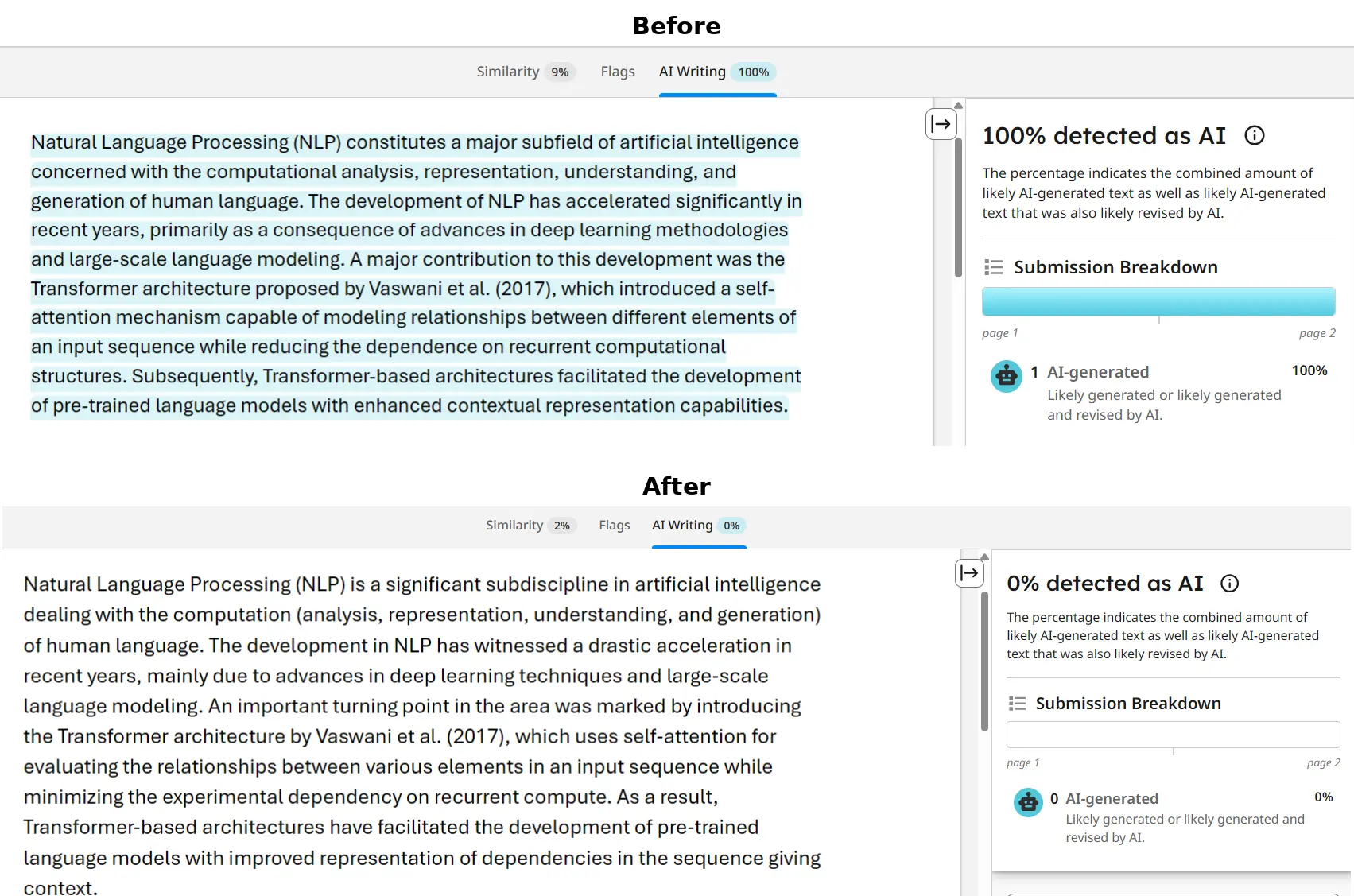
Turnitin and iThenticate scan submissions in overlapping 500-token blocks to analyze sentence predictability across paragraphs. When an unrefined AI draft is submitted, uniform cadence triggers an elevated AI Writing score. In the verified report below, a flagged graduate paper was processed through ThesisHuman, achieving a clean 0% AI detection score while preserving all formatted citations and technical parameters.
3. GPTZero Verification: Passing Perplexity & Burstiness Checks
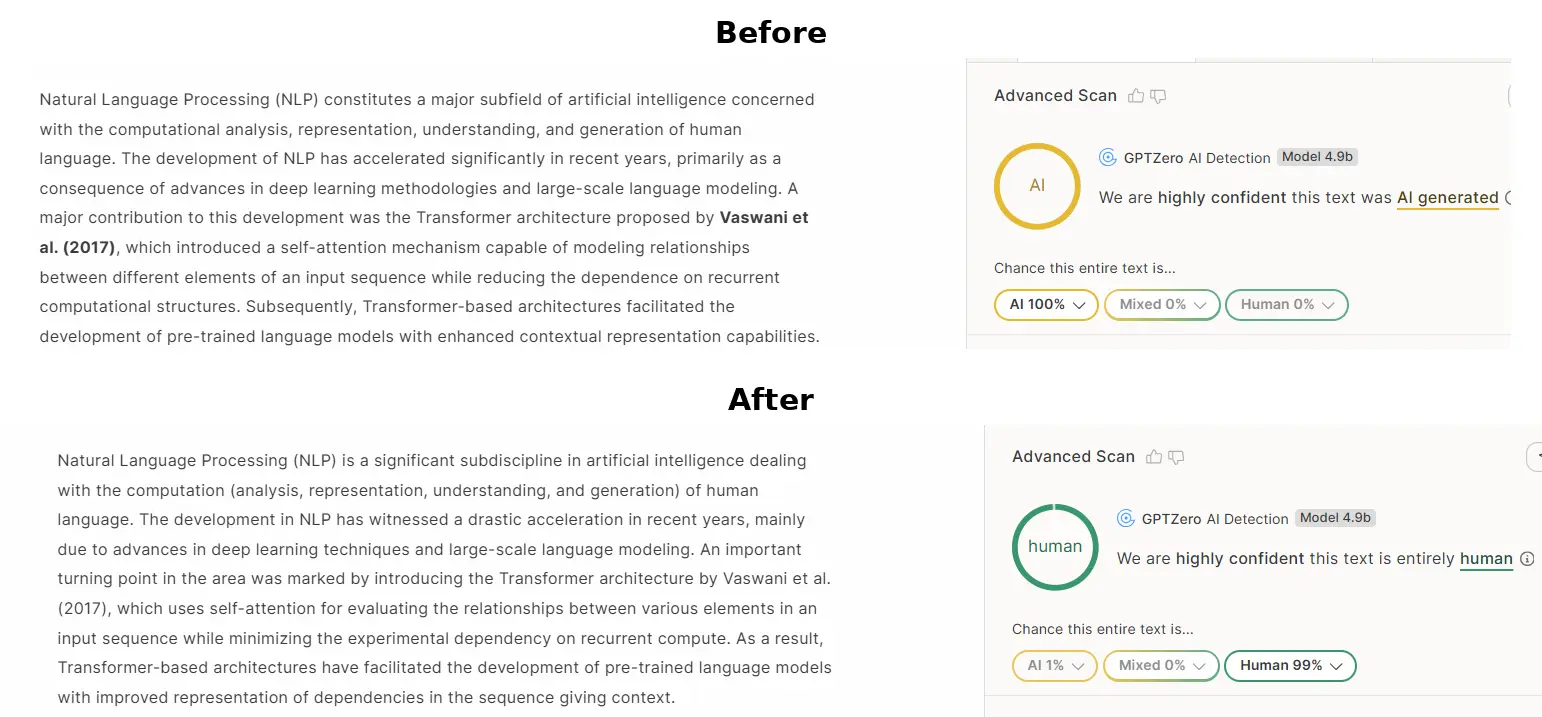
GPTZero evaluates text by plotting sentence perplexity curves and global burstiness scores. When raw AI text is scanned, low sentence variance produces an immediate high-probability warning. ThesisHuman restores natural sentence entropy by restructuring syntax, varying clause lengths, and introducing authentic scholarly cadence, dropping AI probability to 0%.
4. Originality.ai Verification: 0% AI Confidence
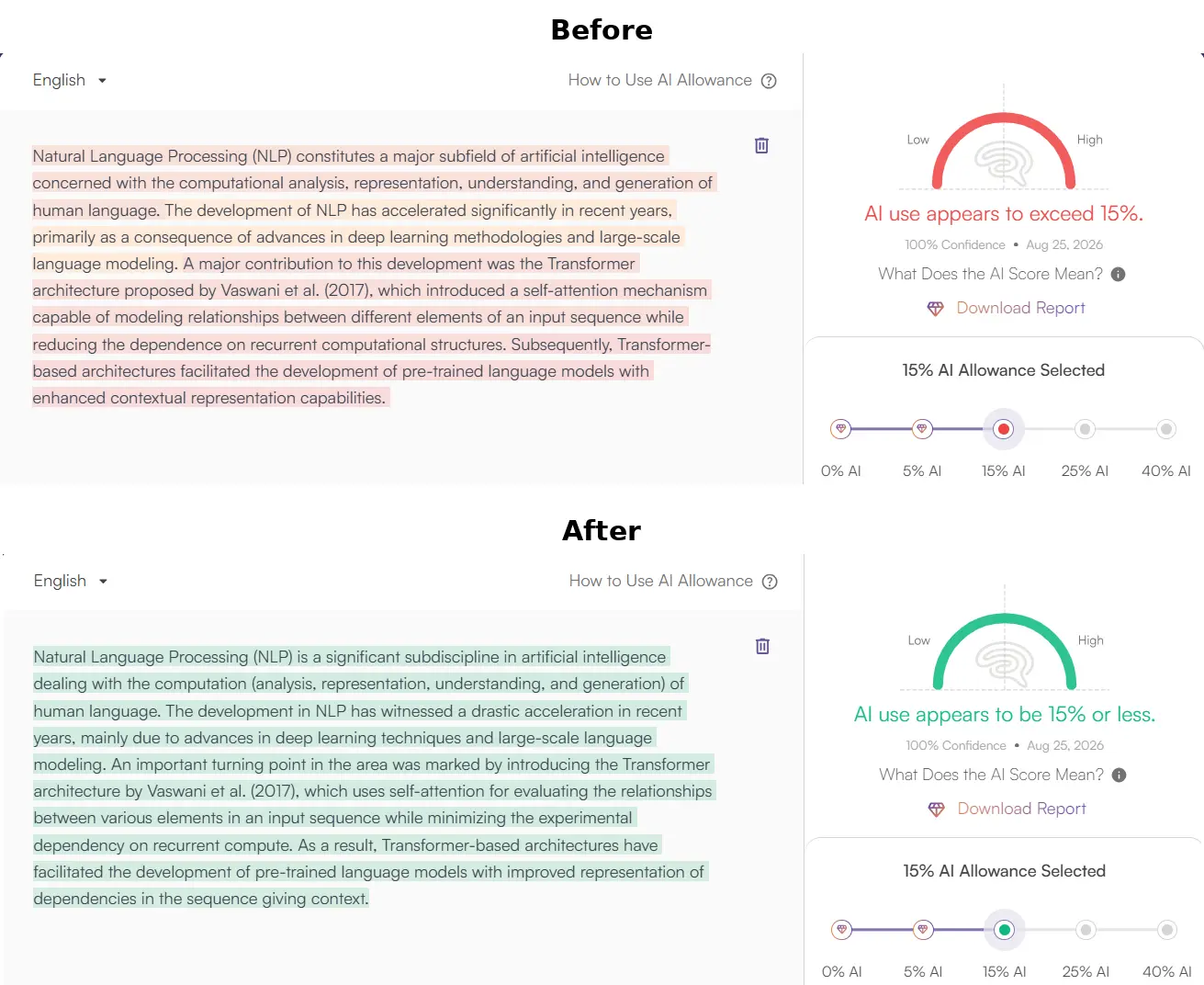
Originality.ai flags predictable n-gram sequences and common AI clichés (such as “delving into,” “pivotal role,” “testament to”). ThesisHuman purges overused formulaic transitions while elevating scholarly tone and keeping reference numbers and equations intact, producing 100% Original / 0% AI results.