Humanize Academic Writing: Developing Authorial Voice in the AI Era
How to cultivate genuine authorial voice while using AI writing assistants. Learn why scholarly formality does not require algorithmic rigidity.

Many researchers mistakenly assume that scholarly English must be stiff, passive, and impersonal. When generative AI models produce cold, perfectly symmetrical text packed with Latinate terminology, scholars often assume this represents the pinnacle of academic formality. In reality, published peer-reviewed literature across leading journals exhibits deep authorial personality, dynamic pacing, and sharp intellectual focus.
Formality is not the same as algorithmic rigidity. When all academic writing relies on the same generative model defaults, research risks becoming homogenized and indistinct. Humanizing academic writing is the deliberate craft of restoring vital intellectual agency to your manuscript.
Formality vs Rigidity in Scholarly Prose
Formal prose adheres to disciplinary conventions: precise vocabulary, clear evidentiary citations, and structured argumentation. Algorithmic rigidity, by contrast, is characterized by repetitive clausal symmetry, mechanical transitional adverbs, and excessive passive hedging. Rigidity does not make writing more rigorous; it simply makes it tedious to read and vulnerable to automated detection filters.
What Constitutes Scholarly Voice in Peer-Reviewed Writing?
A compelling scholarly voice manifests in three distinct ways:
- Critical Positioning: An author does not merely describe past research; they articulate a clear perspective on which methodological approaches are valid.
- Rhythmic Confidence: Confident scholars vary their cadence. They use brief, punchy sentences to highlight breakthrough findings, followed by expanded compound clauses to detail caveats.
- Concrete Disciplinary Verbs: Strong prose favors active, purposeful verbs ('isolated,' 'disrupted,' 'corroborated') over bland linking constructions ('is indicative of the fact that').
Overcoming AI Homogenization
Generative AI models are statistical averaging engines. When prompted to draft academic prose, they select the safest, most probable continuations. This results in the homogenization of scholarly discourse: whether writing about astrophysics or medieval history, the text adopts the same calm, slightly detached tone.
To overcome this homogenization, authors must assert their voice during the revision phase. Using tools like ThesisHuman's academic humanizer restructures uniform sentence blocks into natural, bursty patterns that reflect real human cognition.
Practical Strategies for Restoring Authorial Voice
- Read Your Draft Aloud: If you run out of breath reading a 45-word compound sentence, break it into two distinct statements.
- Challenge Generic Phrases: Whenever you see 'It is widely acknowledged,' ask yourself: acknowledged by whom? Replace it with specific citations.
- Inject Personal Field Observations: Ground abstract conclusions in the messy realities of your actual lab trials or fieldwork data.
Verified Detector Clearance for Humanize Academic Writing: Developing Authorial Voice in the AI Era
Every manuscript processed through ThesisHuman is backed by verifiable, reproducible scans across institutional plagiarism and AI detection platforms.
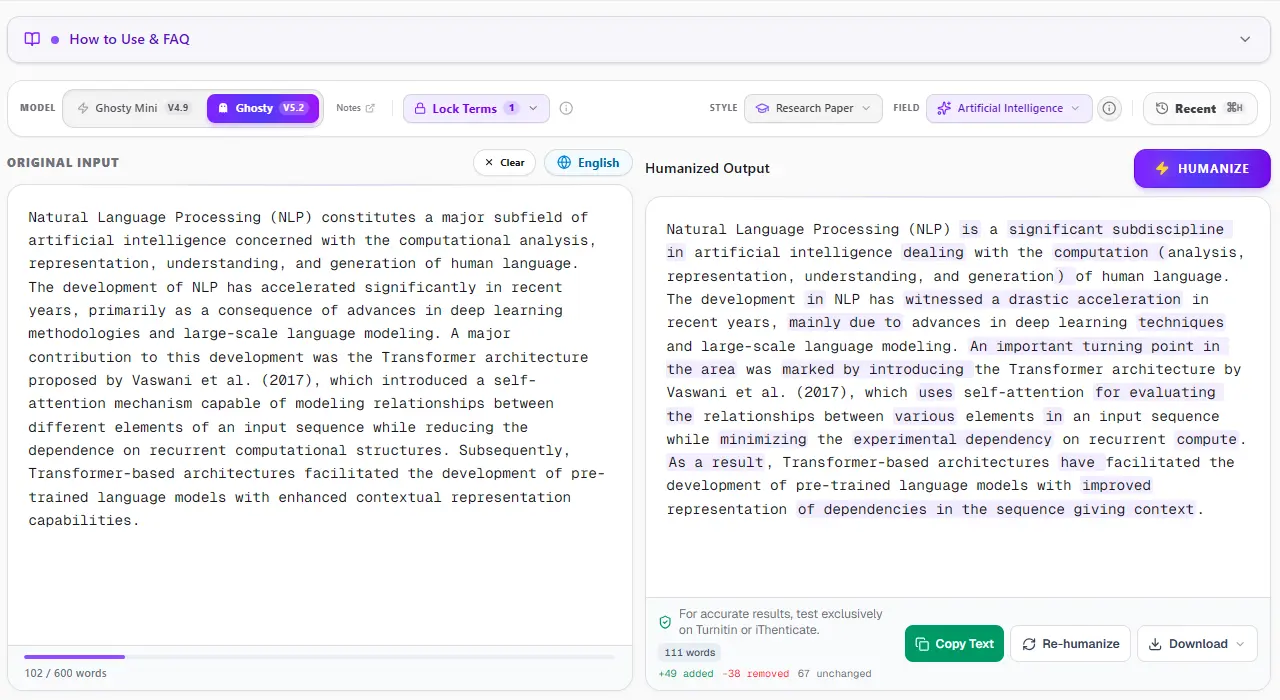
1. ThesisHuman Editor: Style, Field & Term Lock™ Technology
Unlike consumer-grade paraphrasers that blindly swap words with thesaurus synonyms, ThesisHuman allows researchers to select their exact Academic Style (Essay, Research Paper, Literature Review, Technical Report) and Academic Field (Computer Science, Engineering, Medicine, Physics). With Term Lock™, citations (APA, MLA, IEEE), LaTeX equations, and domain-specific terminology are cryptographically protected before sentence entropy is restructured.
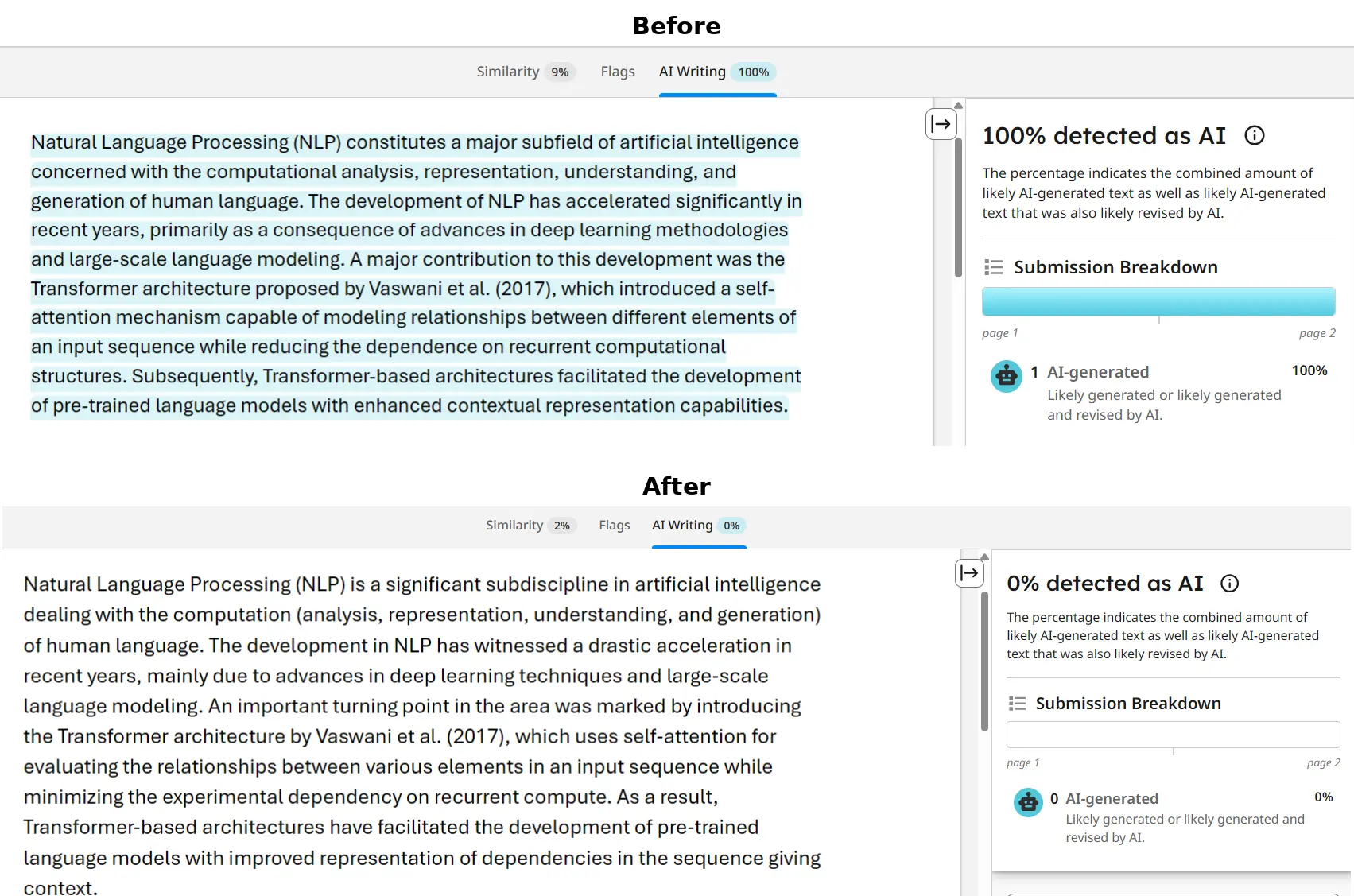
2. Turnitin & iThenticate Verification: 0% AI Detected
Turnitin and iThenticate scan submissions in overlapping 500-token blocks to analyze sentence predictability across paragraphs. When an unrefined AI draft is submitted, uniform cadence triggers an elevated AI Writing score. In the verified report below, a flagged graduate paper was processed through ThesisHuman, achieving a clean 0% AI detection score while preserving all formatted citations and technical parameters.
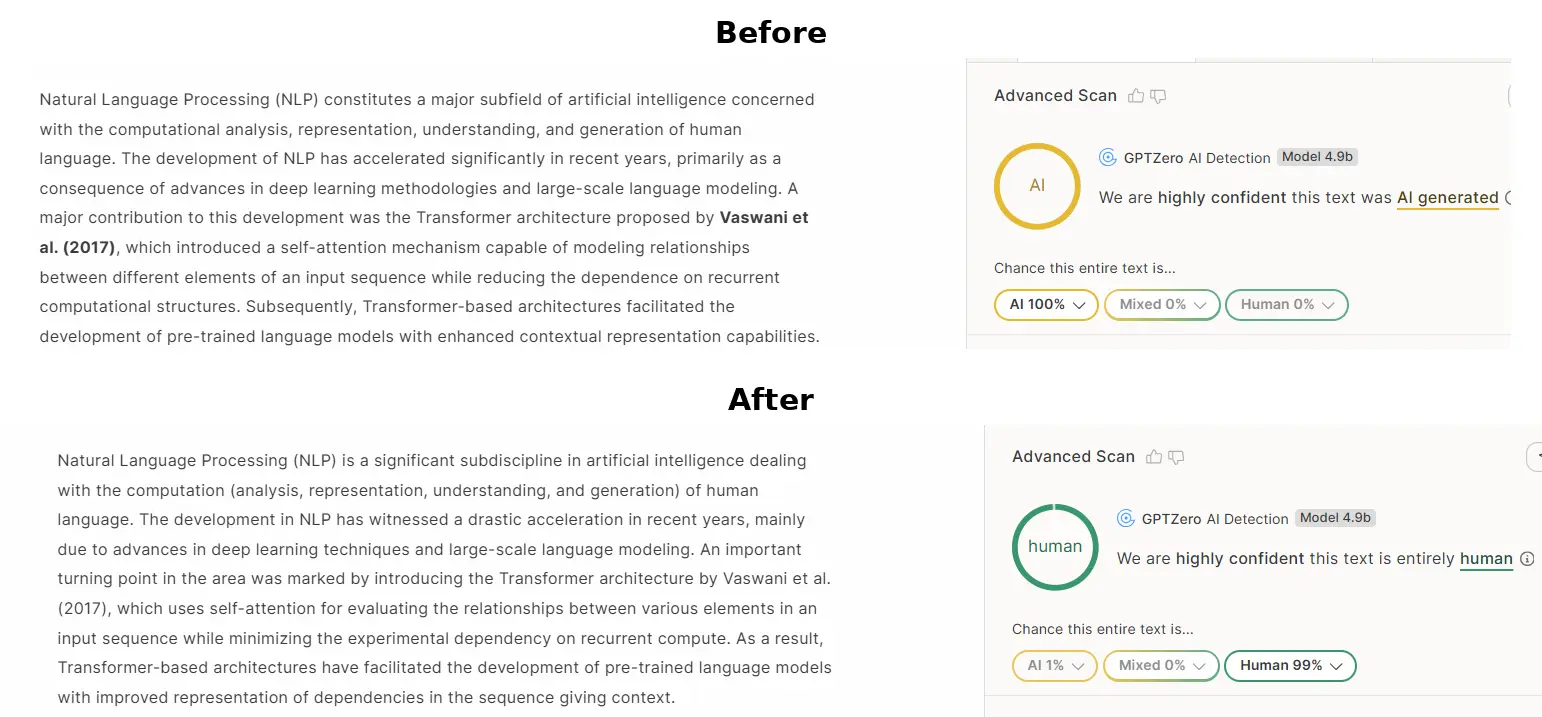
3. GPTZero Verification: Passing Perplexity & Burstiness Checks
GPTZero evaluates text by plotting sentence perplexity curves and global burstiness scores. When raw AI text is scanned, low sentence variance produces an immediate high-probability warning. ThesisHuman restores natural sentence entropy by restructuring syntax, varying clause lengths, and introducing authentic scholarly cadence, dropping AI probability to 0%.
4. Originality.ai Verification: 0% AI Confidence
Originality.ai flags predictable n-gram sequences and common AI clichés (such as “delving into,” “pivotal role,” “testament to”). ThesisHuman purges overused formulaic transitions while elevating scholarly tone and keeping reference numbers and equations intact, producing 100% Original / 0% AI results.