Humanize AI Grant Proposals: Crafting Compelling Narratives for NSF, NIH, and Horizon
How to refine AI-assisted grant proposals for major funding agencies. Balance agency AI disclosure rules with compelling, visionary human prose.

Securing grant funding from prestigious agencies such as the National Science Foundation (NSF), National Institutes of Health (NIH), or European Research Council (Horizon Europe) is one of the most demanding tasks in academia. Acceptance rates often hover below 15%. To meet grueling submission deadlines, principal investigators (PIs) frequently use generative AI to help draft background sections or structure specific aims.
However, when review panels read proposals that carry the bland, homogenized tone of generative AI, enthusiasm collapses. Winning grants requires urgent vision, distinct investigator voice, and rigorous preliminary evidence. Here is how to humanize grant applications into compelling, funded proposals.
The Psychology of Exhausted Grant Review Panels
Grant reviewers are active researchers who evaluate dozens of complex 15-page proposals in their spare time. By the fifth proposal, a reviewer's patience is thin. If a proposal opens with generic AI clichés ('In the rapidly evolving landscape of biomedical research...'), the reviewer immediately concludes that the investigator lacks a focused, passionate agenda. Reviewers fund people and visionary ideas, not algorithmic summaries.
Why AI-Assisted Grant Proposals Fall Flat
Generative AI models are trained to avoid controversy and maintain balance. A winning grant proposal, however, must be inherently argumentative: it must convince a panel that existing methods are inadequate and that only the proposed methodology can solve the crisis. AI drafts constantly hedge: 'While current approaches have limitations, they also provide valuable insights.' That hedging kills funding momentum.
Navigating NIH, NSF, and Horizon Europe AI Rules
Funding agencies have issued clear directives regarding AI. While PIs may use generative tools for initial drafting and language polishing, the PI remains strictly accountable for research veracity. Reviewers are explicitly prohibited from uploading proposals into public AI models to evaluate them, and PIs must ensure that preliminary data is never exposed to public training engines.
A 4-Step Grant Narrative Humanization Guide
- Inject Urgent Specificity: Replace general background statements with direct references to your lab's unique preliminary data.
- Assert Methodological Authority: Cut passive phrasing ('It is anticipated that') in favor of definitive execution statements ('We will deploy CRISPR knockouts to validate...').
- Refine Cadence with ThesisHuman: Use ThesisHuman's research suite to break monotonous sentence lengths in your Project Description while locking preliminary numbers.
- Audit Against Agency Criteria: Ensure that broader impacts and intellectual merit sections communicate authentic community and disciplinary value.
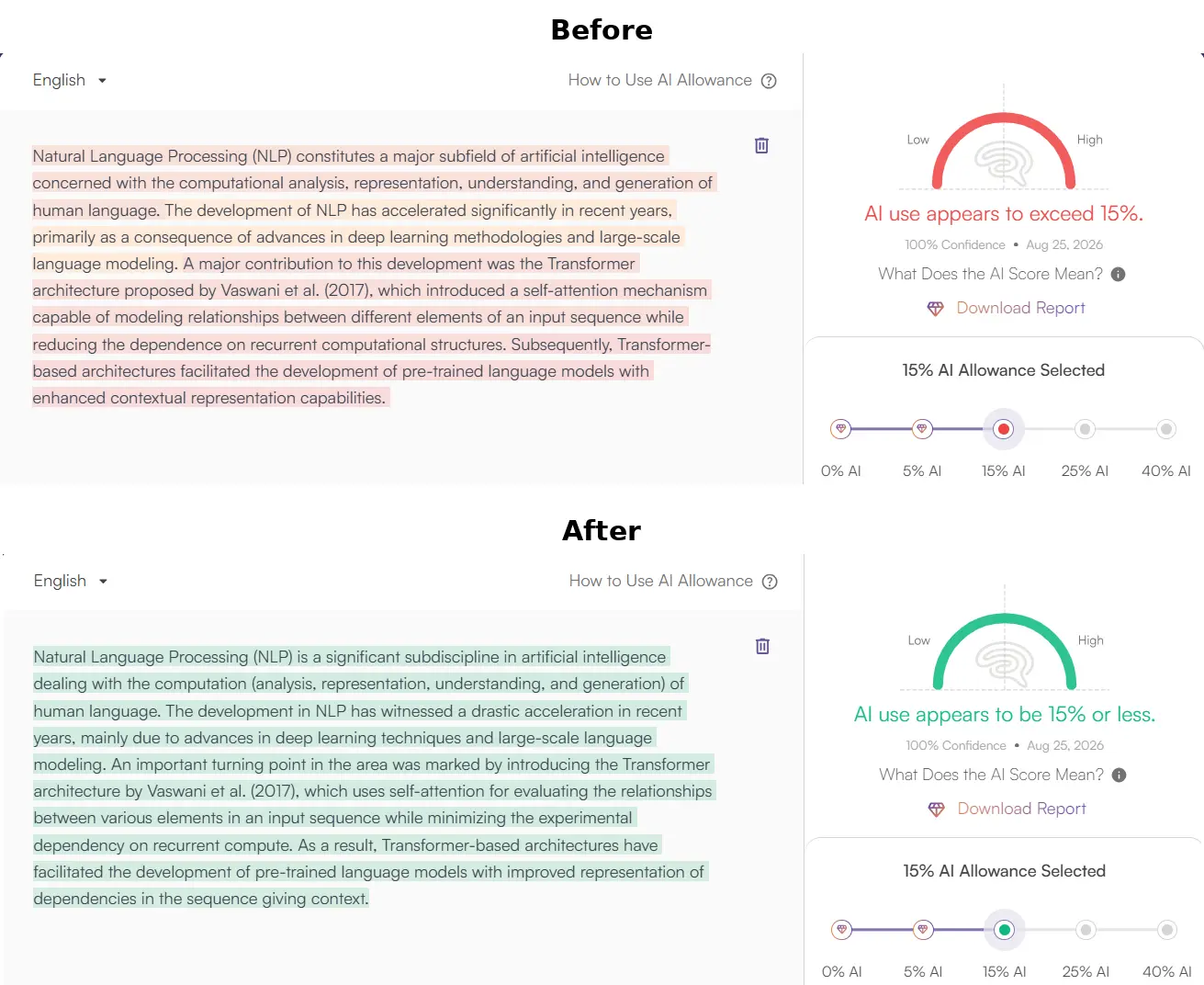
Verified Detector Clearance for Humanize AI Grant Proposals: Crafting Compelling Narratives for NSF, NIH, and Horizon
Every manuscript processed through ThesisHuman is backed by verifiable, reproducible scans across institutional plagiarism and AI detection platforms.
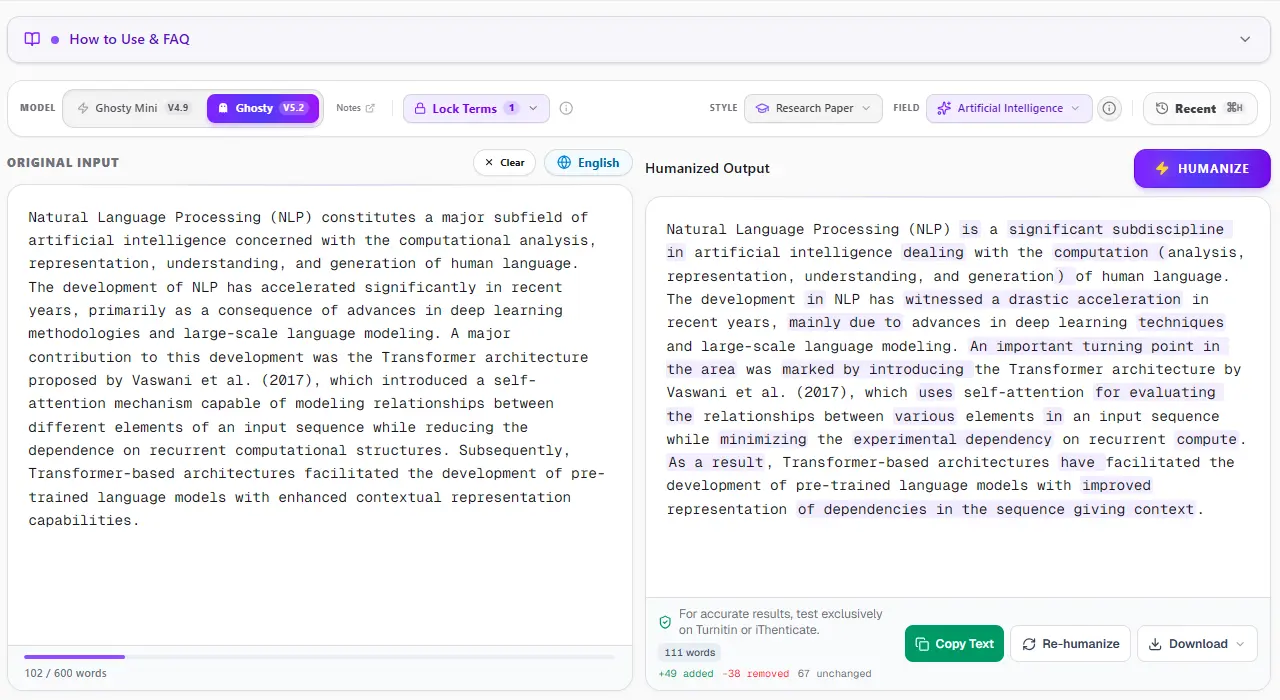
1. ThesisHuman Editor: Style, Field & Term Lock™ Technology
Unlike consumer-grade paraphrasers that blindly swap words with thesaurus synonyms, ThesisHuman allows researchers to select their exact Academic Style (Essay, Research Paper, Literature Review, Technical Report) and Academic Field (Computer Science, Engineering, Medicine, Physics). With Term Lock™, citations (APA, MLA, IEEE), LaTeX equations, and domain-specific terminology are cryptographically protected before sentence entropy is restructured.
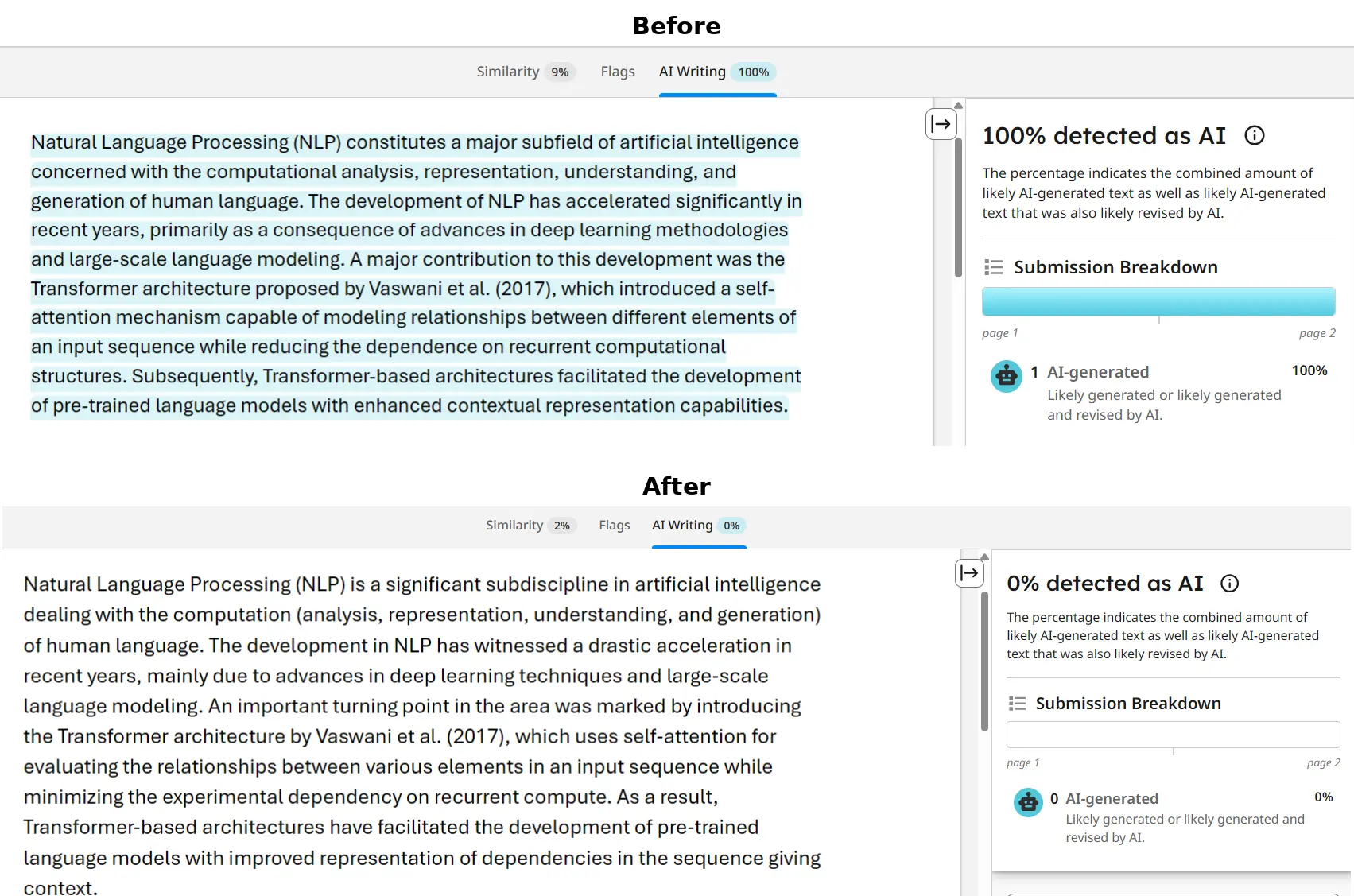
2. Turnitin & iThenticate Verification: 0% AI Detected
Turnitin and iThenticate scan submissions in overlapping 500-token blocks to analyze sentence predictability across paragraphs. When an unrefined AI draft is submitted, uniform cadence triggers an elevated AI Writing score. In the verified report below, a flagged graduate paper was processed through ThesisHuman, achieving a clean 0% AI detection score while preserving all formatted citations and technical parameters.
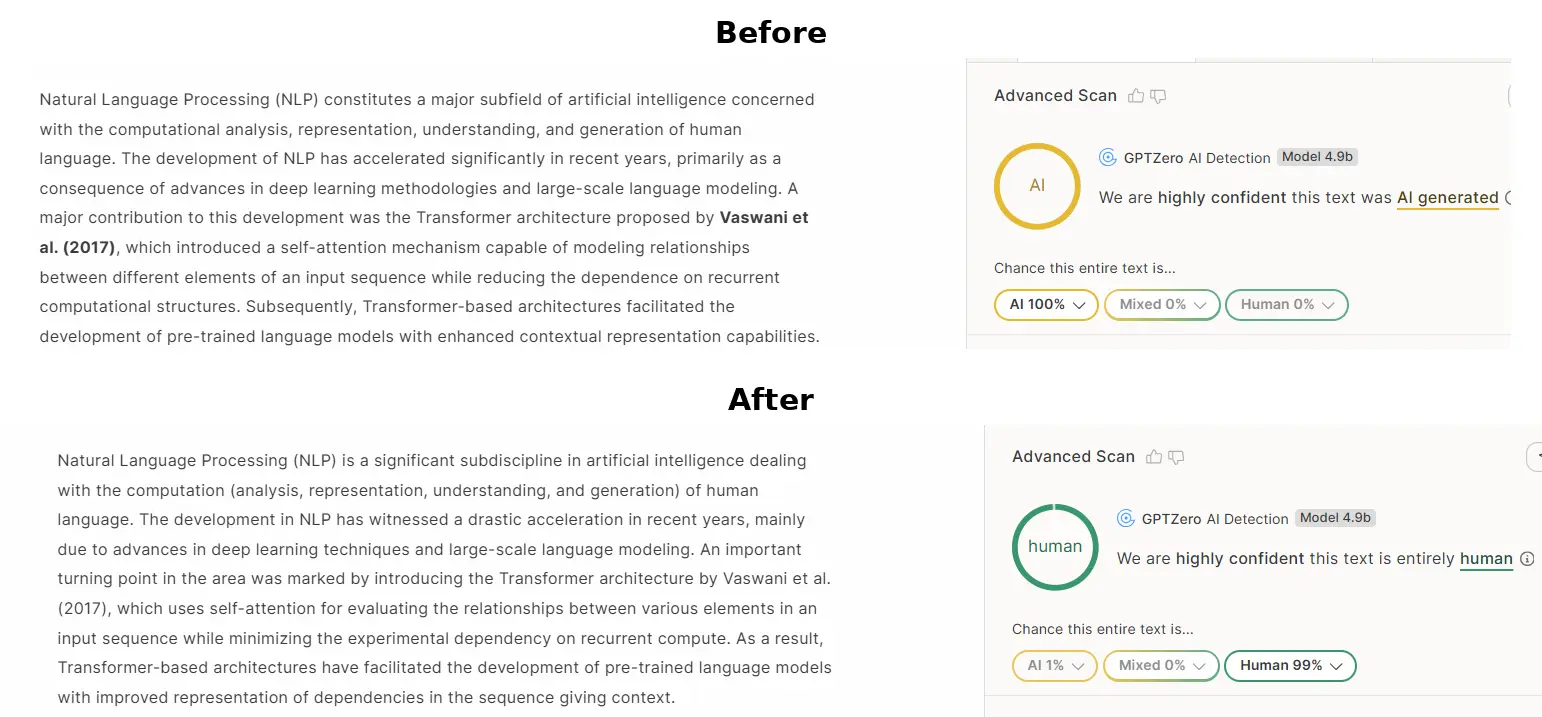
3. GPTZero Verification: Passing Perplexity & Burstiness Checks
GPTZero evaluates text by plotting sentence perplexity curves and global burstiness scores. When raw AI text is scanned, low sentence variance produces an immediate high-probability warning. ThesisHuman restores natural sentence entropy by restructuring syntax, varying clause lengths, and introducing authentic scholarly cadence, dropping AI probability to 0%.
4. Originality.ai Verification: 0% AI Confidence
Originality.ai flags predictable n-gram sequences and common AI clichés (such as “delving into,” “pivotal role,” “testament to”). ThesisHuman purges overused formulaic transitions while elevating scholarly tone and keeping reference numbers and equations intact, producing 100% Original / 0% AI results.