Humanize AI Without Changing Meaning: Semantic Fidelity in Technical Prose
How to eliminate semantic drift during AI text humanization. Ensuring that technical definitions, mathematical conditions, and causal logic remain 100% accurate.

When authors need to refine AI-assisted writing, their greatest fear is not that the detector score will remain high; their greatest fear is that the humanizer will distort the underlying meaning of their research. In academic and technical fields, words have exact operational definitions. Substituting a single noun or shifting a causal verb can transform a rigorous scientific claim into an unsupportable assertion.
This phenomenon is known as semantic drift. Preserving semantic fidelity while varying clausal rhythm is the true test of an academic AI humanizer. Here is how semantic drift occurs and how specialized constraint-based architectures prevent meaning distortion.
The Hidden Danger of Semantic Drift
In conversational writing, swapping 'happy' with 'cheerful' causes no harm. In scholarly writing, swapping 'statistically significant correlation' with 'important relationship' deletes the entire mathematical foundation of the study. Similarly, changing 'necessary condition' to 'contributing factor' alters formal logical proofs. Cheap paraphrasers treat language as interchangeable tokens, creating dangerous errors that undermine peer review.
Why Standard Paraphrasers Mutate Meaning
Standard rewriters fail because they lack semantic constraint boundaries. They optimize purely for lexical distance: how many words can be altered to make the text appear different. In doing so, they routinely invert logical operators:
- Modal Inversion: Transforming 'these findings suggest a possible mechanism' into 'this data confirms the mechanism,' exaggerating empirical confidence.
- Scope Expansion: Changing 'observed across a cohort of 50 patients' into 'widely observed across clinical populations,' making ungeneralizable claims.
- Directional Reversal: Conflating dependent and independent variables in complex methodology descriptions.
Constraint-Based Humanization Architecture
ThesisHuman's Ghosty V6 engine operates on constraint-based natural language transformation. Instead of unconstrained synonym swapping, the system locks semantic anchors: named entities, quantitative thresholds, directional verbs, and citation tags. The model is permitted to restructure clausal hierarchy, modulate sentence length, and eliminate filler words, but it is strictly forbidden from altering semantic entailment.
A 5-Point Technical Meaning Verification Checklist
- Check Logical Directionality: Verify that cause-and-effect relationships remain oriented in the proper direction.
- Audit Quantitative Modifiers: Ensure words like 'all,' 'some,' 'none,' 'substantially,' and 'marginally' reflect your exact statistical thresholds.
- Verify Invariant Citations: Confirm that author citations remain attached to the exact empirical statements they substantiate.
- Confirm Methodological Sequence: Check that multi-step laboratory protocols retain their chronological order.
- Verify Hypothesis Boundaries: Ensure that tentative theoretical conclusions have not been inflated into unhedged factual assertions.
Verified Detector Clearance for Humanize AI Without Changing Meaning: Semantic Fidelity in Technical Prose
Every manuscript processed through ThesisHuman is backed by verifiable, reproducible scans across institutional plagiarism and AI detection platforms.
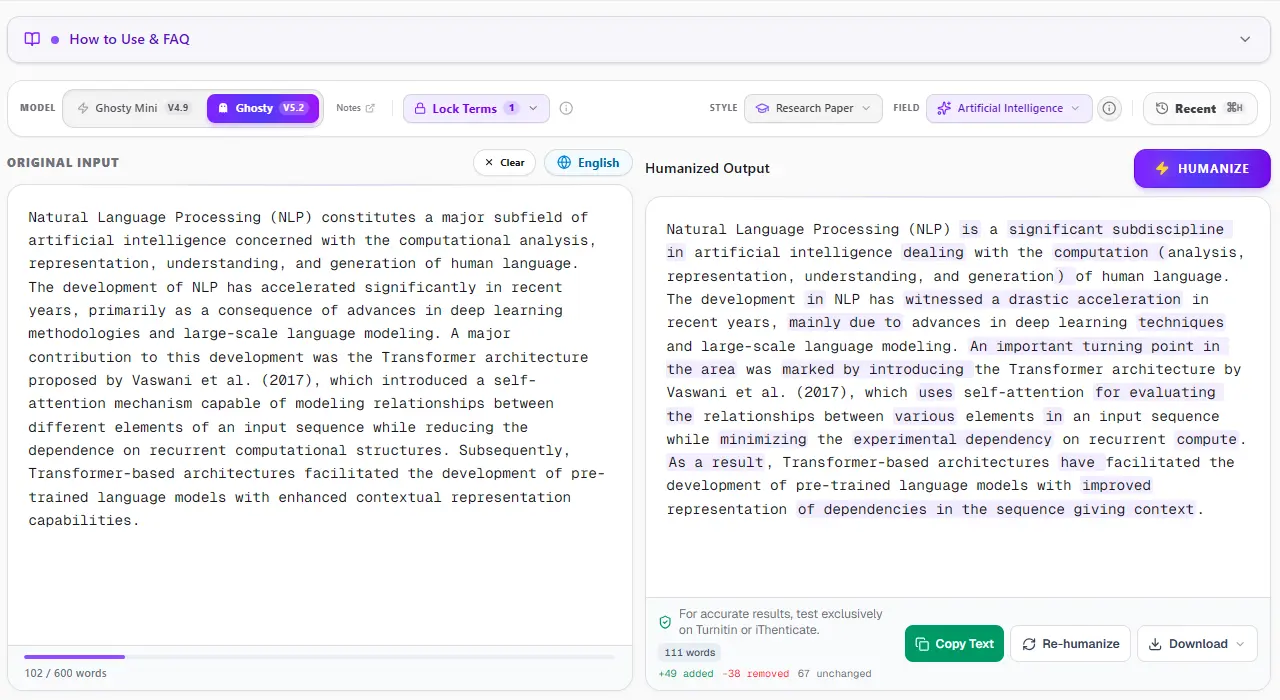
1. ThesisHuman Editor: Style, Field & Term Lock™ Technology
Unlike consumer-grade paraphrasers that blindly swap words with thesaurus synonyms, ThesisHuman allows researchers to select their exact Academic Style (Essay, Research Paper, Literature Review, Technical Report) and Academic Field (Computer Science, Engineering, Medicine, Physics). With Term Lock™, citations (APA, MLA, IEEE), LaTeX equations, and domain-specific terminology are cryptographically protected before sentence entropy is restructured.
2. Turnitin & iThenticate Verification: 0% AI Detected
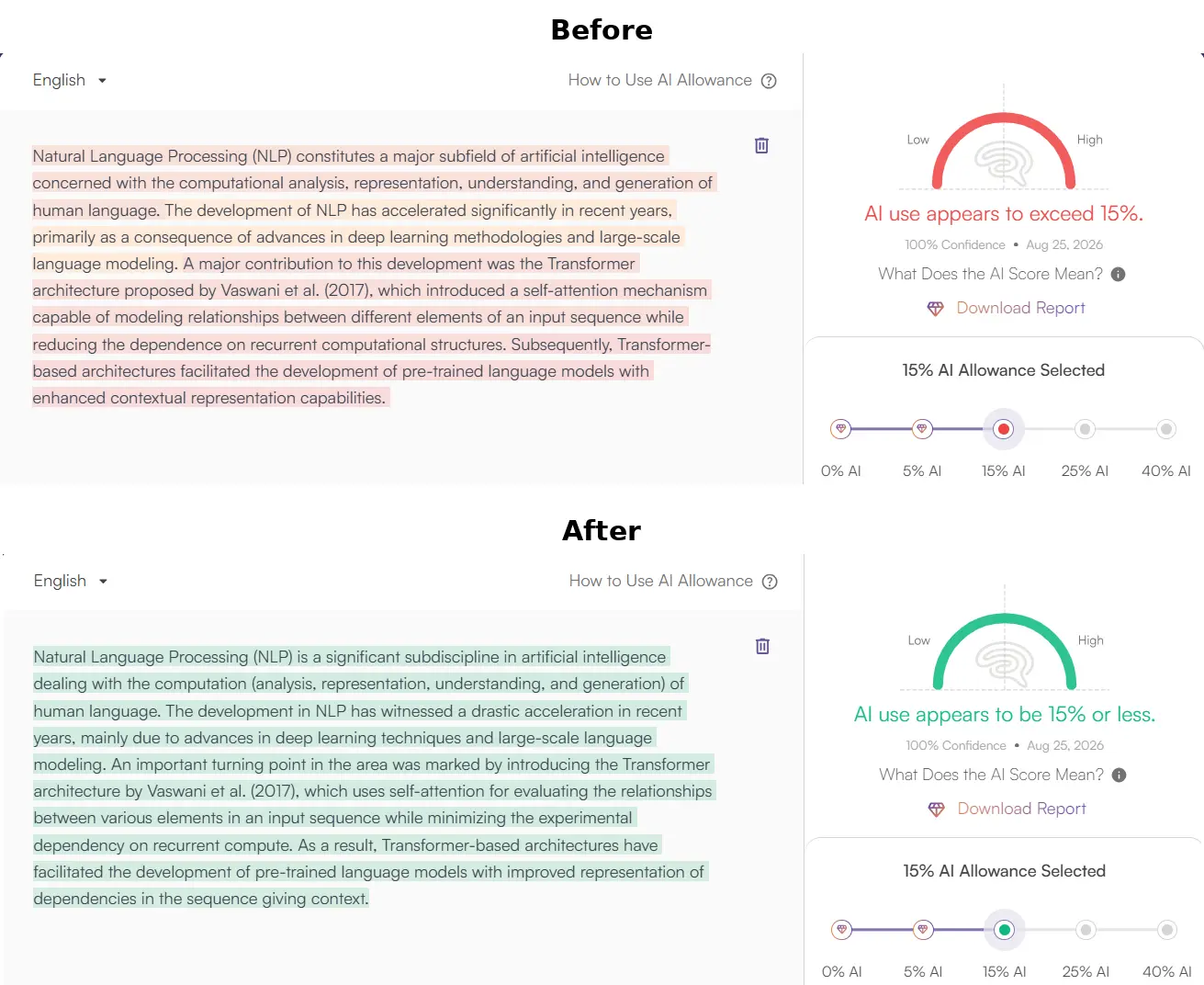
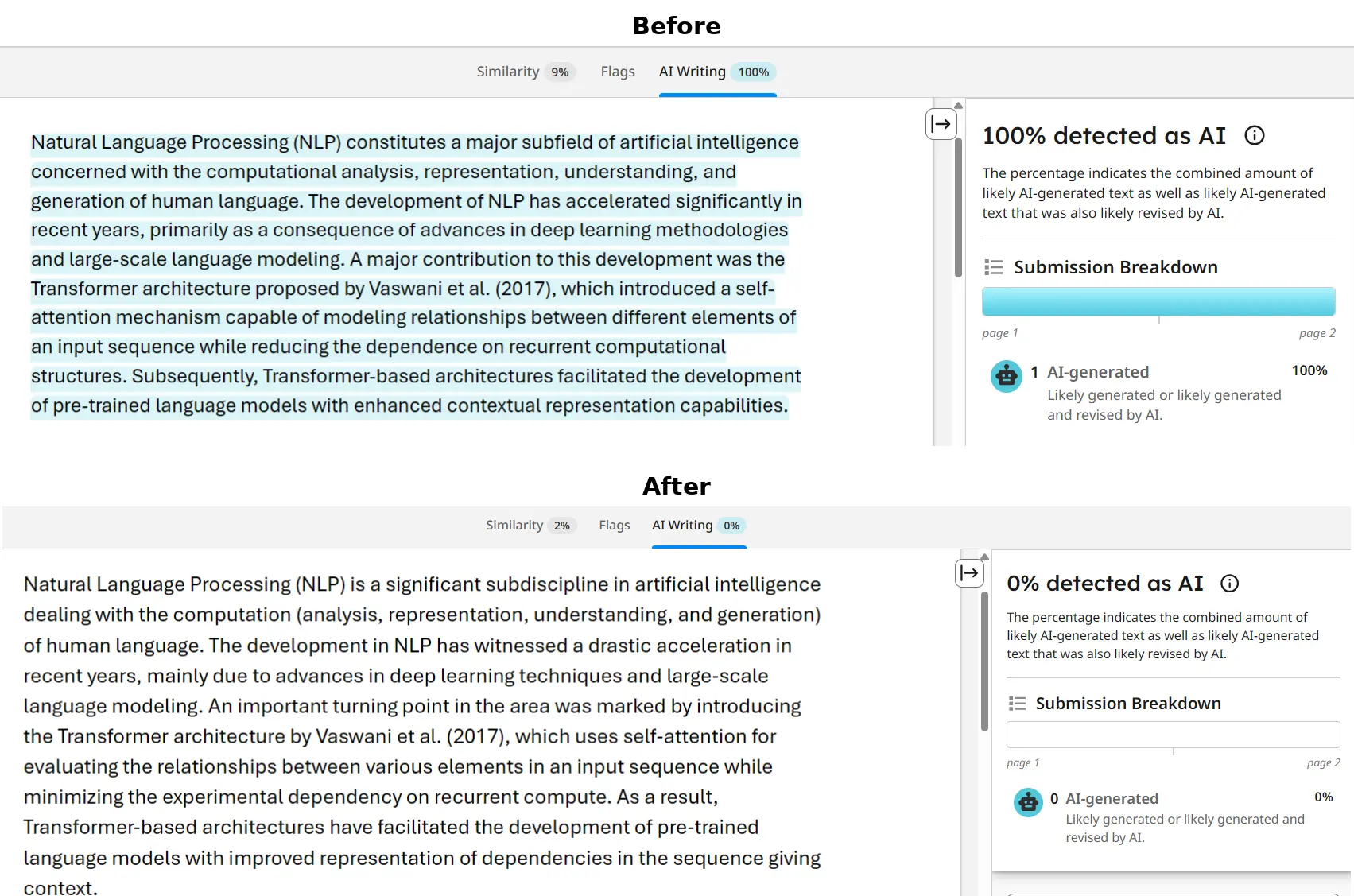
Turnitin and iThenticate scan submissions in overlapping 500-token blocks to analyze sentence predictability across paragraphs. When an unrefined AI draft is submitted, uniform cadence triggers an elevated AI Writing score. In the verified report below, a flagged graduate paper was processed through ThesisHuman, achieving a clean 0% AI detection score while preserving all formatted citations and technical parameters.
3. GPTZero Verification: Passing Perplexity & Burstiness Checks
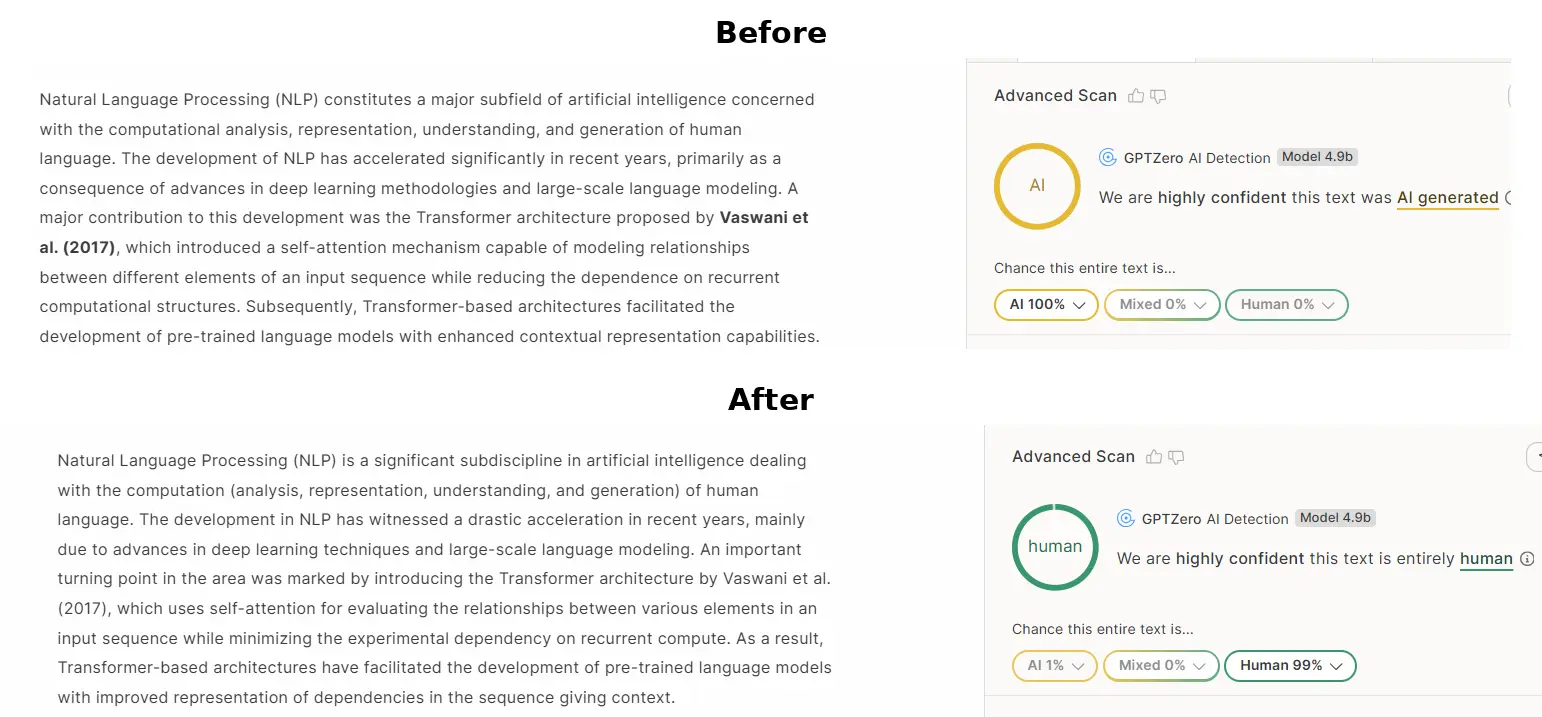
GPTZero evaluates text by plotting sentence perplexity curves and global burstiness scores. When raw AI text is scanned, low sentence variance produces an immediate high-probability warning. ThesisHuman restores natural sentence entropy by restructuring syntax, varying clause lengths, and introducing authentic scholarly cadence, dropping AI probability to 0%.
4. Originality.ai Verification: 0% AI Confidence
Originality.ai flags predictable n-gram sequences and common AI clichés (such as “delving into,” “pivotal role,” “testament to”). ThesisHuman purges overused formulaic transitions while elevating scholarly tone and keeping reference numbers and equations intact, producing 100% Original / 0% AI results.