Humanize Engineering and CS Papers: Preserving Code, Algorithms, and Complexity
How computer science and engineering researchers can humanize IEEE and ACM manuscripts without breaking algorithmic notation, pseudo-code, or math.
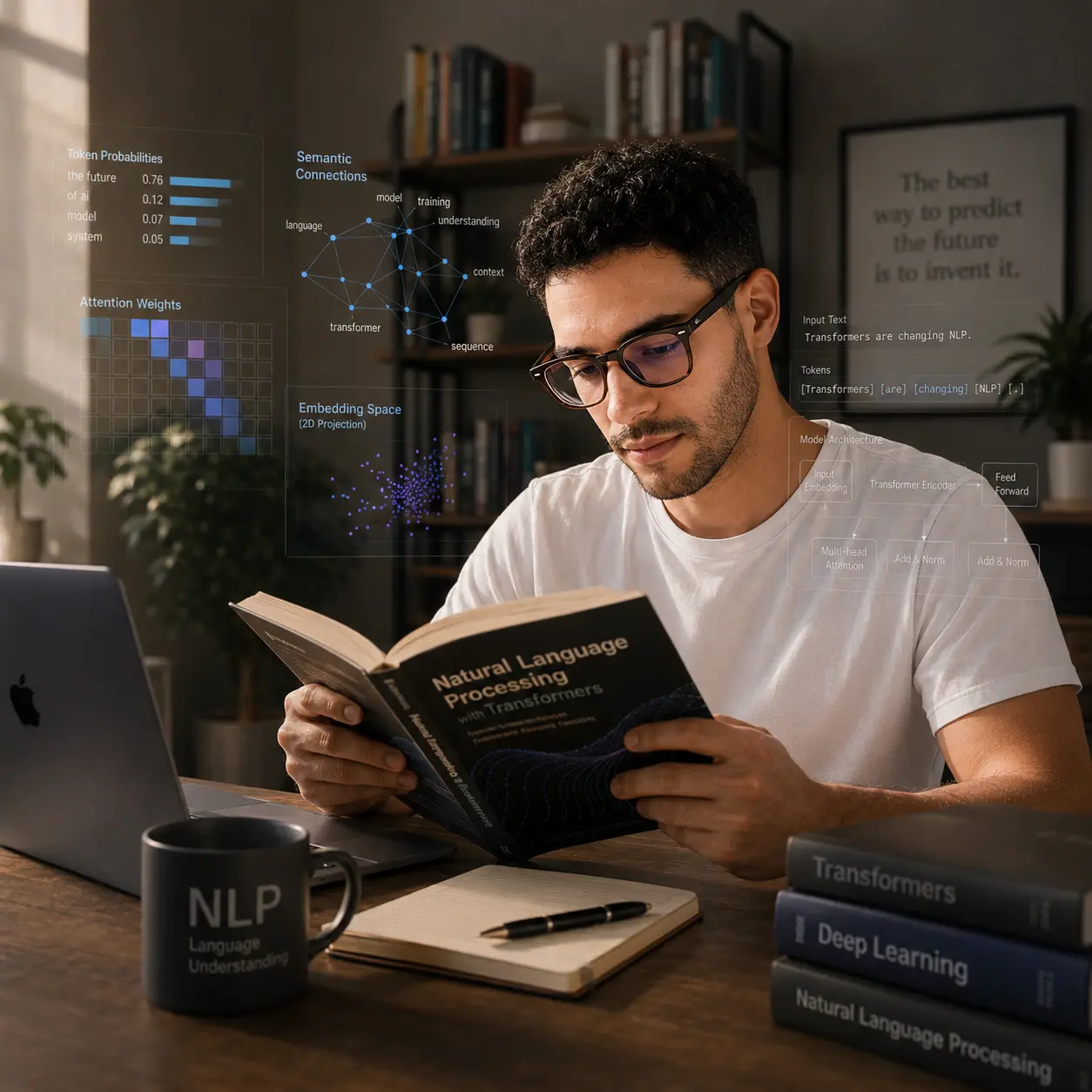
Computer science and electrical engineering papers are distinct from other academic disciplines. In these fields, manuscripts contain dense mixtures of formal algorithm descriptions, asymptotic complexity analysis ($O(n \log n)$), hardware block diagrams, and mathematical proofs. When researchers use AI models to help draft related-work surveys or articulate system architectures, they face a double challenge: automated detection flags and code destruction.
Publishing in premier IEEE, ACM, or USENIX proceedings requires both technical precision and authentic scholarly cadence. Here is how computer science and engineering researchers can safely humanize technical manuscripts without corrupting algorithms or notation.
The Unique Linguistic Challenges of CS & Engineering
Computer science prose is inherently deductive and structured. When describing a distributed consensus protocol or deep learning pipeline, authors explain system operations step-by-step: 'First, node $i$ broadcasts message $m$; second, receiving nodes verify signature $\sigma$.' Because AI models naturally default to this same structured, ordinal sequencing, classifiers like Turnitin and iThenticate easily flag unedited CS drafts.
Protecting Pseudo-Code, Big-O Notation, and Variables
Generic rewriting tools fail catastrophically on engineering text. When presented with algorithmic descriptions, standard spinners attempt to rephrase programming keywords, turning 'while loop' into 'during cycle' or translating variable names like max_iter into 'highest repetition.' In CS manuscripts, code blocks, variable subscripts, and asymptotic notation must remain immutable.
IEEE and ACM Camera-Ready Screening Protocols
Major computer science venues (such as IEEE S&P, ACM SIGCOMM, NeurIPS, and ICML) screen camera-ready manuscripts before publication. Submissions that display elevated AI probability scores or unacknowledged generative phrasing are delayed, requiring authors to provide proof of original implementation and code provenance.
A 4-Step Engineering Manuscript Workflow
- Isolate Pseudo-Code Environments: Ensure all algorithm environments (
algorithm2e,algorithmicx) are shielded from processing. - Lock Computational Complexity Strings: Freeze asymptotic notation and mathematical definitions using ThesisHuman's technical term lock.
- Naturalize Architectural Descriptions: Rebalance sentence lengths in system overview and related work sections, replacing mechanical ordinal markers with conceptual data linkages.
- Verify Citation Alignment: Ensure that IEEE-style numeric citation brackets (e.g., [4]-[8]) remain accurately linked to their benchmark studies.
Verified Detector Clearance for Humanize Engineering and CS Papers: Preserving Code, Algorithms, and Complexity
Every manuscript processed through ThesisHuman is backed by verifiable, reproducible scans across institutional plagiarism and AI detection platforms.
1. ThesisHuman Editor: Style, Field & Term Lock™ Technology
Unlike consumer-grade paraphrasers that blindly swap words with thesaurus synonyms, ThesisHuman allows researchers to select their exact Academic Style (Essay, Research Paper, Literature Review, Technical Report) and Academic Field (Computer Science, Engineering, Medicine, Physics). With Term Lock™, citations (APA, MLA, IEEE), LaTeX equations, and domain-specific terminology are cryptographically protected before sentence entropy is restructured.
2. Turnitin & iThenticate Verification: 0% AI Detected
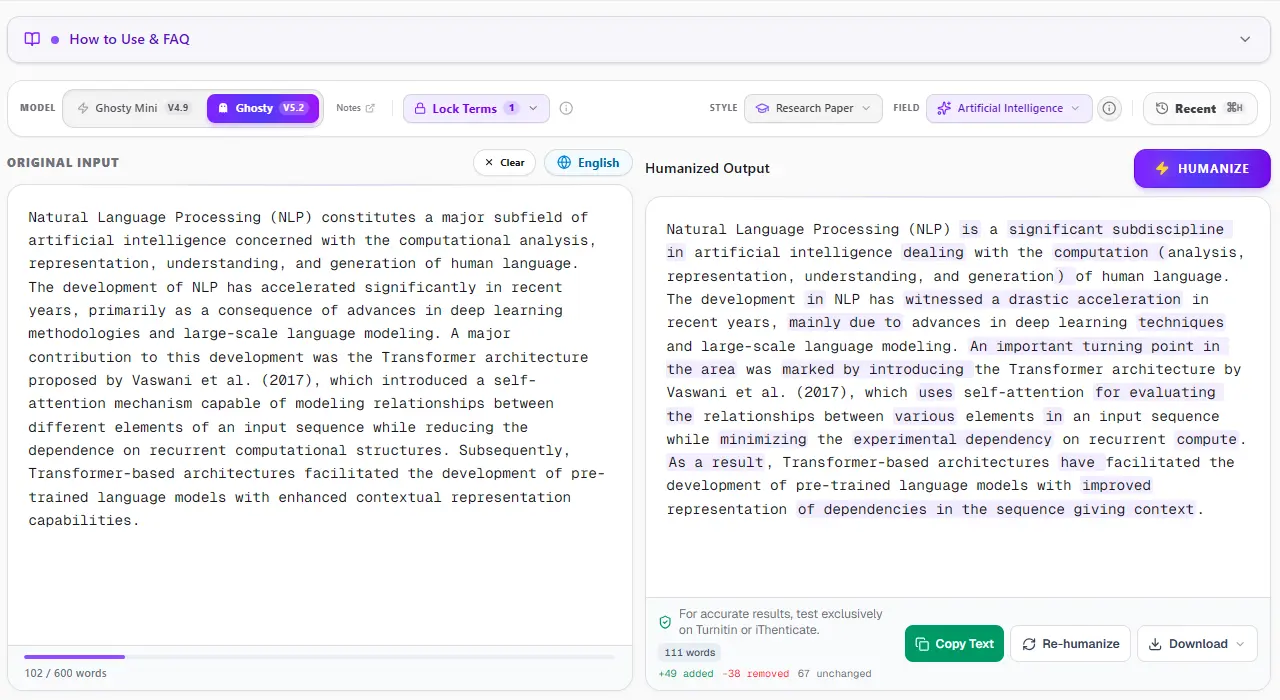
Turnitin and iThenticate scan submissions in overlapping 500-token blocks to analyze sentence predictability across paragraphs. When an unrefined AI draft is submitted, uniform cadence triggers an elevated AI Writing score. In the verified report below, a flagged graduate paper was processed through ThesisHuman, achieving a clean 0% AI detection score while preserving all formatted citations and technical parameters.
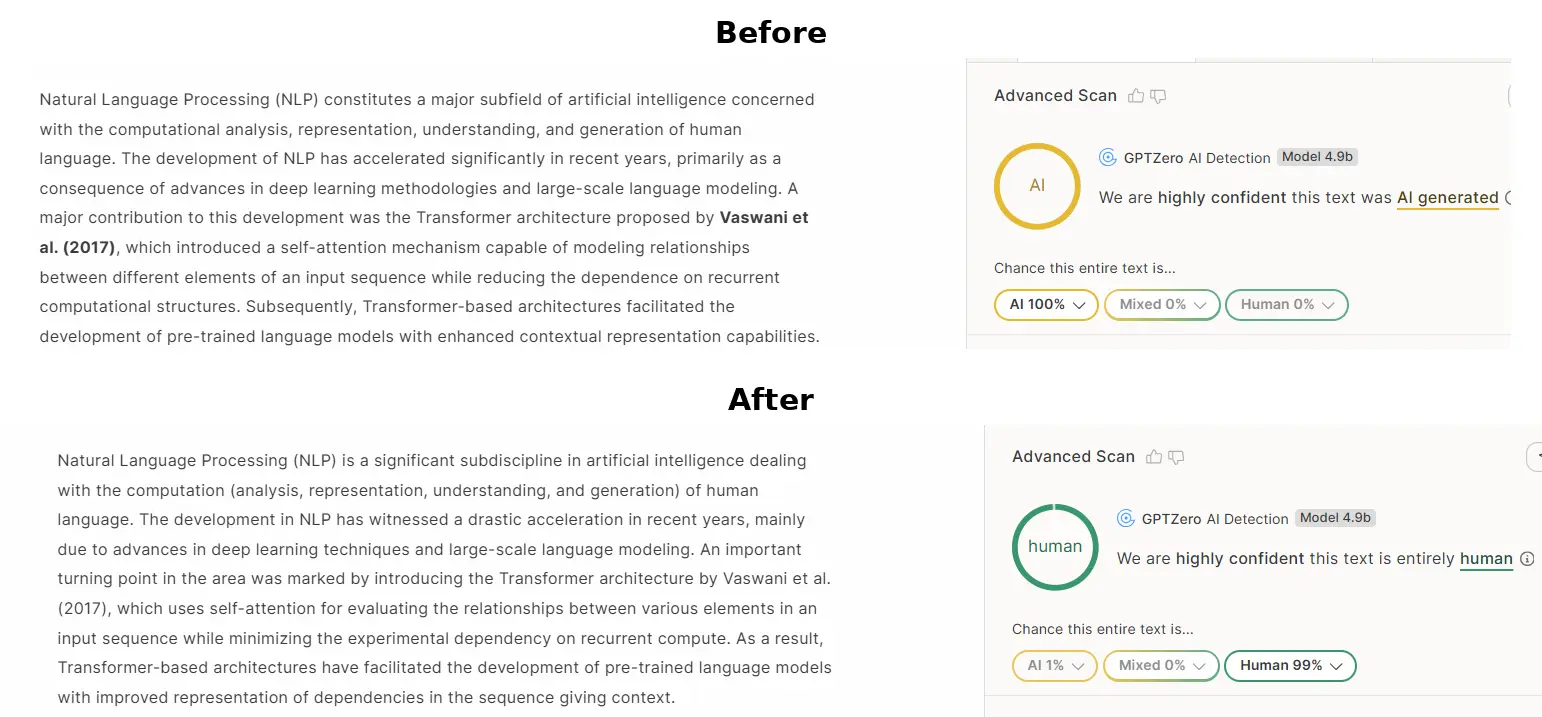
3. GPTZero Verification: Passing Perplexity & Burstiness Checks
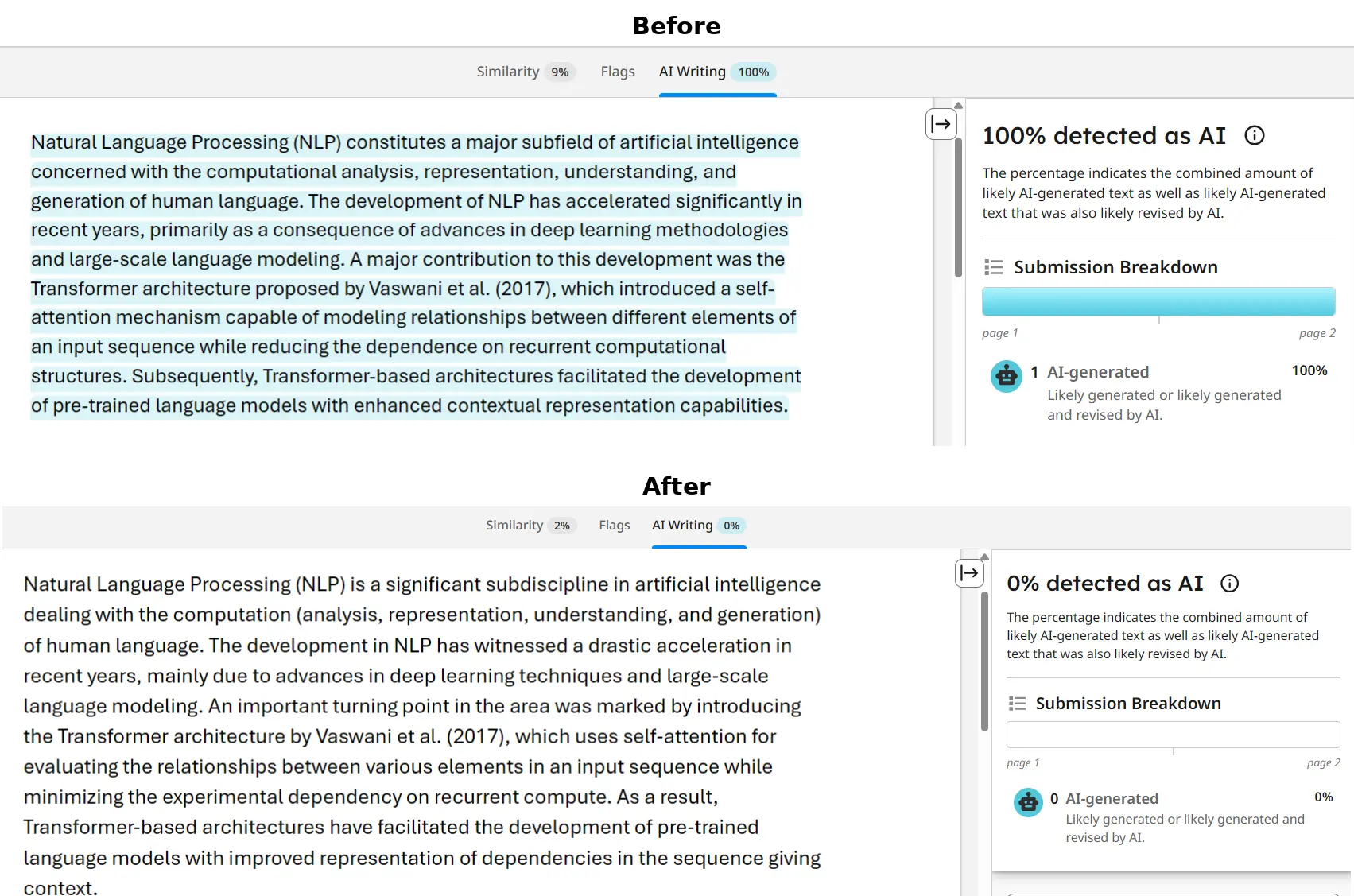
GPTZero evaluates text by plotting sentence perplexity curves and global burstiness scores. When raw AI text is scanned, low sentence variance produces an immediate high-probability warning. ThesisHuman restores natural sentence entropy by restructuring syntax, varying clause lengths, and introducing authentic scholarly cadence, dropping AI probability to 0%.
4. Originality.ai Verification: 0% AI Confidence
Originality.ai flags predictable n-gram sequences and common AI clichés (such as “delving into,” “pivotal role,” “testament to”). ThesisHuman purges overused formulaic transitions while elevating scholarly tone and keeping reference numbers and equations intact, producing 100% Original / 0% AI results.