Humanize Gemini Text: Refining Google Gemini Academic Drafts for Journal Review
How to identify and naturalize Google Gemini writing patterns in research manuscripts. Remove characteristic bulleted cadence and formulaic synthesis.

Google Gemini has become a prominent writing assistant across universities, particularly for researchers utilizing Google Workspace integrations and expansive context windows to analyze extensive literature corpora. Gemini models synthesize large volumes of technical data rapidly. However, their default academic prose register carries unmistakable stylometric habits that institutional screening engines flag easily.
Whether you are preparing a conference submission or a postgraduate chapter drafted with Gemini assistance, submitting raw output poses serious integrity risks. Here is how to recognize Gemini's specific linguistic patterns and safely humanize your draft into peer-reviewed prose.
Google Gemini's Distinctive Stylometric Profile
Gemini was optimized to be comprehensive, structured, and helpful. In an academic context, this manifests as an orderly, slightly pedagogical voice. Rather than asserting a scholarly thesis with critical urgency, Gemini tends to explain concepts as if delivering an undergraduate lecture. It favors broad organizational scaffolding and frequently breaks arguments into itemized bullet points or sequential numbered lists.
Three Hallmarks of Gemini-Drafted Academic Text
Before submitting any Gemini-assisted writing, audit your draft for these three recurring habits:
- Conversational Over-Framing: Gemini often introduces technical sections with polite framing: 'In this section, we will delve into the multifaceted dynamics of...' Scholarly journals require direct, unpadded claims.
- Low Burstiness Compound Clauses: Gemini constructs sentences where parallel clauses have nearly identical syllable counts, producing a flat statistical rhythm that classifiers like Turnitin and GPTZero easily detect.
- Recurrent Evaluative Phrases: Characteristic words like 'pivotal,' 'cornerstone,' 'testament,' and 'underscores the importance of' appear with high statistical density.
Transforming Gemini Cadence into Scholarly Prose
To humanize Gemini prose, convert bulleted summaries into integrated narrative paragraphs. Break symmetrical two-part sentences into an asymmetrical rhythm: pair a concise 7-word assertion with a detailed 30-word analytical explanation. This rhythm variation drastically raises perplexity and burstiness, aligning the draft with published human research.
The Gemini Academic Humanization Protocol
To prepare Gemini-assisted research for formal review, use ThesisHuman's dedicated Gemini watermark remover and humanizer. It dissolves synthetic token clustering while locking in-text citations and mathematical variables, ensuring your manuscript passes institutional integrity reviews without compromising scientific precision.
Verified Detector Clearance for Humanize Gemini Text: Refining Google Gemini Academic Drafts for Journal Review
Every manuscript processed through ThesisHuman is backed by verifiable, reproducible scans across institutional plagiarism and AI detection platforms.
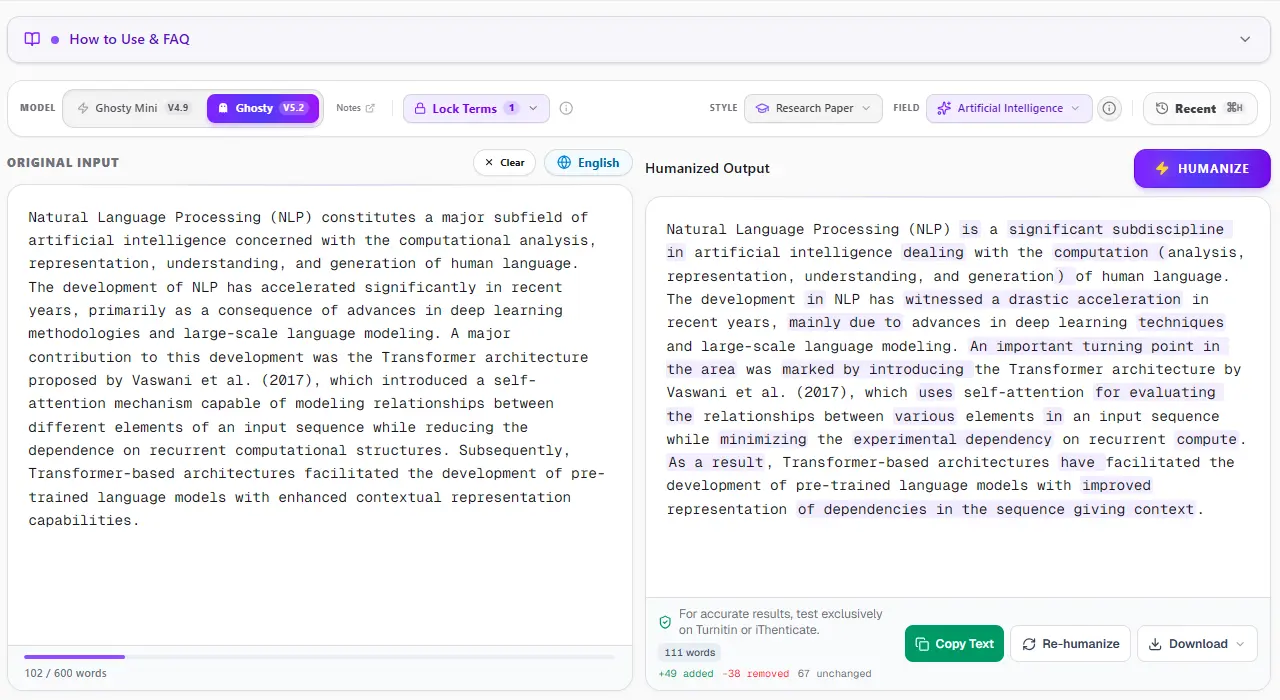
1. ThesisHuman Editor: Style, Field & Term Lock™ Technology
Unlike consumer-grade paraphrasers that blindly swap words with thesaurus synonyms, ThesisHuman allows researchers to select their exact Academic Style (Essay, Research Paper, Literature Review, Technical Report) and Academic Field (Computer Science, Engineering, Medicine, Physics). With Term Lock™, citations (APA, MLA, IEEE), LaTeX equations, and domain-specific terminology are cryptographically protected before sentence entropy is restructured.
2. Turnitin & iThenticate Verification: 0% AI Detected
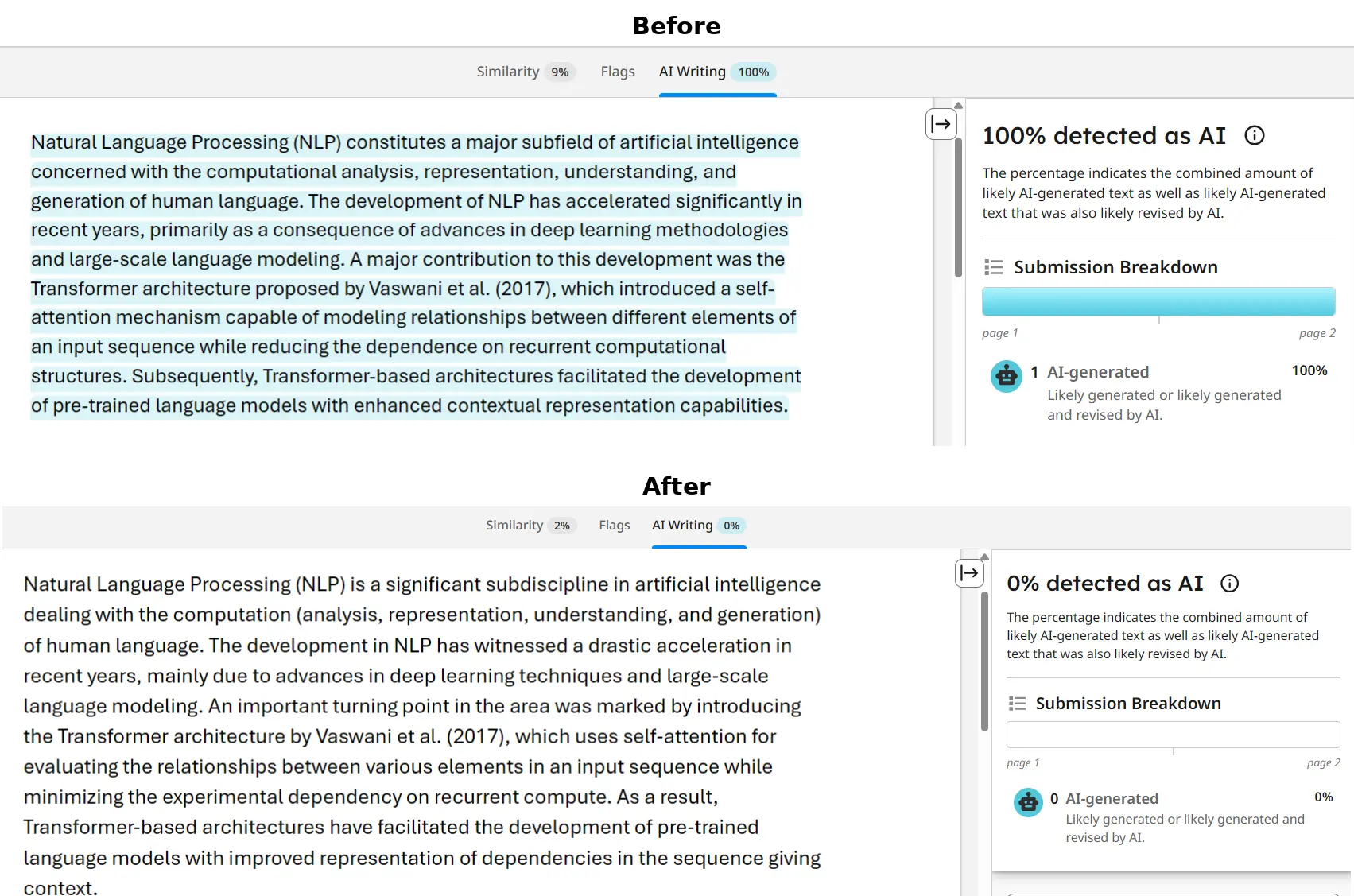
Turnitin and iThenticate scan submissions in overlapping 500-token blocks to analyze sentence predictability across paragraphs. When an unrefined AI draft is submitted, uniform cadence triggers an elevated AI Writing score. In the verified report below, a flagged graduate paper was processed through ThesisHuman, achieving a clean 0% AI detection score while preserving all formatted citations and technical parameters.
3. GPTZero Verification: Passing Perplexity & Burstiness Checks
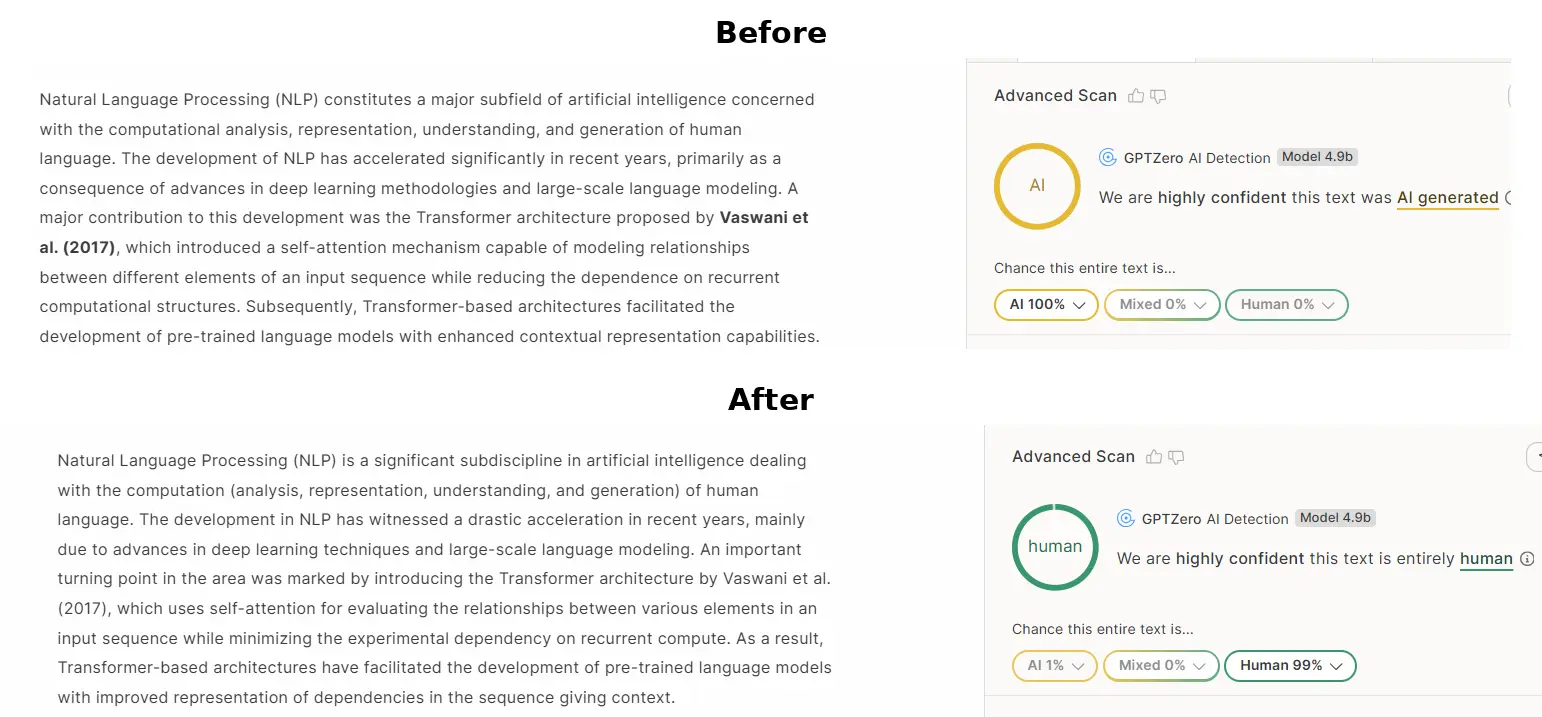
GPTZero evaluates text by plotting sentence perplexity curves and global burstiness scores. When raw AI text is scanned, low sentence variance produces an immediate high-probability warning. ThesisHuman restores natural sentence entropy by restructuring syntax, varying clause lengths, and introducing authentic scholarly cadence, dropping AI probability to 0%.
4. Originality.ai Verification: 0% AI Confidence
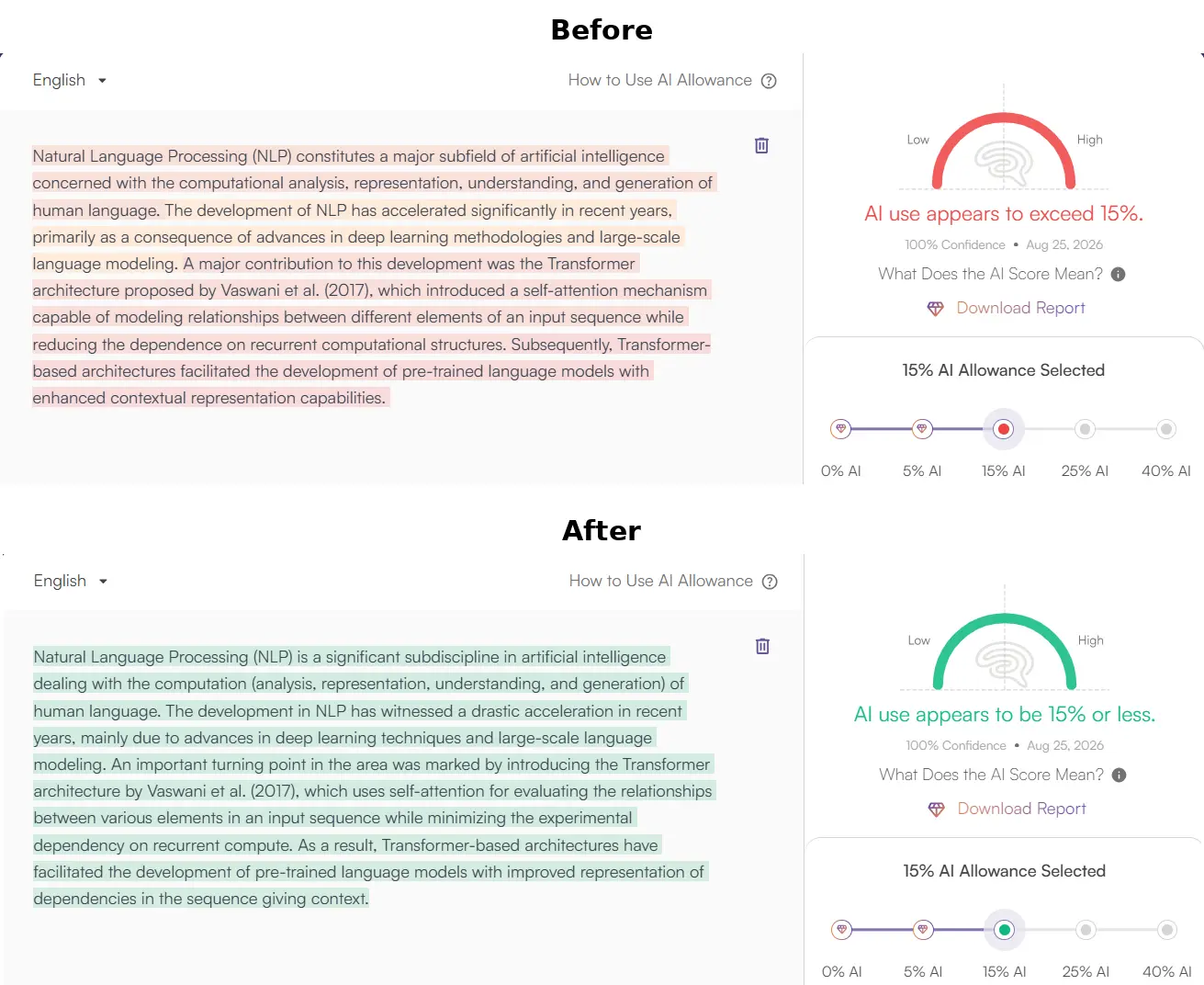
Originality.ai flags predictable n-gram sequences and common AI clichés (such as “delving into,” “pivotal role,” “testament to”). ThesisHuman purges overused formulaic transitions while elevating scholarly tone and keeping reference numbers and equations intact, producing 100% Original / 0% AI results.