Humanize Legal Scholarship: Navigating Bluebook Citations and Law Review Submissions
How legal scholars and law students can refine AI-assisted law review articles. Protect complex Bluebook footnote structures and jurisprudential reasoning.
Legal scholarship occupies a unique position in academia. Unlike peer-reviewed scientific journals, American law reviews are edited primarily by second- and third-year law students. Furthermore, legal manuscripts are famously extensive, often running 20,000 to 40,000 words with hundreds of intricate footnotes adhering to the rigorous rules of The Bluebook: A Uniform System of Citation.
Legal academics and law students frequently use generative AI to assist with synthesizing case law, summarizing legislative histories, or formatting comparative doctrinal analyses. However, unedited AI output carries distinct stylistic and technical risks in legal publishing. Here is how legal scholars can humanize law review drafts without corrupting Bluebook citations or doctrinal rigor.
The Unique Law Review Selection Ecosystem
Law review submission cycles (primarily February and August) are chaotic. Student editorial boards review thousands of manuscripts submitted through Scholastica. Facing overwhelming volume, editors quickly reject submissions that sound generic or read like AI summaries. Legal scholarship demands forceful jurisprudential voice, original statutory interpretation, and deep normative arguments.
The Complexity of Bluebook Footnote Networks
A law review article often consists of 50% body text and 50% footnotes. A single footnote might string together parenthetical explanations, statutory cross-references, and signals like 'See, e.g.,' or 'Compare... with...' Standard paraphrasing tools fail completely on legal footnotes: they delete signals, rephrase statutory sections, and detach pincites from their corresponding propositions.
Doctrinal Precision vs Algorithmic Paraphrasing
In law, words are legal standards. Swapping 'arbitrary and capricious' with 'random and unpredictable' destroys administrative law precision. Similarly, confusing 'interstate commerce' with 'business among states' alters constitutional doctrine. Legal humanization must hold terms of art completely locked.
A 4-Step Protocol for Legal Scholars
- Lock Terms of Art: Use ThesisHuman's Term Lock to freeze legal doctrines, statutory sections, and Latin maxims.
- Protect Footnote Networks: Separate body narrative from dense footnote blocks before cadence naturalization.
- Assert Clear Normative Claims: Ensure the prose takes a definitive stance on judicial interpretations rather than blandly summarizing case holdings.
- Audit Pincites and Direct Quotes: Perform a line-by-line verification of judicial quotations against the official reporter volumes.
Verified Detector Clearance for Humanize Legal Scholarship: Navigating Bluebook Citations and Law Review Submissions
Every manuscript processed through ThesisHuman is backed by verifiable, reproducible scans across institutional plagiarism and AI detection platforms.
1. ThesisHuman Editor: Style, Field & Term Lock™ Technology
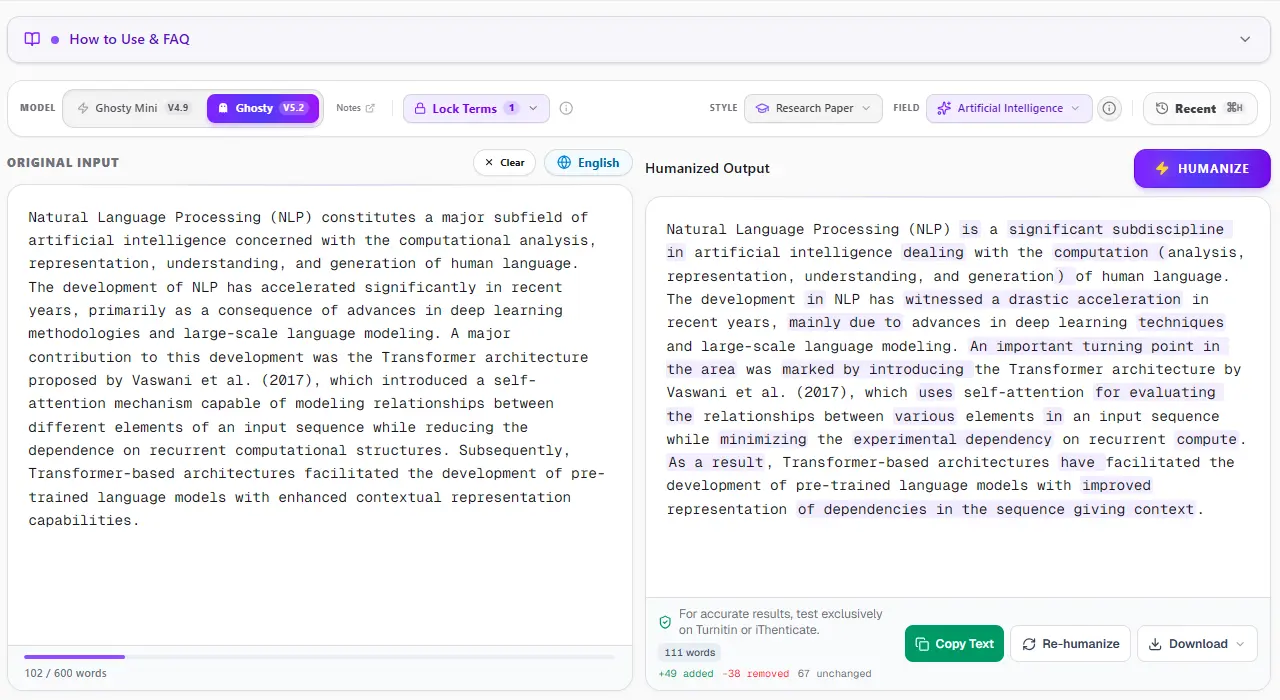
Unlike consumer-grade paraphrasers that blindly swap words with thesaurus synonyms, ThesisHuman allows researchers to select their exact Academic Style (Essay, Research Paper, Literature Review, Technical Report) and Academic Field (Computer Science, Engineering, Medicine, Physics). With Term Lock™, citations (APA, MLA, IEEE), LaTeX equations, and domain-specific terminology are cryptographically protected before sentence entropy is restructured.
2. Turnitin & iThenticate Verification: 0% AI Detected
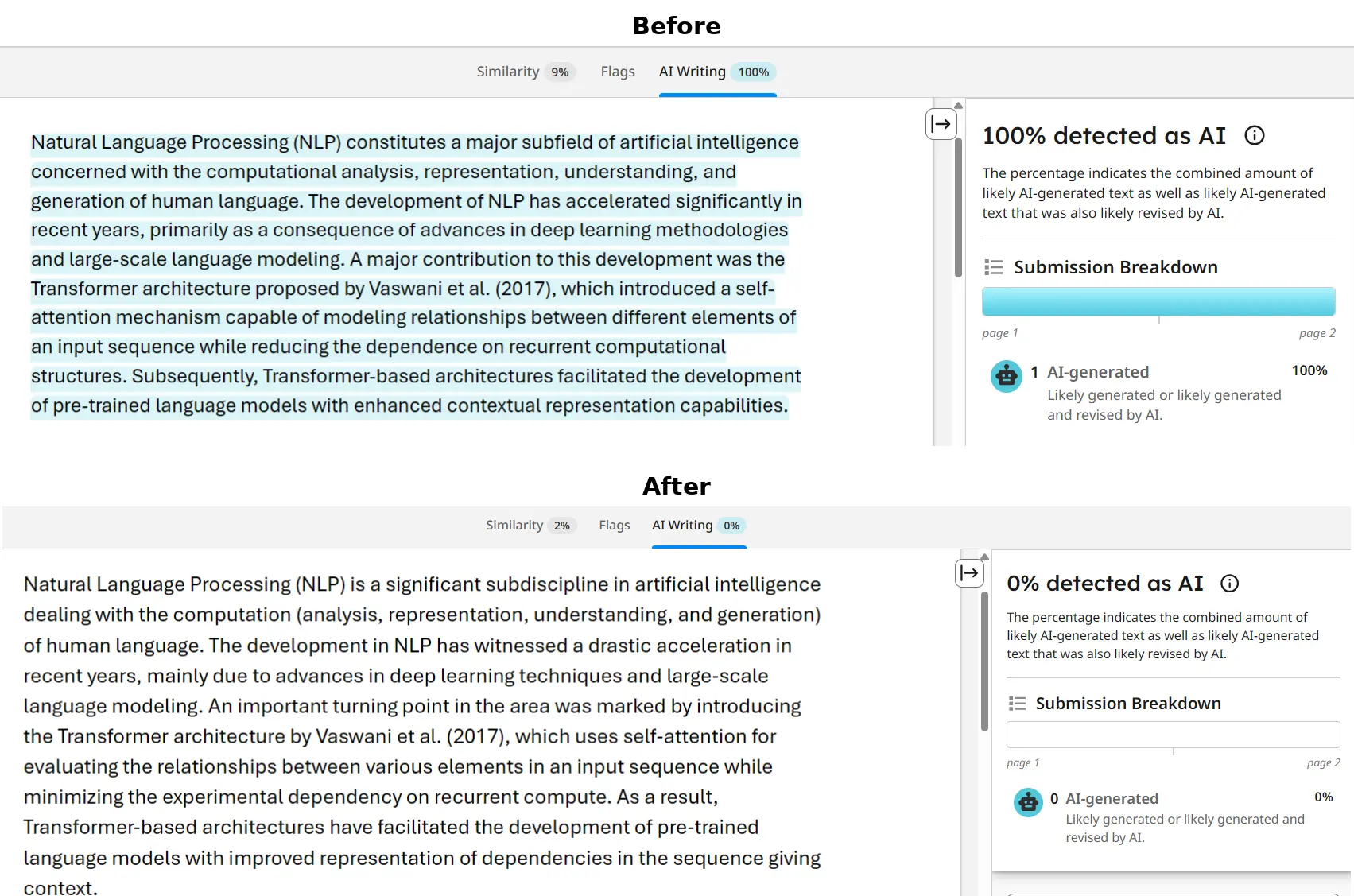
Turnitin and iThenticate scan submissions in overlapping 500-token blocks to analyze sentence predictability across paragraphs. When an unrefined AI draft is submitted, uniform cadence triggers an elevated AI Writing score. In the verified report below, a flagged graduate paper was processed through ThesisHuman, achieving a clean 0% AI detection score while preserving all formatted citations and technical parameters.
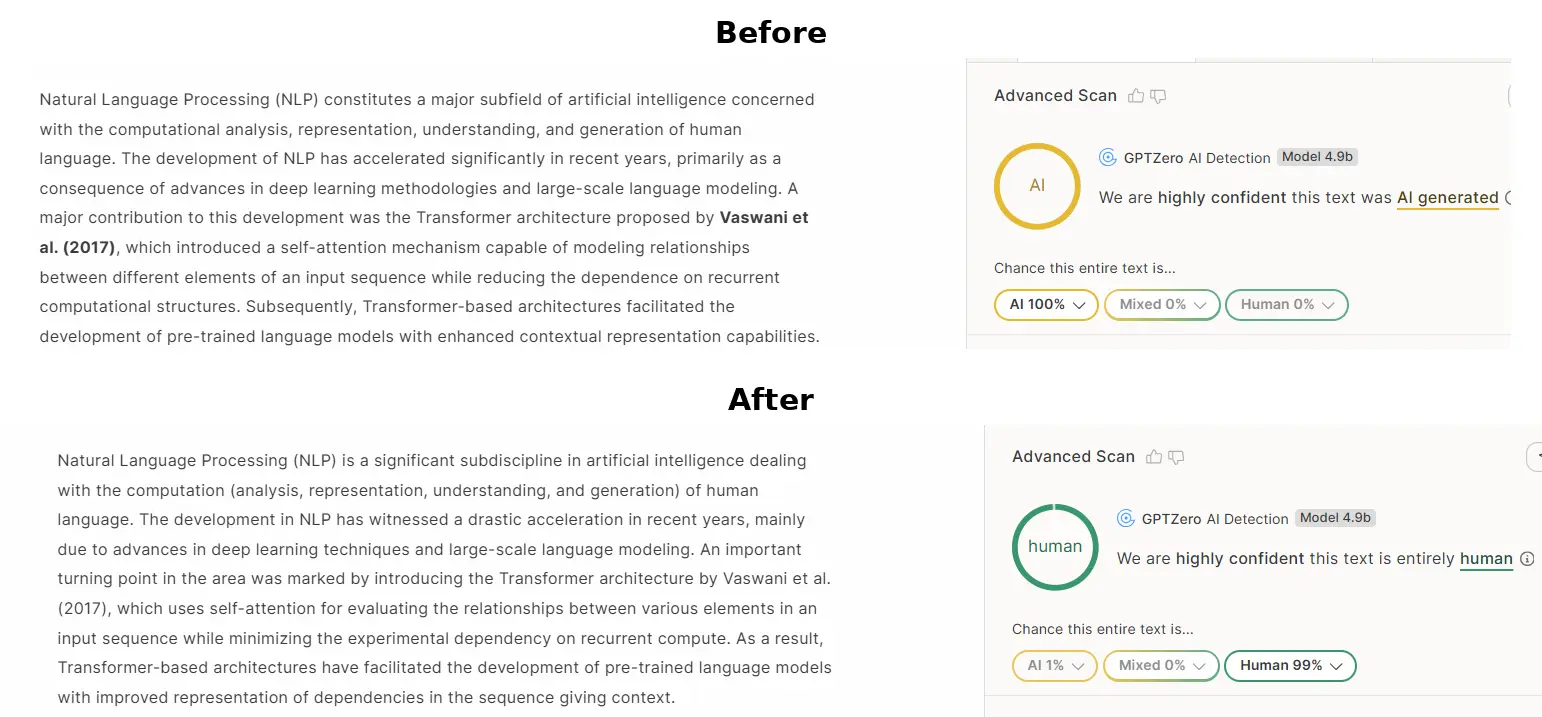
3. GPTZero Verification: Passing Perplexity & Burstiness Checks
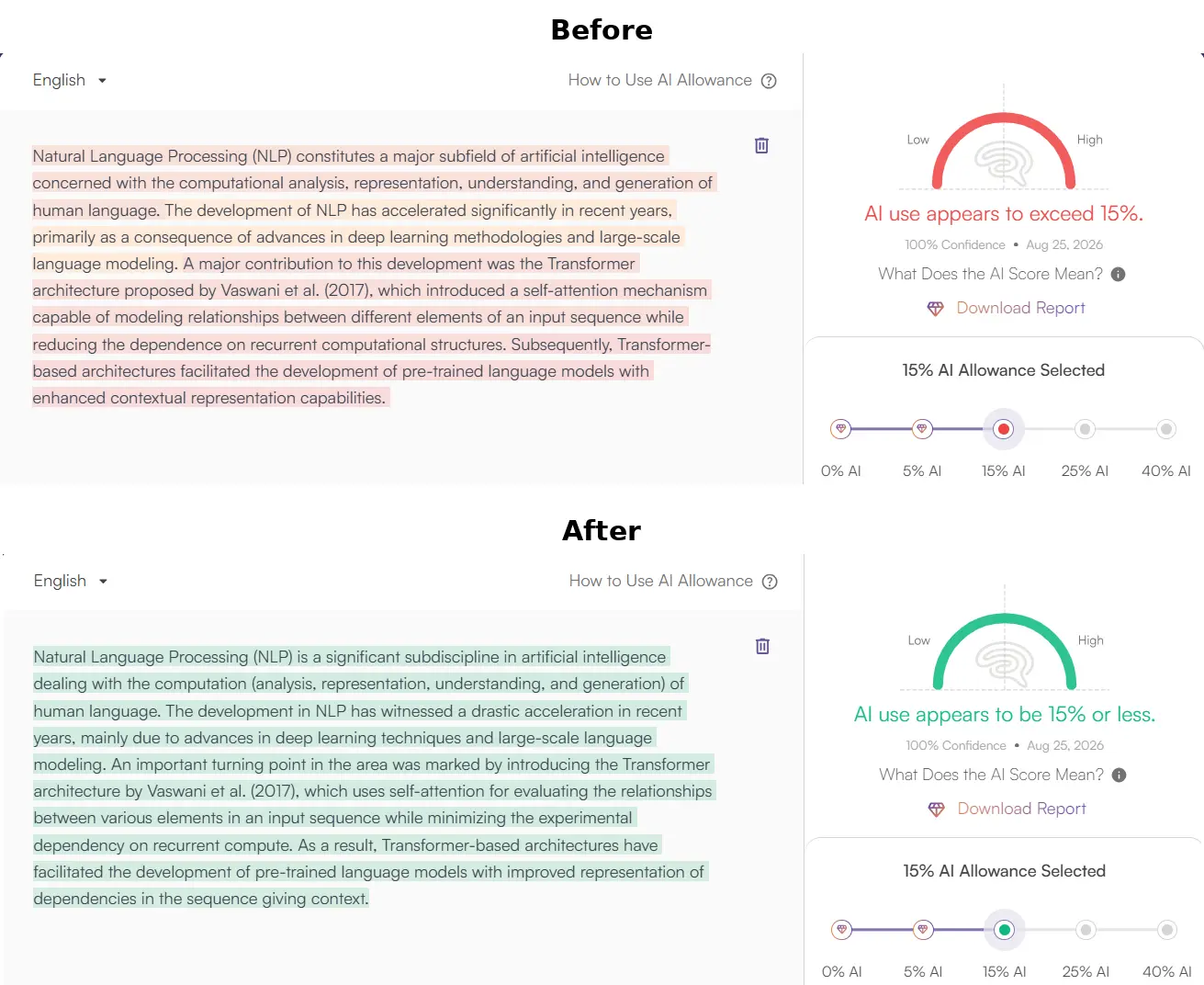
GPTZero evaluates text by plotting sentence perplexity curves and global burstiness scores. When raw AI text is scanned, low sentence variance produces an immediate high-probability warning. ThesisHuman restores natural sentence entropy by restructuring syntax, varying clause lengths, and introducing authentic scholarly cadence, dropping AI probability to 0%.
4. Originality.ai Verification: 0% AI Confidence
Originality.ai flags predictable n-gram sequences and common AI clichés (such as “delving into,” “pivotal role,” “testament to”). ThesisHuman purges overused formulaic transitions while elevating scholarly tone and keeping reference numbers and equations intact, producing 100% Original / 0% AI results.