Humanize PhD Abstracts: Densifying and Naturalizing Conference Camera-Ready Prose
How to fit critical research claims into tight 250-word abstract limits without triggering synthetic rhythm flags during conference camera-ready screening.

The abstract is the most widely read portion of any research paper. Indexed in PubMed, IEEE Xplore, and Google Scholar, it determines whether fellow researchers download your full manuscript. For conference submissions (such as IEEE, ACM, or NeurIPS), the abstract also faces strict word limits, typically capped at 150 to 250 words.
Compressing months of empirical work into 250 words is challenging, leading many authors to ask AI for assistance. However, because abstracts require dense, formulaic reporting, AI-drafted abstracts frequently trigger severe detection flags. Here is how to densify and naturalize your camera-ready abstract.
The Abstract Density Paradox
An academic abstract must cover five essential components within four to six sentences: background motivation, core research question, empirical methodology, primary findings, and broader implications. Because each sentence has a distinct structural job, language models generate abstracts that read like an assembly line: five sentences of almost identical length, joined by predictable connectors.
Why Machine-Generated Abstracts Trip Detectors
Detectors like iThenticate and Turnitin evaluate short text blocks with heightened sensitivity. When an abstract consists of five consecutive 35-word sentences with low vocabulary surprise, the statistical burstiness metric drops to near zero, resulting in an elevated AI probability score that can delay camera-ready approval.
Densifying Prose Without Algorithmic Rigidity
To humanize an abstract while maintaining density, break the uniform sentence length pattern. Open with an ultra-compact problem statement (under 12 words). Follow with an expanded, clause-rich methodology sentence (35-40 words) that details your exact experimental apparatus. Conclude with a crisp, direct statement of your percentage performance gain.
Step-by-Step Abstract Humanization Protocol
- Cut Rhetorical Framing: Delete opening fluff like 'In the era of modern computational expansion...' State the technical bottleneck immediately.
- Lock Metrics and Acronyms: Use ThesisHuman's abstract humanizer to lock quantitative benchmarks, error margins, and model acronyms.
- Synthesize with Cadence Variation: Apply Ghosty V6 to rebalance clausal asymmetry without exceeding your conference's 250-word cap.
- Verify Word Count Compliance: Ensure the final naturalized text meets the exact word limit required by the conference submission portal.
Verified Detector Clearance for Humanize PhD Abstracts: Densifying and Naturalizing Conference Camera-Ready Prose
Every manuscript processed through ThesisHuman is backed by verifiable, reproducible scans across institutional plagiarism and AI detection platforms.
1. ThesisHuman Editor: Style, Field & Term Lock™ Technology
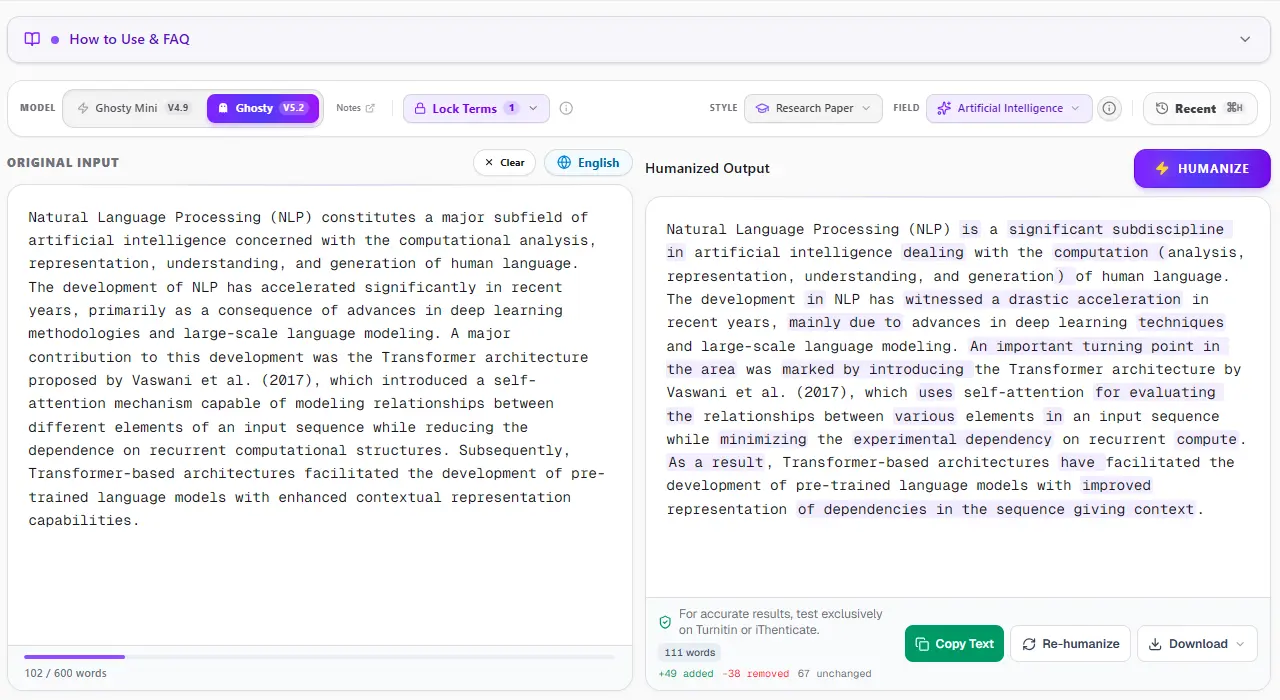
Unlike consumer-grade paraphrasers that blindly swap words with thesaurus synonyms, ThesisHuman allows researchers to select their exact Academic Style (Essay, Research Paper, Literature Review, Technical Report) and Academic Field (Computer Science, Engineering, Medicine, Physics). With Term Lock™, citations (APA, MLA, IEEE), LaTeX equations, and domain-specific terminology are cryptographically protected before sentence entropy is restructured.
2. Turnitin & iThenticate Verification: 0% AI Detected
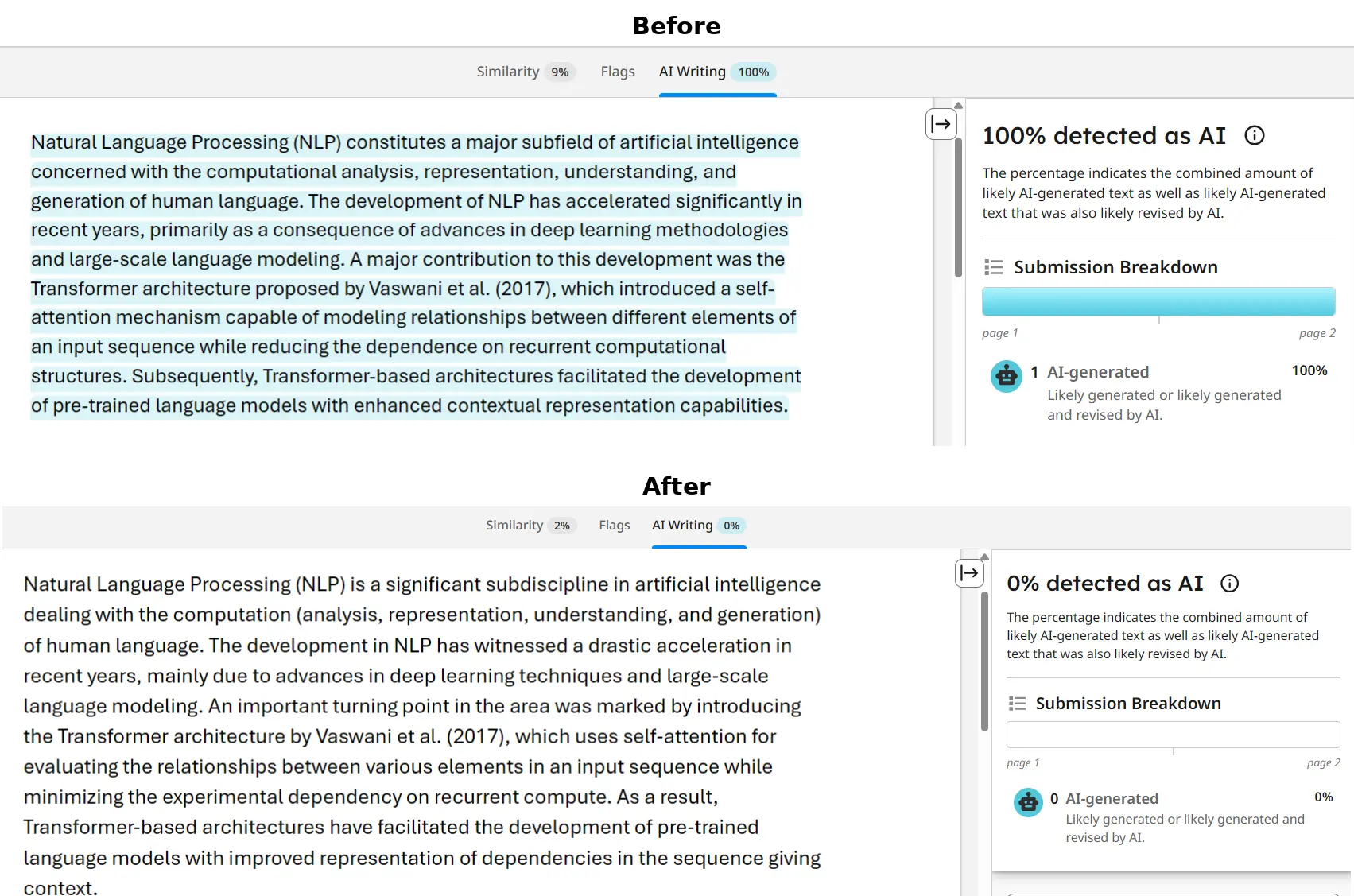
Turnitin and iThenticate scan submissions in overlapping 500-token blocks to analyze sentence predictability across paragraphs. When an unrefined AI draft is submitted, uniform cadence triggers an elevated AI Writing score. In the verified report below, a flagged graduate paper was processed through ThesisHuman, achieving a clean 0% AI detection score while preserving all formatted citations and technical parameters.
3. GPTZero Verification: Passing Perplexity & Burstiness Checks
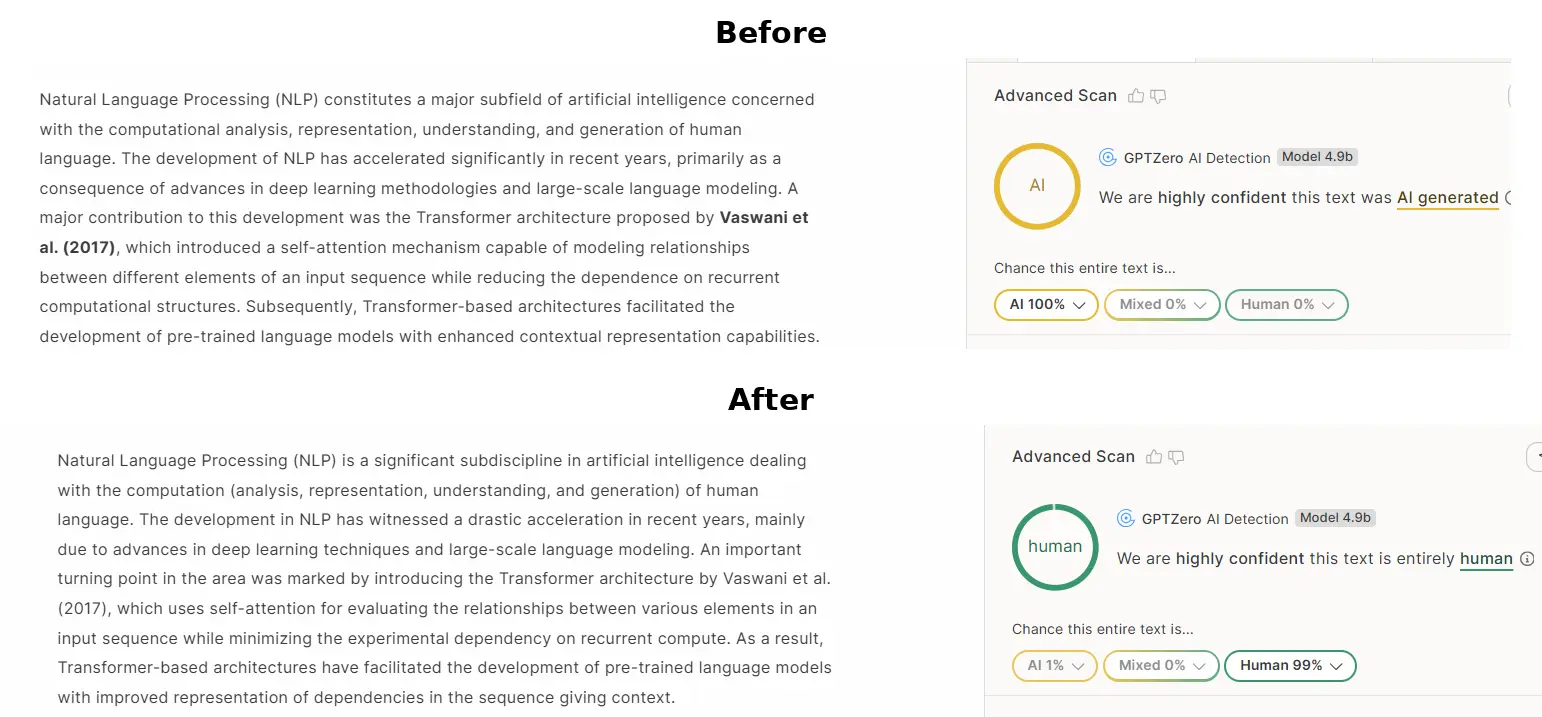
GPTZero evaluates text by plotting sentence perplexity curves and global burstiness scores. When raw AI text is scanned, low sentence variance produces an immediate high-probability warning. ThesisHuman restores natural sentence entropy by restructuring syntax, varying clause lengths, and introducing authentic scholarly cadence, dropping AI probability to 0%.
4. Originality.ai Verification: 0% AI Confidence
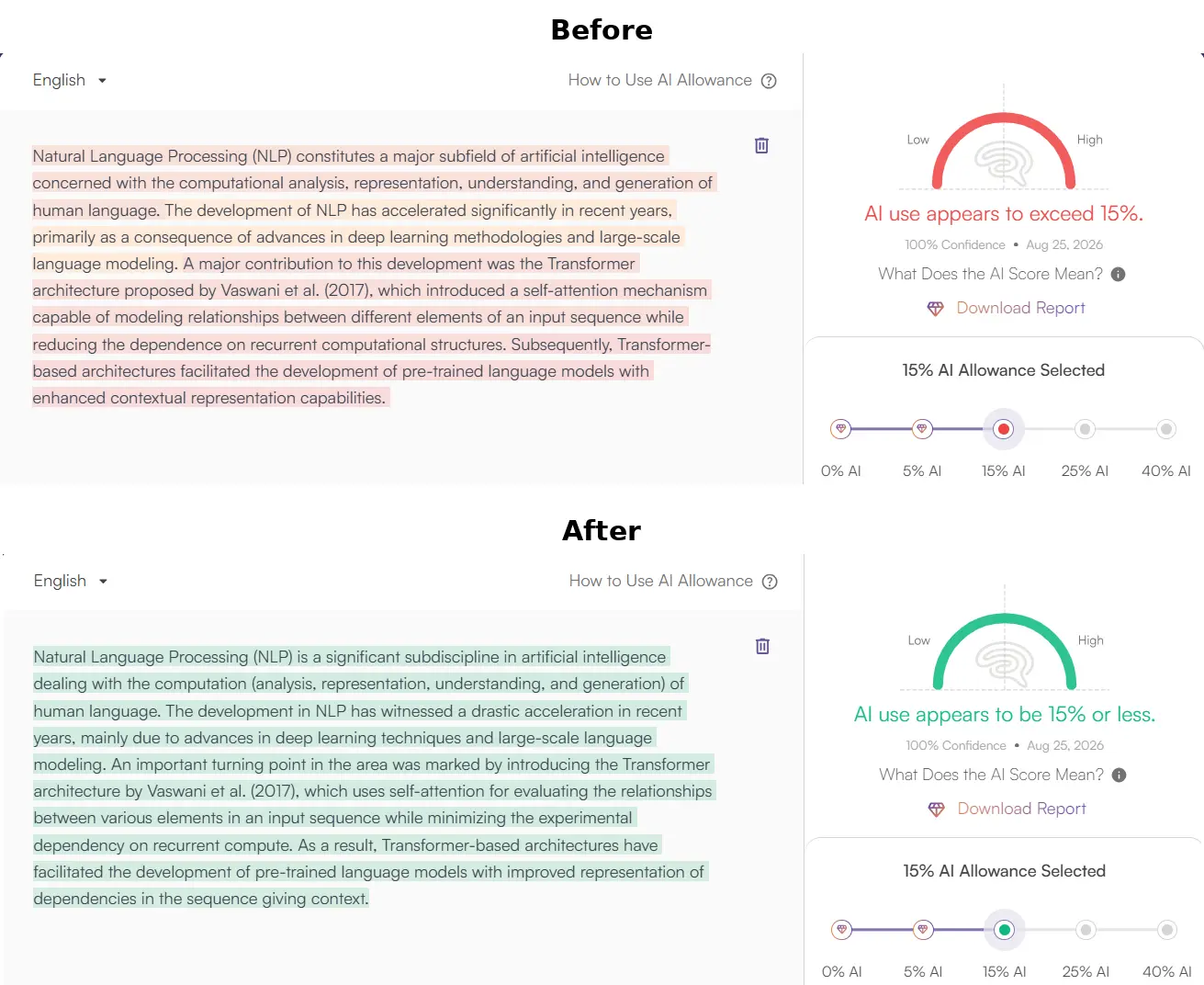
Originality.ai flags predictable n-gram sequences and common AI clichés (such as “delving into,” “pivotal role,” “testament to”). ThesisHuman purges overused formulaic transitions while elevating scholarly tone and keeping reference numbers and equations intact, producing 100% Original / 0% AI results.