Humanize Qualitative Research: Protecting Participant Quotes and Thematic Analysis
Preserving verbatim interview transcripts, grounded theory coding, and researcher reflexivity during AI-assisted qualitative analysis.

Qualitative inquiry in sociology, anthropology, nursing, and education relies on human lived experience. Through in-depth semi-structured interviews, focus groups, and ethnographic observations, qualitative scholars uncover rich, contextual insights. In recent years, researchers have begun using generative AI to help summarize lengthy interview transcripts and organize emergent themes.
However, qualitative scholarship requires deep methodological authenticity. If an automated tool alters a participant's spoken words or sands down the researcher's reflexive voice into generic corporate prose, the methodological integrity of the study is compromised. Here is how to safely humanize qualitative manuscripts while keeping participant voices pristine.
The Authenticity Imperative in Qualitative Research
In quantitative research, numbers provide the evidence; in qualitative research, language itself is the empirical data. Verbatim interview excerpts capture hesitations, colloquial expressions, cultural idioms, and emotional nuances. Peer reviewers and dissertation committees evaluate qualitative papers on the transparency of the researcher's interpretive trail and the fidelity with which participant voices are represented.
The Danger of Corrupting Verbatim Participant Quotes
Standard AI humanizers are programmed to eliminate grammatical irregularities. When passed text containing an informal participant quote (e.g., 'I felt like, you know, nobody was listening to us down there'), a consumer tool frequently rewrites the quote into formal English: 'The participant perceived a lack of institutional attentiveness.' This modification constitutes data falsification in qualitative research. Verbatim quotes must remain completely untouched.
Protecting Researcher Reflexivity and Positionality
Qualitative research requires an explicit statement of researcher positionality: how the author's background, social identity, and theoretical commitments influenced data interpretation. AI models struggle profoundly with reflexivity; they produce homogenized, third-person descriptions that lack personal intellectual honesty. The researcher's personal voice must remain front and center.
A Practical Qualitative Humanization Workflow
- Isolate Participant Quotations: In ThesisHuman's qualitative mode, activate quotation locking so that all text within quotation marks and blockquotes is completely shielded from modification.
- Refine Thematic Transition Prose: Allow the humanizer to restructure the explanatory narrative connecting your empirical themes, breaking repetitive transitional habits.
- Assert Theoretical Framing: Weave your chosen methodology (grounded theory, phenomenology, narrative inquiry) into section openings with varied sentence cadence.
- Verify Data Audit Trail: Ensure each participant quote corresponds precisely to its transcript line and anonymized participant identifier (e.g., Participant 4, Nurse, 8 years experience).
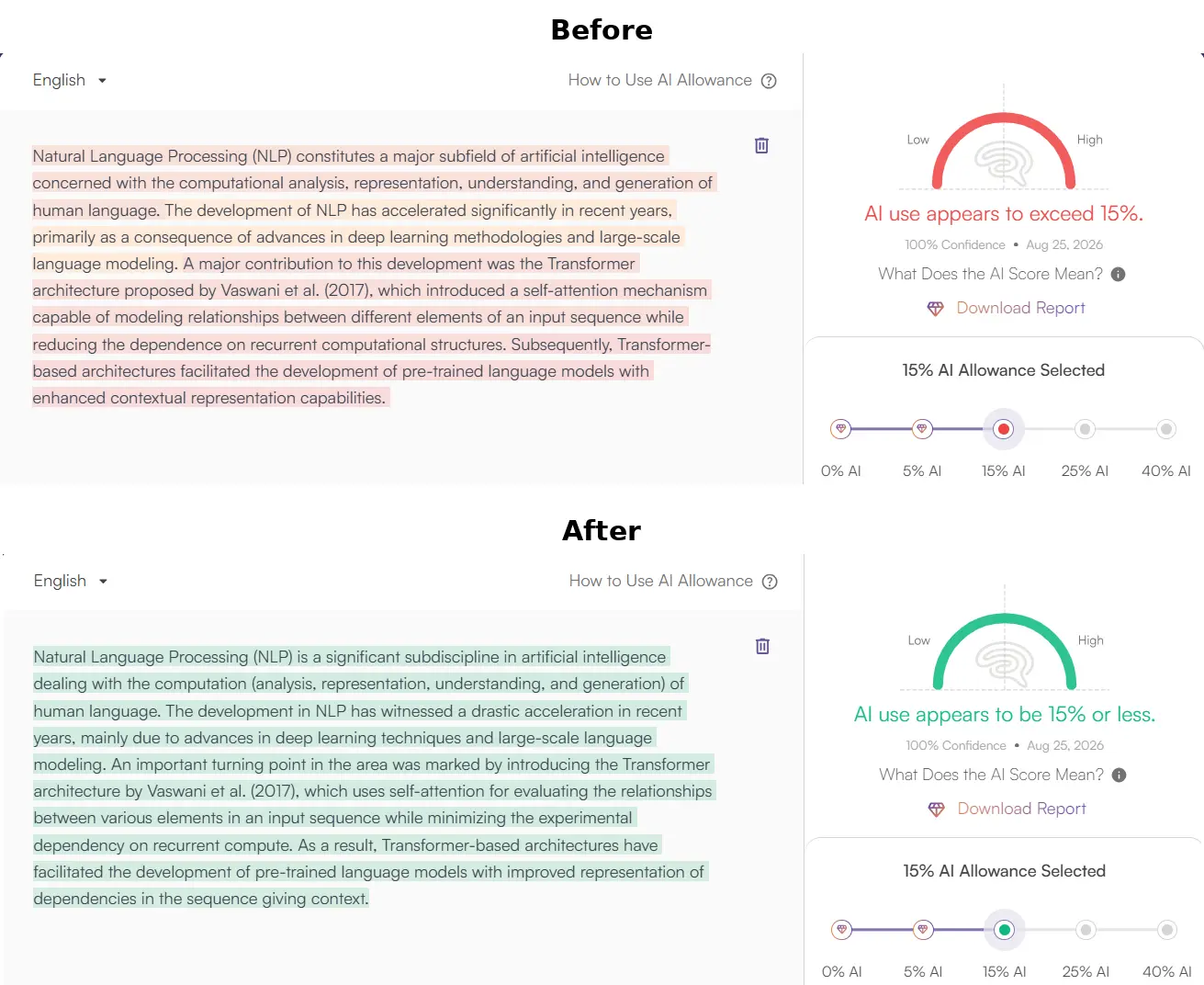
Verified Detector Clearance for Humanize Qualitative Research: Protecting Participant Quotes and Thematic Analysis
Every manuscript processed through ThesisHuman is backed by verifiable, reproducible scans across institutional plagiarism and AI detection platforms.
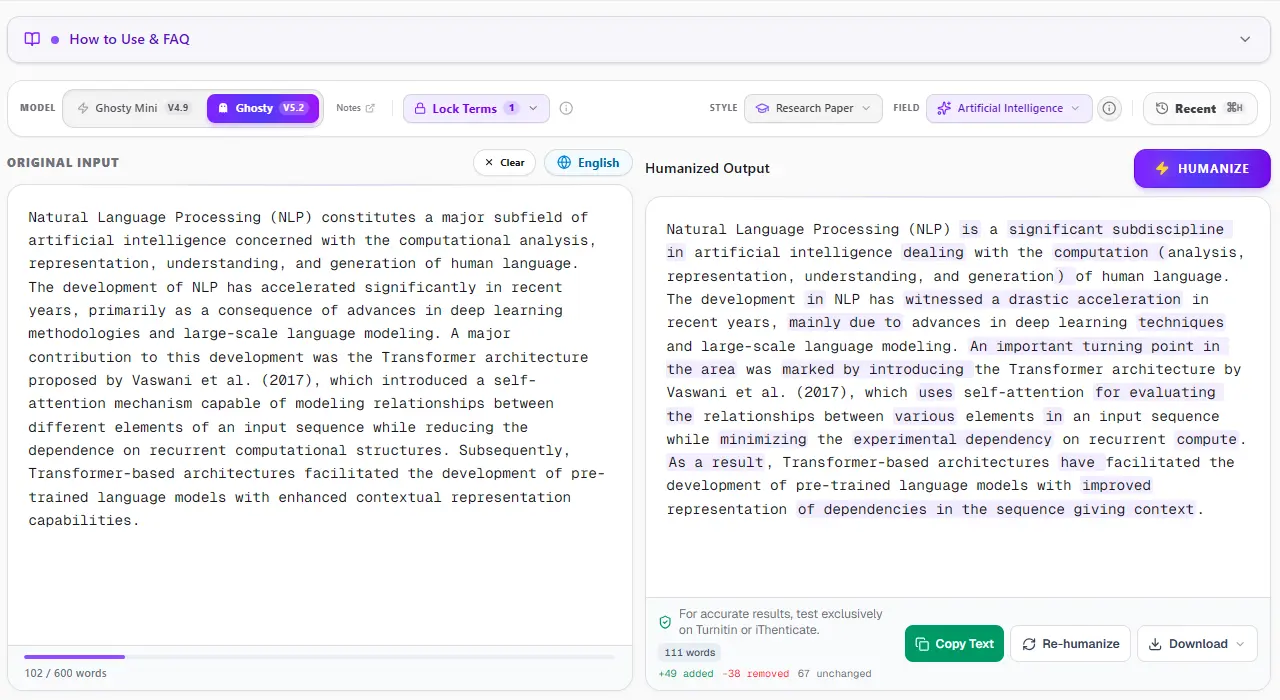
1. ThesisHuman Editor: Style, Field & Term Lock™ Technology
Unlike consumer-grade paraphrasers that blindly swap words with thesaurus synonyms, ThesisHuman allows researchers to select their exact Academic Style (Essay, Research Paper, Literature Review, Technical Report) and Academic Field (Computer Science, Engineering, Medicine, Physics). With Term Lock™, citations (APA, MLA, IEEE), LaTeX equations, and domain-specific terminology are cryptographically protected before sentence entropy is restructured.
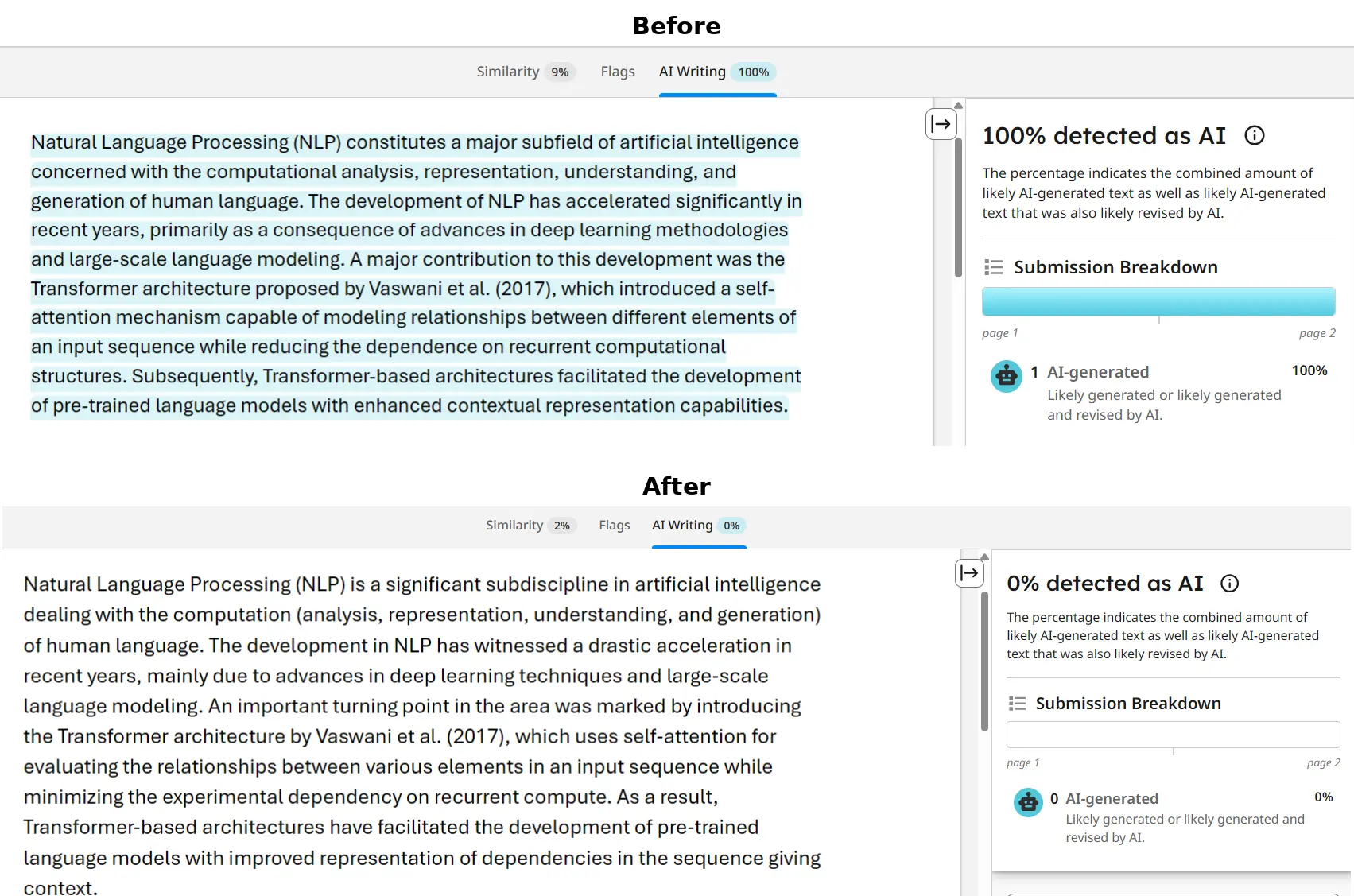
2. Turnitin & iThenticate Verification: 0% AI Detected
Turnitin and iThenticate scan submissions in overlapping 500-token blocks to analyze sentence predictability across paragraphs. When an unrefined AI draft is submitted, uniform cadence triggers an elevated AI Writing score. In the verified report below, a flagged graduate paper was processed through ThesisHuman, achieving a clean 0% AI detection score while preserving all formatted citations and technical parameters.
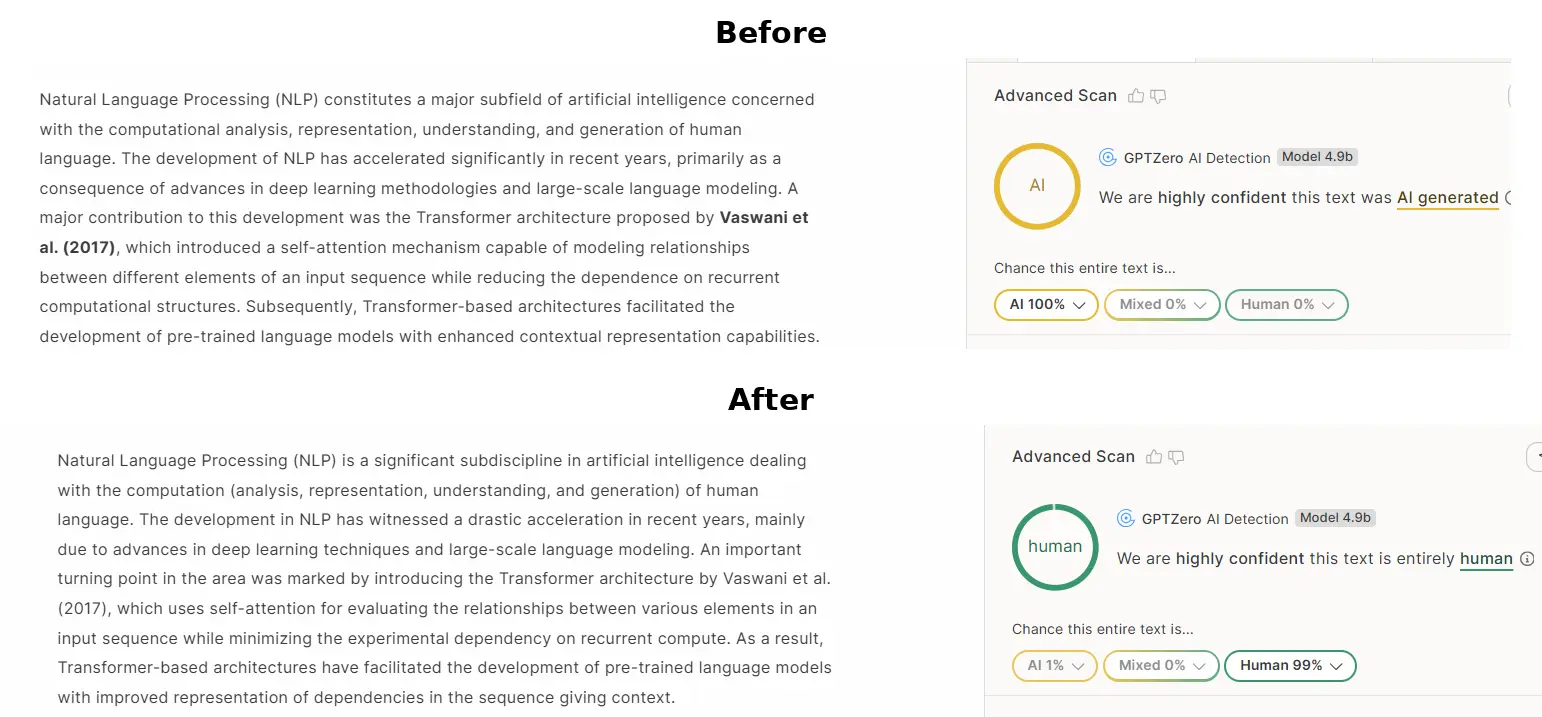
3. GPTZero Verification: Passing Perplexity & Burstiness Checks
GPTZero evaluates text by plotting sentence perplexity curves and global burstiness scores. When raw AI text is scanned, low sentence variance produces an immediate high-probability warning. ThesisHuman restores natural sentence entropy by restructuring syntax, varying clause lengths, and introducing authentic scholarly cadence, dropping AI probability to 0%.
4. Originality.ai Verification: 0% AI Confidence
Originality.ai flags predictable n-gram sequences and common AI clichés (such as “delving into,” “pivotal role,” “testament to”). ThesisHuman purges overused formulaic transitions while elevating scholarly tone and keeping reference numbers and equations intact, producing 100% Original / 0% AI results.