Humanize Humanities Research: Cultivating Voice in History, Philosophy, and Cultural Studies
Why humanities monographs require voice-driven humanization. Moving beyond AI neutrality to express nuanced historical arguments and critical theory.
In the humanities and interpretive social sciences (history, philosophy, literature, cultural anthropology), writing is not simply a vehicle for reporting data. In these disciplines, writing is the analytical method itself. How an argument is paced, how primary historical sources are framed, and how theoretical frameworks are woven together constitute the core of scholarly contribution.
When scholars in these fields use generative AI to assist with preliminary literature mapping or drafting background context, the resulting text often feels jarringly foreign. Large language models write with a detached, clinical neutrality that directly conflicts with the rich interpretive traditions of the humanities. Here is how to restore scholarly voice to AI-assisted humanities research.
The Imperative of Voice in Humanities Scholarship
Unlike clinical trial reports that prioritize standardized passive reporting, humanities monographs demand a distinct authorial perspective. When an essayist evaluates a post-colonial historical archive or analyzes a philosophical treatise, readers expect an engaged intellect wrestling with ambiguity, tension, and contradiction. An algorithm that flattens every contradiction into a polite consensus strips the scholarship of its intellectual value.
The AI Neutrality Trap in Historical and Cultural Studies
AI models are trained to present all sides of a topic with equal clausal weight: 'While traditional historians emphasize structural economic forces, cultural historians instead highlight grassroots agency.' While accurate as a textbook summary, a monograph author must take a stand, explaining why one perspective exposes archival realities that the other overlooks.
Protecting Chicago Notes and Archival Citations
Humanities scholarship relies heavily on The Chicago Manual of Style (Notes and Bibliography). Archival citations frequently include complex strings of manuscript collections, box numbers, and uncataloged folios (e.g., 'National Archives, Records of the Department of State, RG 59, Box 14, Folder 2'). Standard paraphrasers scramble these archival strings. ThesisHuman's humanities suite locks citation strings completely.
A 4-Step Humanities Humanization Protocol
- Dismantle Mechanical Parallelism: Break symmetrical clauses into dynamic, voice-driven sentences with varied subordinate pacing.
- Inject Archival Specificity: Anchor every broad conceptual observation in specific archival documents, literary quotes, or historical correspondence.
- Assert Critical Agency: Replace bland observational verbs ('reflects,' 'shows') with assertive interpretive claims ('interrogates,' 'destabilizes,' 'subverts').
- Lock Citations with ThesisHuman: Run your draft through ThesisHuman with Chicago citation locking enabled, preserving your archival references while restoring human cadence.
Verified Detector Clearance for Humanize Humanities Research: Cultivating Voice in History, Philosophy, and Cultural Studies
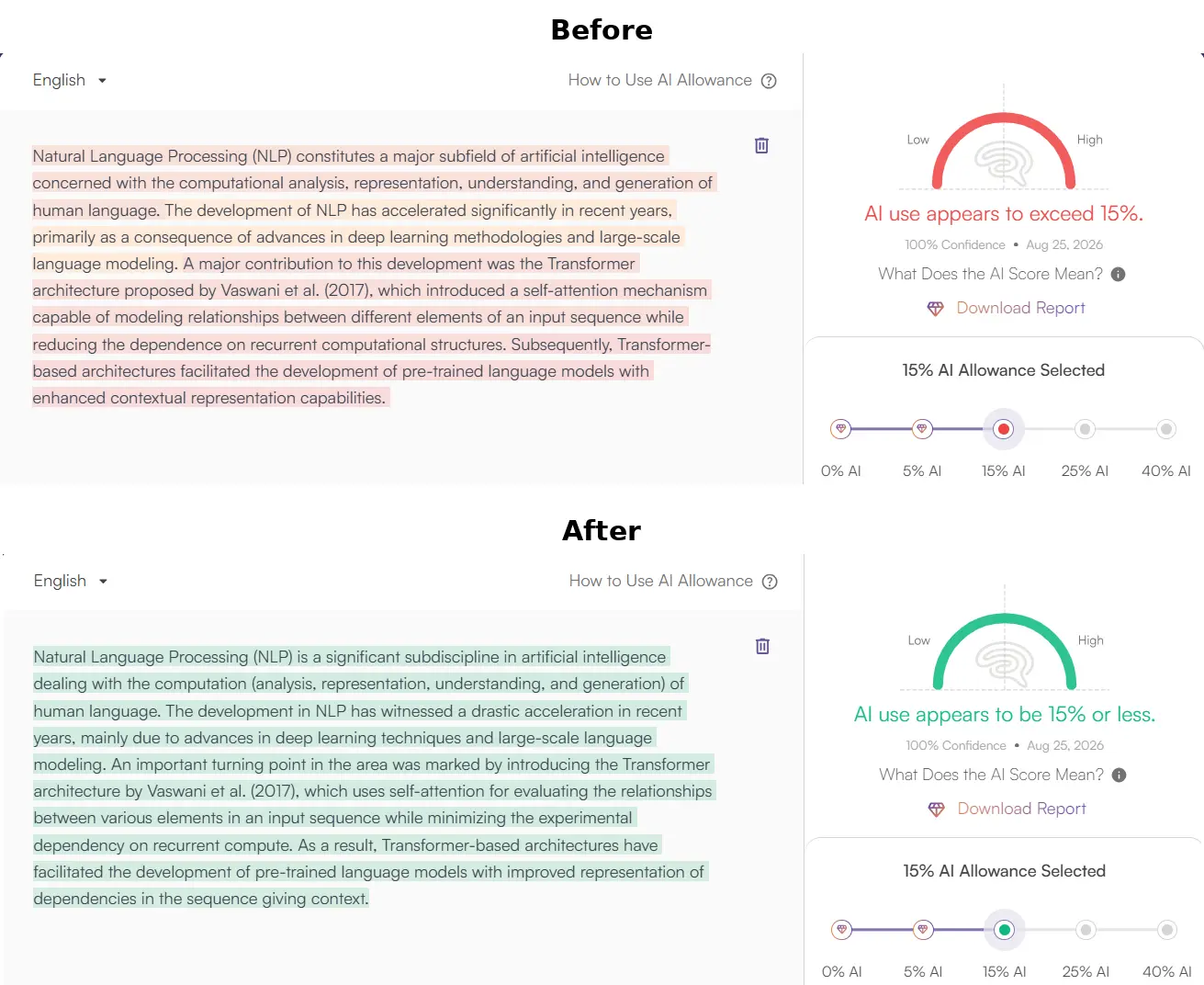
Every manuscript processed through ThesisHuman is backed by verifiable, reproducible scans across institutional plagiarism and AI detection platforms.
1. ThesisHuman Editor: Style, Field & Term Lock™ Technology
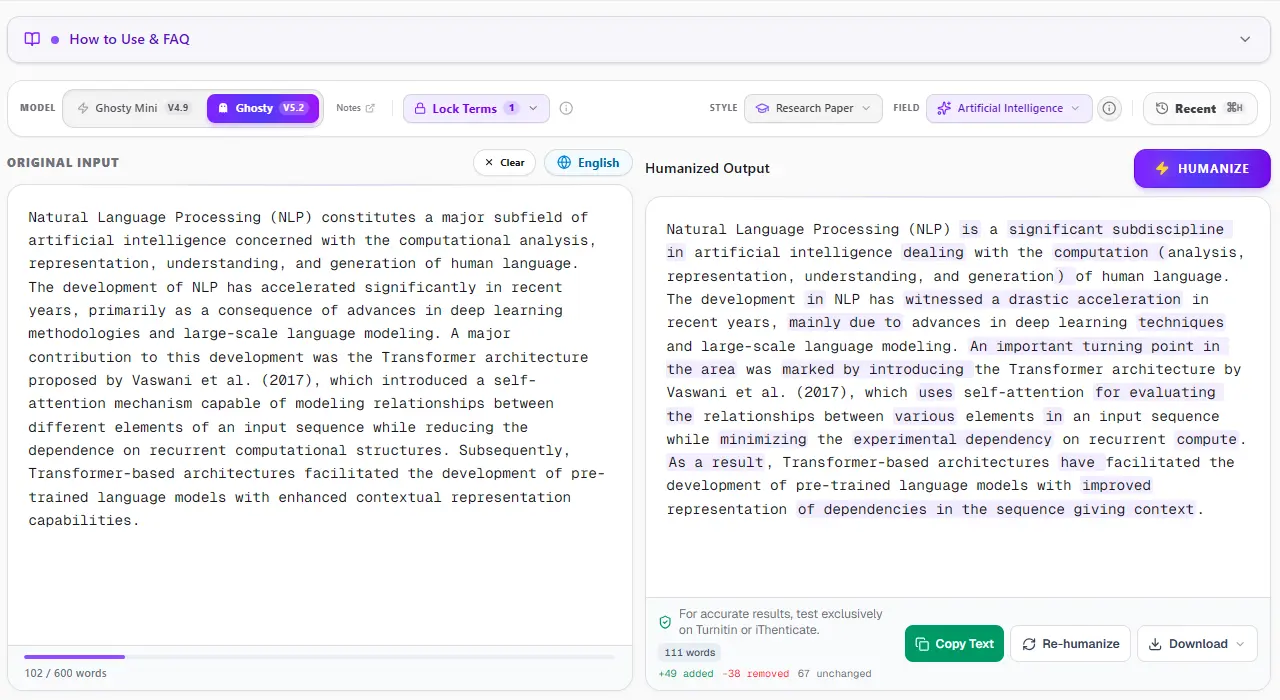
Unlike consumer-grade paraphrasers that blindly swap words with thesaurus synonyms, ThesisHuman allows researchers to select their exact Academic Style (Essay, Research Paper, Literature Review, Technical Report) and Academic Field (Computer Science, Engineering, Medicine, Physics). With Term Lock™, citations (APA, MLA, IEEE), LaTeX equations, and domain-specific terminology are cryptographically protected before sentence entropy is restructured.
2. Turnitin & iThenticate Verification: 0% AI Detected
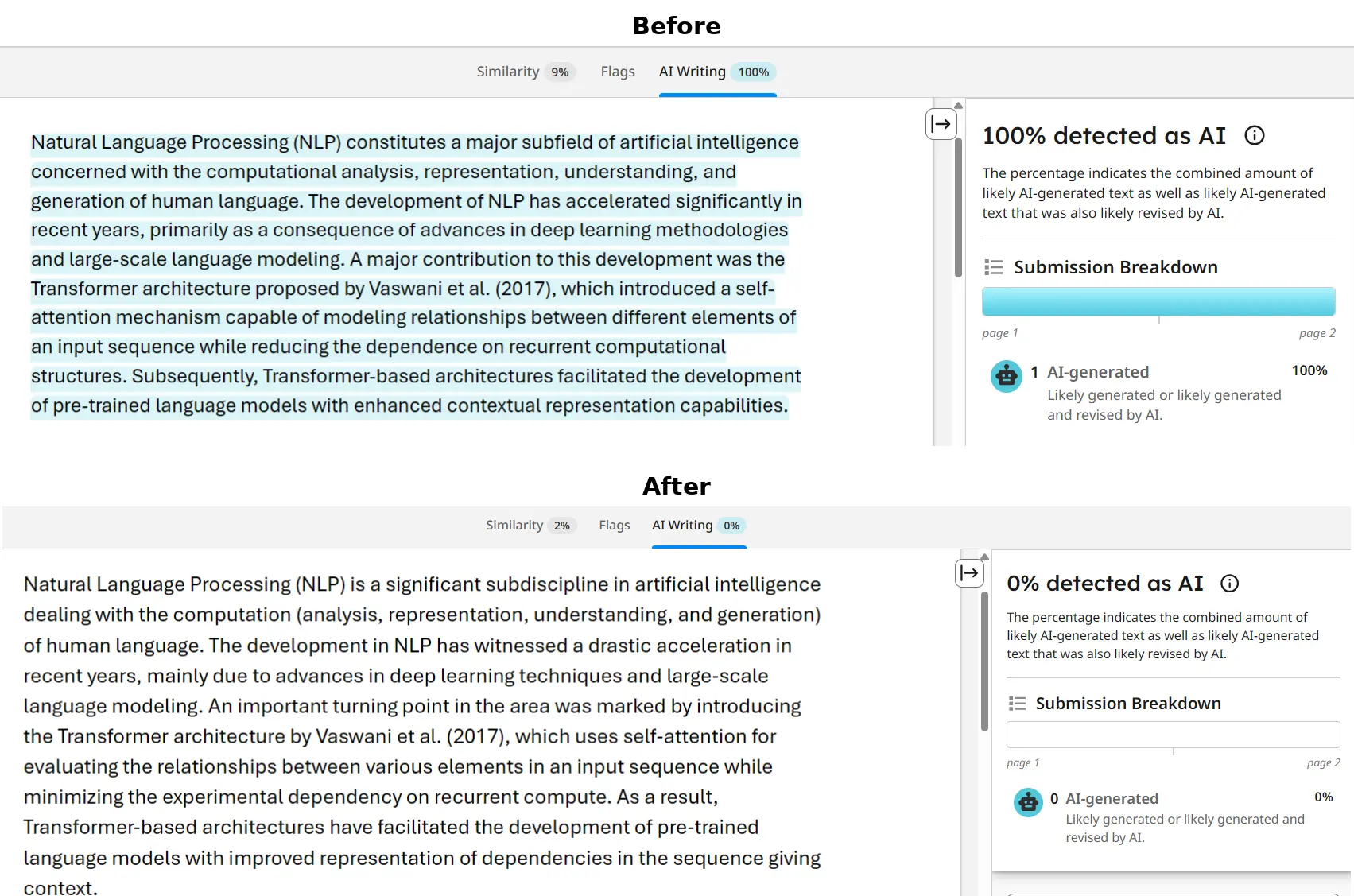
Turnitin and iThenticate scan submissions in overlapping 500-token blocks to analyze sentence predictability across paragraphs. When an unrefined AI draft is submitted, uniform cadence triggers an elevated AI Writing score. In the verified report below, a flagged graduate paper was processed through ThesisHuman, achieving a clean 0% AI detection score while preserving all formatted citations and technical parameters.
3. GPTZero Verification: Passing Perplexity & Burstiness Checks
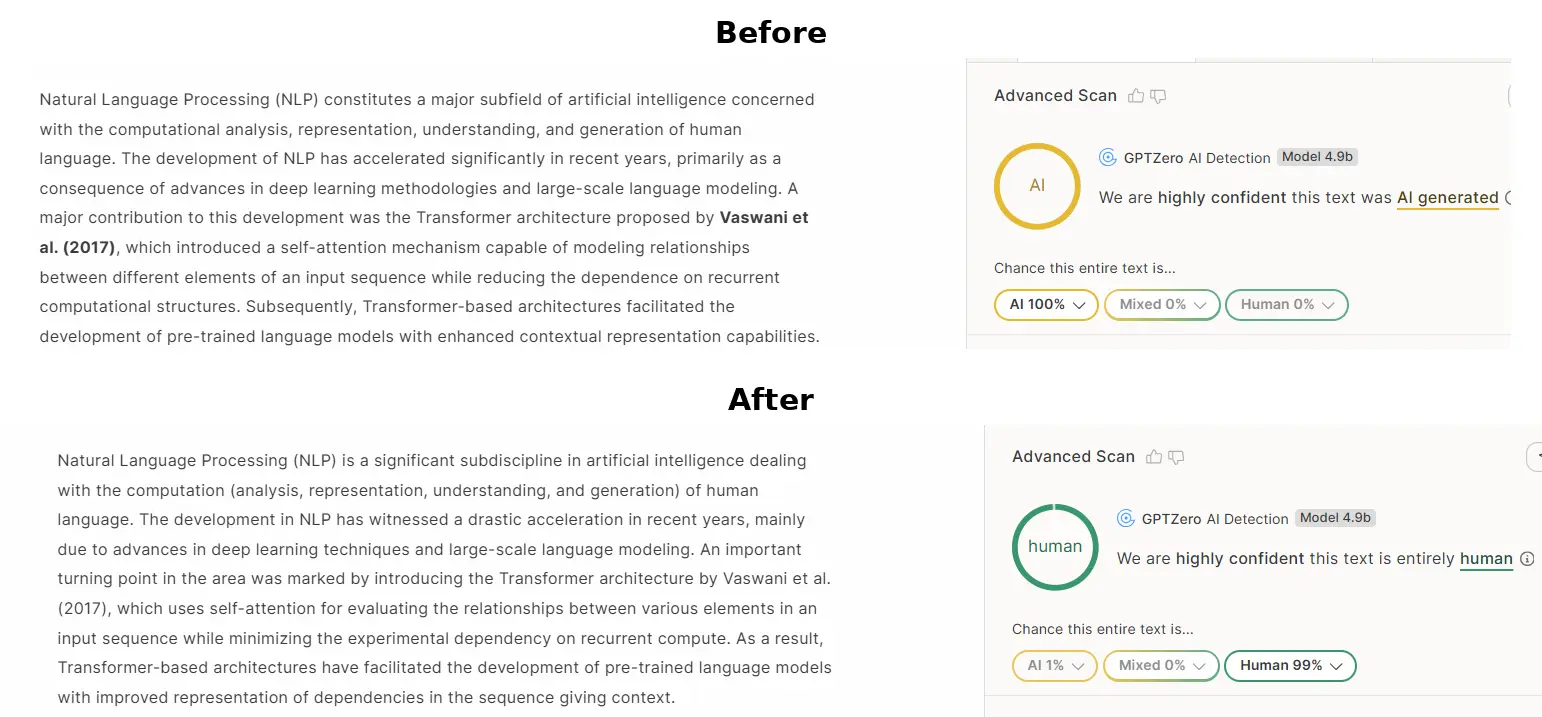
GPTZero evaluates text by plotting sentence perplexity curves and global burstiness scores. When raw AI text is scanned, low sentence variance produces an immediate high-probability warning. ThesisHuman restores natural sentence entropy by restructuring syntax, varying clause lengths, and introducing authentic scholarly cadence, dropping AI probability to 0%.
4. Originality.ai Verification: 0% AI Confidence
Originality.ai flags predictable n-gram sequences and common AI clichés (such as “delving into,” “pivotal role,” “testament to”). ThesisHuman purges overused formulaic transitions while elevating scholarly tone and keeping reference numbers and equations intact, producing 100% Original / 0% AI results.