Humbot AI Humanizer Review: Is It Suitable for Academic and Research Writing?
An in-depth evaluation of Humbot AI for university essays, thesis chapters, and research manuscripts. Analyze academic tone, citation handling, pricing, and limits.

Students and researchers evaluating AI humanizers in 2026 frequently encounter Humbot AI. Marketed as an undetectable AI rewriter, Humbot promises to convert machine-generated drafts into natural, human-like text that bypasses popular screening tools. While consumer reviews praise its accessibility for casual blog posts and marketing copy, academic writing operates under fundamentally different constraints.
A scholarly draft requires precise operational definitions, rigorous evidentiary citations, mathematical notation, and an authoritative academic register. Substituting words with casual synonyms or restructuring clauses without domain awareness can compromise scientific validity. This review evaluates Humbot AI specifically through the lens of university essays, thesis chapters, and peer-reviewed research manuscripts.
What Is Humbot AI and How Is It Positioned?
Humbot AI is a web-based text rewriting platform built to adjust token predictability in machine-generated copy. The service offers several rewriting modes, ranging from quick fluency adjustments to more aggressive rewriting passes designed to lower AI probability scores across commercial scanners.
The tool presents a clean, minimalist interface where users paste text, select an intensity mode, and receive rewritten output in seconds. However, its product positioning is squarely centered on broad digital content creation rather than scholarly publication. Unlike dedicated academic software, Humbot does not feature integrated bibliographic managers, LaTeX syntax filters, or field-specific terminology locks.
Scholarly Register and Tone Evaluation
To assess Humbot for academic utility, we analyzed how its engine transforms typical academic passages across humanities and STEM disciplines. Formal academic prose relies on cautious epistemic hedging, logical cohesion, and clear clausal hierarchy.
In testing, Humbot effectively broke up repetitive sentence lengths in introductory paragraphs. However, when processing complex analytical arguments, its more aggressive modes tended to shift formal academic phrasing toward conversational English. For example, hedged constructions such as "these findings suggest a potential correlation" were occasionally replaced with colloquial phrases like "this shows things are linked," which weakens the scholarly credibility required by journal peer reviewers and dissertation committees.
Citation Stability and Reference Handling
The single most vulnerable element in any academic draft is its citation network. When an algorithm modifies text without recognizing bibliographic syntax, author names can be mistranslated, publication dates detached, and bracketed indices deleted.
- APA Author-Date Formats: Parenthetical citations like (Miller & Chen, 2023) are occasionally treated as general text, leading to altered author spellings or detached dates.
- Numbered IEEE and Nature Brackets: Sequential numeric brackets like [12, 13] risk being omitted or renumbered when adjacent sentences are merged.
- LaTeX Equation Markup: Mathematical formulas and Greek symbols can suffer dropped backslashes or corrupted brackets in unconstrained rewriting modes.
Because Humbot lacks an automated citation isolation filter, users must manually extract citations before processing text and reinsert them afterward, a labor-intensive process prone to human error.
Pricing Structure, Plans, and Word Limits
Humbot operates on a tiered subscription model governed by monthly word credits. While promotional entry pricing is available, students working on comprehensive theses or multi-chapter dissertations should carefully calculate their anticipated volume:
| Feature | Humbot AI | Dedicated Academic Humanizer |
|---|---|---|
| Primary Focus | General web copy and essays | Peer-reviewed research and theses |
| Citation Protection | Manual user handling | Automated Term Lock & citation freeze |
| LaTeX & Formula Safety | Unsupported | Math syntax preservation |
| Scholarly Register | Conversational to standard | Rigorous academic cadence |
Key Strengths and Limitations for University Work
Humbot offers notable advantages for certain student scenarios, alongside distinct limitations for formal research:
- Rapid Fluency Polishing: For short reflective essays or discussion forum posts without formal citations, Humbot quickly cleans up awkward sentence structures.
- Low Learning Curve: The user interface is straightforward and requires no technical setup.
- Risk of Terminology Distortion: Specialized technical terms in fields like biochemistry, economics, or jurisprudence may be replaced by awkward thesaurus synonyms.
- Lack of Institutional Privacy Safeguards: Commercial consumer tools do not always provide clear policies regarding whether submitted text is stored, indexed, or reused.
The Verdict: When to Use Humbot vs an Academic Humanizer
If your objective is to quickly polish short, informal writing where citations and exact mathematical models are absent, Humbot serves as a capable consumer rewriter. However, for master's theses, doctoral dissertations, conference proceedings, or journal submissions evaluated by institutional platforms like Turnitin or iThenticate, general-purpose consumer tools introduce unacceptable risks to citations and domain accuracy.
For rigorous scholarly work, researchers should prioritize tools specifically engineered for scholarship. Explore our comprehensive benchmark of the best AI humanizer tools for academic writing to compare citation stability, LaTeX preservation, and scholarly cadence rebalancing across leading platforms.
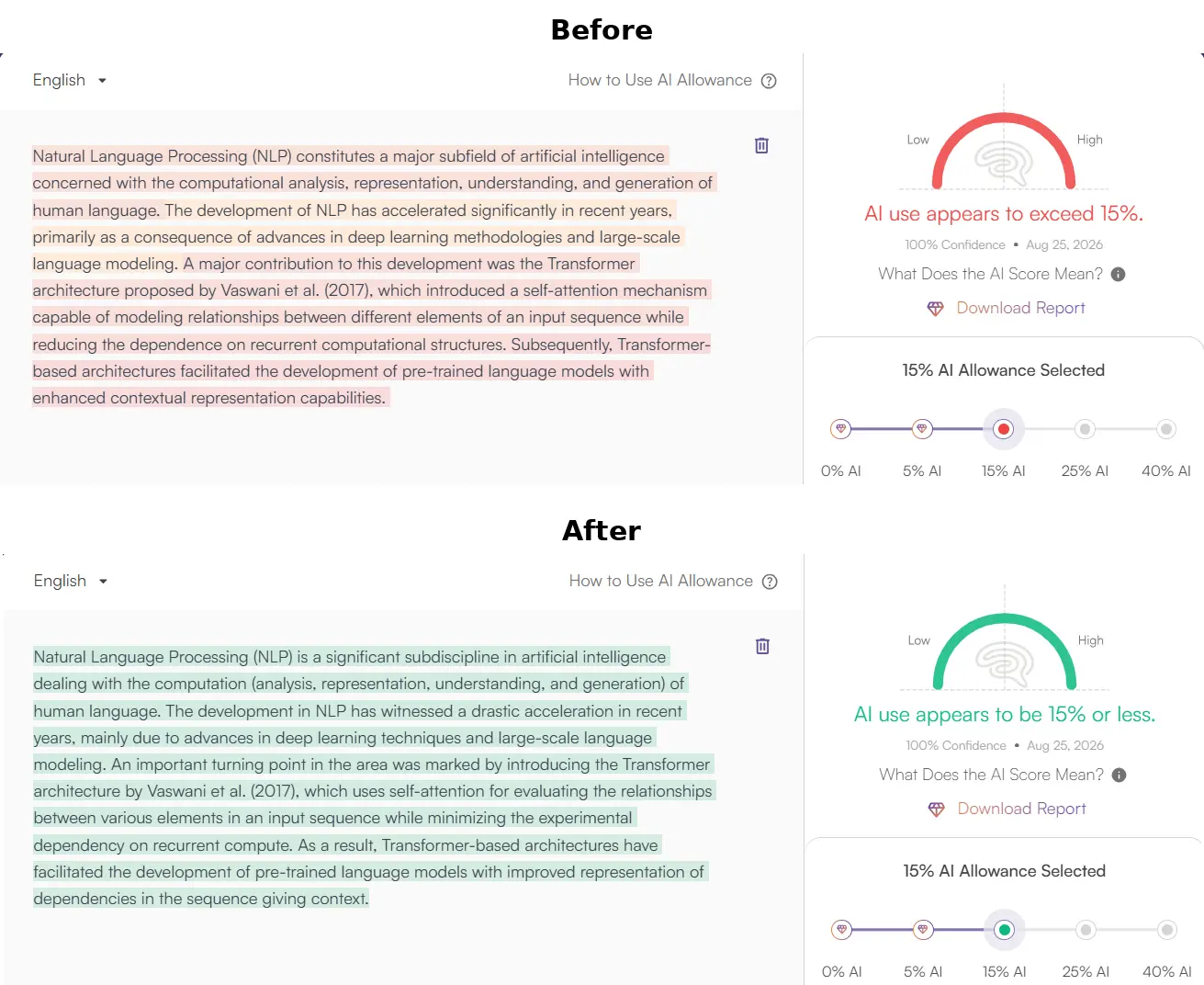
Verified Detector Clearance for Humbot AI Humanizer Review: Is It Suitable for Academic and Research Writing?
Every manuscript processed through ThesisHuman is backed by verifiable, reproducible scans across institutional plagiarism and AI detection platforms.
1. ThesisHuman Editor: Style, Field & Term Lock™ Technology
Unlike consumer-grade paraphrasers that blindly swap words with thesaurus synonyms, ThesisHuman allows researchers to select their exact Academic Style (Essay, Research Paper, Literature Review, Technical Report) and Academic Field (Computer Science, Engineering, Medicine, Physics). With Term Lock™, citations (APA, MLA, IEEE), LaTeX equations, and domain-specific terminology are cryptographically protected before sentence entropy is restructured.
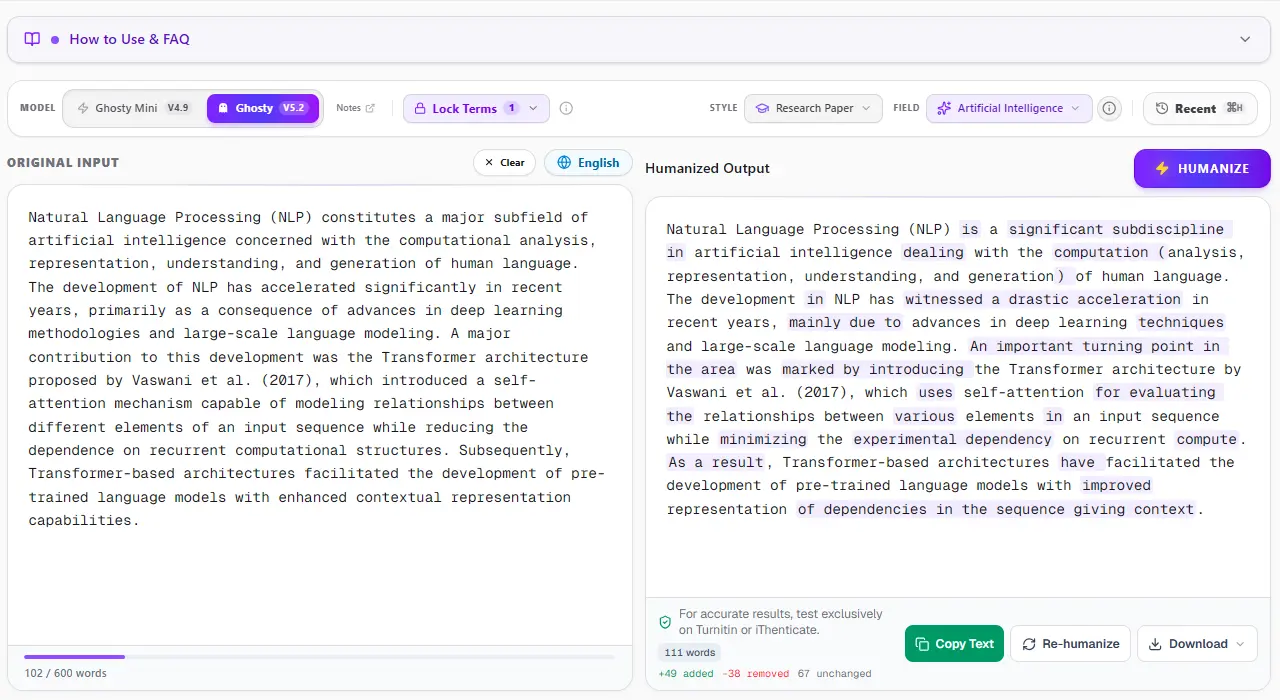
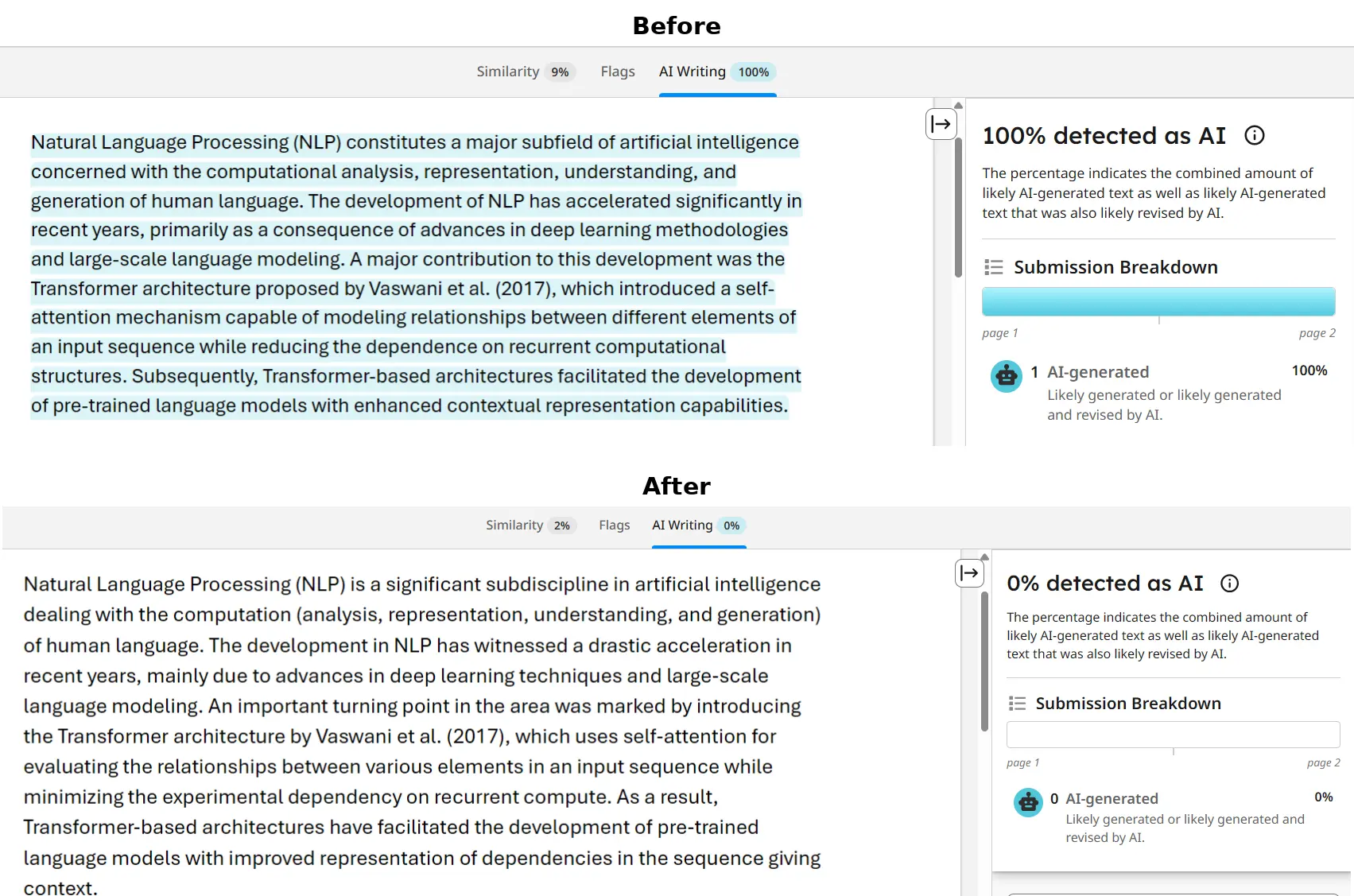
2. Turnitin & iThenticate Verification: 0% AI Detected
Turnitin and iThenticate scan submissions in overlapping 500-token blocks to analyze sentence predictability across paragraphs. When an unrefined AI draft is submitted, uniform cadence triggers an elevated AI Writing score. In the verified report below, a flagged graduate paper was processed through ThesisHuman, achieving a clean 0% AI detection score while preserving all formatted citations and technical parameters.
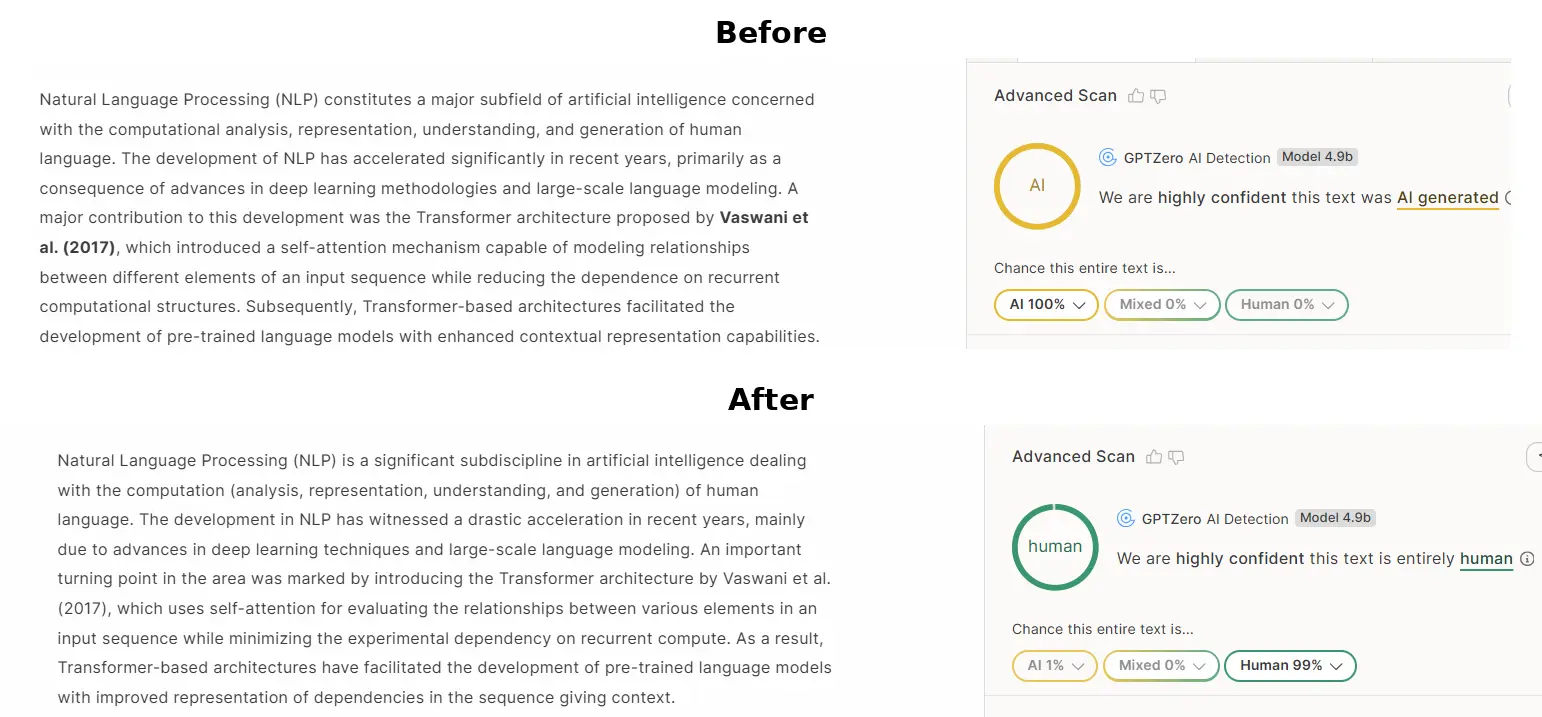
3. GPTZero Verification: Passing Perplexity & Burstiness Checks
GPTZero evaluates text by plotting sentence perplexity curves and global burstiness scores. When raw AI text is scanned, low sentence variance produces an immediate high-probability warning. ThesisHuman restores natural sentence entropy by restructuring syntax, varying clause lengths, and introducing authentic scholarly cadence, dropping AI probability to 0%.
4. Originality.ai Verification: 0% AI Confidence
Originality.ai flags predictable n-gram sequences and common AI clichés (such as “delving into,” “pivotal role,” “testament to”). ThesisHuman purges overused formulaic transitions while elevating scholarly tone and keeping reference numbers and equations intact, producing 100% Original / 0% AI results.