Is Copyleaks Accurate in Canvas LMS? Detection Mechanics, Sentence Flags, and Student Rights
How Copyleaks evaluates student submissions inside Canvas LMS. Examine sentence-level highlighting, false positive risks in technical writing, and how to defend authentic coursework.
Across hundreds of universities and colleges, Canvas has become the primary digital backbone for course administration, assignment submissions, and grading. As institutions seek automated screening tools, many have integrated Copyleaks into Canvas SpeedGrader. For students, seeing an assignment flagged with an AI percentage score can trigger immediate panic.
Understanding how Copyleaks functions within Canvas is essential for every university student. Copyleaks operates differently from general plagiarism checkers, using sentence-level statistical classifiers that carry documented limitations, particularly in technical, mathematical, and multilingual writing.
How Copyleaks Integrates with Canvas LMS
Copyleaks connects to Canvas through a Learning Tools Interoperability (LTI) application. When a student uploads an essay, lab report, or discussion post, Canvas automatically sends the document to the Copyleaks processing pipeline.
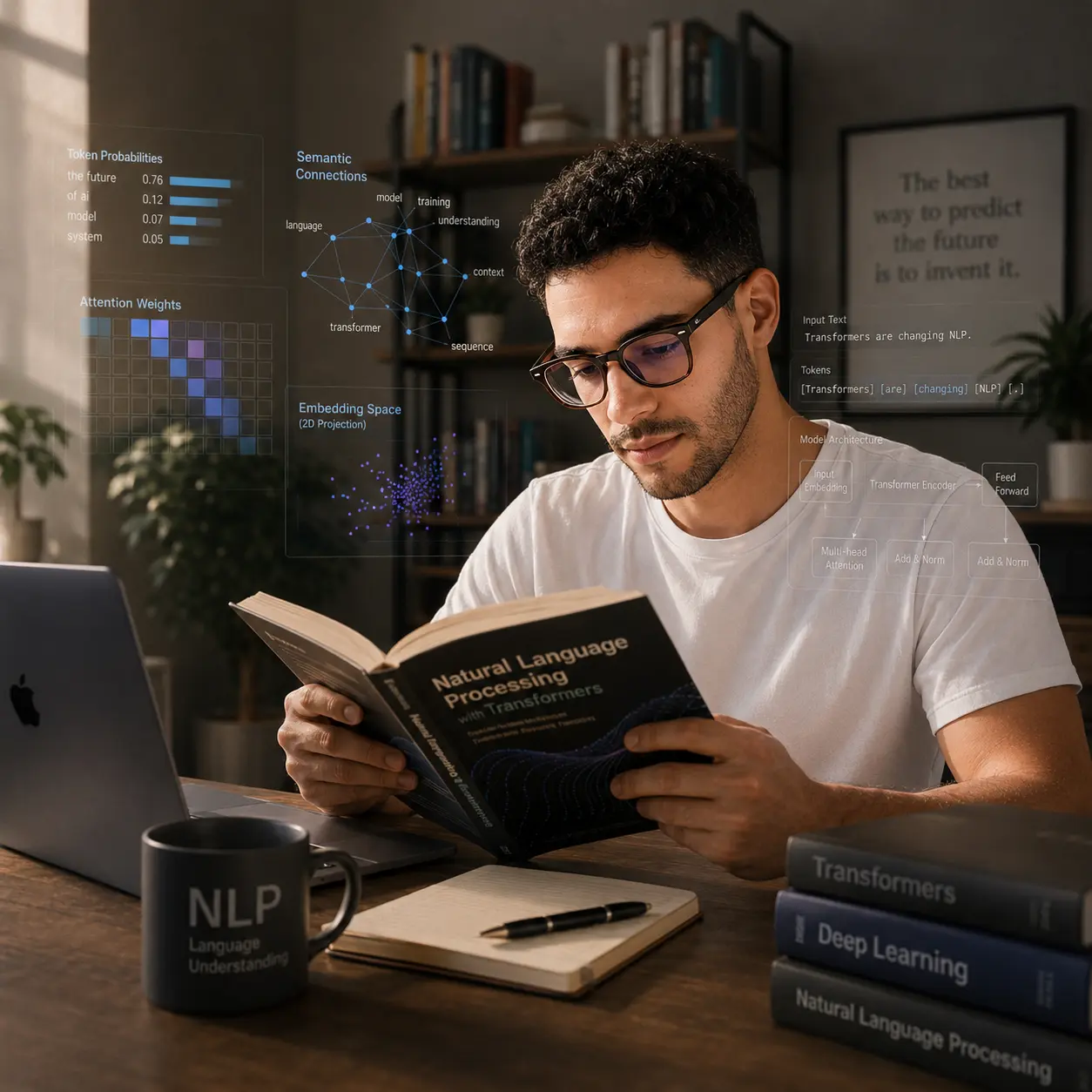
Within Canvas SpeedGrader, the instructor sees a dashboard widget displaying two distinct metrics: an overall similarity score (plagiarism matching against web pages and student archives) and an AI writing probability indicator. Clicking into the report reveals the document with specific passages highlighted in color-coded bands indicating suspected machine authorship.
Sentence-Level Highlighting and Scoring Mechanics
Unlike tools that only produce an overall aggregate score, Copyleaks emphasizes sentence-level classification. According to its public documentation, the engine evaluates each sentence within its surrounding context, classifying spans into categories such as Human, AI-Generated, or Paraphrased.
While sentence-level granularity appears helpful, it introduces significant volatility. A student may write an entire eight-page paper by hand, but if three consecutive sentences in the literature review feature formulaic academic syntax, Copyleaks may highlight those three sentences in bright red. An instructor reviewing the report without technical training might mistakenly assume those paragraphs were pasted directly from a language model.
False Positive Challenges in STEM and Technical Writing
The risk of misclassification is particularly pronounced in science, technology, engineering, and mathematics coursework:
- Standardized Laboratory Descriptions: Explaining standard equipment calibration, titration protocols, or Python data cleaning steps relies on fixed, predictable terminology that algorithms frequently flag.
- Mathematical Derivations: Explanations accompanying formulas and proofs adhere to precise logical transitions that mimic machine-generated structures.
- Direct Quotations and References: Even when properly formatted in APA or IEEE, dense citation clusters can distort sentence-level probability calculations.
Impact on Multilingual and International Students
Substantial academic research has documented that automated AI detection tools produce higher false positive rates when evaluating writing by non-native English speakers. Multilingual students often write with careful syntactic templates and a restrained, formal vocabulary.
To an automated classifier, this careful, disciplined human prose exhibits the same low perplexity characteristic of large language models. International students submitting coursework in Canvas are therefore at heightened risk of false flags, making institutional awareness and defensible writing trails essential.
How Students Can Defend a Flagged Canvas Submission
If your professor flags an assignment in Canvas based on a Copyleaks report, take these structured steps to demonstrate authentic authorship:
- Request the Detailed Report: Ask to see the full Copyleaks report so you can identify exactly which sentences were highlighted and understand the basis of the concern.
- Provide Cloud Version Logs: Share the version history from your original Google Doc or Microsoft Word file, showing timestamped revisions that prove human drafting.
- Demonstrate Subject Mastery: Offer to meet during office hours to explain your methodology, discuss your cited sources, and answer questions about your analytical reasoning.
When using assistive tools for language polishing, ensure your final prose incorporates natural human sentence length variation while locking citations. Learn more about how academic text humanizers modulate sentence cadence to prevent false positive triggers.
Verified Detector Clearance for Is Copyleaks Accurate in Canvas LMS? Detection Mechanics, Sentence Flags, and Student Rights
Every manuscript processed through ThesisHuman is backed by verifiable, reproducible scans across institutional plagiarism and AI detection platforms.
1. ThesisHuman Editor: Style, Field & Term Lock™ Technology
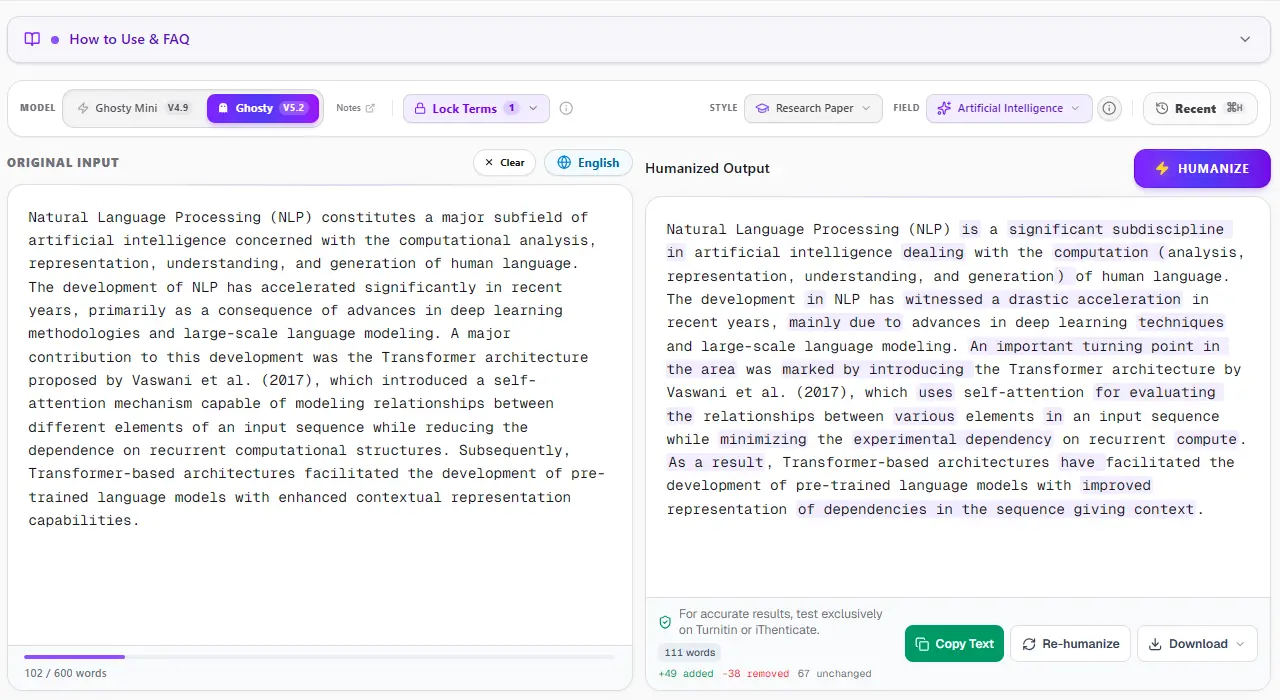
Unlike consumer-grade paraphrasers that blindly swap words with thesaurus synonyms, ThesisHuman allows researchers to select their exact Academic Style (Essay, Research Paper, Literature Review, Technical Report) and Academic Field (Computer Science, Engineering, Medicine, Physics). With Term Lock™, citations (APA, MLA, IEEE), LaTeX equations, and domain-specific terminology are cryptographically protected before sentence entropy is restructured.
2. Turnitin & iThenticate Verification: 0% AI Detected
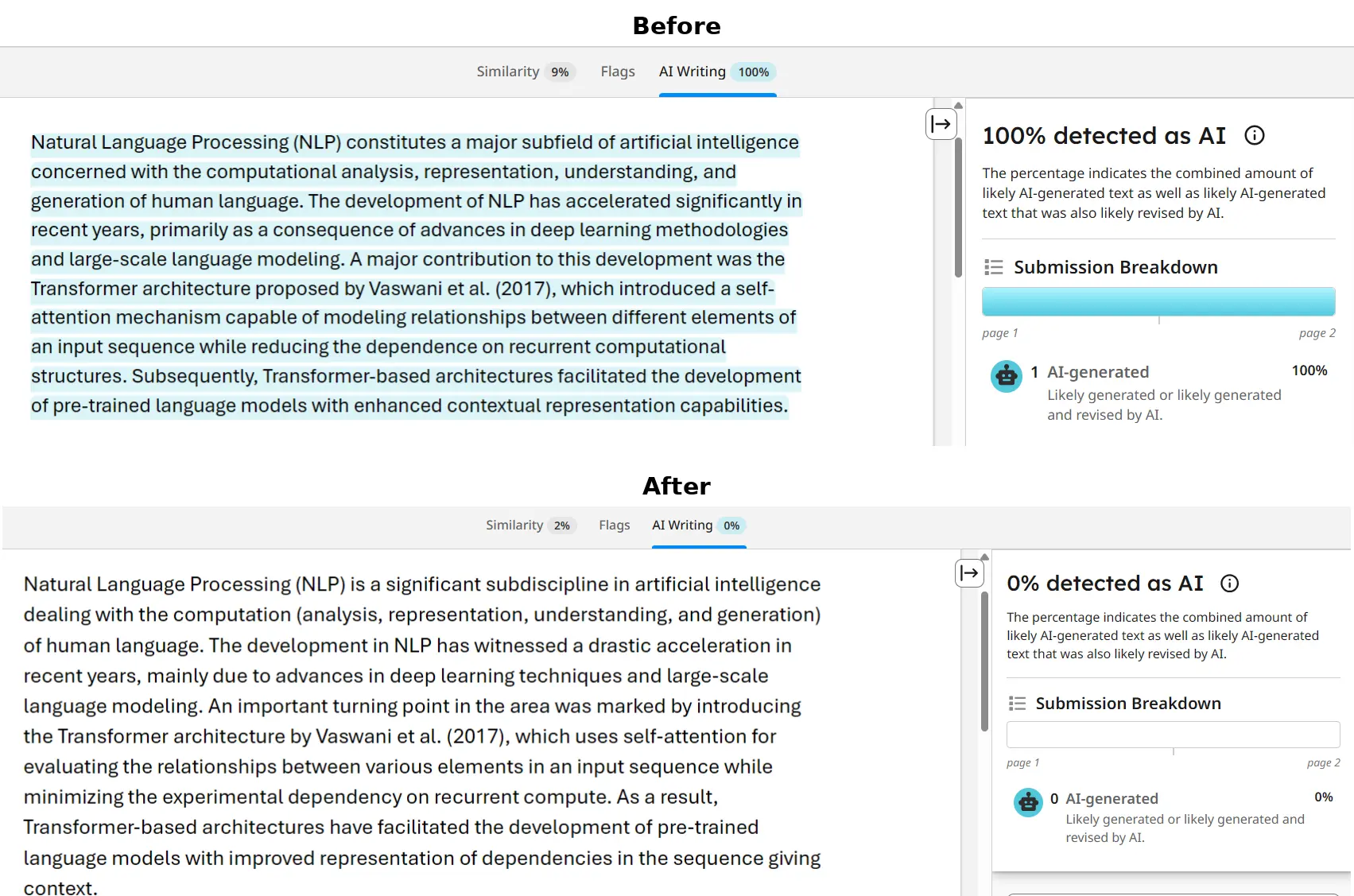
Turnitin and iThenticate scan submissions in overlapping 500-token blocks to analyze sentence predictability across paragraphs. When an unrefined AI draft is submitted, uniform cadence triggers an elevated AI Writing score. In the verified report below, a flagged graduate paper was processed through ThesisHuman, achieving a clean 0% AI detection score while preserving all formatted citations and technical parameters.
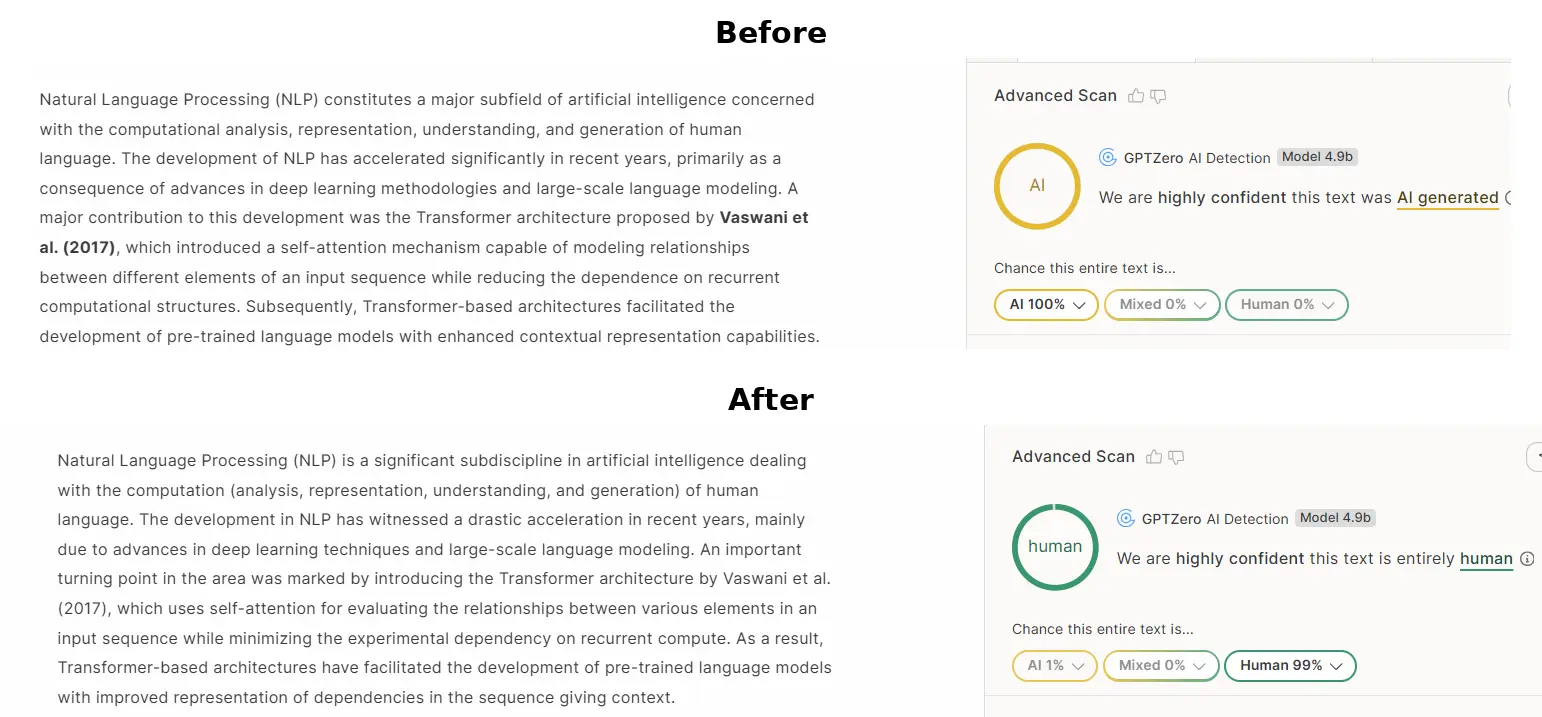
3. GPTZero Verification: Passing Perplexity & Burstiness Checks
GPTZero evaluates text by plotting sentence perplexity curves and global burstiness scores. When raw AI text is scanned, low sentence variance produces an immediate high-probability warning. ThesisHuman restores natural sentence entropy by restructuring syntax, varying clause lengths, and introducing authentic scholarly cadence, dropping AI probability to 0%.
4. Originality.ai Verification: 0% AI Confidence
Originality.ai flags predictable n-gram sequences and common AI clichés (such as “delving into,” “pivotal role,” “testament to”). ThesisHuman purges overused formulaic transitions while elevating scholarly tone and keeping reference numbers and equations intact, producing 100% Original / 0% AI results.