Is GPTZero Accurate for Academic Writing? Evidence, False Positives, and Defense Guide
An evidence-based assessment of GPTZero accuracy on research papers, literature reviews, and student essays. Learn why false positives occur and how scholars document authentic drafting.
As universities and publishers expand automated screening for machine-generated text, GPTZero has become one of the most visible detection platforms in higher education. Marketed to educators, admissions offices, and researchers, the tool scans documents and highlights passages it classifies as likely generated by large language models. But for scholars submitting high-stakes manuscripts, the critical question remains: is GPTZero accurate when evaluating formal academic writing?
Independent computational linguistics research and real-world classroom experiences reveal a nuanced reality. While GPTZero reliably flags raw, unedited drafts from models like ChatGPT, its underlying probabilistic architecture creates substantial risks of false positives when evaluating the structured, formulaic conventions of scholarly prose.
How GPTZero Evaluates Prose: Perplexity and Burstiness
Unlike traditional plagiarism checkers that match text strings against indexed web pages and academic journals, GPTZero operates as a probabilistic classifier. According to its public technical documentation, the system primarily calculates two statistical metrics:
- Perplexity: A mathematical measurement of how predictable words are within a given context. If a language model can easily predict each subsequent token, the text exhibits low perplexity, which the detector associates with automated generation.
- Burstiness: A measurement of variation in sentence length and syntactic structure across a passage. Human authors typically vary their sentence cadence, while language models tend to generate uniform clause lengths.
While these metrics provide useful signals for conversational text, they encounter significant challenges when applied to academic papers, where discipline-specific conventions dictate both vocabulary choice and sentence rhythm.
Empirical Research on Detection Accuracy and Error Rates
Peer-reviewed studies evaluating commercial AI detection tools have repeatedly demonstrated that no classifier operates with 100% accuracy. Benchmarks conducted across major universities highlight several consistent operational realities:
First, accuracy decreases substantially when text has undergone human developmental editing. Light restructuring of clause order and vocabulary selection can alter perplexity distributions, leading to mixed classification scores. Second, false positive rates are non-zero. In academic settings, even a 2% or 3% false positive rate represents thousands of authentic student papers and research chapters incorrectly flagged for misconduct.
Why Academic Writing Triggers False Positive Flags
Academic English is structured, conventional, and highly repetitive by design. These very characteristics mimic the low-perplexity statistical signature of generative AI models:
- Standardized Methodology Protocols: Describing a t-test, cell culture protocol, or survey methodology requires standardized disciplinary phrases that any language model easily predicts.
- Field-Specific Jargon: Terminology in molecular biology, statutory legal analysis, and econometrics cannot be altered without introducing technical inaccuracies.
- Extensive Literature Reviews: Synthesizing prior scholarship often requires balanced compound sentences that can register as low-burstiness prose.
The Documented Impact on Non-Native English Scholars
One of the most concerning findings in computational linguistics research is the disproportionate rate of false positives observed in writing by non-native English speakers. In a widely cited 2023 study by Stanford researchers (Liang et al.), commercial AI detectors evaluated TOEFL essays written by international students alongside essays by native eighth graders.
The study revealed that more than half of the human-authored TOEFL essays were erroneously classified as AI-generated. Non-native writers often employ safe, standardized syntactic templates and a more limited, formal vocabulary. To a perplexity-based classifier, this careful, disciplined human prose looks statistically indistinguishable from machine output.
How Researchers Can Document Authentic Drafting
Because detection tools remain probabilistic, authors must proactively protect their work against mistaken allegations. Maintain a comprehensive provenance trail throughout the drafting lifecycle:
- Preserve Complete Version Histories: Draft directly in cloud-based editors like Google Docs, Overleaf, or Microsoft 365 with revision logging enabled to record granular timestamped edits.
- Archive Rough Outlines and Research Notes: Keep early conceptual diagrams, lab notebooks, annotated PDFs, and reference manager libraries.
- Maintain Clean Authorial Cadence: When polishing assisted drafts, use tools that modulate sentence burstiness and perplexity while preserving citations. Learn more about how academic humanizers restore natural scholarly rhythm.
Ultimately, GPTZero and similar scanners provide preliminary indicators rather than definitive verdicts. Understanding their mathematical foundations enables scholars to write with confidence and defend their authentic intellectual contributions.
Verified Detector Clearance for Is GPTZero Accurate for Academic Writing? Evidence, False Positives, and Defense Guide
Every manuscript processed through ThesisHuman is backed by verifiable, reproducible scans across institutional plagiarism and AI detection platforms.
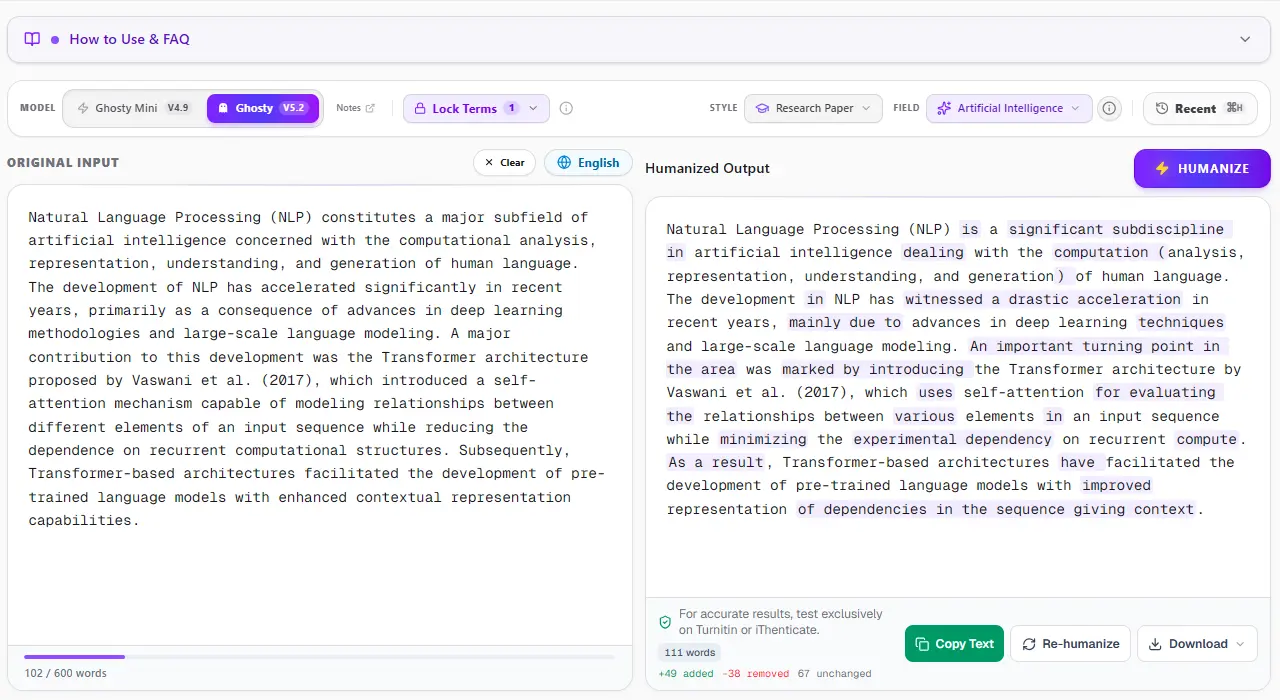
1. ThesisHuman Editor: Style, Field & Term Lock™ Technology
Unlike consumer-grade paraphrasers that blindly swap words with thesaurus synonyms, ThesisHuman allows researchers to select their exact Academic Style (Essay, Research Paper, Literature Review, Technical Report) and Academic Field (Computer Science, Engineering, Medicine, Physics). With Term Lock™, citations (APA, MLA, IEEE), LaTeX equations, and domain-specific terminology are cryptographically protected before sentence entropy is restructured.
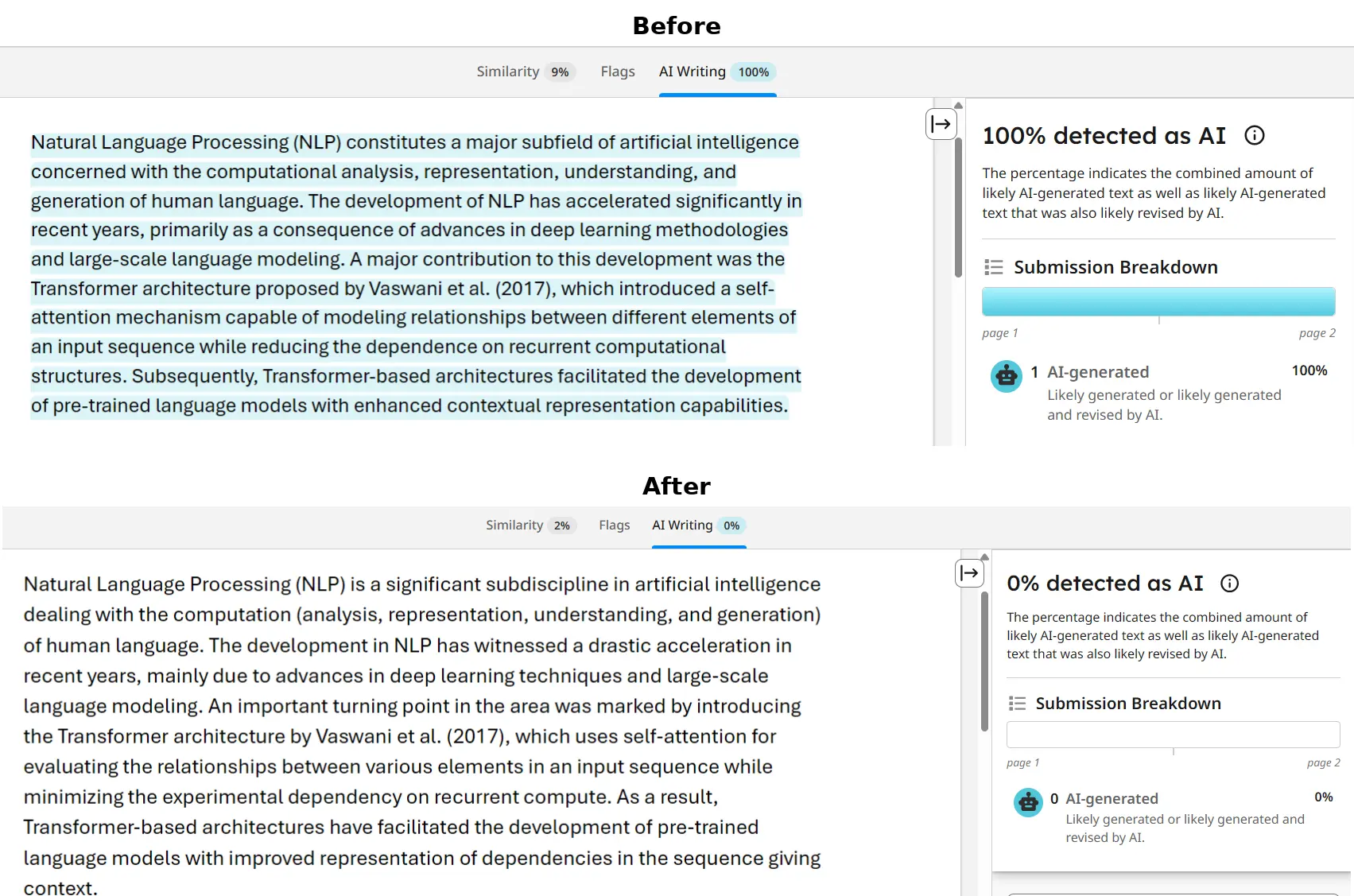
2. Turnitin & iThenticate Verification: 0% AI Detected
Turnitin and iThenticate scan submissions in overlapping 500-token blocks to analyze sentence predictability across paragraphs. When an unrefined AI draft is submitted, uniform cadence triggers an elevated AI Writing score. In the verified report below, a flagged graduate paper was processed through ThesisHuman, achieving a clean 0% AI detection score while preserving all formatted citations and technical parameters.
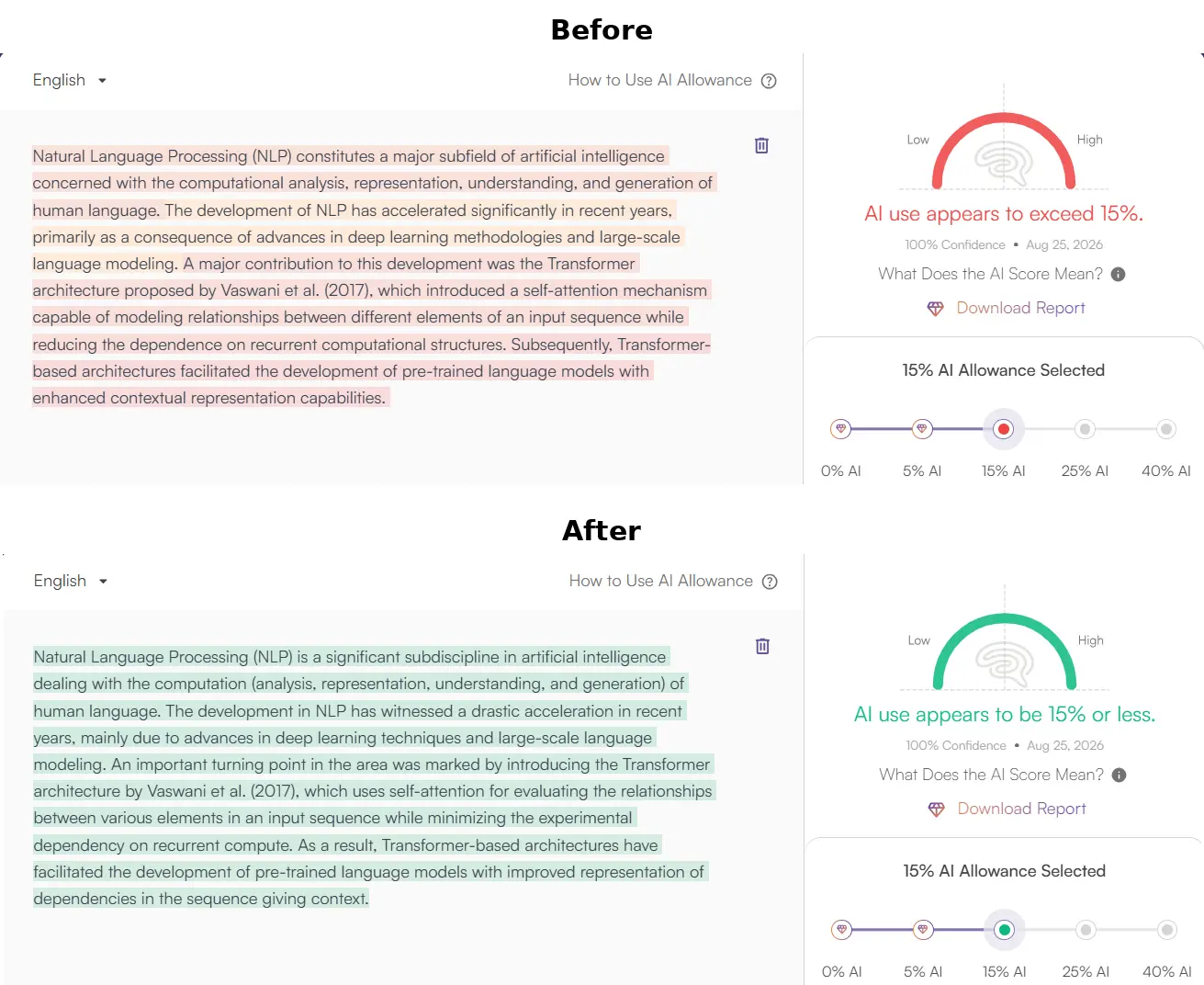
3. GPTZero Verification: Passing Perplexity & Burstiness Checks
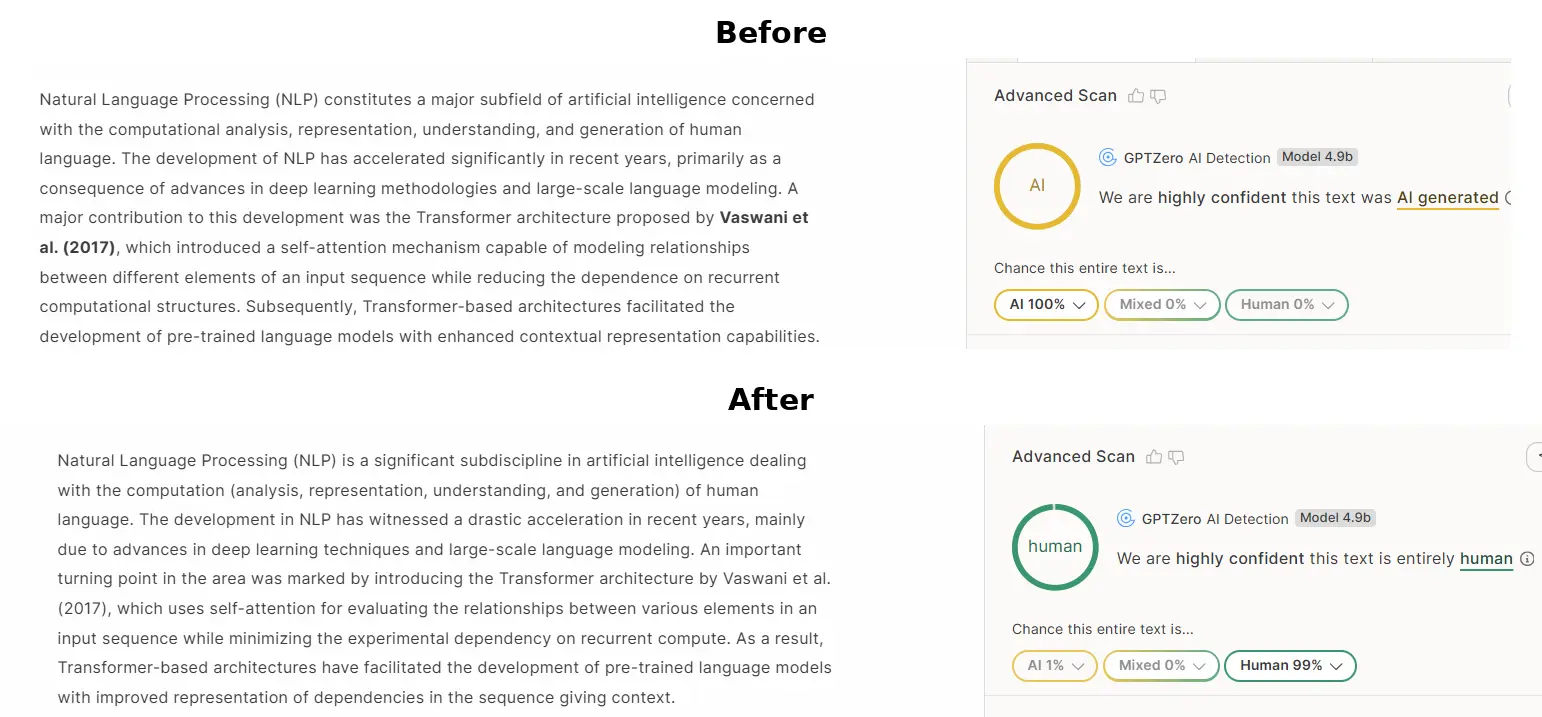
GPTZero evaluates text by plotting sentence perplexity curves and global burstiness scores. When raw AI text is scanned, low sentence variance produces an immediate high-probability warning. ThesisHuman restores natural sentence entropy by restructuring syntax, varying clause lengths, and introducing authentic scholarly cadence, dropping AI probability to 0%.
4. Originality.ai Verification: 0% AI Confidence
Originality.ai flags predictable n-gram sequences and common AI clichés (such as “delving into,” “pivotal role,” “testament to”). ThesisHuman purges overused formulaic transitions while elevating scholarly tone and keeping reference numbers and equations intact, producing 100% Original / 0% AI results.