iThenticate Crossref AI Humanizer Protocol: Navigating Publisher Screening
How journal authors can navigate Crossref Similarity Check and iThenticate AI screening. Separate similarity percentage from the AI indicator safely.

Academic journal publishing is fiercely competitive. At leading peer-reviewed journals, over 60% of submitted manuscripts are desk-rejected before reaching peer reviewers. Increasingly, these initial rejections are triggered by automated screening reports generated by Crossref Similarity Check powered by iThenticate.
Understanding how publishers deploy iThenticate and how its two distinct reporting mechanisms operate is essential for any working researcher. Here is how to navigate the publisher screening pipeline and humanize your manuscript safely.
Crossref Similarity Check: The Publisher Pipeline
Crossref Similarity Check gives journal publishers discounted access to iThenticate in exchange for contributing published articles into a shared database of over 80 million full-text papers. When you click 'Submit Manuscript' on Editorial Manager, ScholarOne, or Evise, your PDF is automatically ingested by iThenticate. Managing editors review the resulting report before deciding whether to assign an associate editor.
Separating String Similarity from AI Probability
A major source of confusion among scholars is conflating the Similarity Score with the AI Writing Indicator:
- Similarity Score: A string-matching percentage showing text overlap with existing papers. It is normal for method sections and references to match published sources.
- AI Writing Indicator: A statistical probability classifier that analyzes token predictability. It flags text that matches nothing in existing literature if its clausal rhythm resembles a language model.
A 4-Step Protocol for High-Stakes Submissions
- Fix Genuine Overlap First: Ensure all borrowed definitions and method descriptions are properly cited with quotation marks or scholarly paraphrasing.
- Isolate Formulas and Citations: Use ThesisHuman's iThenticate humanizer to freeze bracketed references and LaTeX equations.
- Restructure Cadence in Introduction & Discussion: Break uniform 20-word compound sentences, injecting disciplinary tension and varied clausal lengths.
- Review Tone for Peer-Review Authority: Ensure the prose reflects decisive scholarly agency rather than generic AI hedging.
Pre-Screening Without Violating Copyright or Repository Rules
Never pre-screen unpublished manuscripts using public plagiarism checkers that store submissions. Doing so creates a false match against your own paper when the journal runs its official check. ThesisHuman operates strictly in ephemeral memory with zero repository indexing, protecting your preprint and intellectual property completely.
Verified Detector Clearance for iThenticate Crossref AI Humanizer Protocol: Navigating Publisher Screening
Every manuscript processed through ThesisHuman is backed by verifiable, reproducible scans across institutional plagiarism and AI detection platforms.
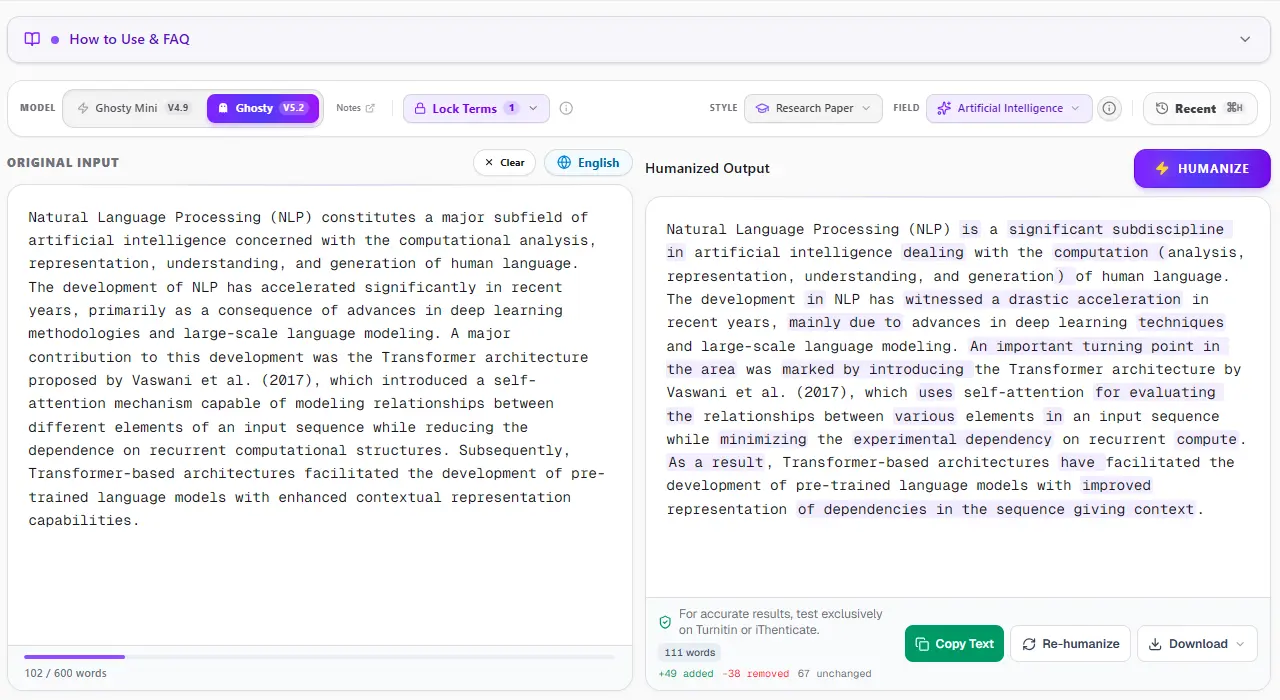
1. ThesisHuman Editor: Style, Field & Term Lock™ Technology
Unlike consumer-grade paraphrasers that blindly swap words with thesaurus synonyms, ThesisHuman allows researchers to select their exact Academic Style (Essay, Research Paper, Literature Review, Technical Report) and Academic Field (Computer Science, Engineering, Medicine, Physics). With Term Lock™, citations (APA, MLA, IEEE), LaTeX equations, and domain-specific terminology are cryptographically protected before sentence entropy is restructured.
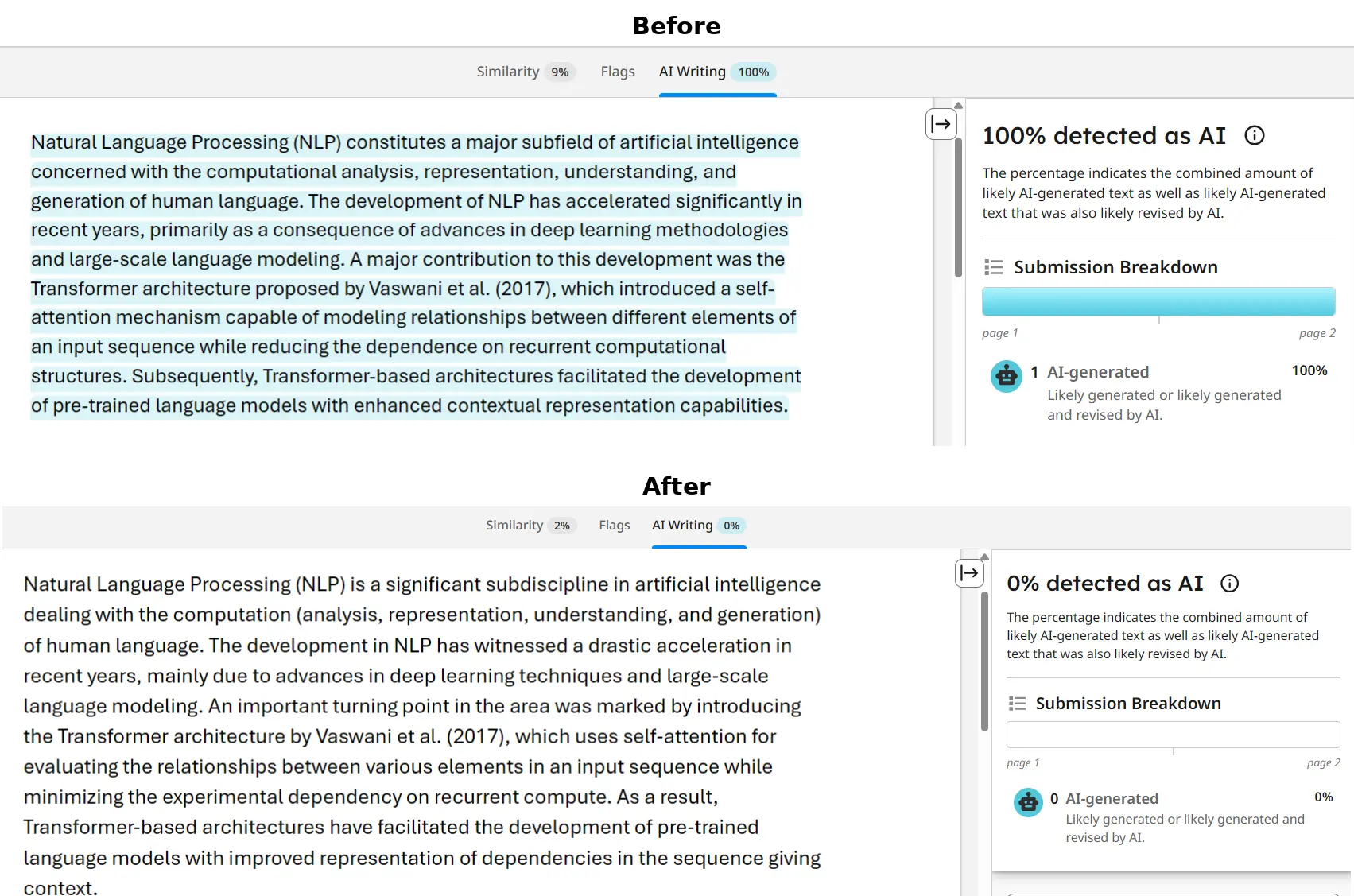
2. Turnitin & iThenticate Verification: 0% AI Detected
Turnitin and iThenticate scan submissions in overlapping 500-token blocks to analyze sentence predictability across paragraphs. When an unrefined AI draft is submitted, uniform cadence triggers an elevated AI Writing score. In the verified report below, a flagged graduate paper was processed through ThesisHuman, achieving a clean 0% AI detection score while preserving all formatted citations and technical parameters.
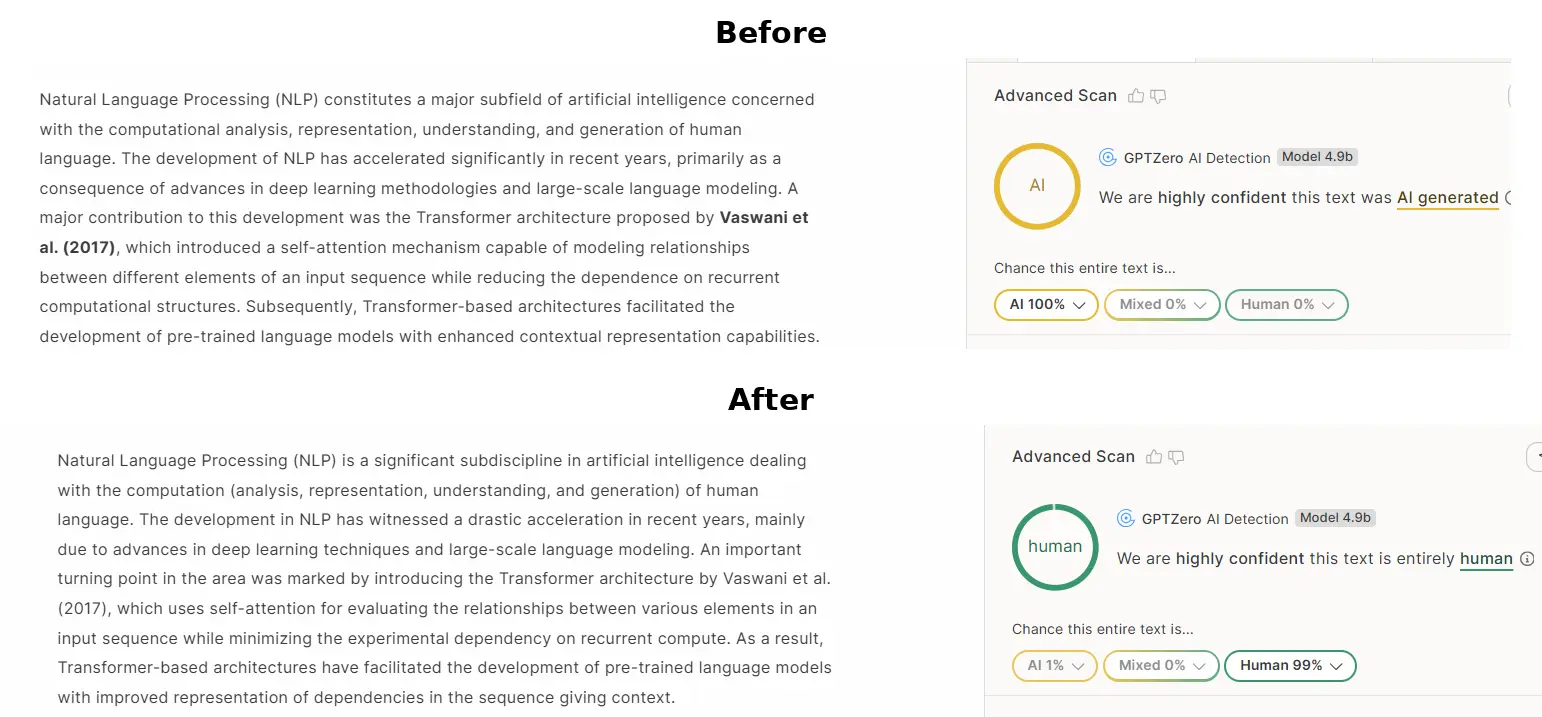
3. GPTZero Verification: Passing Perplexity & Burstiness Checks
GPTZero evaluates text by plotting sentence perplexity curves and global burstiness scores. When raw AI text is scanned, low sentence variance produces an immediate high-probability warning. ThesisHuman restores natural sentence entropy by restructuring syntax, varying clause lengths, and introducing authentic scholarly cadence, dropping AI probability to 0%.
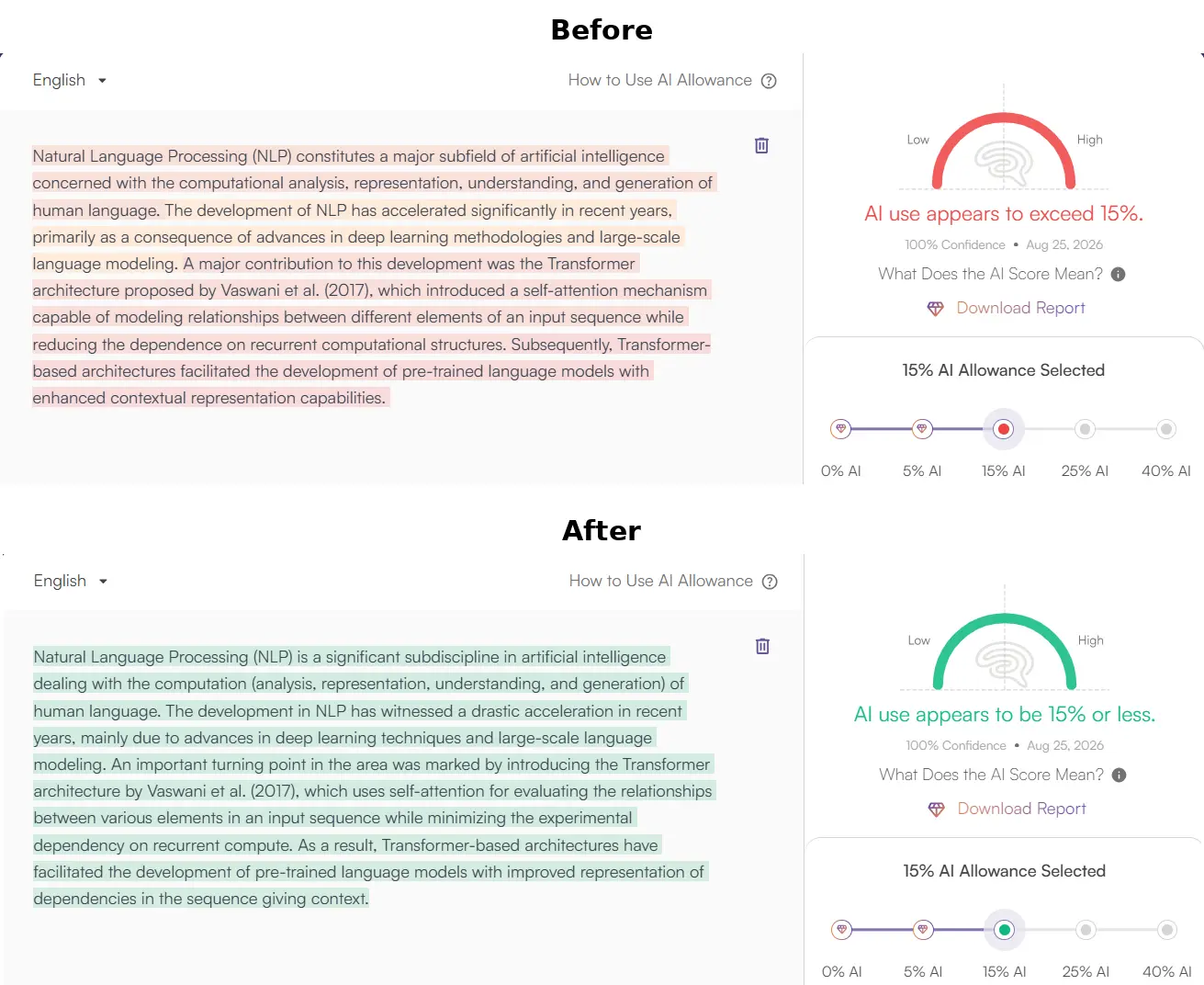
4. Originality.ai Verification: 0% AI Confidence
Originality.ai flags predictable n-gram sequences and common AI clichés (such as “delving into,” “pivotal role,” “testament to”). ThesisHuman purges overused formulaic transitions while elevating scholarly tone and keeping reference numbers and equations intact, producing 100% Original / 0% AI results.