Literature Review AI Humanizer: Transforming AI Summaries into Critical Synthesis
How to turn formulaic, repetitive AI literature summaries into dynamic, critical scholarly synthesis that engages published scholarship with authentic authorial perspective.
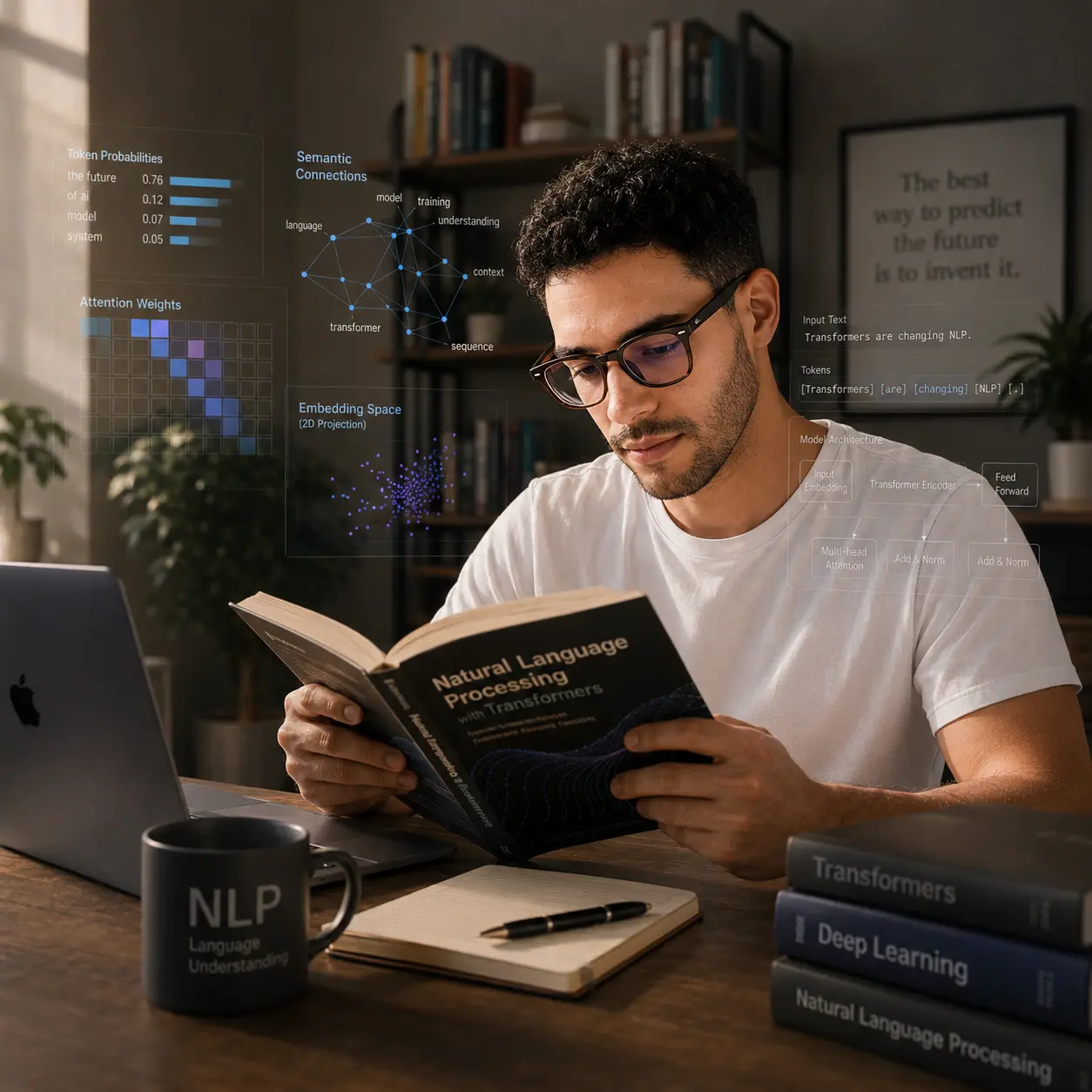
The literature review is the intellectual foundation of any thesis or journal article. It establishes what is known, exposes controversies, and demonstrates the necessity of your research. Because synthesizing dozens of scholarly articles is labor-intensive, researchers frequently enlist generative AI to help summarize abstracts and organize source notes.
However, when authors paste raw or lightly edited AI summaries into their manuscripts, the result rarely reads like true academic scholarship. Instead of critical synthesis, the prose collapses into a predictable catalog of author summaries. Here is how to humanize literature reviews into compelling, defensible academic discourse.
The Trap: Summary vs Critical Synthesis
A literature summary merely reports what individual researchers wrote: 'Author A demonstrated X. Author B explored Y.' A critical synthesis, by contrast, evaluates how these studies converse with one another: where methodologies conflict, where theoretical assumptions diverge, and where empirical gaps remain.
Generative AI models excel at summarization but struggle with true critical synthesis. Because they avoid intellectual conflict and optimize for smooth transitions, their literature reviews read as an unbroken series of polite acknowledgments. Detectors identify this low-perplexity, low-tension rhythm immediately.
Recognizing 'AI Literature Review Syndrome'
Before finalizing your chapter, check for these recognizable symptoms of machine-drafted literature reviews:
- Monotonous Serial Attributions: Every paragraph begins with an author's name and publication year, followed by an identical verb: 'examined,' 'investigated,' or 'explored.'
- Superficial Contrast Markers: Reliance on generic transitional pairs: 'While Smith observed X, in contrast Jones noted Y.' The underlying theoretical contradiction is never actually analyzed.
- Missing Disciplinary Agenda: The review reads like an encyclopedia entry without pointing toward the author's own research hypothesis.
Structuring Thematic Clusters Instead of Serial Lists
Transforming mechanical summaries requires thematic clustering. Group three or four studies around a shared methodological limitation. Instead of giving each author a separate sentence, synthesize the consensus in one assertive statement and anchor it with a grouped citation bracket (e.g., [4, 9, 15]).
A 4-Step Synthesis Humanization Protocol
- Anchor with an Analytical Claim: Open every paragraph with a conceptual claim about the field, not an author's name.
- Lock Citations with Term Lock: In ThesisHuman's literature review mode, activate citation freeze so clustered references remain intact.
- Vary Syntactic Cadence: Combine dense evidentiary sentences with sharp evaluative questions to elevate burstiness.
- Connect to Your Research Gap: End every section by demonstrating how existing limitations directly justify your own methodology.
Verified Detector Clearance for Literature Review AI Humanizer: Transforming AI Summaries into Critical Synthesis
Every manuscript processed through ThesisHuman is backed by verifiable, reproducible scans across institutional plagiarism and AI detection platforms.
1. ThesisHuman Editor: Style, Field & Term Lock™ Technology
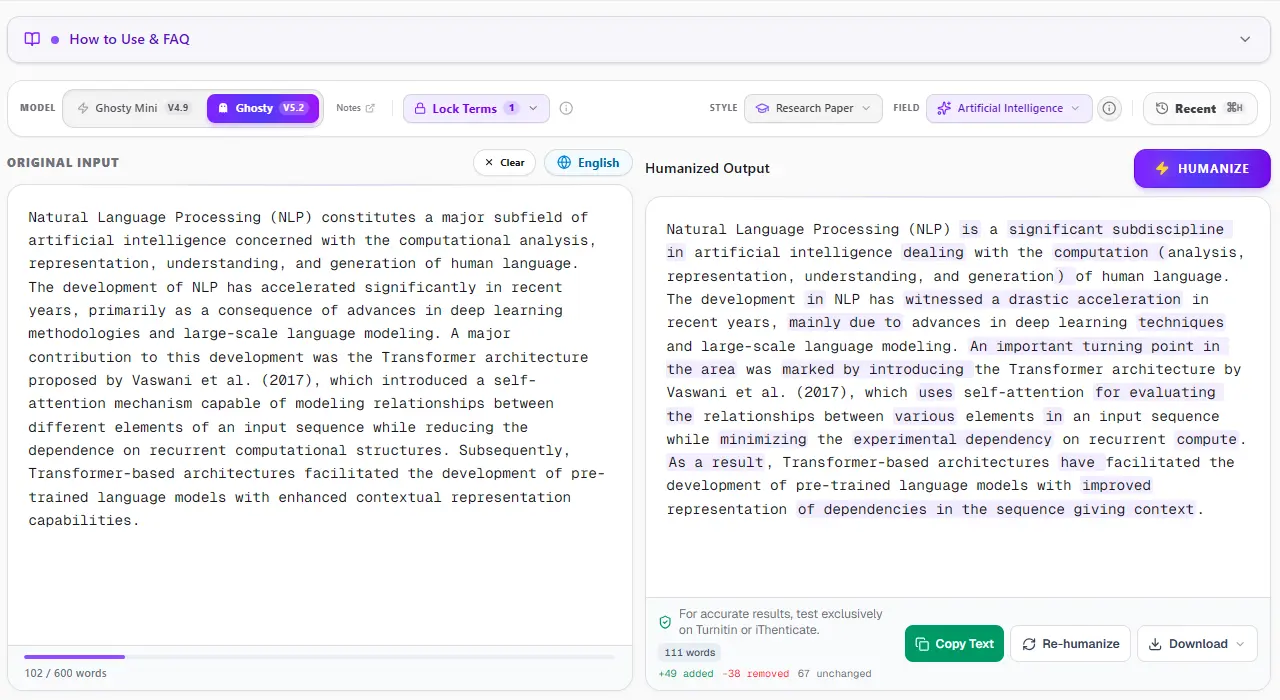
Unlike consumer-grade paraphrasers that blindly swap words with thesaurus synonyms, ThesisHuman allows researchers to select their exact Academic Style (Essay, Research Paper, Literature Review, Technical Report) and Academic Field (Computer Science, Engineering, Medicine, Physics). With Term Lock™, citations (APA, MLA, IEEE), LaTeX equations, and domain-specific terminology are cryptographically protected before sentence entropy is restructured.
2. Turnitin & iThenticate Verification: 0% AI Detected
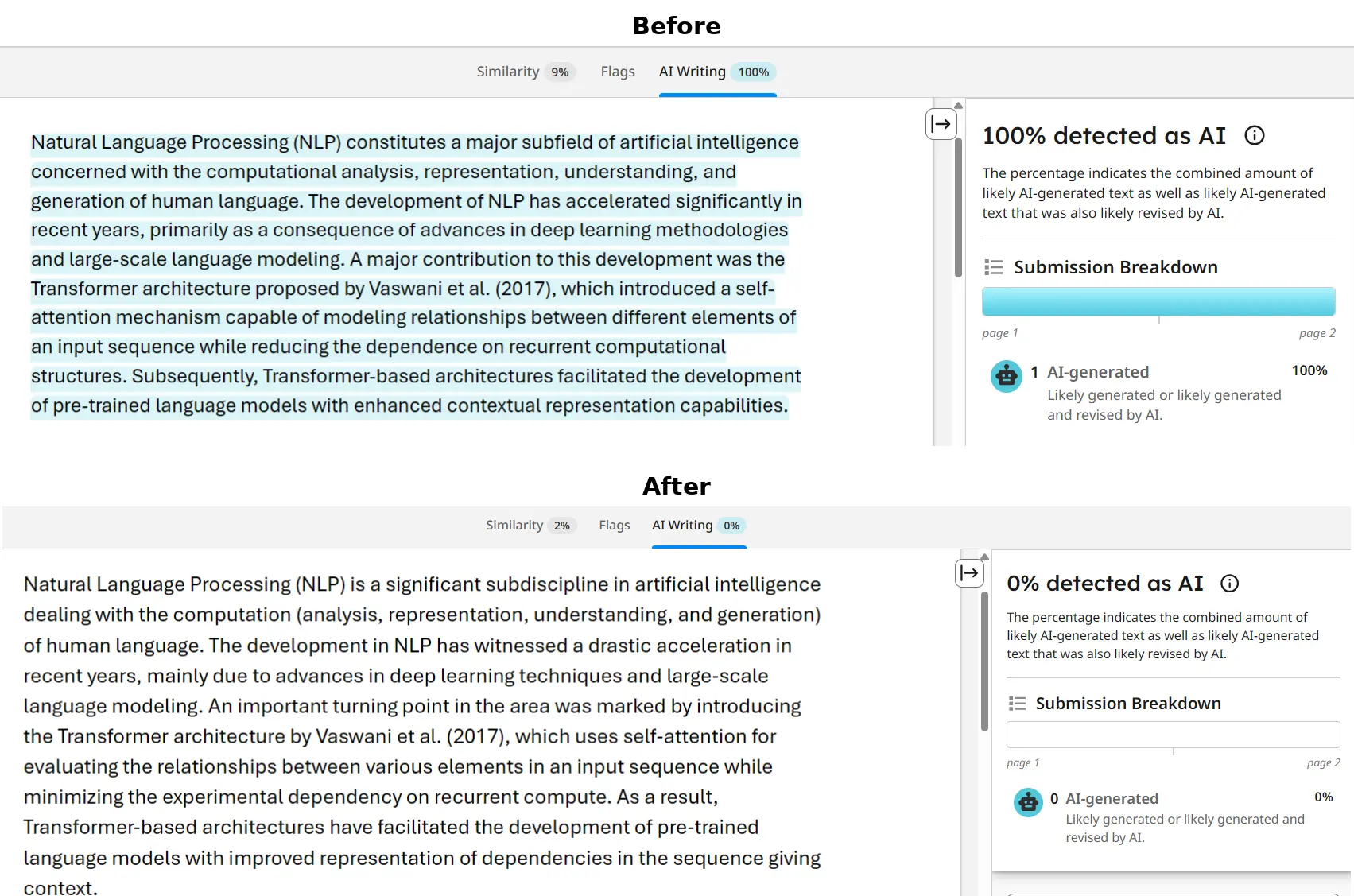
Turnitin and iThenticate scan submissions in overlapping 500-token blocks to analyze sentence predictability across paragraphs. When an unrefined AI draft is submitted, uniform cadence triggers an elevated AI Writing score. In the verified report below, a flagged graduate paper was processed through ThesisHuman, achieving a clean 0% AI detection score while preserving all formatted citations and technical parameters.
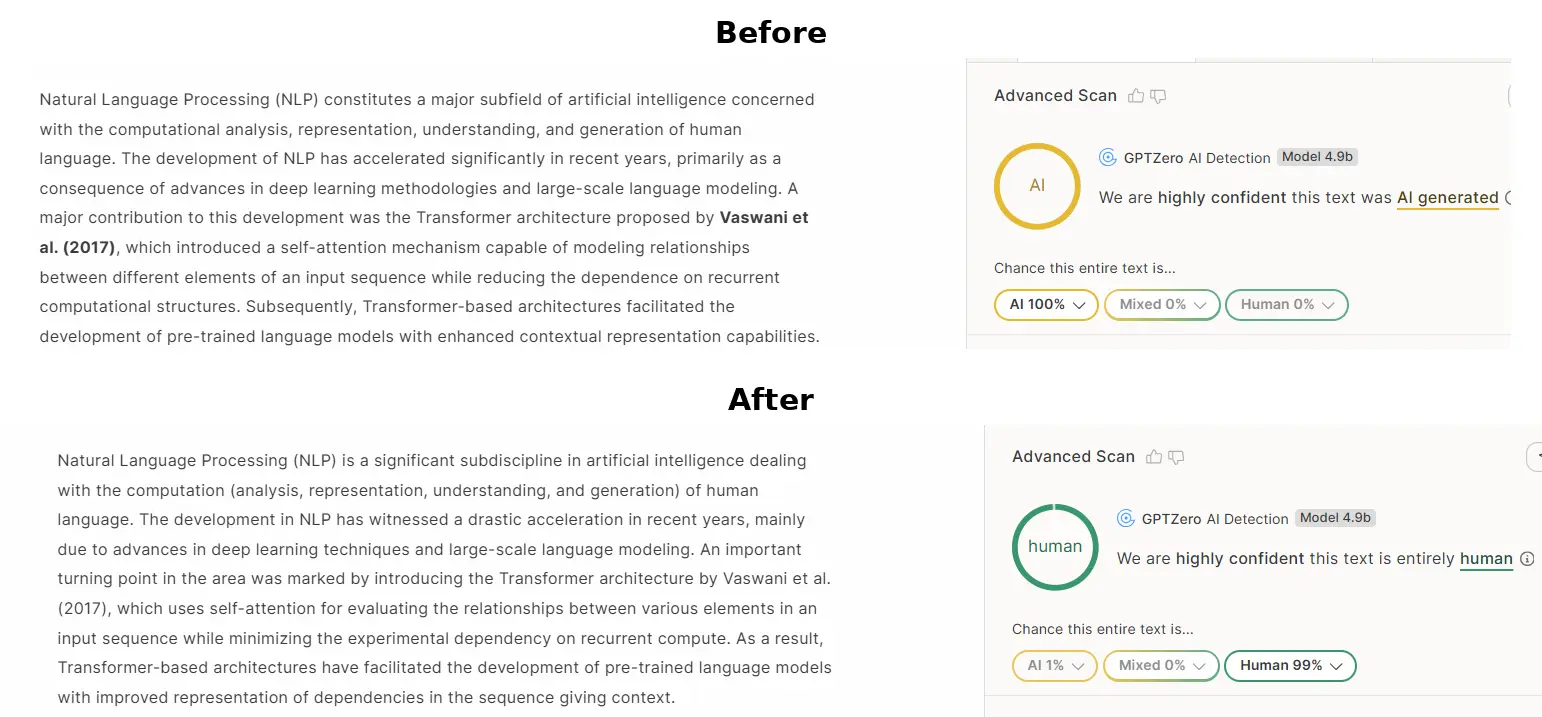
3. GPTZero Verification: Passing Perplexity & Burstiness Checks
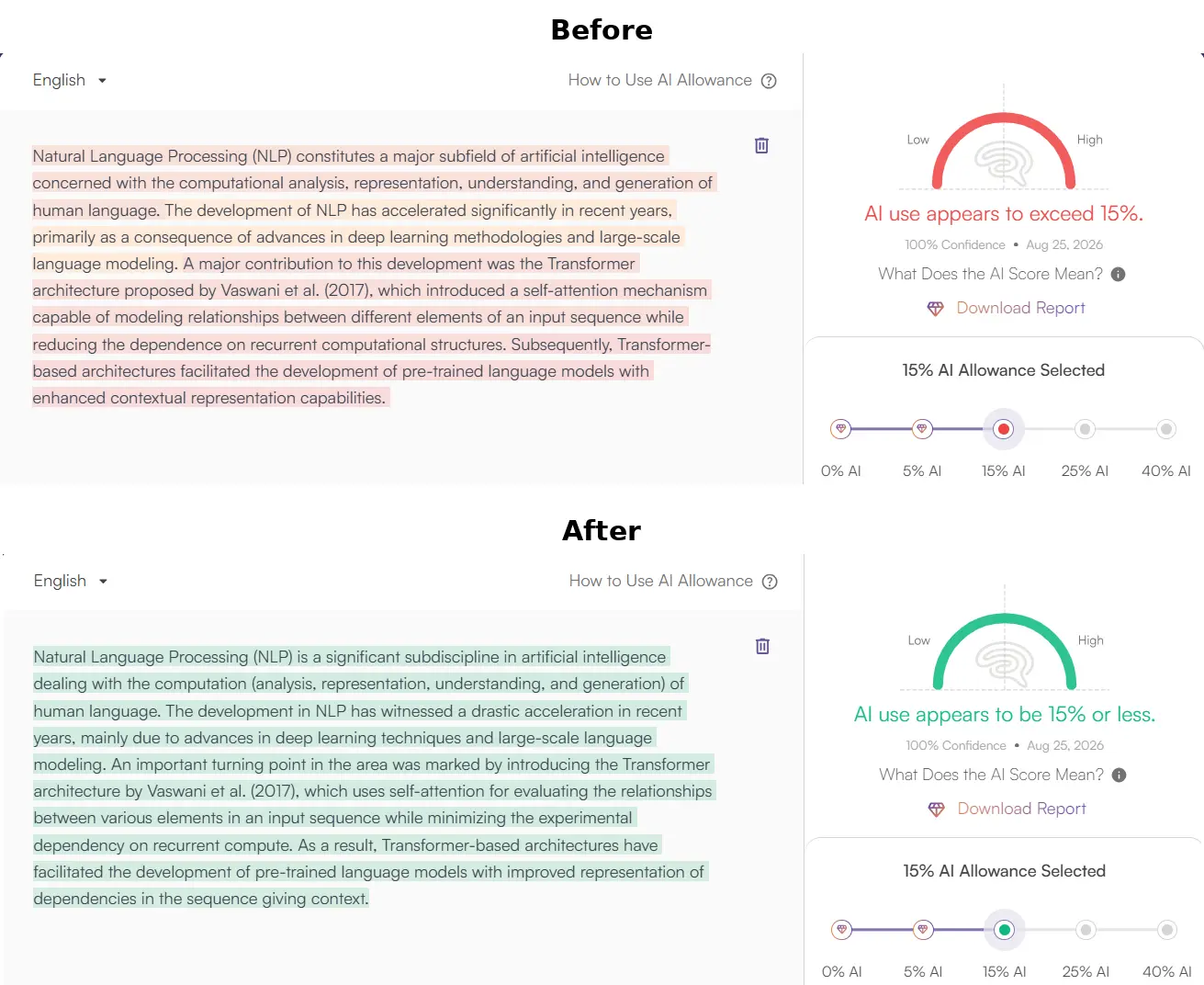
GPTZero evaluates text by plotting sentence perplexity curves and global burstiness scores. When raw AI text is scanned, low sentence variance produces an immediate high-probability warning. ThesisHuman restores natural sentence entropy by restructuring syntax, varying clause lengths, and introducing authentic scholarly cadence, dropping AI probability to 0%.
4. Originality.ai Verification: 0% AI Confidence
Originality.ai flags predictable n-gram sequences and common AI clichés (such as “delving into,” “pivotal role,” “testament to”). ThesisHuman purges overused formulaic transitions while elevating scholarly tone and keeping reference numbers and equations intact, producing 100% Original / 0% AI results.